


Legal Question: Repossessing the Roses
This week’s question is from Kelly via the form. Kelly asks:
In the 2nd episode of the Girardis, you discuss how items up to a certain value do/don’t get repossessed. This made me think of Schitt’s Creek. The Roses (mostly Moira) were still in possession of many designer clothes and jewelry that I would imagine would be within the price range of being repossessed. Would they realistically have been able to keep those items?
Great question, Kelly!
We recently covered the legal battle being waged by victims of tragedy against the formerly prominent trial lawyer Tom Girardi and his law firm, Girardi Keese. He stands accused of misappropriating millions of dollars in client and lender assets to support his Real Housewife of Beverly Hills, Erika Jayne’s, extravagant lifestyle. You can get the full scoop in the two parts from Sinisterhood here in Part One and Part Two.
On to the Roses…
I love this question because I love any excuse to re-watch Schitt’s Creek. A couple of important things to set up first.
WHERE IS SCHITT’S CREEK?
Tom Girardi and Girardi Keese are both going through bankruptcy proceedings under United States law. What he can/cannot keep is determined by the Bankruptcy Code and state law. Girardi is in California, so the list of items he gets to keep is determined under California law. Some examples of items he could possibly keep (depending on some factors that are outside the scope of this newsletter but which are discussed in the second episode) include:
A home worth $175,000,
A car worth $3,325,
Jewelry and art worth $8,725, and
Retirement accounts worth $1.3 million.
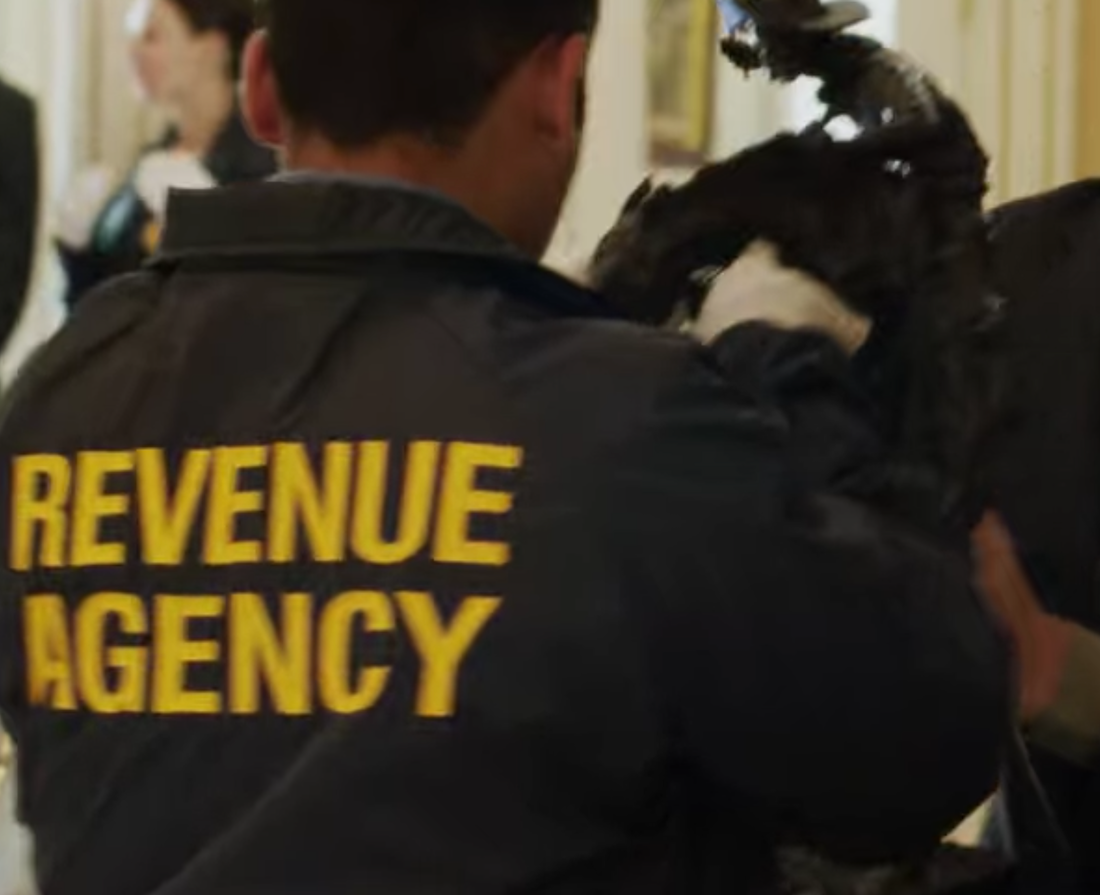
The Rose family lives in Canada. Yes, Schitt’s Creek is in Canada. Though there was some hemming and hawing at first, Dan Levy eventually confirmed it to BuzzFeed News. Additionally, the “people from the government” who ring the Roses’ doorbell in the pilot episode are wearing blue jackets with “REVENUE AGENCY” printed on the back. The tax-collecting authority in Canada is called the Revenue Agency.
I’m still trying to wrap my mind around what kind of a sick person wants to get paid to destroy another person’s life. DESTROY ANOTHER PERSONS’ LIFE!
In the United States, the tax agency is called the Internal Revenue Service, and their jackets are printed with “IRS Revenue Officer” or “IRS-CID Police.” CID is the Criminal Investigation Division. Using the clue of the jackets and Dan Levy’s proclamation, we’ll look at this question under Canadian law.
WHAT HAPPENED TO THE ROSES?
In the first five minutes of the pilot episode, Johnny Rose calls a person named Eli a “son of a bitch.” Turns out Eli was the family’s business manager who was like “family” and was in charge of the Roses’ finances. The Revenue Agency officer then tells Johnny, “Eli really did a number, Johnny. He took everything,” and explains that Eli has run off to the Cayman Islands.
The phrase “He took everything” indicates to me that their business manager stole the majority of their assets. The Netflix episode description also states that “their business manager loots their family fortune,” which indicates to me that Eli both took the cash and left a big ol’ tax bill, especially since Johnny also says, “He was our business manager. He was supposed to pay taxes.”
The Revenue Agency officer then tells the Roses that there was a “very small amount set aside” for the family and also “one asset the government has allowed [the Roses] to retain” – the town of Schitt’s Creek.
Since Eli took “everything” – presumably their cash – then whatever physical property the Roses had left would be what the Canadian government would go after to satisfy the debt of unpaid taxes. Let’s discuss how that works.
WHAT HAPPENS WHEN YOU STIFF THE CANADIAN GOVERNMENT?According to the Canadian Revenue Agency (CRA), “Any amount you owe is payable in full immediately when you're assessed.” If the Roses failed to pay the CRA in a timely fashion, they were charged “compound daily interest at the prescribed rate on any amount owing.” Whatever amount the Roses owed was also subject to a daily interest rate, so their tax bill ballooned up even higher.
Since the Roses did not pay the outstanding debt to the CRA or contact the CRA to discuss payment plans, the CRA was entitled to take legal action to collect the unpaid amount. That legal action could have been garnishment, which means the CRA would go into bank accounts and seize the funds. Since Eli apparently took all of the Roses’ money and fled the country, that would not likely be successful.
Since the garnishment wouldn’t work so well, the CRA could put a lien on the Roses’ home or other large assets. That means, if the Roses tried to sell the property, the tax debt would get paid first.
What happened in the pilot episode was even more severe than just a lien. It is called a seizure of assets. First, the CRA would have gone to court and gotten a written command or formal order in favor of the Crown (the Canadian government) that allowed the CRA to seize and sell the Roses assets and property. Under Canadian law, the CRA can do this without notifying the Roses. If you think about it, it makes sense. You know you’re supposed to pay your taxes. Although they relied on their “business manager,” the liability still falls on the Roses as the taxpayers.
On the CRA website the agency states that it will seize property like: “your car, boat, artwork, cottage, rental property, or personal residence.”
Lock up your cottages, y’all. The CRA ain’t messing around.
After the CRA seized the Roses’ assets, it would sell them off to pay both the tax debt owed and all of the costs associated with selling the assets. If the sale proceeds didn’t satisfy the whole tax debt, then the Roses would still be liable to pay the remaining amount. Tax debts are not dischargeable in bankruptcy, either.
The Canadian Broadcasting Company recently reported that asset freezes and seizures were on the rise, with the CRA using provisions of the Criminal Code to enforce tax debts. Since tax evasion is technically a crime, then money retained and not used to pay taxes are fruits of that crime.
So, to the question…
Would the Roses realistically have been able to keep those items?
During the pandemonium of the asset seizure, Johnny shouts at Moira, “We’ve got 15 minutes to collect our personals.” Of the assets being seized in the house, it appeared to be large piece of furniture, statues, and large pieces of jewelry and expensive designer bags, not personal items like clothes or shoes.
When the family arrives in the town, they have luggage, duffle bags, some cardboard boxes, and cases containing Moira’s extensive wig collection.
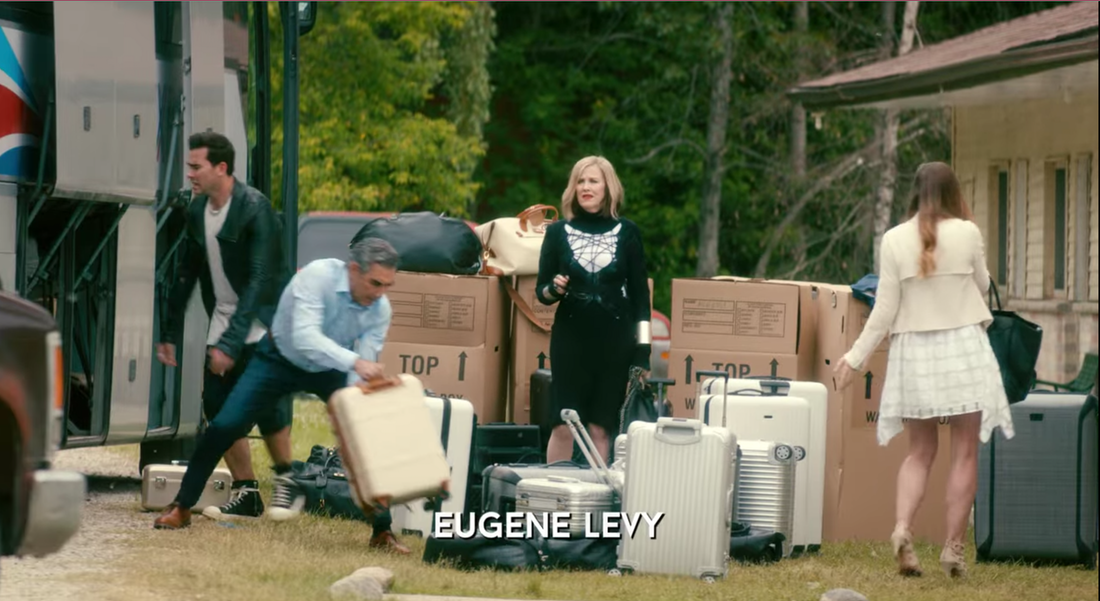
75% of the suitcases are filled with wigs.
The CRA agents came to seize assets of value that could be sold to satisfy the Roses’ tax debt. Their enormous house and various other properties would probably make the largest dent, then the larger, more valuable personal property pieces would be the next most valuable.
Though they wear some incredible designer clothes, taxing authorities don’t generally seize clothing. In the United States, the IRS will also allow individual taxpayers to keep “tools necessary for the trade, business or profession of the taxpayer,” which could arguably include their phones and laptops.

The looks of an icon
As for Moira’s jewelry, it’s not as recognizable as her designer clothes. For instance, the iconic panther brooch was created by the production designer, Debra Hansen. It later sold at a charity auction for $3,200, but that’s likely because it was a part of the show and not because of its inherent value.

Rawr! Look at that sweet brooch.
Many of the other pieces were either from the costume designer’s own collection or were costume jewelry, though there were some finer pieces layered in as well, according to this interview with Debra Hanson.

SO many layers of necklace
If Moira somehow successfully hid those assets and the tax debt got paid off with everything else the CRA took, she would be able to keep those items. Also, she’s Moira fricken Rose. She can do whatever she wants. PROOF: Check out this iconic collection of legendary Moira moments.
I hope that answers your question, Kelly!
Got a question? Submit it here. They can be legal what-if questions, questions on current events, or questions about the legality of actions in TV shows or movies you’ve seen. I never ever want to answer your personal legal questions, so don't send those. Love you, but I don’t do that.
***
This piece first appeared in Sunday Morning Hot Tea. Subscribe so you don’t miss another piece.

Legal Question: Consequences for Airplane Shenanigans
This question was inspired by a text from my mom. She sent me this article from her personal favorite news source, TMZ. It’s about a woman who had a mental health episode on a plane and tried opening the door while the plane was in mid-flight. While reading that article, a link came up for a second article about a man who tried breaching the cockpit on a different flight. Great reading right before my first plane ride since the pandemic!
Some commenters on the videos expressed disgust that flight attendants had duct taped the woman or zip tied the man, especially if there were mental health concerns. Since the flight crew has the obligation to keep the plane safe, others were saying the crew did what they had to in order to ensure a safe landing for everyone else on board.
These two are not the only incidents. Since the beginning of the year, the FAA has received approximately 3,271 reports of unruly behavior by passengers. The agency identified potential violations in 540 cases and initiated enforcement action in 83 cases. During the same timeframe, the FAA has proposed more than $682,000 in fines against unruly passengers, as of July 6, 2021.
That got me thinking: What are the consequences for flipping out on a plane?
Here’s a free bit of legal advice, if you’re going on a plane – sit down, shut up, and do exactly what the crew tells you. The Federal Aviation Administration has recently implemented a zero-tolerance policy in punishing passenger behavior. That means they’re charging people for initial infractions without issuing warnings.
The FAA has also begun publicizing details of incidents, a departure from its previous norms, in an effort to shame passengers into compliance. Has it worked? Not so far. There have still been a huge increase in confiscated weapons at TSA security checkpoints and repeated incidents.
So what’s the worse that could happen if you go apeshit on a plane?
CONSEQUENCE 1 – GO TO JAIL, DO NOT COLLECT $200
Under to federal law (49 U.S.C. § 46504), if someone (1) assaults or intimidates a flight crew member or flight attendant, (2) interferes with the performance of their duties, or (3) lessens their ability to perform those duties, that person “shall be fined,” imprisoned for not more than 20 years, or both. However, if the person uses a dangerous weapon assaulting or intimidating the crew member, they “shall” be imprisoned for any term of years or for life.
CONSEQUENCE 2 – OK, FINE
In addition to criminal charges, the FAA can levy civil files. The administration’s recent press releases detail the fines along with breakdowns of what each person did. The most recent press release lists hefty fines for wild behavior. They include:
$21,500 fine for a man who refused to wear a face mask, drank alcohol that he brought on board, fought with the crew and other passengers, then punched the person next to him.
$17,000 fine for a man who refused to wear a face mask, talked on his phone during the safety demonstration, then got up and walked through the plane during landing.
$10,500 fine for a man who called 911 and reported that the flight attendant was being held a knifepoint and the plane was being hijacked. None of this was true. As the plane taxied back, he called the FBI and reported a bomb on board.
So far, there have not been announcements as to what is going to happen to the duct tape woman or zip tie man. The duct tape woman allegedly bit the flight attendant, so she’s probably going to be charged criminally, in addition to being fined. The zip tied man may be charged criminally since he fought the flight crew and interfered with the performance of their duties.
WHAT ABOUT AIR MARSHALS?
The TSA does not reveal how many air marshals are working at a given time or what flight routes they are on. Based on the high number of flights each day in the United States, it is safe to say there is no way for an air marshal to be on every single flight out there.
In fact, in a 2014 interview with John Casaretti, the then-current National President of the Air Marshal Association/CWA in USA Today, he said air marshals only “cover a very small percentage of commercial flights.” Super. In that same article, it states that air marshals are to get involved “only after a flight crew has exhausted its ability to handle a situation.”
DO THE PASSENGERS GET A TRIAL?
When someone is civilly fined, they don’t quite get a full trial. The process is slightly different. Since the FAA is a government agency, it has its own type of judges called Administrative Law Judges, or ALJs. Though it is not a full trial, the passengers will be able to hire an attorney and present evidence to tell their sides of the stories. The FAA will also present the evidence it has collected against the passengers. The judge will hear both sides then make a ruling. Just like a regular lawsuit, the ALJ’s decision can be appealed. If they lose, the passengers first appeal to the FAA Administrator, then on to the Federal Court of Appeals.
As for criminal charges, the U.S. Attorney (federal prosecutors) gets involved. This was true in the case of a Miami man who caused a disturbance during a flight on July 7. The FBI investigated the incident after two on-board air marshals subdued the man. After the investigation, the Department of Justice announced charges against the man on their website just a week later. If he does not reach a plea deal with the U.S. Attorney, he will go to trial in federal court where he faces a sentence of up to twenty years in federal prison.
Civil and criminal penalties aside, my recommendation is not to mess with flight attendants. Just this week, Business Insider reported they are receiving intensive self-defense training, including moves like “the double-ear slap, the eye-poke, and the groin-kick” intended to disarm unruly passengers who may be wielding sharp weapons. They’re also taught to use items on the plane to as weapons for self-defense.
Meanwhile, I’m flying out later this afternoon. I’ll be sure to pack my boxing gloves in my carry-on, just in case.
Thanks for sending that article to me, Mom!
Got a question? Submit it here. They can be legal what-if questions, questions on current events, or questions about the legality of actions in TV shows or movies you’ve seen. I never ever want to answer your personal legal questions, so don't send those. Love you, but I don’t do that.
***
This piece first appeared in Sunday Morning Hot Tea. Subscribe so you don’t miss another piece.
Legal Question: The Nitty Griddy Truth
This week’s question comes from Katie M. via Instagram DMs.
“Griddy is charging customers several thousand dollars for a few days of electricity service – is that legal? I don’t understand how this happened.”
Excellent question, Katie! First of all, we need to clarify that Griddy, the Texas electricity company, is NOT the same as Gritty, the maniacal orange Philadelphia Flyers mascot and icon for freedom. Gritty would never do people like this. Gritty loves us.
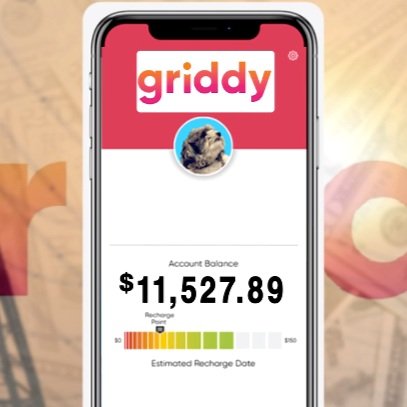
This past week, winter storms ravaged Texas, took power generators offline, and left millions without power or running water. Adding insult to injury, members of one electricity wholesaler called Griddy have found themselves facing down enormous bills. One customer found himself on the hook for a $17,000 electric bill for the month of February so far. Another is poised to pay over $8,000. Stories are piling up with people paying hundreds of dollars per day for electricity.
So … is this legal and how did this happen? To answer this, we need to cover a few preliminaries.
[This is kinda long, but I broke it up with headings for you.]
What’s Up with the Texas Energy Market?
Texas deregulated its energy market beginning in 2002 with the hopes of “driving down consumer prices.” This hasn’t exactly happened, as reports indicate Texan consumers actually pay more than lots of other states who are connected to the federal grid. This energy historian explains it way better than me. But basically, in Texas, there are a handful of players in charge of doling out electricity, and none of them are the federal government.
Up near the top, you have the Electric Reliability Council of Texas (ERCOT). ERCOT is a non-profit corporation that “manages the flow” of electricity in Texas, which sounds like the stated benefit of a menstruation product. ERCOT is not a government agency, but it is under the oversight of the Texas legislature and a three-member panel of gubernatorial appointees called the Public Utility Commission of Texas (PUCT or PUC). The Austin-American Statesman published a great breakdown of ERCOT if you want more info on them. Just know they act as a self-described “air traffic controller” for our electricity in Texas.
As for how the juice gets from a windmill to my phone charger, there are a few more players.
Generators generate the electricity using natural gas, nuclear, coal, wind, or solar power. They sell that energy to a retail provider. That retail provider then utilizes a distributor to distribute the electricity to customers. As an example, I am a customer of a retailer called Champion Energy. Champion gets its energy from generators. Then Champion uses a distributor called Oncor to deliver that energy to me.
I am under a contract to pay Champion a certain amount of pennies per kilowatt hour of energy. The amount Champion charges me is a little more than what they pay for it. They make money off the spread between those two numbers. Oncor also charges me a few cents per kilowatt hour for delivery. Everybody makes their margins, and I don’t have to worry because no matter what the price of energy is, I pay the same amount under my contract.
This can be good for me when energy prices are higher than what I am paying, like the summer, or not-as-good for me if energy prices are lower than what I am paying. But, like insurance, I pay a premium to ensure my bills won’t skyrocket. This is called a “fixed” product.
Enter Griddy.
Griddy considers itself a bit of a disruptor in this market, like the Uber or Netflix of energy in Texas. Griddy offers a “pay-as-you-go indexed product.” What is that exactly? Well, you pay a $9.99 per month membership fee, then you pay whatever retailers like Champion pay to get the electricity from the generators.
Members pay only the wholesale price of electricity as published by ERCOT. No retailer is standing between the consumer and the juice charging a premium, so in theory, Griddy members pay less. This sounds like a really good deal, right?
How Much Do People Usually Pay for Electricity?
According to Griddy’s website, its customers “usually” pay the following rates:
96.1% of the time, prices are lower than 6¢/kWh
3.3% of the time, prices are between 6¢/kWh – 30¢/kWh
0.5% of the time, prices are between 30¢/kWh - $1/kWh·
0.1% of the time, prices are above $1/kWh
As a comparison, on my fixed rate energy plan, I pay 6.3¢/kWh to Champion, the energy retailer, and an additional 3¢/kWh to Oncor who delivers the energy, for a total of 9.3¢/kWh.
Soooo…WTF Happened This Week?
This past week was one of those 0.1% times on Griddy’s list above. Generators failed to generate. This created a high demand and low supply of energy. On Monday, the PUC ordered ERCOT “to modify pricing models to more accurately reflect the scarcity conditions in the market” allowing generators to charge $9/kWh.
Yes, you are reading correctly. That is nine DOLLARS per kilowatt hour, when people were used to paying 6-10 cents retail, and even less if they were with Griddy.
Utilities Code § 39.151(d) gives the PUC “complete authority” over ERCOT, so when the PUC said jump, ERCOT had to say “How high?” $9/kWh was how high, as that is the maximum price allowed under the law.
This led to the rash of enormous and in some cases multi-thousand-dollar bills to users on Griddy’s indexed plan. In response, Griddy sent an alert to its members to ditch their service, as well as reduce energy usage if possible. In some cases, that effort was all for naught because other energy retailers either weren’t taking on new customers or were taking several days to process new customers, meaning by the time the switch was made, the damage was done.
When something like this previously happened in 2019, Griddy’s former CEO Greg Craig (no relation to Julia Gulia) insisted that despite the enormous spikes, customers were still saving in the long run. This is not necessarily true for everyone. One Redditor stated that over their time with Griddy from 2018 to January 2021, their total savings was $660. Their bill for one half of February? $2500.
On Friday, Feb. 19, prices plunged from $9/kWh to 5¢/kWh in a matter of hours once PUC ended its emergency energy declaration. Those who remained with Griddy saw their rates go back to normal, more palatable rates.
Is It Legal for Griddy to Do This?
Under current law, it seems to be. On the very first page of its website, Griddy explains its business model: “Get access to wholesale electricity for $9.99 a month. You’ll pay exactly the price we buy electricity at.” Griddy doesn’t make any more or less money if it sells you energy at $9/kWh or 5¢/kWh. Griddy makes money from that $9.99 membership fee. Their Facebook page’s tagline states customers will pay “Just the wholesale price!”
The problem with consumers paying “exactly” what retailers pay is that retailers have an advantage with buying wholesale. Large businesses can hedge their exposure to the market, which insulate them from major spikes. So even if retailers like NRG, for example, are “exposed” to the changes in energy prices, they have the money and ability to hedge themselves against those spikes. How? They won’t say. Their method is “proprietary and financially material.” Consumers, on the other hand, don’t have that capability.
So, yeah, Griddy members signed up to pay “exactly” what retailers pay, if those retailers weren’t hedged. Then, because of the PUC/ERCOT’s actions this past week, retailers were paying $9/kWh, and so were Griddy members.
Can the Impacted Customers Sue Griddy?
As I’ve always said, you can sue anybody for any reason. The question is whether you’ll win.
Here, you likely won’t, for a couple of reasons.
On the super-secret Texas Lawyers Facebook group (yes, we have that. Actually we have a lot of groups. Arguably too many groups…) some lawyers were discussing what causes of action may be available to impacted consumers. Some floated the idea of suing Griddy under the Texas Deceptive Trade Practices, a consumer protection law.
Others countered that the problem is that Griddy isn’t the one who jacked up the price. Griddy told their members two things: (1) we will sell energy to you at market price set by ERCOT, whatever that price may be, and (2) oh shit, the price is about to spike, you should bail. Arguably, there was no deception in that behavior. Griddy delivered what it promised – energy at market price. The problem was the “market price” was increased by ERCOT at the direct request of the PUC.
A second hurdle is that Griddy’s members have waived their right to sue in court. Griddy has its members agree to a mandatory arbitration policy, which you’ll likely find in most “adhesion” contracts. Adhesion contracts are boilerplate, standard form contracts that consumers don’t have the opportunity to negotiate. For instance, you sign up for AT&T internet service, they provide you with a contract, and you agree to it. They don’t ask for your thoughts on the contract or negotiate with individual consumers.
Arbitration provisions are pretty common in these kinds of contracts. Arbitration is a way of settling disputes outside of court. You have seen arbitration in action if you have ever watched an episode of Judge Judy. Although she used to be a real judge, now Judge Judy is an arbitrator. Show participants sign a binding arbitration agreement in which they agree to abide by whatever Judge Judy decides. In that sense, the cases are actually real, and the rulings are final (except you can, in some cases, appeal an arbitration decision.)
So, what happens if you try to sue a company, but you have already agreed to arbitration? The company will likely file a motion to compel arbitration, citing the clause you “agreed” to when you signed up for the contract. The judge will bump your case to arbitration, and you have to abide by the decision of a private, neutral third party rather than a jury in a court of law. (There are some ways to get around this, but that is outside the scope of this answer.)
But what about a class action suit? Well, a 2011 U.S. Supreme Court decision in favor of AT&T allowed companies to force certain terms on customers in addition to mandatory arbitration provisions. One of those terms was waiving consumers’ rights to class action lawsuits.
It just so happens that Griddy’s mandatory arbitration policy includes such a class action waiver. They give you a 30-day opt-out period where you can email them to let them know you don’t want to be bound by that policy, but if you don’t email them in the first 30 days after you sign up, you’re bound. This means if consumers attempt to file a class action suit, Griddy can file a motion with the court citing the waiver in the policy in order to keep consumers from banding together.
If They Can’t Sue Griddy, Can They Sue Someone Else?
Other lawyers mentioned the possibility of going after the PUC or ERCOT for setting the price as they did. The roadblock there? The PUC is a state agency, and as such, enjoys sovereign immunity.
Sovereign immunity generally means you cannot sue the state/government without its consent. The state can consent to being sued in a statute, like the Texas Tort Claims Act (TTCA). The TTCA allows Texans to sue the government for certain incidents. For instance, if you are injured by a government employee operating a motor vehicle, you can sue for damages under the TTCA. Outside of exceptions listed in the TTCA, you cannot sue the government.
That means you can sue ERCOT since it’s not a government agency, right? Not so fast. The Texas Supreme Court is currently reviewing whether ERCOT is eligible for “sovereign immunity.”
On its website, ERCOT describes itself as “a membership-based 501(c)(4) nonprofit corporation” subject to oversight by the PUC and Texas legislature. So why would it ask for sovereign immunity if it is only a non-profit corporation, and not the government?
In a recent lawsuit brought by Panda Power, ERCOT argued, among other things, that money coming out of ERCOT’s pockets for lawsuits would be passed on to consumers in the form of higher energy prices. Plus, ERCOT operates under full government oversight, therefore it argued it should be eligible for sovereign immunity.
An appeals court agreed with ERCOT, reasoning that extending sovereign immunity to ERCOT “protects the public as a whole by preventing potential disruptions of key government services that could occur when government funds are unexpectedly and substantially diverted by litigation.” The Texas Supreme Court has agreed to review the case, and oral argument is currently set for September 15, 2021.
In the meantime, the first handful of lawsuits against ERCOT have already been filed for incidents and injuries related to the winter storm. One attorney filing on behalf of a client in Nueces county argues that ERCOT’s shutting off consumers’ power amounts to an unlawful taking without just compensation in violation of the Texas constitution. The argument follows that sovereign immunity does not extend a case where a plaintiff is claiming a violation of the state or federal constitution. Whether this argument will be successful remains to be seen.
Others still floated the idea of suing Oncor for the service interruptions. That option isn’t likely to be successful because of language in Oncor’s tariff (the agreement under which it delivers energy for retailers). A provision at section 4.2.4 states that Oncor is not “liable for damages” for “an act of God,” and goes further, stating it’s also not liable for a “breakdown or accident to machinery” or “good-faith compliance with a then valid curtailment, order, regulation or restriction imposed” by the government or ERCOT.
Short version: the tariff says Oncor is not liable for turning off your power if ERCOT told them to do it.
So WTF Are Griddy Customers Supposed to Do?
The good news is Griddy seems to be working on its customers’ behalf. This could be due to benevolence on Griddy’s part, or them just knowing that a huge swath of folks aren’t going to pay what the app says they owe.
They probably already know this. Griddy just failed to make a payment on a settlement invoice to ERCOT on February 18, meaning Griddy couldn’t make its financial obligation for the energy it passed on to its members. A company being unable to meet its financial obligations is not usually a good sign.
In a statement on Friday, February 19, Griddy stated that it had begun “engaging with ERCOT and the PUCT seeking customer relief. Griddy is continuing these efforts and is committed to crediting customers for any relief received, dollar-for-dollar.” Griddy argues that customers should have been on the hook for energy at much lower rates, as low as 3¢/kWh, rather than the $9/kWh called for by the PUC in the emergency order.
In a statement to NBC 5, the PUC appeared to indicate that it was the energy plans offered by Griddy that are risky, calling the plans “tantalizing to consumers when the sales emphasis is placed on the possibility of very low rates during times of pleasant weather.” The PUC also called the Griddy-type plans “financially devastating when harsh hot or cold weather creates scarcity in the wholesale energy market.” For that reason, the PUC “encourages fixed-rate plans” to moderate risk.
As for consumers hit with enormous bills, oil and gas attorney Chrysta Castañeda told ABC 8 that Griddy customers should turn off auto-pay on their accounts, contact the energy provider to clarify charges, and contact their elected representatives to take action on the issue.
Griddy’s website instructs impacted members to visit TexasRentRelief, the site where Texans can apply for COVID-19 funds available to pay past-due rent and utilities. Unfortunately, newly earmarked federal FEMA disaster funds do not currently apply to utility bills.
Governor Greg Abbott has already called for changes to the energy delivery market in Texas, including mandatory winterization. Failure to winterize equipment, which is not currently required under Texas law or regulations, is what many experts say led to the system failures. He also called an emergency meeting on February 20 with the Lieutenant Governor and key committee members of the Texas house and senate. In a statement afterwards, he called the meeting “productive.”
A readout of the meeting indicated the group discussed short-term relief to “ensure that Texans are not left with unreasonable utility bills they cannot afford because of the temporary massive spike in the energy market” as well as long-term solutions. Legislators will work on ways to “quickly calculate the total cost of these energy bills” and determine “how the state can help reduce this burden.”
TL; DR
Yes, what Griddy did is technically legal under the current rules. As promised, Griddy charged consumers “exactly” what retailers were paying in real time. However, Griddy is arguing those underlying wholesale prices were based on numbers artificially inflated by PUC and ERCOT.
In the end, what should be done? Texans facing multi-thousand-dollar bills, especially those Texans who were already devastated by the pandemic, are asking for some kind of relief. What form that relief will take is a question for the governor who appoints the members of the PUC, the legislative committees who oversee ERCOT, and other elected officials whose responsibility it is to serve their constituents’ interests.
Based on the Feb. 20 meeting, it sounds like they’re working on it. When consumers will see results is still TBD.
** UPDATE ** On February 21, Governor Abbott announced that the PUC will be issuing a moratorium on electricity disconnects due to nonpayment. It appears the moratorium will last through the end of February while the commission determines a long-term plan. The governor also promised that the legislative session will not end until “ERCOT is fully winterized so we do not go through this again,” according to the Dallas Morning News. Attorney General Ken Paxton has also begun an investigation into ERCOT and PUC regarding their role in the power outages and high electricity bills.
I hope that answers your question, Katie! Thanks for sending.
Got a question? Submit it here. They can be legal what-if questions, questions on current events, or questions about the legality of actions in TV shows or movies you’ve seen. I never ever want to answer your personal legal questions, so don't send those. Love you, but I don’t do that.
***
This piece first appeared in Sunday Morning Hot Tea. Subscribe so you don’t miss another piece.