


Legal Question: Logistics of a Hallmark Movie Ending
This question comes from Michele L., who asks:
In light of the endless Hallmark/Lifetime Christmas movies I've seen (they started doing Halloween week and I cannot stop watching; send help) where a lovely American lady meets and is swept off her feet by a handsome Prince/King/Earl/whatever from a nondescript, vaguely British-esque country no one has ever heard of before - here is my question:
What, if any, legal hurdles would there be to relocating to a foreign nation and marrying into the ruling family of said nation?
Say I meet Prince Charisma from Moldivitinia, could I, a lawyer barred in the state of NJ, transfer any certifications to work in a legal capacity there to help the local children's center remain open? Could his evil queen mother have me deported and or thrown in prison for accidentally knocking over and denting that Medieval suit of armor while practicing my curtsey? Or is it all happily ever after? Thanks!
Great question, Michele! I chose this question because I'm in a particularly Hallmark-y mood. This week on Thursday, February 10 at 8PM CT, Christie and I are going to roast a Hallmark Valentine’s Day movie for you live on CrowdCast. Neither of us have seen it. We’re going to throw it on screen, let the saccharine sweet plot wash over us, and holler out our observations. Join us and re-watch on demand by registering here and check out the replay of the one we did for Christmas by clicking here.
On to the question…
What, if any, legal hurdles would there be to relocating to a foreign nation and marrying into the ruling family of said nation?
For starters, there shouldn't be any legal hurdles if you have the blessing of the ruling family. If they truly are in charge (as they are many times in these movies - stuff like Constitutions and Parliaments and Prime Minsters are boring!!!), then by the wave of Her Majesty's hand, you'd be golden. No paperwork, no red tape.
In an absolute monarchy, like Saudi Arabia for instance, the ruling family, well, rules. Sure, there are laws that they follow called the Basic Law of Saudi Arabia, but everybody serves at the pleasure of the royal family. Anyone with authority is appointed by the royal family and can be un-appointed just the same.
So once you fall in love with the Prince of Moldivitinia, assuming that Moldivitinia is an absolute monarchy, the family can square away any red tape you may run into. If, on the other hand, Moldivitinia is a constitutional monarchy, the royal family’s authority to make your immigration easy would be subject to the rules as outlined in the Moldivitinian constitution.
Say I meet Prince Charisma from Moldivitinia, could I, a lawyer barred in the state of NJ, transfer any certifications to work in a legal capacity there to help the local children's center remain open?
When I did a study abroad program in law school to the Cayman Islands, I was verrrrry interested in how a law license may transfer over to a foreign jurisdiction. When I looked into it, I became verrrrry disappointed.
Turns out, you must have practiced in a Commonwealth jurisdiction for over three years to qualify for transfer. Those include the UK, Canada, Australia, New Zealand, and South Africa. I noticed Texas was not on that list. Boooo!
The laws of reciprocity vary by jurisdiction. For instance, to transfer your foreign law license to practice in England and Wales, you need to fill out an application and submit it to the Bar Standards Board (BSB). This application provides evidence of your academic and professional qualifications. You have to jump through several hoops and provide evidence of your good character and repute, your academic transcripts, and any representations you are relying on to be admitted. You also have to pass the Bar Transfer Test if what you learned in law school and what you have experienced in practice differ substantially from what is covered by the education and training provided in England and Wales.
But that’s a bunch of rules for a stick-in-the-mud constitutional monarchy. The absolute monarchy of Moldivitinia has laws, sure, but those laws are subject to the whims of the royal family aka your new in-laws. With the wave of a wand or the cross of a sword, your license transfers and you can help as many children's centers stay open as your heart desires.
Could his evil queen mother have me deported and/or thrown in prison for accidentally knocking over and denting that Medieval suit of armor while practicing my curtsey?
I feel you on the knocking over and denting a Medieval suit of armor. I knock over stuff all the time, so I'd be on the Moldivitinian chopping block if I hooked up with Prince Charisma and that was a jailable offense.
In short, yes, she could definitely deport you for whatever reason she wanted, assuming Moldivitinia is an absolute monarchy.
As for jailing you? Also probably yes. I’m not sure whether Moldivitinia has signed on any human rights treaties. Regardless, in the view of the United Nations, all countries are subject to the International Criminal Court. Set up in 2002, the ICC normally tries lower level individuals responsible for very serious crimes like genocide, crimes against humanity, war crimes, and the crime of aggression.
Even though she is the Queen of Moldivitinia, she's not completely immune from punishment. Many leaders and former leaders have also been prosecuted and convicted by international courts for those kinds of serious crimes listed above, including leaders from Liberia, Rwanda, Serbia, and Sudan.
Locking you up for denting a suit doesn't quite fit the definition of any of those serious crimes per the definitions laid out by the UN/ICC. However, a widespread media campaign may pressure her to release you, so just make sure someone you love with access to social media knows your whereabouts so they can start the Change.org petition asking her to let you go.
Or is it all happily ever after?
In a Hallmark movie? Always.
Thanks for asking!
Got a question? Submit it here. They can be legal what-if questions, questions on current events, or questions about the legality of actions in TV shows or movies you’ve seen. I never ever want to answer your personal legal questions, so don't send those. Love you, but I don’t do that.
Until next week, that’s the tea, and there’s no ending happier than a Hallmark movie.
Got a question? Submit it here. They can be legal what-if questions, questions on current events, or questions about the legality of actions in TV shows or movies you’ve seen. I never ever want to answer your personal legal questions, so don't send those. Love you, but I don’t do that.
***
This piece first appeared in Sunday Morning Hot Tea. Subscribe so you don’t miss another piece.

Legal Question: Do Cops Need a Warrant to Search Your Hotel Room?
This question comes from Austin, who asks:
Can cops just bust into your hotel room without a warrant? We’re watching “Law and Order: SVU,” and the cops had the hotel manager open up someone’s hotel room without the hotel guest’s permission. Can they do that?
Great question, Austin!
CAN BENSON AND STABLER BUST UP IN YOUR ROOM AT THE LA QUINTA?
No, but there are exceptions. Searches of someone’s “residence,” including a temporary residence like a hotel room, are governed by our constitutional right against unlawful search and seizure. That right is found in the Fourth Amendment to the Constitution, which reads:
The right of the people to be secure in their persons and houses against unreasonable searches and seizures, and no Warrants shall issue, but upon probable cause, particularly describing the place to be searched, and the persons or things to be seized.
Constitutional rights are not absolute. The Supreme Court is empowered with judicial review, meaning it decides whether laws are in line with the Constitution. Whether a search is reasonable or valid under the Fourth Amendment has been refined through case law and statutes throughout the years.
The Court has recognized a few exceptions to the right against unlawful searches. If one of those exceptions is present, the ragtag crew from NYPD’s 16th Precinct would be able to crack that hotel door and dig around in your stuff.
WHAT ARE THE EXCEPTIONS?
If the person being searched gives their permission (called “consenting” to the search), then the police don’t need a warrant. If they don’t have consent and they don’t have a warrant, then authorities need an exception in order to try and perform a lawful search.
The exception used fairly often is known as “exigent circumstances.” Exigent means “pressing or demanding,” so exigent circumstances are situations where there is an immediate need for the authorities to enter without waiting for a warrant. These include a “grave threat” to the safety of the investigating police, members of the public, or their property. It could also be to stop a suspect from escaping. It could also be when there is a belief that evidence will be lost or destroyed by not entering. I’m
The police can’t just be walking by when this happens. They have to have “probable cause” or the reasonable belief that crime has taken place or is currently taking place before they can act.
LoûIf there are no exigent circumstances, no consent, and no warrant to search, there are other ways for police to search. If you leave something illegal out in the open and the cops just happen to see it, then that is not usually considered an unlawful search. This is called the “plain view doctrine.” There's no need to search when anyone walking by could see the contraband. Similarly, if the police are lawfully arresting someone, they are able to search while making that arrest. This is called a “search incident to a lawful arrest.”
WHAT IF THE MANAGER LETS THEM IN?
If the cops aren’t kicking down your hotel door, they may be sweet talking the manager to let them in. Unless they have a warrant or one of the exceptions above exist, the manager can’t let them in your room. Your room is your domain for as long as you've checked in, followed hotel rules, and paid for your reservation.
WHAT IF I CHECK OUT?
Once you check out, your rights stop. Anything you left behind in the now-vacant room could be searched by the police.
Also, if you are forcibly removed from the hotel for violating hotel rules, or if you leave on your own accord before you check out (called “abandonment”), you no longer have claim to the room you were staying in. After that, the hotel management could let authorities in and whatever they find may be used against you.
WHAT IF THEY BUST IN ANYWAY?
Kicking in a door without a warrant and without a valid Fourth Amendment exception would not be a great idea. If that happens, the evidence found could be suppressed by the court or your defense attorney could ask that the entire case against you be dismissed. The police would also open themselves up to civil liability, and you could sue the government. Lawsuits like these are brought under 42 USC §1983, a federal statute which allows individuals to sue the government for violations of their civil rights.
In the episode, there was some mention of “exigent circumstances.” If such circumstances existed - a person was in danger or evidence was in danger of being destroyed - then the cops could come in and search. If the search was challenged later, they could try to argue that their warrantless search was necessary later in court. If no exigent circumstances or other exceptions existed, then the evidence would probably be suppressed, bhuhyy G on or kept out of the proceedings.
In any case, the dedicated detectives who investigate these vicious felonies are members of an elite squad known as the Stay-the-Hell-Out-of-My-Hotel-Unless-You-Have-A-Warrant Unit.
I hope that answers your question, Austin. Thanks for sending!
Got a question? Submit it here. They can be legal what-if questions, questions on current events, or questions about the legality of actions in TV shows or movies you’ve seen. I never ever want to answer your personal legal questions, so don't send those. Love you, but I don’t do that.
***
This piece first appeared in Sunday Morning Hot Tea. Subscribe so you don’t miss another piece.

Legal Question: Michael Scott's Diary Drama
This question comes from my dear friend, Todd, who will also co-officiate our wedding soon! Todd asks:
“Watching The Office where Michael’s journal is submitted in Jan’s wrongful termination deposition. He literally says he does not want it submitted. That should be the end of it, right?”
Thanks for the question, Todd! This is an excellent episode. I laugh every time at, “Tan almost everywhere. Jan almost everywhere.” It is also an excellent episode for Michael’s development as a character and standing up for himself.
When answering these questions, I like to establish where the players are and what rules apply. The Office is set in Scranton, Pennsylvania. Jan is suing Dunder Mifflin for employment discrimination and asking for $4 million. Dunder Mifflin is publicly traded and headquartered in New York. Most publicly traded companies are incorporated in Delaware, even if they are headquartered somewhere else. By this point in the series, Jan is living with Michael in Scranton, making her a Pennsylvania resident.
When a resident of one state sues the resident of another state and the amount at issue is over $75,000, this is called “diversity of jurisdiction” and the proper place to file a lawsuit is in federal court. Plus, employment discrimination suits often end up in federal court because they involve federal employment laws.
For this we’ll assume the federal rules apply. One of the federal rules regarding discovery states that “Parties may obtain discovery regarding any non-privileged matter that is relevant to any party's claim or defense.”
Although Jan stole the diary, it would be non-privileged and relevant to her claims as it proves the timeline of her relationship with Michael. Despite its shady origin, the court would likely allow its admission.
In the show, once the diary is introduced during the deposition, the attorneys then copy the whole thing and distribute its entirety to both sides. This is because of something called the doctrine of completeness (Rule 106 in the Federal Rules of Evidence). It allows an adverse party (Dunder Mifflin) to require that “any other part” of a writing be revealed after part of the writing is introduced. In this case, since Jan introduced the diary entry about Jamaica, Dunder Mifflin’s attorney had every right to ask for the rest of the diary to be made available as well.
To answer the question, the stolen nature of the diary does not have any bearing on its admissibility. On a gut level, that may not seem right. There is a doctrine known as the “exclusionary rule” that applies in criminal cases, which prevents the government from using most evidence gathered in violation of the United States Constitution. However, Jan’s employment lawsuit against Dunder Mifflin is a civil case - not criminal, therefore the exclusionary rule does not apply.
If Michael felt wronged by Jan stealing his diary, which she admits to doing, he could press charges against her for criminal theft or file a civil lawsuit against her. However, she asks him to “call it even” by pointing out that he emailed a topless photo to everyone in the company. Michael agrees. Still, if he wanted to call the law offices of James P. Albini and see if he’ll take the case, Michael has that option.
I hope that answers your question, Todd. Thanks for sending!
Got a question? Submit it here. They can be legal what-if questions, questions on current events, or questions about the legality of actions in TV shows or movies you’ve seen. I never ever want to answer your personal legal questions, so don't send those. Love you, but I don’t do that.
***
This piece first appeared in Sunday Morning Hot Tea. Subscribe so you don’t miss another piece.

Legal Question: Repossessing the Roses
This week’s question is from Kelly via the form. Kelly asks:
In the 2nd episode of the Girardis, you discuss how items up to a certain value do/don’t get repossessed. This made me think of Schitt’s Creek. The Roses (mostly Moira) were still in possession of many designer clothes and jewelry that I would imagine would be within the price range of being repossessed. Would they realistically have been able to keep those items?
Great question, Kelly!
We recently covered the legal battle being waged by victims of tragedy against the formerly prominent trial lawyer Tom Girardi and his law firm, Girardi Keese. He stands accused of misappropriating millions of dollars in client and lender assets to support his Real Housewife of Beverly Hills, Erika Jayne’s, extravagant lifestyle. You can get the full scoop in the two parts from Sinisterhood here in Part One and Part Two.
On to the Roses…
I love this question because I love any excuse to re-watch Schitt’s Creek. A couple of important things to set up first.
WHERE IS SCHITT’S CREEK?
Tom Girardi and Girardi Keese are both going through bankruptcy proceedings under United States law. What he can/cannot keep is determined by the Bankruptcy Code and state law. Girardi is in California, so the list of items he gets to keep is determined under California law. Some examples of items he could possibly keep (depending on some factors that are outside the scope of this newsletter but which are discussed in the second episode) include:
A home worth $175,000,
A car worth $3,325,
Jewelry and art worth $8,725, and
Retirement accounts worth $1.3 million.
The Rose family lives in Canada. Yes, Schitt’s Creek is in Canada. Though there was some hemming and hawing at first, Dan Levy eventually confirmed it to BuzzFeed News. Additionally, the “people from the government” who ring the Roses’ doorbell in the pilot episode are wearing blue jackets with “REVENUE AGENCY” printed on the back. The tax-collecting authority in Canada is called the Revenue Agency.
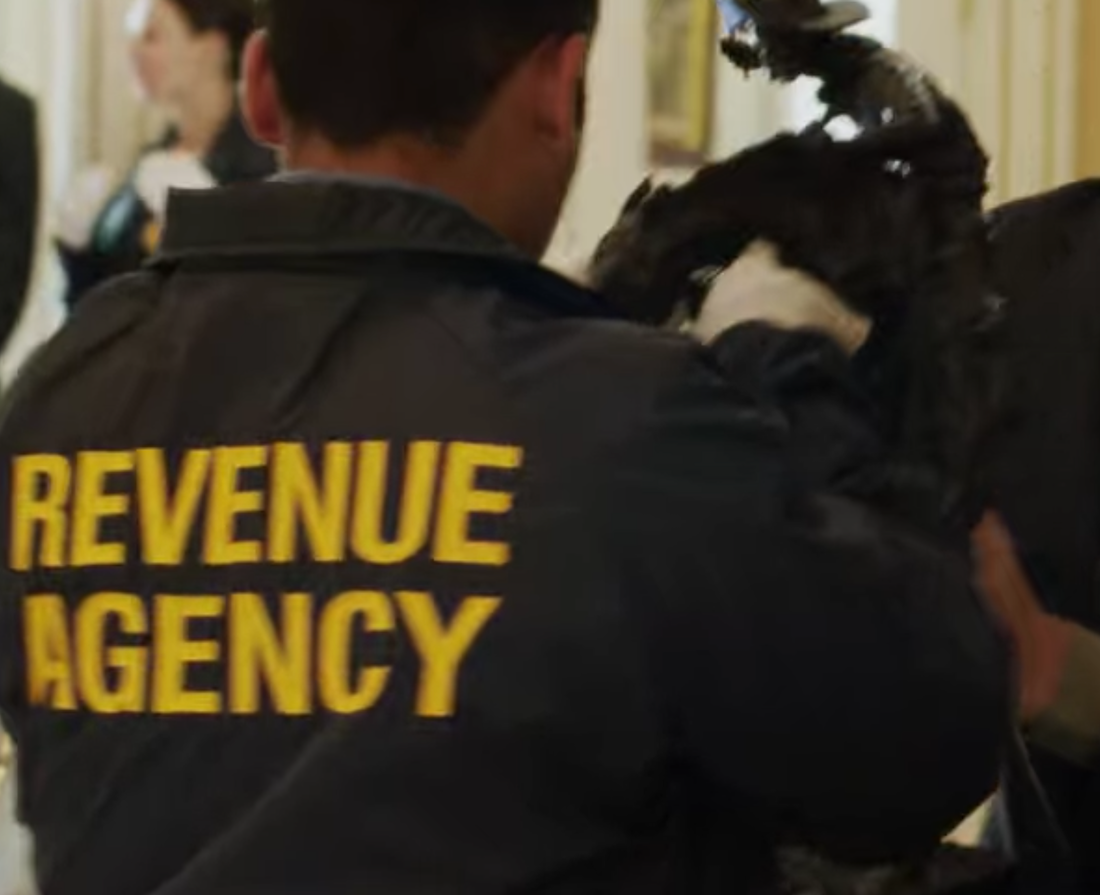
I’m still trying to wrap my mind around what kind of a sick person wants to get paid to destroy another person’s life. DESTROY ANOTHER PERSONS’ LIFE!
In the United States, the tax agency is called the Internal Revenue Service, and their jackets are printed with “IRS Revenue Officer” or “IRS-CID Police.” CID is the Criminal Investigation Division. Using the clue of the jackets and Dan Levy’s proclamation, we’ll look at this question under Canadian law.
WHAT HAPPENED TO THE ROSES?
In the first five minutes of the pilot episode, Johnny Rose calls a person named Eli a “son of a bitch.” Turns out Eli was the family’s business manager who was like “family” and was in charge of the Roses’ finances. The Revenue Agency officer then tells Johnny, “Eli really did a number, Johnny. He took everything,” and explains that Eli has run off to the Cayman Islands.
The phrase “He took everything” indicates to me that their business manager stole the majority of their assets. The Netflix episode description also states that “their business manager loots their family fortune,” which indicates to me that Eli both took the cash and left a big ol’ tax bill, especially since Johnny also says, “He was our business manager. He was supposed to pay taxes.”
The Revenue Agency officer then tells the Roses that there was a “very small amount set aside” for the family and also “one asset the government has allowed [the Roses] to retain” – the town of Schitt’s Creek.
Since Eli took “everything” – presumably their cash – then whatever physical property the Roses had left would be what the Canadian government would go after to satisfy the debt of unpaid taxes. Let’s discuss how that works.
WHAT HAPPENS WHEN YOU STIFF THE CANADIAN GOVERNMENT?According to the Canadian Revenue Agency (CRA), “Any amount you owe is payable in full immediately when you're assessed.” If the Roses failed to pay the CRA in a timely fashion, they were charged “compound daily interest at the prescribed rate on any amount owing.” Whatever amount the Roses owed was also subject to a daily interest rate, so their tax bill ballooned up even higher.
Since the Roses did not pay the outstanding debt to the CRA or contact the CRA to discuss payment plans, the CRA was entitled to take legal action to collect the unpaid amount. That legal action could have been garnishment, which means the CRA would go into bank accounts and seize the funds. Since Eli apparently took all of the Roses’ money and fled the country, that would not likely be successful.
Since the garnishment wouldn’t work so well, the CRA could put a lien on the Roses’ home or other large assets. That means, if the Roses tried to sell the property, the tax debt would get paid first.
What happened in the pilot episode was even more severe than just a lien. It is called a seizure of assets. First, the CRA would have gone to court and gotten a written command or formal order in favor of the Crown (the Canadian government) that allowed the CRA to seize and sell the Roses assets and property. Under Canadian law, the CRA can do this without notifying the Roses. If you think about it, it makes sense. You know you’re supposed to pay your taxes. Although they relied on their “business manager,” the liability still falls on the Roses as the taxpayers.
On the CRA website the agency states that it will seize property like: “your car, boat, artwork, cottage, rental property, or personal residence.”
Lock up your cottages, y’all. The CRA ain’t messing around.
After the CRA seized the Roses’ assets, it would sell them off to pay both the tax debt owed and all of the costs associated with selling the assets. If the sale proceeds didn’t satisfy the whole tax debt, then the Roses would still be liable to pay the remaining amount. Tax debts are not dischargeable in bankruptcy, either.
The Canadian Broadcasting Company recently reported that asset freezes and seizures were on the rise, with the CRA using provisions of the Criminal Code to enforce tax debts. Since tax evasion is technically a crime, then money retained and not used to pay taxes are fruits of that crime.
So, to the question…
Would the Roses realistically have been able to keep those items?
During the pandemonium of the asset seizure, Johnny shouts at Moira, “We’ve got 15 minutes to collect our personals.” Of the assets being seized in the house, it appeared to be large piece of furniture, statues, and large pieces of jewelry and expensive designer bags, not personal items like clothes or shoes.
When the family arrives in the town, they have luggage, duffle bags, some cardboard boxes, and cases containing Moira’s extensive wig collection.

75% of the suitcases are filled with wigs.
The CRA agents came to seize assets of value that could be sold to satisfy the Roses’ tax debt. Their enormous house and various other properties would probably make the largest dent, then the larger, more valuable personal property pieces would be the next most valuable.
Though they wear some incredible designer clothes, taxing authorities don’t generally seize clothing. In the United States, the IRS will also allow individual taxpayers to keep “tools necessary for the trade, business or profession of the taxpayer,” which could arguably include their phones and laptops.

The looks of an icon
As for Moira’s jewelry, it’s not as recognizable as her designer clothes. For instance, the iconic panther brooch was created by the production designer, Debra Hansen. It later sold at a charity auction for $3,200, but that’s likely because it was a part of the show and not because of its inherent value.

Rawr! Look at that sweet brooch.
Many of the other pieces were either from the costume designer’s own collection or were costume jewelry, though there were some finer pieces layered in as well, according to this interview with Debra Hanson.

SO many layers of necklace
If Moira somehow successfully hid those assets and the tax debt got paid off with everything else the CRA took, she would be able to keep those items. Also, she’s Moira fricken Rose. She can do whatever she wants. PROOF: Check out this iconic collection of legendary Moira moments.
I hope that answers your question, Kelly!
Got a question? Submit it here. They can be legal what-if questions, questions on current events, or questions about the legality of actions in TV shows or movies you’ve seen. I never ever want to answer your personal legal questions, so don't send those. Love you, but I don’t do that.
***
This piece first appeared in Sunday Morning Hot Tea. Subscribe so you don’t miss another piece.

Legal Question: If You Give a Lawyer a Dollar
This week’s question is from me watching a lot of Breaking Bad. No real spoliers below, but if you are concerned about me ruining a 12-ish year old show, by all means skip. Along those same lines, I am only on season 3, so don’t email me any spoliers please.
On to the question:
Does giving a lawyer a dollar make everything you say subject to attorney-client privilege?
While watching an early episode in Season 2, we see Saul Goodman speaking with Jesse and Walt. He’s tied up, kneeling on his knees, and tells Walt and Jesse to “put a dollar in my pocket” so they could start an attorney client/relationship thus making any meth-dealing info the pair told him subject to the attorney-client privilege.
As we watched, Paris asked whether what Saul did was necessary.
Great question, Paris! I thought I told you to use the form next time you had a question like this?! Anyway, thank you for insisting that we watch Breaking Bad. I am very much enjoying it!
Quick note: I don’t live in New Mexico. I live and practice in Texas, so I’m going to answer with references to Texas rules of evidence and professional conduct, though I’m sure New Mexico’s rules are similar. I’ll also refer to federal rules because – this may come as a surprise to you – drug-dealing across state lines is a federal offense.
What kicks off the attorney-client relationship?
Walt and Jesse didn’t even need to give Saul a dollar to start the relationship. Attorney-client privilege and confidentiality extend even between a lawyer and a person who is considering hiring that lawyer for legal work. Information given to the attorney even before money changed hands is subject to confidentiality and, without careful clarification, can inadvertently create an attorney-client relationship.
Once you and a lawyer are in an attorney-client relationship, that lawyer is subject to a LOT of responsibilities. Keeping you informed about the status of your problem, providing you with diligent and zealous representation, not having sexual relations with you (sorry!), etc. So we try our best as lawyers not to even set up that relationship in the first place, or at the very least, clarify the parameters of that relationship and when it ends as soon as possible.
This may be why your lawyer friends are hesitant to give you off-the-cuff legal advice (that and the fact that we hate it and it’s annoying and anyway you haven’t even talked to us since that freshman biology class we had together like 15 years ago and now you’re DMing us for legal advice? Really?)
But I digress.
The exchange of money is not necessarily required to begin an attorney-client relationship. Even just asking for and being provided with legal advice can possibly make the information exchanged subject to confidentiality and privilege.
That being said, it sure feels cool and clandestine to hand somebody a dollar and be like “You’re my lawyer now.” I know. It’s happened to me before. And it was cool as hell.
What is the attorney-client privilege?
The attorney-client privilege is outlined in the Texas Rules of Evidence at Rule 5.03 and the Federal Rules of Evidence at Rule 5.01. These rules say that a client has a privilege to refuse to disclose and to prevent any other person from disclosing confidential communications made to facilitate the rendition of professional legal services to the client. People governed by this privilege include the lawyer, the lawyer’s representatives, and other lawyers the client’s lawyer consulted with.
In addition, the Texas Rules of Professional Conduct generally require lawyers to keep confidential any information provided to us in the course of representation or giving legal advice. In fact, the communications that are protected by the attorney-client privilege are only those that the client or attorney makes for the purposes of providing/obtaining legal services AND that are confidential.
The communications have to be confidential to be protected. If you’ve ever accompanied a friend or a family member to a lawyer’s office and the lawyer makes you wait outside in the waiting room, this is why. Having non-client third-parties in the room can waive the privilege.
This set up of confidentiality and privilege is important. If we’re going to give you competent and thorough legal representation, we need to know what we’re working with. If you’re paranoid that we could rat you out to the cops for what you tell us, you may withhold information and, in turn, we may give you bad advice.
It’s a bit like going to the doctor (by the way, lawyers LOVE equating ourselves with doctors. We can even call ourselves “Doctor” by Texas professional standards, but when a lawyer calls themselves “Doctor” most people substitute in the word “douche bag” so most of us don’t do that).
When you go to the doctor, she will listen to your symptoms then prescribe a treatment to you – either a medication or a course of action. If you don’t tell her all the other medicines you’re taking, she could inadvertently prescribe something that kills you.
We lawyers need to know allll the facts of a given situation to advise you of all the possible outcomes and courses of action available to you. That absolute honesty includes telling us about crimes you may have done. If you go confessing crimes to your lawyer, then your lawyer is called on the stand and forced to testify against you, that would eliminate the whole purpose of lawyers in the first place.
Instead, the Rules of Evidence, both state and federal, and the Rules of Professional Conduct require attorneys to keep the information our clients tell us to ourselves.
But not always.
Exceptions to the Attorney-Client Privilege and Confidentiality
So you found your Saul Goodman. You paid him his unnecessary dollar or even just asked him for legal advice, which requires him to keep your info private. But then he helps you commit a crime or series of crimes. It’s all privileged because he’s your lawyer, right? Wrong.
The attorney-client privilege is not absolute. The Rules of Evidence lay out specific exceptions to which the privilege does not apply. One of these is called the Crime/Fraud Exception. If the lawyer’s services were “sought or obtained to enable or aid anyone to commit or plan to commit what the client knew or reasonably should have known to be a crime or fraud,” the communication is no longer privileged
Because Walt and Jesse were seeking Saul’s services, not to help them navigate having been charged with a crime, but to continue to commit those crimes and get away with it, the privilege does not apply. Walt and Jesse could not assert the privilege and keep Saul from testifying.
As recently as 2016, a pair of lawyers were required to disclose confidential information that would otherwise be protected by the attorney-client privilege in a case of tax evasion. A man had used the lawyers’ services to write a tax protest letter, appeal the results of an audit, and allegedly engage in other sneaky tax-hiding behavior to the IRS and Tax Court.
Because the lawyers’ services were used to aid the man in his tax evasion, the court required the lawyers to produce the incriminating evidence they had about their client.
In an interesting twist of loyalty, the man insisted that the lawyers continue to represent him even after they were required to reveal information about him to the Department of Justice. I would say they sound like very good lawyers, but then again, their client was sentenced to 70 months in jail for the ordeal. Who knows, maybe they were just really good friends.
As much as we love him, Saul is a serial violator of the rules of professional conduct, except the rule of confidentiality. As for his illegal behavior, of course it’s against the law. It’s also against the Rules of Professional Conduct, one of which is, basically, don’t do crime. The exact language is a little more flowery, but you tell me if it boils down to anything other than “don’t do crime.”
A lawyer shall neither “engage in conduct involving dishonest, fraud, deceit, or misrepresentation” nor shall he “commit a serious crime…or any other criminal act that reflects adversely on the lawyer’s honest, trustworthiness, or fitness as a lawyer.”
I may be a prude, but I think money laundering and/or facilitating connections between a meth cooker and meth distributor fits squarely in that definition.
Amongst other pretty obvious ethical concerns, there is also some concern about representing both Walt and Jesse. In fact, at one point, Jesse even asks Saul, “Yo, whose lawyer are you?” when Saul jumps at the chance to offer Walt a deal that he previously offered to Jesse.
It is just as important to know when someone is your lawyer as it is to know whether someone has a duty to keep your confidential information confidential, or when you as a client can assert privilege and keep your lawyer from testifying against you.
Don’t let Saul fool you – it doesn’t take a dollar for those rules to apply. And once they do, they can stop applying if your lawyer jumps into the criminal bed with you, so to speak.
Thanks for asking and for forcing me to watch Breaking Bad, babe! I am loving it!
(PS – For realskis, don’t send me spoilers because I already accidentally saw some when I was researching this, and I am actively trying to forget them so I can be surprised when I see the finale, please and thank you.)
Got a question? Submit it here. They can be legal what-if questions, questions on current events, or questions about the legality of actions in TV shows or movies you’ve seen. I never ever want to answer your personal legal questions, so don't send those. Love you, but I don’t do that.
***
This piece first appeared in Sunday Morning Hot Tea. Subscribe so you don’t miss another piece.

Legal Question: Raging Abe Simpson and His Misguided Miscalculation in “The Unenforceability of the Flying Hellfish Agreement”
This week’s question comes from Paris via asking me on the couch and me responding, “If you really want to know, you should fill out the form on the website.” Paris asks:
“Is the Tontine agreement made in The Simpsons Season 7, Episode 22 legal? Abe Simpson and Monty Burns enter into a contract where the last surviving participant becomes the sole inheritor of valuables. Is that legally possible?”
Great question, Paris! Spoilers ahead for those of you who missed this episode when it aired 25 years ago this week.
In case you haven’t seen The Simpsons episode in question, it involves a pact made between nine of Springfield’s men who served together in World War II in Germany as part of a crew called The Flying Hellfish. In the present day (1996), Grandpa Simpson checks his mail and receives notice that someone named Asa Phelps has died. Grandpa yells, “The seventh Hellfish has died!” Then remarks how he is one step closer to “the treasure.”
Grandpa meets Monty Burns in the cemetery for Asa’s sad and poorly attended funeral, where the men each put keys into a monument. A door opens to reveal a box. Inside is a list of nine names, six of which are crossed off, including Sheldon Skinner, Arnie Gumble, Iggy Wiggum, Milton “OX” Haas, Etell Westgrin, and Braff McDonald. Grandpa Simpson crosses off Asa Phelps, leaving only Mr. Burns and himself on the list.
Burns tells him, “Seven gone. As soon as you’re in your press-board coffin, I’ll be the sole survivor, and the treasure will be mine.” Mr. Burns refers to their “gentlemen’s agreement” saying that the crew swore on their lives to uphold it. The two men keep referring to the treasure as the “Hellfish Bonanza.”

“Seven gone. As soon as you’re in your press board coffin, I’ll be the sole survivor and the treasure will be mine.”
That “Bonanza” was made up of priceless paintings by what looks like a Rembrandt with mentions of Monet and Botecelli, that they had taken from a German castle. When the group of men found the paintings during the war, they figured that immediately selling the stolen loot would get them busted. To lay low, the group agrees to hold the paintings in a “tontine” suggested by Mr. Burns.
Ox, one of the soldiers, explains the scheme as, “Essentially we all enter into a contract whereby the last surviving participant becomes the sole possessor of all them purty pictures.”

Fast forward back to 1996 where Grandpa and Bart retrieve the paintings from under the waters of Lake Springfield. No sooner have they come up for air, the paintings are stolen by Mr. Burns. Grandpa Simpson catches up to Burnsy and “discharges” him from the Hellfish. Grandpa says this ouster also kicks Mr. Burns out of the Tontine, so Grandpa declares himself entitled to keep the paintings. His victory doesn’t last long. Soon U.S. government agents show up to return the paintings to the descendants of their rightful owner.
WHAT IS A TONTINE?
A tontine is, not surprisingly, a real thing. Writers for The Simpsons are always bringing in real historical and cultural references. Invented in the 1600s, tontines were ways for people to obtain payouts based on their own mortality. They were also used as investment plans often run by the government in order to fund large scale projects, similar to how municipal bonds are used today.
In a tontine, the government/organizer sets up the structure and maintains the money. People called “subscribers” put money into the scheme. The subscribers receive payments of interest while the pot of money grows. Then as each person dies, the share of the pie and payouts become bigger based on the fewer number of remaining participants. Finally, the last person to survive would be entitled to the payout of the remainder once the rest of the participants died.
The setup is not quite the same as what the Flying Hellfish used it for, but it is similar. This investment structure was invented by and named for a banker and politician from Naples, Lorenzo de Tonti. Though he later had to seek political asylum for participating in a revolt, his name remains tied to the financial setup he created so many centuries ago.
Tontines were popular throughout the years and eventually made their way to the United States. However, in 1905, tontines had devolved into something more similar to a Ponzi scheme. An investigation by the state of New York put restrictions on tontines after an executive of a life insurance company was misusing money from the tontine accounts to fund his lavish lifestyle. This misuse made tontines appear risky, so they became subject to heightened regulation.
COULD THE FLYING HELLFISH USE THIS SET UP FOR THEIR PAINTINGS?
Not likely. Tontines don’t normally hold property. They hold money and pay out dividend-like payments. Instead, what the men may have created was more like a trust. Under the law, a trust is an arrangement whereby a person (a trustee) holds property as its owner in name only for the benefit of one or more beneficiaries.
Under Oregon law, a trust need not be evidenced by a trust instrument. That means that a trust can be created by speaking the trust into words. The initial “trust” may have been created back in Germany, but the men acted in accordance with the trust for years in Springfield. Arguably, it would be governed by Oregon law. Yeah, the Simpsons live in Oregon.
Whether it was a “tontine” in the strict sense of the word or a trust, the Flying Hellfish “tontine” is still an oral contract to which all nine of the Flying Hellfish agreed. The major problem with this oral agreement is a law called the Statute of Frauds.
The Statute of Frauds requires that certain agreements must be in writing to be enforceable. For instance, if an agreement cannot be performed within one year, it must be in writing to be enforceable. Since the agreement was contingent on the deaths of members several years apart, the contract would likely be void under Oregon’s Statute of Frauds law. This means that if the agreement was not in writing, it would not be a real agreement.
The biggest issue with determining legal title to the Hellfish Bonanza is the court’s abhorrence of illegal contracts. Even if it were in writing, it’s based on the underlying illegal act of stealing paintings.
Oregon courts have held that, “If the consideration for the contract or its agreed purpose is illegal or against public policy on its face, it will not be enforced.”
Because the underlying consideration for the Hellfish contract was stolen paintings, the contract is based on illegal consideration and “against public policy.” Contracts are usually considered “against public policy” if they are harmful to society or citizens. Awarding ownership of stolen paintings to one of two thieves would be both illegal and against public policy.
If Mr. Burns or Grandpa Simpson wanted to argue in court that either of them was entitled to the paintings, they would not likely be successful. They are fighting over stolen property, based on an oral contract that does not satisfy the Statute of Frauds. The court wouldn’t likely award the paintings to either man.
Even though Mr. Burns and Grandpa Simpson’s tontine was probably not enforceable, real life tontines are trying to make a comeback. According to the Washington Post, there is a growing set of lawyers and economists that think tontines are the future of retirement savings plans in America. They’re overwhelmingly more popular than annuities, which require participants to bet on their own lives. Tontines allow people to bet against the lives of others, which people seem more enthusiastic about.
In countries throughout Africa, a version of tontines that work like “peer-to-peer savings circles” are an important source of capital for small businesses that would not otherwise have easy access to capital to scale up in size. So while they would not be a good way to hold stolen paintings in trust for the benefit of stubborn old men unwilling to die, tontines are real and are still used to this day.
Thanks for the question, Paris! If you have any other questions, I expect you to submit them through the form and not ask me directly. (Kiddddding!)
Got a question? Submit it here. They can be legal what-if questions, questions on current events, or questions about the legality of actions in TV shows or movies you’ve seen. I never ever want to answer your personal legal questions, so don't send those. Love you, but I don’t do that.
***
This piece first appeared in Sunday Morning Hot Tea. Subscribe so you don’t miss another piece.

Legal Question: WandaVision and the Rights of Robots
[SPOILER ALERT – This will have spoilers for WandaVision. If you haven’t finished the show, save this for another day when you’re done.]
This week’s question comes from Megan R. via the form.
Megan asked:
“No spoilers but on WandaVision, I saw Vision’s name next to Wanda’s on a legal document for a house. Could a robot own a house?”
Excellent question, Megan!
If you haven’t watched WandaVision and you really like Marvel stuff and/or television, I’d highly recommend it. As a fan of The Dick Van Dyke Show, I particularly enjoyed the references to 1960s sitcom tropes. I also love my college improv teammate and friend, Asif Ali, and will watch him in anything. He absolutely crushed his role in this show!
Now to the question. The document Wanda was seen holding was a deed for a piece of land in Westview, New Jersey. A deed is used to transfer land between owners. The person receiving the land is called the Grantee. The one transferring the land is called the Grantor. After the deed is signed, the parties record it with the county clerk, and the transfer is done.
The deed in the show listed the grantees as “Wanda Maximoff AND The Vision.” We do not see who the Grantor was. Presumably, it was the former owner of the house, but the internet has some fan theories about who gave her that deed and whether it’s from some evil doer or future villain.
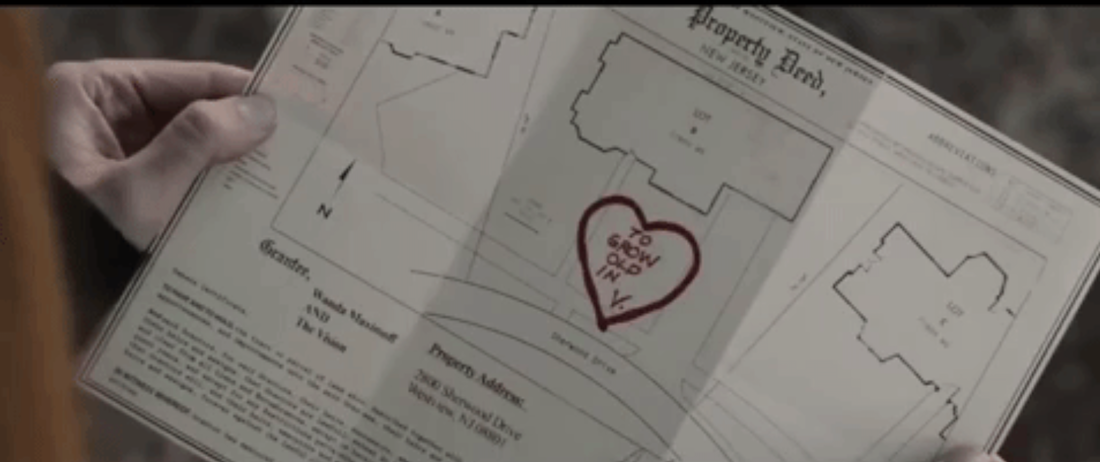
TBD on whether you can write love notes on a legal document. I wouldn’t personally recommend it.
CAN VISION OWN A HOUSE SINCE HE’S A ROBOT?
Not to sound like Comic Book Guy, but first of all, Vision is not just a robot. According to the MCU Fandom Wiki, “Vision is a synthezoid made from vibranium… and given life by the powerful artifact known as the Mind Stone.” Synthezoid means an android (a robot designed to resemble a human) that is “made partly or entirely of synthetic, organic-like materials.” He’s a robot with fake people guts. AND FEELINGS!

It me.
Let’s go point by point and decide whether Vision is a human or robot.
In an early episode of WandaVision, we see Vision chew a piece of gum. He’s got a human-like mouth, but when he swallows the gum, his inner gears grind to a halt. LOL A MULTI-BILLION DOLLAR ROBOT WAS STOPPED BY GUM! Somebody keep that lady from the retirement home parade away from him! While he can chew gum, he apparently cannot digest it. Can any of us? One point for the human category.
The MCU Fandom Wiki also says that synthezoids don’t sleep because they run on internal batteries. This brings along with it some disturbing visuals of Wanda, a human, sleeping soundly while Vision stares blankly at the ceiling. Yikes. That is definitely creepy robot behavior. One point for the robot category.
In Captain America: Civil War, the United Nations ratified the Sokovia Accords, which purport to regulate the Avengers. Vision is one of the “enhanced individuals” who “signs” on to the Accords. If he’s merely a thing and not a human, they would not need or want his signature. Another point in the human category.
He is made of vibranium and has a bunch of wires inside him. He can walk through walls and fly. He’s got a metal Ken-doll situation going on downstairs. Another point in the robot category.
So we’re at a tie. Even if Vision is a robot, he is no ordinary one. He’s kind of like a robot+, especially since he was “given life” by the Mind Stone. The Mind Stone is a magical gem as old as the universe. It sits in the middle of Vision’s forehead, which, if rapper Lil Uzi Vert is any indication, is a very convenient place to put an irreplaceable gem.

I’ll just put this priceless stone right here out front for safe keeping.
Then, when Thanos rips off Vision’s Mind Stone in Avengers: Infinity War, Vision dies.
Sooooo…. Vision is a partially synthetic being that has been given life and can be killed and can feel feelings and sign documents? Sounds human-ish to me! But human-ish is not human, which means he doesn’t have rights, including the right to own property … right?
DO ROBOTS HAVE RIGHTS?
This is a decades-old discussion of legal theory that took me down some philosophical rabbit holes as I was researching. As a basis, when we think of rights, we tend to think of the rights of people. Heck, the U.S. Constitution starts off “We the people.”
But non-humans also have rights - namely, animals and corporations. Why is it so unthinkable that someday robots may have rights?
According to legal scholars and even a UK Supreme Court Justice, the idea of robots having rights is not too far off. Yes, this thought is disturbing. I, for one, don’t want to see these unstoppable horror machines given rights any more than you do.

“KILL ME”
The question really comes down to personhood. If a “person” has rights, what do we mean by “person”? Does that mean human beings only?
When we refer to the rights of corporations to sue, be sued, or to enter into contracts including for real estate transactions, we call that “corporate personhood.” Further, in 2010, the United States Supreme Court determined that corporations have First Amendment political rights to buy ads in all American elections in the Citizens United v. FEC decision. This means a non-human corporation has the rights to constitutional First Amendment protections. Nevermind the fact that the Constitution begins “We the people.”
If a corporation can have property rights, the right to sue, and the right to free speech, can’t we let this synthezoid and his human lady friend own a frickin’ piece of land?
IF VISION CAN’T OWN THE LAND – DOES WANDA OWN IT OUTRIGHT?
Let’s say you’re a monster who doesn’t want to see Vision and Wanda own this land together. Or, even if you do, too bad. Vision is dead.
In that case, who owns the land? For that we turn to basic property rights.
As with most legal questions, the answer is: it depends. If the wording of the deed includes language that the land is owned by the two as “joint tenants with rights of survivorship” then the land will pass to the surviving co-tenant/co-owner – Wanda.
If the deed does not use that phrase, then it means that the property was owned as tenants in common. This is a different type of ownership scenario where the parties own their halves separately. Therefore, the share belonging to the deceased co-tenant (Vision) would pass to his heirs.
Who are Vision’s heirs? He and Wanda weren’t legally married. Their kids were figments of her imagination (OR WERE THEY? TBD!) He has no parents because he was Frankenstein’ed together by several creators.
So who gets the land then?
In 2017, the EU Parliament wrote a report to the Commission on Civil Law Rules on Robotics that proposes a concept of robot rights/liabilities similar to that of corporations. The determination was that “the responsibility must lie with a human and not a robot” in determining liability. I would argue that property rights would pass much the same way: to the robot’s owner.
Ok then, who “owned” Vision? Wanda? S.W.O.R.D.? S.H.I.E.L.D.? Nobody?
And, for that matter, is Vision even dead?
White Vision is out sailing through the sky trying to find himself, a reassembled synthezoid made of old Vision’s parts who has been endowed with old Vision’s thoughts and memories. After the Vision vs. White Vision fight and the Ship of Theseus conversation, perhaps White Vision is Vision now. He’s the only Vision still standing. the WandaVision Vision was contained to the Hex and went poof right along with it when the Hex was taken down.
In the WandaVision post-credits scene, Wanda hears the screams of their kids as she’s meditating. If their kids are alive out there in some alternate universe and weren’t totally destroyed when the Hex went down, then is the WandaVision Vision out there, too? And if so, what does that mean for White Vision? All this comic book universe talk is all giving me double vision. (See what I did there?)
CONCLUSION
I say Vision should have the right to own land. Corporations aren’t people, and they own land all the time. Plus, with the way robots are evolving, there may soon come a time when machines that autonomously create will be given rights over their creations, paving the way for robot property rights. Until that time, it doesn’t make much sense to say no to a being with unlimited power and a wife who is the most powerful Avenger. Probably won’t end well.
Thanks for the question!
Got a question of your own? Submit it here. They can be legal what-if questions, questions on current events, or questions about the legality of actions in TV shows or movies you’ve seen. I never ever want to answer your personal legal questions, so don't send those. Love you, but I don’t do that.
***
This piece first appeared in Sunday Morning Hot Tea. Subscribe so you don’t miss another piece.

Legal Question: I Care A Lot - A Horror Film for the Aged
This week’s question comes from my mom via text. Yeah, I know I recently answered another question from her, but she’s my mom so she gets to the front of the line. She also tells me things like, “I brought you into this world and I can take you out,” and I don’t plan on testing her.
Mama McKinney asked:
“I watched I Care A Lot and found it very upsetting. Does this really happen to vulnerable seniors? Could she really do that in real life?”
Excellent question, Mom!
Holy shit! I Care A Lot is … a lot. When Paris and I went to see Uncut Gems in the theaters (LOL REMEMBER THEATERS??) I had to get up and leave my seat several times because it was making me anxious! I Care A Lot is a slightly funnier version of Uncut Gems.
Instead of getting up to leave the theater during I Care A Lot, I sat on my couch absolutely sweating because of how upsetting it is to watch older people be mistreated. And my job every day is to help older people who have been mistreated! That’s how intense the movie is.
** SPOILER ALERT ** I don’t plan on spoiling the twists and turns of the movie, but if you are like me and don’t want to hear anything about a film before watching it, now may be a good time to close this article and open Netflix to check out the flick before going further.
So, to the first question at hand – does this happen to vulnerable people?
Yes, it does happen! Instances of guardianship abuse occur (1, 2), but due to the decentralized nature of guardianship regulation, there is a lack of data on the subject. The U.S. Senate Special Committee on Aging published a report in 2018 calling for reform and increased oversight of guardianships. At the time of the report, 1.3 million people were under guardianships across the country with around $50 billion dollars of wards’ assets controlled by guardians.
Britney Spears and her conservatorship struggles are arguably the most famous current example. In California, a guardianship is called a “conservatorship,” but it is functionally the same as guardianship, so I’ll use that term throughout this article. For all the coverage on the #freebritney conservatorship situation, check out our two-parter on Sinisterhood.
Another controversial guardianship story was “From Headache to Hostage,” the story of Doris Davis, a woman in Houston in her 80s who, in 2014, checked into the hospital for a headache and ended up in a nursing home, controlled by a guardianship managed by the state with her house sold to pay expenses.
Page after page of filings in Ms. Davis’s case show concerned family members advocating on her behalf and asking for her release from the state’s control. However, the requests were repeatedly denied, although Ms. Davis was granted a partial restoration of her rights. Documents do not indicate whether she was able to take advantage of those restored rights. Public records show that, despite her family’s best efforts, Ms. Davis remained under the arrangement until her death in mid-2018.
The most Marla-Grayson-ish real life story was that of April Parks. Short and stocky with dark hair, she was the exact opposite of Marla in appearance. But in action? The movie may as well have been based on her true story.
According to The New Yorker, Parks not only was overbilling her wards, many of whom didn’t need to be in the guardianships, she was also found to have benefited from the “collusion of hospital social workers and medical staff” who sent wards to Parks, just like in the film.
Last Week Tonight with John Oliver mentioned Parks’s case in a 2018 segment on guardianship abuse, which shows actual footage of Parks admitting to overbilling her wards. She was eventually sentenced to 16 to 40 years in jail after pleading guilty to two counts of elder exploitation, two counts of theft and one count of perjury.
The stories are awful and scary and real, so let’s break it down and see how it happens.
WHAT IS A GUARDIANSHIP?
A guardianship gives full or limited authority to a person called a “guardian” to manage the financial and personal affairs of an “incapacitated” person called a “ward.”
Several players are involved in a guardianship. They are:
Guardian: This is the person who takes control of the vulnerable adult’s finances and care. If the guardian is a disinterested third party appointed by the court (like Marla Grayson), then they are sometimes referred to as a “Guardian Ad Litem.”
Ward: The vulnerable adult who is in the guardian’s control. Before the guardianship has officially started, this person can be referred to as “the proposed ward.”
Probate Court: In some Texas counties, specialized probate courts decide whether to approve guardianships. In other smaller, more rural counties and other states, the decision may be made by a judge who is possibly not even a lawyer.
Attorney Ad Litem:This is an attorney appointed by the court to represent the best interests of the ward. Texas appoints these lawyers for wards, but not all states do.
Court Investigator: This person works on behalf of the court to provide reports to the judge on the ward’s condition.
On “probable cause,” which can include a letter from “an interested person” or a letter from a physician who has examined the proposed ward, a judge can order a guardian ad litem or court investigator to determine if the proposed ward is incapacitated.
If it is determined that the ward is “substantially unable to feed, clothe or shelter himself/herself, to care for his/her physical health, or to manage his/her financial affairs,” then the guardian ad litem or court investigator shall file an application for guardianship over the proposed ward.
The process works much the same in the movie. Marla gets the ball rolling by having a physician submit a letter about her patients’ well-being. Rather than appoint a random guardian ad litem, the judge seems to continually appoint Marla. Instead of having Marla investigate and determine whether the wards are incapacitated, the judge in the movie fast tracks the process and just approves the guardianship. This is probably because the move is only an hour and fifty-eight minutes long, and legal proceedings take a lot longer than that.
COULD MARLA DO THIS IN REAL LIFE?
Possibly, but it wouldn’t be quite as easy as it was in the movie.
The type of guardianship Marla seems to be getting in the film are temporary emergency guardianships. Under the Texas Estates Code, temporary guardianships are required to end after 60 days. In order to obtain permanent guardianship over her wards, Marla would have to undertake the full guardianship process. That process would present a lot of speedbumps to Marla’s scam and would require a massive, concerted conspiracy involving multiple parties.
The first hurdle Marla would encounter is in the form of the Attorney Ad Litem (AAL). Texas law states that a court shall appoint an AAL, an actual lawyer, to represent the proposed ward’s interests in guardianship proceedings. That’s not the case for every state.
The AAL must meet with and interview the ward before the permanent guardianship hearing. The AAL also must be provided with copies of all of the documents filed with the court. The purpose of the AAL is to act in the ward’s best interest. Neither the ward nor the guardian selects the AAL. The court assigns an AAL from the pool of qualified attorneys in the ward’s area.
Marla would have to pay off and bribe every qualified AAL in the area who was assigned to her wards’ cases. This would be very difficult and costly to achieve. As a person who paid an ass load to go to law school and who values her law license, integrity, and freedom (not necessarily in that order), there is no amount of money in the world that would convince me to let some vape-sucking shrew lock up older people for no reason.

Gtfo of here with that
But even if she could somehow bribe the assigned AAL, Marla would still have to deal with the court investigator. Not only are court investigators required to meet with the ward and investigate the circumstances of the guardianship, the investigator has to file a report stating that the guardianship is more appropriate than any of the possible “least restrictive alternatives.”
The least restrictive alternatives are Marla’s biggest hurdle. Between 2015 and 2018, Texas guardianship law underwent several changes. The most significant change is that anyone applying for guardianship now must prove that they first tried using “least restrictive alternatives” to avoid the guardianship before applying to take away the ward’s rights.
Some of those “least restrictive alternatives” are powers of attorney, trusts, and supported decision-making agreements. A ward should also be offered supports and services, which include Meals on Wheels, in-home caregivers, Adult Protective Services, mental health resources, and assistance through charity organizations. Marla would have to certify to the court that all alternatives to guardianship have been considered.
A Texas judge would be unlikely to grant a permanent guardianship without some indication that those supports and alternatives were offered. The judge would also look to the court investigator and attorney ad litem to get their take on the situation. If Marla paid all those people off, sure, maybe. But that seems highly unlikely and too expensive to be worth it.
She’d likely just move to another state where there is way less oversight of the process.
GETTING OUT OF A GUARDIANSHIP
In Texas, either the ward or an interested person can submit an Application for Restoration with the court. A ward can also write an informal letter to the court. When a court receives a letter, the court investigator or guardian ad litem must meet with the ward and determine whether “the ward is no longer an incapacitated person or a modification of the guardianship is necessary.”
Texas law also requires the court to appoint an attorney ad litem to represent the ward in a proceeding for “restoration” – the legal term for ending the guardianship – or modification of the guardianship.
The good news? The evidentiary standard of proof required to restore someone’s rights is lower than it is for asking for a guardianship in the first place.
The bad news? The American Bar Association conducted a survey on “restoration of rights” – that is, getting out of guardianships. It showed that “an unknown number of adults languish under guardianship,” even if their conditions improve or they never should have been under the guardianship in the first place. The report warned that guardianships are “permanent, leaving no way out— ‘until death do us part.’”
However, there is a growing focus across the country on alternatives to guardianships to keep people from “languishing” unnecessarily. Part of that includes providing necessary supports and services to keep incapacitated adults as independent as possible for as long as possible. Texas has put in several statutory safeguards meant to preserve the independence of incapacitated adults, including the Ward’s Bill of Rights.
One of the most valuable parts of the Ward’s Bill of Rights is the right to “complain or raise concerns regarding the guardian or guardianship to the court, including living arrangements, retaliation by the guardian, conflicts of interest between the guardian and service providers, or a violation of any rights under this section.” If the court receives a complaint from “any person,” the court investigator has a duty to investigate the complaint and report to the judge if necessary.
That means if Dean Erickson appeared in a Texas court and complained to the judge, he wouldn’t be thrown out for being unrelated to Jennifer Peterson. He is “any person” complaining of the ward’s treatment and has a right to make a complaint regarding her guardianship.

And what a person he is 😍
HOW TO PROTECT YOURSELF FROM MARLA GRAYSON
The best way to protect yourself from being taken advantage of is by planning in advance. A few simple estate planning documents can work to prevent a Marla from slithering in, draining your assets, and taking your freedom. Heads up: these are what the documents are called in Texas – if you’re in another state, they may have different names.
Here are three of many planning tools you could use to protect yourself from the Marlas of the world.
Power of Attorney – A power of attorney or “POA” is a document that lets you designate someone to act on your behalf. You can either execute:
a general power of attorney that ends if you become physically or mentally incapacitated,
a durable power of attorney (usually called a “statutory durable power of attorney”) that stays in place regardless of your mental or physical incapacity, or
a springing power of attorney that gives the agent you choose power ONLY when you become disabled or incapacitated.
How it Protects You from Marla: In its analysis for least-restrictive alternatives, the court will ask whether a POA is in effect, and if so, whether it is working. If it is in effect and working well, the court should deny her application for the guardianship of your estate to manage your money and let your loved one continue helping you.
Medical Power of Attorney: Similar to the POA above, a medical power of attorney allows you to designate someone to make healthcare decisions on your behalf if you become mentally or physically incapacitated.
How it Protects You from Marla: Just like the POA would protect against an application for guardianship of your estate, a medical POA that is in effect and working well would show the court that there is no need to grant a guardianship of your person to make your healthcare decisions.
Designation of Guardian Before Need Arises: Texas law allows any person (other than an incapacitated person) designate who they want to serve as their guardian in case the need arises. Unless the court determines that the person designated is disqualified or would not serve the best interest of the ward, the court SHALL appoint the guardian designated by the ward.
How it Protects You from Marla: If a Marla rolled into your life and tried obtaining guardianship over you, but a family member or trusted contact has a validly executed Designation of Guardian Before Need Arises, that trusted person would bring the designation to the court and ask to be appointed instead.
Supported Decision-Making Agreement: This special agreement allows an adult with a disability to designate a “supporter” to help the adult make decisions. Unlike a power of attorney, the supporter does not make decisions for the adult. The role is more of information gathering and advising. Any adult can be designated as a supporter, and it does not require an attorney or a court to fill out the form.
How it Protects You from Marla: Texas courts determine whether “least restrictive alternatives” have been put in place before granting a guardianship. Showing that an adult has a Supported Decision-Making Agreement in place and is able to make decisions on their own with the help would be a mark in the column against guardianship.
Of course, nothing is totally foolproof. However, the more hurdles in place, the more difficult it is for an unscrupulous person to take advantage of you or your loved ones.
There have also been calls for reform nationwide from key stakeholders in the legal and elder care communities. Some proposed changes include screening for less restrictive options, focusing on values and preferences of individual, and strong guardian practice standards and training, among others. As those reforms are enacted throughout the states, seniors and adults with disabilities will be even safer from future Marla Graysons and April Parkses.
It is important to note that not all guardianships are bad. There are certain incapacitated adults who truly need the oversight of someone to make decisions for them. But guardianships are drastic and should only be implemented where absolutely necessary after all alternatives have been tried and failed.
I hope that answers your question, Mom! Thanks for sending. Also please know if anyone tried to Marla Grayson you, I would Peter Dinklage them right back.
Got a question? Submit it here. They can be legal what-if questions, questions on current events, or questions about the legality of actions in TV shows or movies you’ve seen. I never ever want to answer your personal legal questions, so don't send those. Love you, but I don’t do that.
***
This piece first appeared in Sunday Morning Hot Tea. Subscribe so you don’t miss another piece.