


Legal Question: Recuse Me, Please
This week’s question is from Frank via the form. Frank asks:
I was watching The Trial of the Chicago 7 and was wondering. Could you file to have a judge removed from your case?
Hi Frank! This is a great question; thanks for asking. I have not watched this movie, but I am somewhat familiar with the case.
BACKGROUND
To summarize for those of you who haven’t seen the movie or heard of the case – the trial of the Chicago 7 or the Conspiracy 8 (or the Chicago 8… they had a lot of monikers) took place in Chicago from September 1969 to February 1970, following the protests and subsequent riots of the Democratic National Convention. The defendants were charged with conspiracy and crossing state lines to incite a riot.
The judge in the case was named Julius Hoffman. The trial was lengthy, with something like 180 witnesses testifying. One of the eight defendants had the case against him declared a mistrial, so that’s why they’re sometimes referred to as “the Chicago 7.” The judge didn’t declare a mistrial in the case of that defendant right away. First, he had that defendant bound and shackled in the courtroom as well as dragged away and beaten in another room.
After the trial, at which the defendants were acquitted of conspiracy but convicted of inciting a riot, the judge sentenced the defendants and their attorneys to jail time on charges of contempt. Judge Hoffman gave defense attorney Kunstler four years in prison for addressing him as "Mr. Hoffman" instead as "Your Honor." Defendant Abbie Hoffman (no relation to the judge) received 8 months for laughing in court. Defendant Hayden was sentenced to one year for protesting the treatment of co-defendant Seale (the one who had been shackled). Defendant Weiner received two months for refusing to stand when Judge Hoffman entered the courtroom.
At the time of the trial, Judge Hoffman was 74 years old and had been on the bench for sixteen years, having been appointed by President Eisenhower. He was later part of an expose on the judicial bench where he was accused of "acting erratically and abusively from the bench." Despite this, he continued to preside over ongoing cases until his death in 1983.
The depiction in the Netflix movie is, by most accounts, not all that different from what happened in real life. Eventually, the contempt convictions were vacated as were the convictions for conspiracy and other charges. The United States Court of Appeals for the Seventh Circuit found that the judge had demonstrated a "deprecatory and often antagonistic attitude toward the defense." That’s a real flowery way of saying he threw their asses in jail because he had beef with them.
Now, on to your question. I’ll speak in terms of federal judges since the Chicago 7 trial was in federal court. Rules vary by state for state and local judges.
Could you file to have a judge removed from your case?
Under federal law (28 U.S.C. § 455), any federal judge “shall disqualify himself in any proceeding in which his impartiality might reasonably be questioned.” Sounds super great, right? Wrong. That’s not something that happens every day. People overestimate their own abilities all the time, judges included. Where someone else may believe the judge is biased, the judge could disagree.
When that happens, what do you do? File a motion for recusal. However, be aware that it is difficult to get a judge to recuse on motion unless that judge agrees. This is because the bar for disqualifying a judge is high. Just because a judge has past experiences or political preferences, or even if the judge has interacted with the attorneys or parties before, he or she is still qualified to sit on the bench.
In some states, judges are elected, and their political leanings may be well known. In the cases of federal judges, they are appointed, usually having been sponsored by a senator from their home state. You’ll sometimes hear, “Judge So-and-So, a Clinton appointee” or “Judge Thus-and-Such, a Bush appointee.” The speaker is usually implying some type of political affiliation or likely ruling based on the administration under which each judge was appointed. This political leaning does not disqualify a judge from presiding over a case absent certain behaviors on his or her part.
Those instances where judges “shall” recuse themselves are listed in §455 and include things like having a spouse or family member involved in the case at issue, having served as a lawyer for one of the parties, or having a financial interest in the case. That last one is interesting given the Wall Street Journal report that 131 federal judges “failed to recuse themselves from 685 lawsuits from 2010 to 2018 involving firms in which they or their family held shares.” Yikes.
So what if a judge won’t recuse himself and your motion to recuse is denied? The Judicial Conduct and Disability Act of 1980 and the Rules for Judicial-Conduct and Judicial-Disability Proceedings govern the complaint process. It begins with filing a complaint against the offending judge. The circuit chief judge over the judge at issue then reviews the complaint. If it is determined the complaint has merit, the circuit chief judge would appoint a special committee to review the complaint. The committee then files a report with the judicial counsel, who then issues an order.
Federal judges can also be impeached, a formal process by which a judge could possibly be removed from the bench. According to the Federal Bar Association, 66 federal judges have been investigated for impeachment since 1776, with 15 of those being impeached, and 8 actually being removed from the bench. Some examples of conduct that led to impeached judges being removed include:
Soliciting and accepting bribes;
Perjury;
Sexual assault;
Conviction of income tax evasion;
Practicing law while sitting as a judge;
Improper business relations with litigants; and
Intoxication on the bench.
As you can see, none of those are really “acting like a dick to the defendant.” Is that conduct bad? Yes. Clearly, Judge Hoffman was not behaving so badly as to be removed from the bench by federal standards, but he exhibited extreme bias against the defense attorneys and defendants that disqualified him from ruling on their contempt charges. That is why his contempt convictions were overturned on appeal.
The Seventh Circuit’s decision vacating the contempt charges essentially said the defense attorneys’ interaction with the judge was so pernicious that Judge Hoffman would have necessarily been biased. The appellate court found “[J]udge [Hoffman] was the recipient of numerous and unprecedented attacks and insults by both trial counsel. These attacks would have affected any judge personally.” Owing to that, it was impossible for Hoffman to be unbiased and should have recused himself. The defense attorneys and defendants should have stood trial for contempt before another judge.
What does this tell us? Judges have great power. Appellate judges have event greater power because they can overturn the actions of out-of-control judges. When a federal judge misbehaves, the processes of complaint and impeachment are available. When a state judge does it (at least in Texas and other jurisdictions where judges are elected), make sure you get to the polls, organize, and when a judge is not upholding the law, get someone to run against him and replace him at the next opportunity.
I hope that answers your question, Frank! Happy Franksgiving!
Got a question? Submit it here. They can be legal what-if questions, questions on current events, or questions about the legality of actions in TV shows or movies you’ve seen. I never ever want to answer your personal legal questions, so don't send those. Love you, but I don’t do that.
***
This piece first appeared in Sunday Morning Hot Tea. Subscribe so you don’t miss another piece.
Legal Question: Ever Heard of a Camera? Why Do We Use Courtroom Sketch Artists?
This week’s question is from Alex via the form. Alex asks:
I just watched Evil Genius on Netflix and was struck by the interview with the courtroom artist. He described his shifting interpretation of the defendant as the trial progressed, and it made me wonder: what is the role of a sketch artist in a courtroom? If they're present to visually document the trial, why not a camera? Surely photo or video would be a more objective recording of proceedings?
Also, on the theme of documentation - what does the stenographer produce on that little baby keyboard?! Hope you're well - thanks for brightening up some dreary English Sundays!
Great question, Alex! I hope you’re doing well, too. I hope your English Sundays are less dreary these summer days.
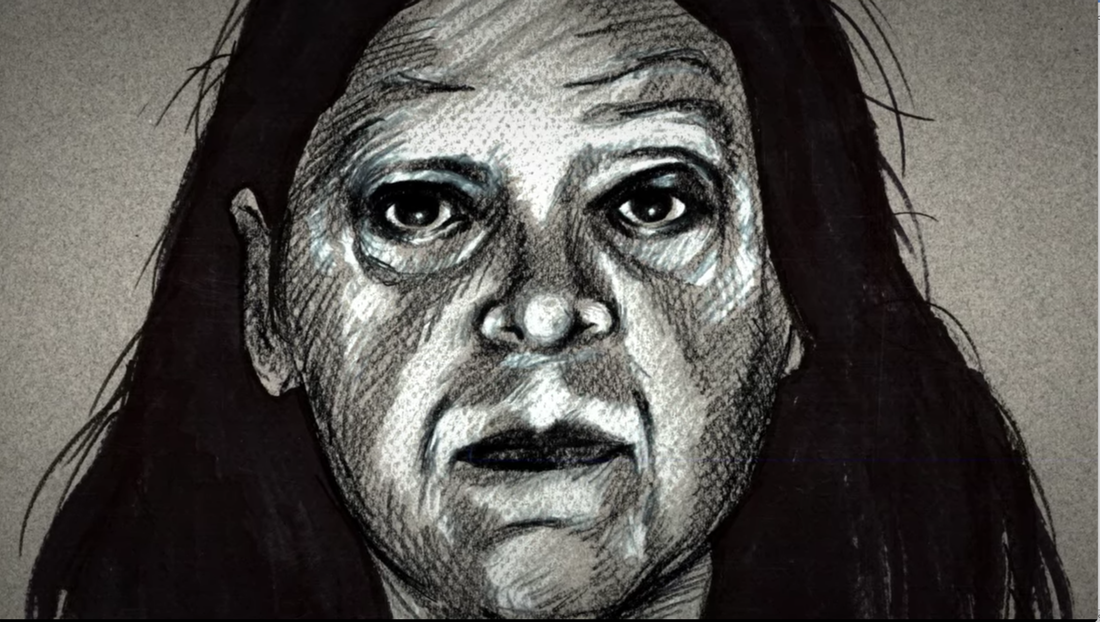
It’s been awhile since I have watched Evil Genius, but I flipped on the last episode to hear the part you referenced. The courtroom sketch artist described his interpretation of the defendant to the documentarian, saying:
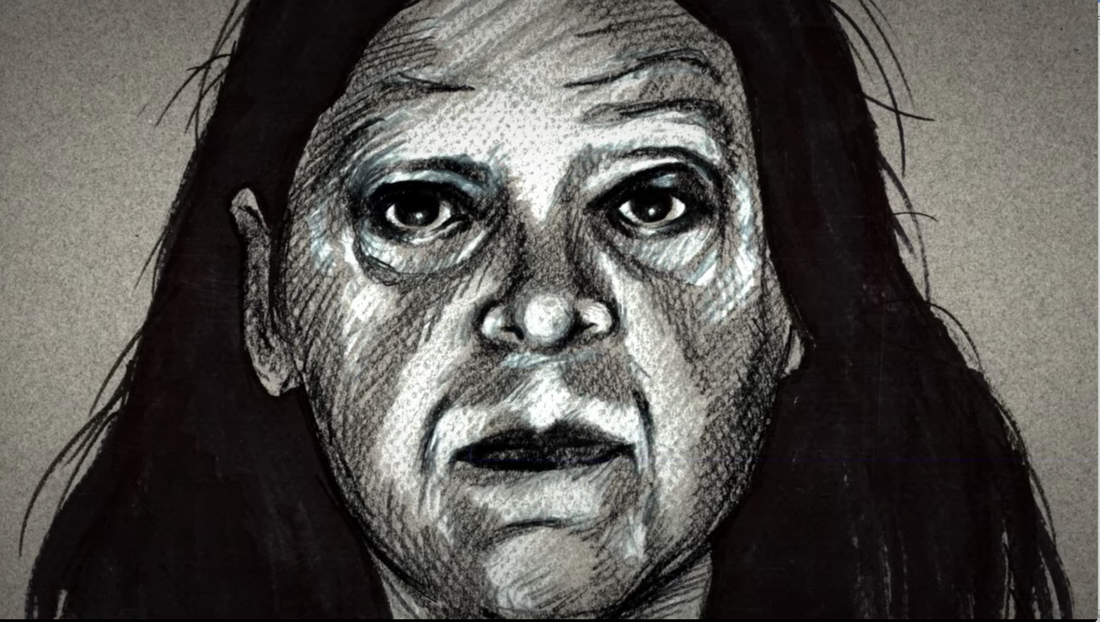
“Early in the case, I wanted to bring out the – for lack of a better word - the animal. I wanted to bring out the villain in my illustrations – dark tones, dark eyes, wild hair. After I see her mingling with you and some of the other people and being this charming character, I found myself today starting to soften the likeness that I’m illustrating of her.”
Here are two pictures, one of the artist’s “villain” rendering earlier in the trial:
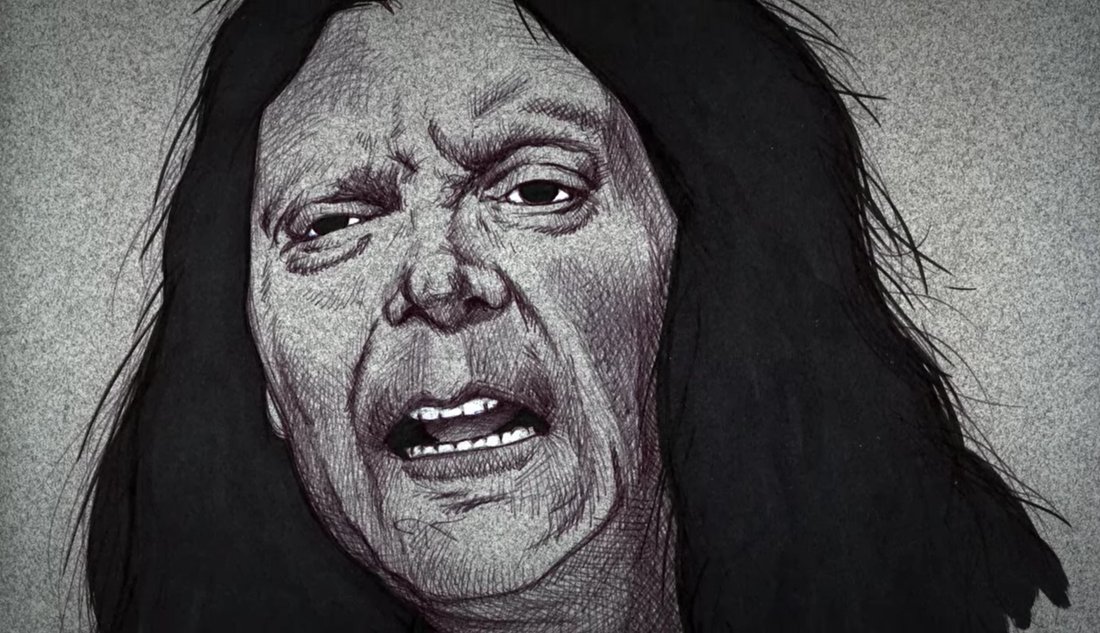
And one after he “softened” her likeness:
A HISTORY OF ALLOWING CAMERAS IN THE COURTROOM
The 1935 trial of Richard “Bruno” Hauptmann for the Lindburgh kidnapping drew tons of media scrutiny. Cameramen were climbing on the lawyers’ tables and blinding jury members and witnesses with their flashbulbs. In response to the chaos, the American Bar Association adopted a rule that banned cameras from courtrooms just two years later.
Federal Rule of Criminal Procedure adopted in 1946 later mandated that: “The court must not permit the taking of photographs in the courtroom during judicial proceedings or the broadcasting of judicial proceedings from the courtroom.” Then in 1972, the national policy-making body for the federal courts known as the Judicial Conference of the United States, adopted a prohibition against “broadcasting, televising, recording, or taking photographs in the courtroom and areas immediately adjacent thereto.”
In the 1960s, the state of Texas ignored the ABA’s rules and allowed cameras in the courtroom, but that was only for state-level proceedings. That didn’t go so well, and the Supreme Court actually overturned a Texas criminal conviction based on excessive media coverage of the trial in the decision Estes v. Texas, 381 U.S. 532 (1965).
In 1981, the unanimous Supreme Court decision, Chandler v. Florida, 449 U.S. 560, didn’t go so far as to mandate cameras in the court room, but paved the way for state courts to allow cameras during proceedings.
As of 2006, all 50 states allow for some type of camera in the court. There have been some changes made regarding civil cases in federal courts, as well as naturalization and other ceremonial events. But to this day, photographs and video cameras are prohibited in federal criminal trials in federal district courts.
The crime at issue in Evil Genius is bank robbery, which falls under federal criminal jurisdiction. This is why they needed a courtroom sketch artist to document the proceedings.
WHY DO WE NEED SKETCH ARTISTS?
When cameras are banned from court, the public and the media rely on courtroom sketch artists to capture a visual representation of what happened. There is no prohibition on sketch artists in the courtroom. Some may be treated as members of the press and required to sit in a specific area of the courtroom. Others may be treated like regular spectators.
While every artist’s process varies, many make rough sketches at the time of the court proceeding and make notes of details. Then they later finalize the sketches before selling them either to newspapers or TV stations.
You are right, Alex – a camera would be a more objective documentation of the proceeding. The pros and cons of cameras in the courtroom have been debated for decades. While some argue that it offers greater access to justice and accessibility, others say it can be a distraction and result in an unfair trial for the defendants.
Different constitutional factors are at play – while the First Amendment guarantees a free press, it doesn’t guarantee that press can send cameras anywhere. Justice Earl Warren reasoned in the Estes case that, as long as the press could send in reporters to write down what was happening, their First Amendment rights were not infringed upon.
Similarly, the constitutional due process rights of the accused should be protected. The court in the Chandler case held that a state allowing cameras in the court room does not necessarily infringe on a defendant’s constitutional rights so long as the allowance does not infringe on “fundamental guarantees” under the constitution. For instance, a state would have to hear arguments from a defendant on why cameras may bias the jury or deprive him of some other right.
You make a good point that a camera is objective. The Evil Genius sketch artist admitted that he let his emotions color his interpretation of the defendant. At the same time, doesn’t that somewhat represent how she looked? If, at first, she was rougher and more aggressive, but over time became more likable, then he captured what she “really” looked like, maybe even better than a camera. But either way, cameras weren’t allowed since it was federal district court, so his interpretation is all we have.
WHAT DOES THE STENOGRAPHER PRODUCE ON THAT BABY KEYBOARD?
Exact transcripts of a trial. How do they do it? No clue. I have been recorded by a stenographer in open court (who repeatedly asked me to slow down). I also just watched five videos on YouTube. I am still struggling to explain just how they do it. I know they use their baby keyboards to record everything that is said, word-for-word, and do it at 200+ words per minute, which is incredible.
They do it using a special keyboard that is laid out as such:

They can also add in custom dictionaries – almost like iPhone keyboard shortcuts – where a quick letter combo brings up an often-used phrase in court so they can easily keep up with the proceedings.
Here are some examples:
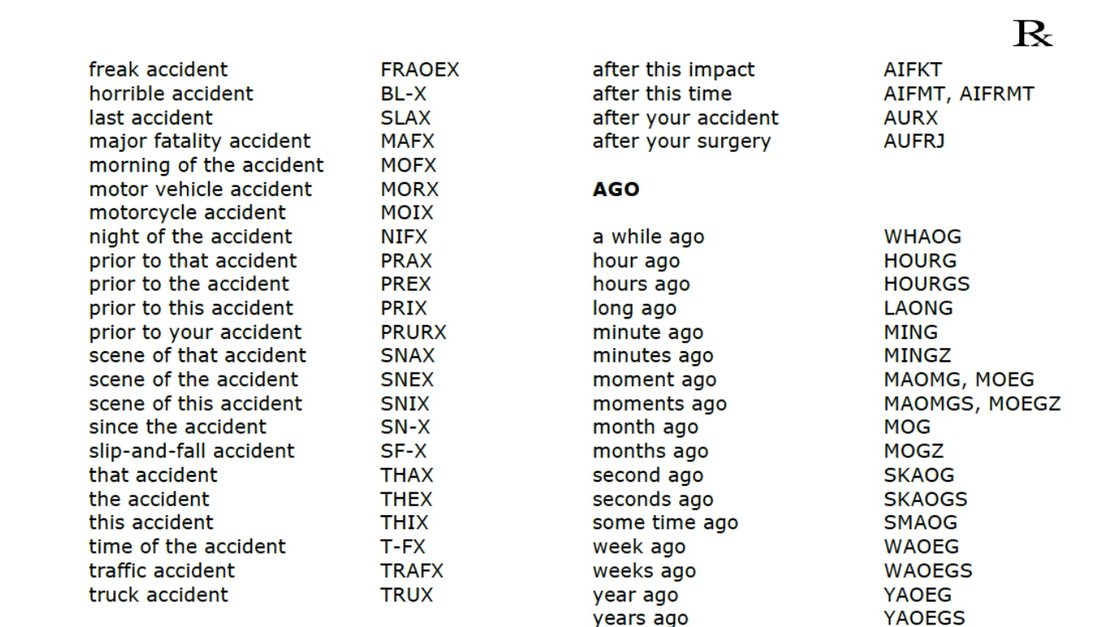
Using their fancy little keyboards and a connected laptop, court reporters produce a clear transcript of proceedings, delineating between speakers and obtaining clarification when needed. They are more accurate than voice-to-text software and provide human cognition that computers just can’t compete with.
They do an incredible service along with sketch artists. Without them, we wouldn’t have records of important proceedings like the ones on display here at the Library of Congress.
I hope that answers your question, Alex!
Got a question? Submit it here. They can be legal what-if questions, questions on current events, or questions about the legality of actions in TV shows or movies you’ve seen. I never ever want to answer your personal legal questions, so don't send those. Love you, but I don’t do that.
***
This piece first appeared in Sunday Morning Hot Tea. Subscribe so you don’t miss another piece.

Legal Question: Your Honor, I’ve Got to GO
This week’s question is from Frank via the form. Frank asks:
What does a lawyer do if they have to take a dump during a hearing? Like what options do you have to call for a recess so you don’t soil yourself?
Great question, Frank! I just had a hearing in Hood county this week. Luckily it only lasted about 20 minutes, so I was able to make it through with no need to slip out for a dump. However, as a person who constantly has to go to the bathroom, this thought has crossed my mind a lot. A LOT.
My initial instinct would be that you simply ask the judge, “Your honor, may we have a short recess?” This should work, unless the judge is frustrated or doesn’t quite understand what you’re getting at.
Not wanting to lead you all astray, I decided to consult with an expert, Julie Aguilar. Julie is a family law attorney and regularly tries cases. I go to Julie for all my family law questions or any time someone asks me for a referral to a family law attorney.
Today I had to audacity to ask this D Magazine Best Lawyers Under 40 honoree just what one does when a turtle head starts poking out during a hearing. She obliged because she is infinitely patient and wonderful. She said that my “May we have a short recess?” idea should work. But, she suggested, if the request for a recess didn’t work, an attorney could then ask the judge for a quick side bar to discuss “an urgent matter.” At that point, you would tell the judge that nature was calling.
I asked another excellent litigator I know, Ian Ross Phillips, the same thing. He confirmed that asking for a recess should work. Attorneys could also discuss scheduled bathroom breaks with the judge and opposing counsel before the jury was brought in. That way the breaks could be at convenient times like after a witness has been questioned or before the witness is cross-examined by the opposing side.
Phillips also said that jurors are normally instructed to alert the bailiff with a note or signal if they need to use the restroom during proceedings.
God bless friends who answer late night texts like “What if you have to poop in trial???” Love you guys.
WHEN GOING TO THE BATHROOM GOES WRONG
Whether to go on recess is up to the judge’s discretion, but denying a party access to a jury trial simply because a lawyer was squatting a grumpy down the hall is an abuse of discretion.
An attorney in Texas had an unfortunately-timed bathroom break in 2018. The suit at issue was a custody battle where a grandmother, having lost her daughter to cancer, was fighting for the right to see her grandchildren. The case was set for a pre-trial conference at which the attorneys and all parties were scheduled to appear before a judge at 9:00am.
The notice of pre-trial conference informed the parties that failure to appear would constitute a waiver of a party’s request for a jury trial. This means if they missed the meeting with the judge, the grandmother would lose the chance to have her case heard by a jury.
What happened next is the stuff of my nightmares as a lawyer.
The grandmother’s lawyer answered the docket call at 9:00 am. This means he went in and informed the court coordinator that he was there. He then left the room, and accounts vary whether he went to the bathroom or to another court room. He then came back at 9:25 and let them know he had returned. He left again at 9:35, telling opposing counsel and the coordinator that he had to go to the bathroom. The coordinator told him, “Hurry up.”
He didn’t hurry up enough for the judge’s liking. The judge called the case at 9:39am, just four minutes later, while the lawyer was still out launching his sea pickle. Four minutes is definitely not enough time to get any bathroom business done, let me tell you.
Nonetheless, the judge marked down with the coordinator that neither the lawyer nor his client appeared. The judge considered this momentary absence as “not appearing” and set the case for a non-jury trial. The lawyer’s morning constitutional lasted around ten minutes, and he returned to the court at 9:50am, horrified to learn he had missed the conference.
The lawyer asked the court to reconsider several times, but it refused. The lawyer was forced to file for mandamus relief on his client’s behalf. Mandamus is when you ask a higher court to look at a case and require a lower court judge to do something they are obligated to do. To obtain mandamus relief, a person must show both that the trial court clearly abused its discretion and that the person has no adequate remedy at law, such as an appeal.
The Fourteenth Court of Appeals took up the request for mandamus and determined that the judge’s removal of the case from the jury docket was an abuse of discretion. It was over a year before the lawyer finally got relief for his client. That didn’t take the sting away from him. He told the ABA Journal, “I could have died of embarrassment reading the opinion. But I cannot afford to dwell on it. Instead, I will take advice given by my late grandmother: ‘Pick up the pieces, and move on.’”
Here’s a piece of advice from my mom, “Go to the bathroom before you leave.”
Great question, Frank!
Got a question? Submit it here. They can be legal what-if questions, questions on current events, or questions about the legality of actions in TV shows or movies you’ve seen. I never ever want to answer your personal legal questions, so don't send those. Love you, but I don’t do that.
***
This piece first appeared in Sunday Morning Hot Tea. Subscribe so you don’t miss another piece.