

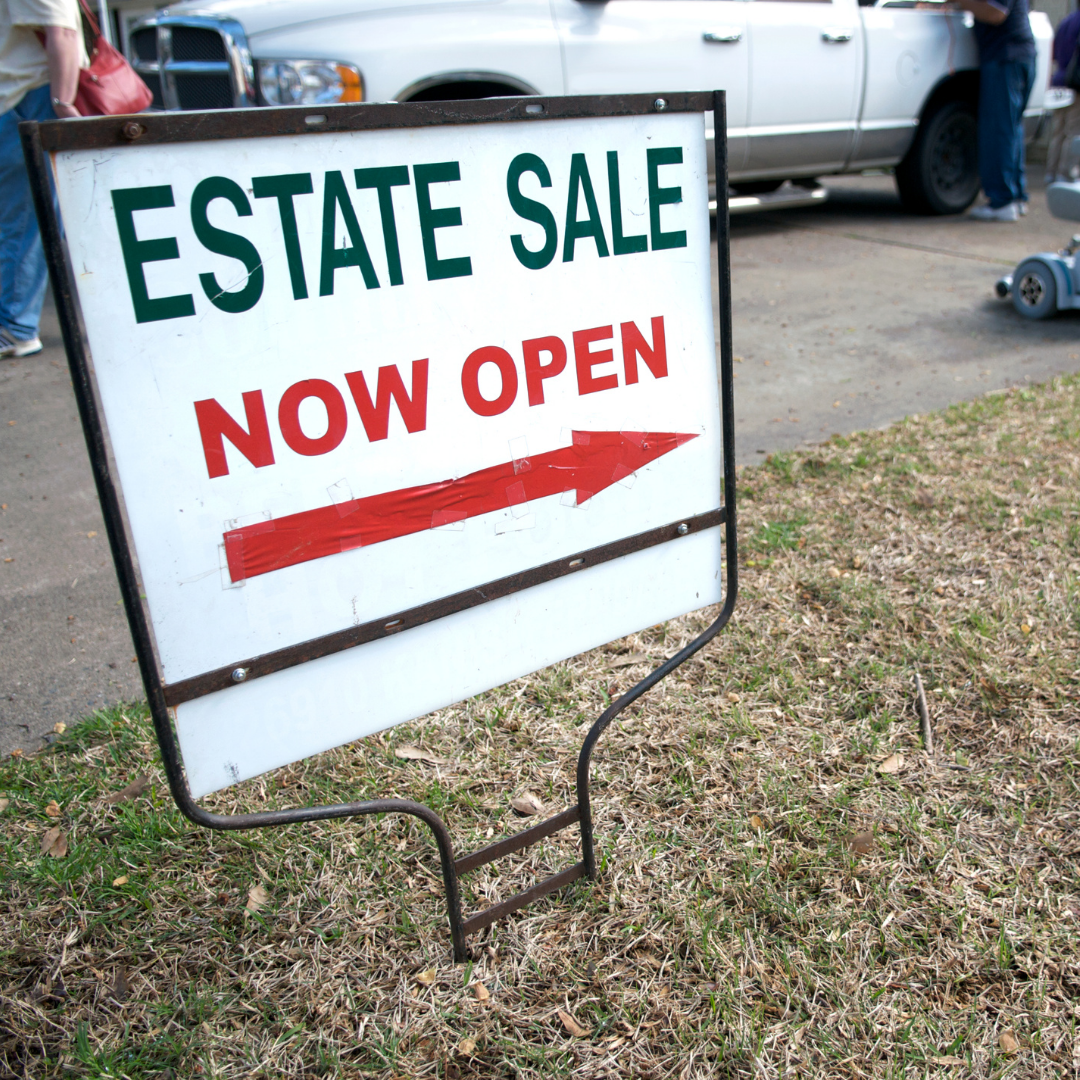
Fire Sale on a Life Well Lived
One of the best parts about working for myself is doing things at off-hours. Going to the grocery store, for instance, is much less stressful during the day when you’re only there with stay-at-home parents, retired folks, and Instacart shoppers. In that relaxed state, not having to rush around the after-fivers in their rolled-up button-downs and pinching heels, I can shop thoughtfully. On my last trip, I bought hopeful things like spinach and fresh raspberries and gluten free organic granola. Choices that said to the world, “I care about what goes into my body.”
I loaded the groceries into my car and headed home. About five minutes before getting to my house, I saw a bright yellow sign with the black outline of a cartoon finger pointing down a street well out of my way. It read “ESTATE SALE – THIS WAY,” as if it were offering me directions I didn’t know I had been waiting for. I wanted to turn toward the sign, but I had a momentary flood of doubt, the stuff that keeps me from acting on my every whim and impulse. A lesson learned over time.
“Silly child, you don’t need anything from an estate sale,” I thought to myself and kept driving.
“The fuck I don’t,” I thought, as I whipped a U-turn in a nearby circle drive to turn back toward the sign.
I followed the cartoon finger down a long stretch of street into a neighborhood I never knew existed. I’d passed the turn to enter this subdivision a thousand times before, but I had never made the turn to head inside. I drove so long that I started to lose hope, thinking I’d missed the sign directing me where to turn next. Then I saw another yellow sign, and yet another, beckoning me to hang a left, then a right.
When I was a kid, my mom and her best friend, Lillian, would sometimes take me to estate sales. Garage sales were always a childhood staple – we both hosted them and stopped at them, browsing yards full of random this-and-thats. But a garage sale feels different than an estate sale. The host of a garage sale has the autonomy to say, “I do not want this anymore.” Whereas an estate sale is made up of stuff someone wanted and would have liked to keep had they not, you know, died.
This estate sale was at a brick ranch house set off from the street by a curved walkway. At least a dozen cars were parked on either side of the street in both directions. Two other cars pulled in at the same time as me. I was nearly side-swiped by one of them, an older model Honda Civic which, judging by the car’s speed and proximity to my side mirror, was operated by Vin Diesel. The other was a larger black sedan that double-parked and engaged its hazard lights.
The Honda’s door opened, and a thick-necked man with thick dark hair stepped out, adjusting his t-shirt as he raced me to the door. An older gentleman stepped out of the black sedan carrying a large brown shopping bag with a receipt stapled to the exterior. The three of us were met at the home’s front door by a young woman with a mess of sandy curls wearing a t-shirt printed with the logo of the estate liquidation company.
“Uber?” she said to the three of us, and the older man obliged by holding the bag forward.
“I think you’re waiting for me,” he said. I got a whiff of the bag – fried chicken and fresh bread and hot wing sauce.
Honda Vin Diesel and I followed the woman inside the home, crossing the elevated threshold marked with yellow caution tape. I turned left into the dining room, carpeted with thick pink tread, and began to root through some stranger’s life.
A low-hanging chandelier in the center of the dining room was draped with more caution tape. The dining table had been shoved flush against one wall, serving as a makeshift display. every inch of the six-person table was covered with this impressive set of dishes – over a hundred pieces, easily – all matching and painted with a dusty pink and green floral pattern.
In the center, someone had propped up a faded booklet that featured photos of the dish set. A sort of dish manual, I suppose, though I am not sure what could necessitate over two dozen pages on dish use and maintenance. My instructions for dishes consist of: “Put food on dish, eat food off dish, clean dish, repeat.” Sometimes I even skip a step or two. The previous owner clearly followed the manual because, though the dishes were old, they were in great shape. I could tell they were her good dishes, the kind that you only break out for important company.
I moved past a pile of warped plastic tubs labeled VINTAGE TUPPERWARE - $3 and into the kitchen which looked frozen in time. The double oven was copper colored with a manual dial, labeled in a font that belonged in the Nixon administration. The Vent-a-Hood was also copper, with a scalloped edge that would have fit seamlessly in an old issue of Better Homes and Gardens Magazine.
The estate liquidation company had posted helpful signs around, listing the prices for various items: dishes - $2 each, cups - $3. I noted the handwritten $5 price tag on a special microwave bundt pan, accompanied by its manual in mint condition that read – “Optimized for the Microwave Chef.” I felt very seen. I am not much of a chef in the conventional sense. Aside from the occasional bag of burnt popcorn – which I agree with you, should be punishable by a day in the stocks – I can make just about anything in the microwave. Now that I know “Microwave Chef” is an available title, I know what to call myself.
I passed a set of commemorative glasses from the 1962 Seattle World’s Fair, then stopped to read a wooden plaque hanging from a cabinet knob. It read, “Being a mother is the most important job, but being a grandmother is the most fun.” Someone had tagged it with a small white sticker marked $3.
I made my way into the living room which was carpeted in the same thick pink polyester as the dining area. The fireplace hearth was blocked by a card table. On its left side, the liquidation company had set out black velvet boxes to display this grandmother’s jewelry. A glass cabinet behind the boxes held, I guessed, more valuable items like newer model cameras. On the right side of the table was a full-size professional cash register manned by a dark haired woman in her late twenties, wearing the same t-shirt as the woman who had answered the door.
I passed to the other side of the living room and browsed a wall-length built-in bookshelf. It was half-full of recipe books – both professionally published and typed at home on a typewriter – and half-full of medical books. Gray’s Anatomy. A medical encyclopedia. I flipped through some pages and saw the previous owners’ names – I’ll call him Bob and her Betty – stamped inside each inside volume.
I wondered if Bob had been a doctor or, like me, just curious about diseases. I found an orange tome as thick as a phone book titled, Basic Human Physiology: Normal Function and Mechanisms of Disease. Bob had highlighted, annotated, and circled multiple sections of the chapter on “Body Fluids and the Kidney.” The notes made me think he really understood what he was studying. When I flipped to the page titled, “Radiation Hazards in Space,” I slipped the book under my arm and continued browsing.
When I turned around, I noticed for the first time the taxidermy fish mounted on the living room wall. It was shiny and had its head turned, facing me, and keeping watch over a rifle sitting on the coffee table. A framed painting of birds in the forest hung on the wall perpendicular to the fish, above the head of the woman from the entryway who had taken delivery of the hot wings. Her takeout container was lying open just inches from the rifle, while she sat leaned back, licking sauce from her fingers on Bob and Betty’s sofa.
It occurred to me that, wherever she was, Betty probably did not allow eating in the living room. Based on the pristine condition of nearly everything in the kitchen, dining room, and living room, I imagined she would have especially not allowed eating hot wings on her sofa. But, then again, Betty wasn’t there.
I headed out toward the garage, stopping for a moment in the laundry room. Above the washer and dryer on some shelves, I saw an empty glass Dr Pepper bottle printed with an image of 1970s Dallas Cowboys legend, Roger Staubach. A collectors’ item in Bob’s eyes, surely, now labeled with a handwritten white sticker - $5.
Down the stairs and out the garage door, I was met with long tables that covered the entirety of the garage. The liquidators lined each table with box after box of screws, nails, hinges, and general garage items. I passed those to head toward the driveway, my eyes firmly affixed to a giant black leather trunk with a gold buckle. It was enormous, and my first instinct was to buy it right away. Then I tried imagining any possible spot for it in my house.
Finding none, I left the trunk behind and moved past four wooden schoolhouse chairs toward a stack of boxes, nearly as tall as me. Their initial function, based on the letters printed on the side, was to ship school yearbooks. Someone had written on the sides in black Sharpie, “PICKLE JARS,” which made sense in context with the nearby open box of various empty glass jars, ready to be filled with jams, jellies, and preserves.
There was a man behind the stack of pickle jar boxes. He lifted the trucker hat off his head and ran a hand over his sweaty head. He was older than me, maybe in his late 50s, with a thick gray beard.
“Can I help you?” he asked.
It wasn’t said in the chipper tone of an eager salesman. He wasn’t dressed like the liquidation company employees, either. He wore a black t-shirt stretched over his belly with red print reading “Stranger Things” from the Netflix show. It also looked to me like he was surveying the people themselves, rather than the objects. I wondered if he knew Betty and Bob, or at least, used to know them.
“I’m just wandering,” I said. I clutched my book to my chest, feeling suddenly guilty, like a vulture pilfering what was left of this man’s childhood home.
“We don’t sell needs here, you know,” he said, walking closer. “We sell wants.”
“That’s good,” I said. “Since I really want this book.” I held the book out, showing him the title.
“Mechanisms of Disease,” he read from the cover. “Humanity is a disease.”
“I hear you, brother,” I said, putting on a thicker than usually Texan twang. What I said was technically true, anyway. I had heard him.
I walked away from him, toward the shelves labeled CHEMICALS (VARIOUS) - $3. On my way back inside, I saw a rack of Bob’s hunting jackets – thick canvas pieces, printed with camouflage. Under the rack, someone had dumped all his bright orange knit caps, the kind hunters wear to avoid shooting each other, into a cardboard box. I wondered for a moment if Bob had been killed in a hunting accident, but figured, based on the state of the world we are in, probably not. Based on the sheer age of the items, it didn’t seem like he had been an active hunter, anyway, but was, instead, someone who had hunted – past tense.
I had a similar thought when I entered a nook, only slightly larger than a closet, adjacent to the living room. I found his photography equipment, laid out on the desktop beneath a mounted bookshelf. It was filled, rows and rows, with travel books. The pages lush with landscapes – Hawaii, Greece, Indonesia. Had he gone to these places? Taken his own photos there? Or just dreamed about it?
Some of the cameras had been used, their shutter buttons worn. Others stayed in dusty boxes, their technology long since obsolete. The optimism of a new purchase unfulfilled. What photos he must of imagined taking on those new cameras. What must have stopped him.
Rounding a corner to enter a spare bedroom, I was met with former president John F. Kennedy’s enormous face, framed in gold, propped up against a wall beside some empty suitcases, winter coats, and a brand new “Wedding Photos” album, still in its shrink wrap.
I moved on to the next door way. Pink tile clung to the walls in the guest bathroom, where rows and rows of old toiletries – like make-up and cologne – covered the countertop.
Who buys used cologne? I thought as a pair of women entered and began reading labels and sniffing a bottle marked Racquet Club for Men.
In the next spare bedroom, I found a porcelain jewelry box painted with the word “Grandmother” above a mushy messaged you would find inside any drug store greeting card. Beside the box, there was an open leather suitcase had a handle worn down to the tan underneath. It was propped open, with a folded Army uniform inside.
The rest of the room had all the makings of a spare bedroom/junk room. Unused printable labels still in their package. An old brown Swingline stapler. A pair of silver flashlights. An ancient clipboard. As I walked out, I passed a little boy’s baseball uniform with the word “Eagles” hand-stitched across the front.
When I reached the main bedroom, I saw that the woman of the house had quite a shoe collection. In addition to the 15 pairs hanging behind the closet door, there was another half-dozen pairs in plastic containers sitting on the top shelf. I could tell from the clothes on the hangers and the size of the shoes that she had been itty bitty, a waif of a thing, whose gloves could have been mistaken for those of a child.
In the otherwise middle-class elegant bedroom, with wood furniture and sensible drapes, I struggled to make sense of the lamp.
It stood nearly a foot tall on top of the dresser beside the mirror. It had a tan metal base and an opaque glass shade printed with the bisected head of an elephant. In yellow letters, it said “ZOO FREAK” with “KZEW 98 FM” printed smaller in black font along the bottom. The print above “ZOO FREAK” touted that this lamp was a “Collector’s Edition.” This led me to wonder: (a) what collector? and (b) were their other editions of this lamp?
How did Bob and Betty end up with this lamp? Did he insist on its place in the bedroom, the start of an argument that would linger as a lifelong ace up her sleeve she could use any time the subject of taste came up?
“Oh really, Bob? You think that would look good, like the zoo lamp?”
“I’ve told you, that lamp is a collector’s edition!”
Or did Betty so love her husband – radio station lamp and all – that she kept the lamp there long after he was gone?
So often things that drive us crazy when a person is around come to be some of the very things we miss the most about them. I wasn’t fully certain about all of their quirks, but I started to miss them.
When I wandered into their den and found a pile of board games, I missed them even more. A game of Clue, marked © 1956, caught my eye. I opened the box and found the pad of Detective’s Notes, scribbled with page after page of pencil marks, chronicling all the games they had played over the years. I closed up the box and put it back in its place, on top of Parcheesi and Battleship, and headed back into the living room to check out.
As I approached, the woman behind the register was absolutely destroying a piece of Texas toast. I took my time browsing Betty’s jewelry to let the woman finish her bite. Then I began looking in the small glass cabinet. I spotted a tiny gun inside the case, formerly a toy, I thought, but by then was missing so many parts it could only serve as a paper weight. I hated to bother the woman, but I wanted that gun. She handed it to me and I turned over my cash before leaving with my wants.
I looked around one last time at the things left behind. Stuff that would be discounted deeper and deeper each day as the weekend ticked by. The things over the years that they had bought and used and packed away, now on their way to future lives in new homes.
For a quick second, I felt bad for Betty and Bob, their lives on sale like this. But then I thought better of it. They didn’t sell needs there after all. They sold wants. At various times in their lives, all of this was exactly what they wanted – the Racquet Club cologne, the microwave bundt pan, the KZEW lamp. They wanted those things at one point or another, and for so many years, they got exactly that.
***
This piece first appeared in Sunday Morning Hot Tea. Subscribe so you don’t miss another piece.
Mall Madness
(When I was a kid, maybe nine years old, I remember sitting at home with my mom on a Saturday night, waiting to drive back up to our local mall and pick up my sister, Shannon, at closing time. She was around 15 then, outfitted with a pager my mom bought for her at that very mall. It was a simple model. You would call a number, then the pager would beep, notifying her of what number to call back. The pager was enclosed in an opaque, dark purple case and affixed to the belt loop of her Levi’s with a gold chain.
My mom and I had dropped Shannon and her friend, Laura, off at the Foley’s a few hours before. Foley’s, the now defunct department store chain, was my family’s standard mall meeting point. If we got dropped off, it was at the Foley’s. If we were to be picked up? Foley’s. Lost in the mall and couldn’t find each other? Meet at the Foley’s, specifically on the sofas right by the glass doors. This wasn’t due to any brand loyalty on our part. In fact, mama always said Foley’s was “too rich for our blood.” It was sheer convenience. Foley’s was situated on the back side of Town East Mall, meaning you could avoid the highway access road to get there.
That fateful night, we returned to Foley’s to pick up Shannon and Laura only to find them in hysterics. Some boys Laura tried picking up had stolen Shannon’s pager. They hadn’t stolen it from Shannon’s body, however. She had let Laura wear it, I suppose so that Laura could look cool in that certain way that only a pager can accomplish. But Laura’s canoodling proved dangerous and the pager was snatched away, never to be recovered. It turned out that the gold chain was no match for the clutches of a determined teenage boy.
Town East Mall was the center point of our suburban town back then. Erected in 1971, the mall was anchored by four stores. Sanger-Harris, later turned Foley’s, is currently a Macy’s. Years’ worth of my back-to-school clothes were purchased at another of the anchor stores, JC Penney.
Extremely fancy clothes like prom dresses and bridesmaids’ dresses were procured from down the way at the more upscale Dillard’s (formerly Tiche-Gottinger then Joske’s). Sears has stood stalwart since the beginning, but like hundreds of other locations across the country, it is set to close up shop in April 2021.
The thing about growing up a suburban kid is the mall becomes your be-all, end-all. It is a place that contains not just stores, but the hope and belief that something lies inside that is just what you need. That something waiting for you has the possibility to change your life. What is that thing? Doesn’t matter. That’s the mall’s magic. The perfect thing could be in there. You just have to go in and find out.
Just thinking of the baby-bottle-lighthouse affixed on our hometown shopping center’s roof jostles loose an avalanche of formative memories for me.
I feel like that descriptor requires photographic evidence for you non-Mesquitians.
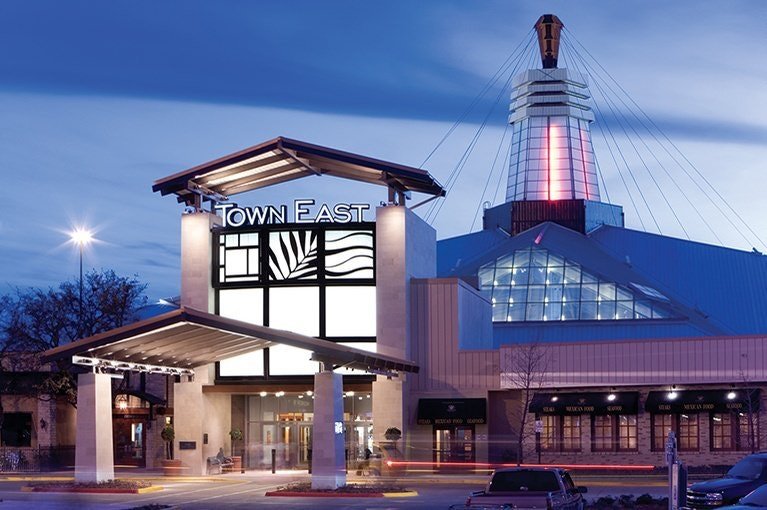
That looks like a straight up baby bottle, right?
My family got our first cell phone from a Cingular kiosk right outside the Foley’s. I believe having said that sentence, I now qualify for the senior breakfast special at Denny’s. I used to walk the aisles of KB Toys, craving a new board game or action figure or Barbie doll. I filled cellophane bags full of treats at The Sweet Factory. I got the clothes for my first ever grown-up job from the women’s section at JC Penney. I had some arguably too glamorous Glamour Shots taken for a friend’s birthday party outside the Sears.
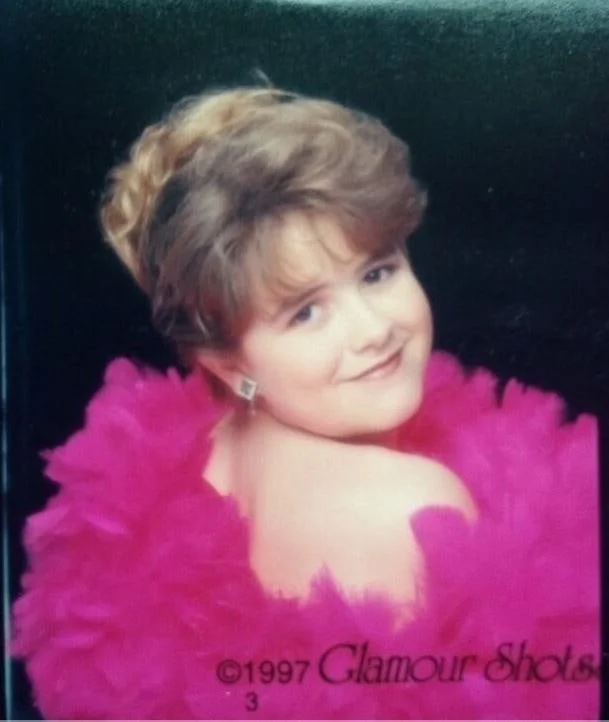
This photo alone was the cause of Glamour Shots’ shuttering its doors.
Sure, my mall nostalgia may be turned up to 11 with the isolation from COVID, but I also think I’m not off the mark. Online shopping is great, don’t get me wrong. I love being able to Google something as specific as “Zack Morris divinity candle” and within days, have that same item arrive at my house. But the intrinsic value of a mall is that I shouldn’t have to Google that in the first place. I should be able to walk into a Spencer’s Gifts, and it should be there, waiting for me, beckoning me to buy it.
On the flip side, I will concede that malls are also breeding grounds for filthy teenagers making out, smoking cigarettes, doing petty crime. But that’s what gives us* the grit to become responsible adults.
* It feels disingenuous not to correct your thinking that I’ve done any of those things. To be clear: I have never made out, smoked a cigarette, or done a petty crime at a mall. This is not because I am better than anyone. It’s just that I currently am and always have been a big ol’ chicken shit scared of getting busted. But think of all the rebellious things I could have done! The mall gave me that chance. It was I who squandered it.
The original creator of malls, store designer and architect Victor David Gruen, saw the mall’s potential as a fully operational center point for the rising suburban communities. More than just stores, Gruen’s invention was to be the “third place” for many suburbanites. If home was first and work was second, then the mall could be that third place where families spent time away from the house, but not in the city.
Across many towns, that third place is now dead.
An entire genre of YouTubers has emerged around “dead malls.” A sub-genre of urban exploration, “dead mall” vloggers show the decrepit remains of long-abandoned malls, often interspersed with archival footage showing the malls in all their former glory.
This devolution was seemingly inevitable. What Gruen initially intended as an indoor oasis became overrun by commerce. Where his first mall in Edina, Minnesota included a bird sanctuary and a green space, later malls that sprung up in its wake included, rather than birds, Sbarro’s, Auntie Anne’s, and Cinnabon.
The Slamdance film Jasper Mall covers a year in the life of the titular shopping center in Jasper, Alabama. The town is home to just over 14,000 residents, many of whom use the mall as a sort of community center.
Seniors show up right as the doors are unlocked, walking shoes laced up, ready to make their loops. A foursome of septuagenarians gathers around a food court table, not to enjoy a quick bite, but to play dominoes and socialize for hours. In the introductory moments of the movie, the security guard/mall manager/jack of all trades, Mike, mentions that he lets the city’s homeless population in during cold winter months to protect them from the elements.
Malls have been on a steady decline over the past few years, a trend that has been exacerbated by COVID. But much like Gruen’s initial vision, malls across the country have begun trending back toward their community-centered roots. The emptied-out anchor space in Jasper that sat idle since 2017 is now home to a worship center, kid’s play place, and private school. One mall in Gwinnett, Georgia has utilized empty retail space to conduct mass COVID vaccinations, and it’s not the only one. Where once you tried on the latest pair of Reebok’s or sniffed CK-One from rectangular sample cards, soon you will be able receive your COVID vaccine.
The over-saturation of malls that began in the late 1970s and eventually tapered off in the late 1990s may have been the mall’s downfall. In Dallas, for instance, Valley View Mall’s traffic was significantly diminished when the Galleria was built less than a mile away. Updated and sleek, the Galleria sucked major brands away from Valley View, leaving the older mall to suck in its final dying gasps these past few years. Corridor by corridor have found themselves on the business end of a bulldozer.
Maybe I’ve just been cooped up for too long. Maybe I’m drunk on nostalgia and fuzzy feelings. But I fear that the loss of malls means the death of a major American institution that has powered suburban commerce for the past seven decades. Plus, where else am I supposed to get my Dippin’ Dots?
From the looks of things, the mall of my youth isn’t a total loss cause. In the past few years, Town East has received interest from some big retailers, with Dick’s Sporting Goods moving in as another anchor in 2018. Even with that, the old gray mall just ain’t what she used to be. She isn’t ghastly or gutted enough to find herself on a “dead mall” video, but neither is she beautiful or bountiful enough to be featured on a shopping vlogger’s channel. But still she stands, right where I remember her, doors open, ready for our return.
***
This piece first appeared in Sunday Morning Hot Tea. Subscribe so you don’t miss another piece.