

The Gospel According to Bieber
Mid-morning on a Tuesday, I am sitting in Well Grounded Coffee trying to get my morning pages done. At once, I am surrounded on all sides by people. The first is a man in his mid-40s, taking a seat at a table just to my right. He opens his laptop and starts typing on a corporate messaging app. In short order, he has minimized the app and is now hosting a full-blown meeting via video chat. To his credit, he has headphones in, but that doesn’t do much for the rest of us who can hear his half of the meeting.
At the counter, an older gentleman has pulled out his phone while waiting for his coffee. He dials a number, and the ring bursts from his speaker. A woman answers. This guy is easily in his mid-70s, and the woman who has answered on the other end sounds both young and interested in his call. From the sounds of their voices, she is probably his daughter. He begins by telling her all the latest medical procedures he has undergone. Then he follows up with news of the recent “gully washer” that we had all endured the night before.
“How about all that lightning waking us up last night?” the corporate guy says to his meeting attendees.
“It hasn’t rained that hard in months,” the older man says.
They are each having two sides of the same conversation.
A third man stands up from his tall stool, laptop propped beside a wall.
“Hello, this is Dave,” he says into the microphone of his headset.
Aren’t I in a public place? I think. Not wanting to give up my primo writing spot before finishing my coffee or my pages, I put in my earbuds to drown them all out.
The playlist I choose? All Bieber.
I was not born a Belieber. I am a recent convert. Like many adults who join a religion later in life, I converted after attending a particularly moving service. In this case, it was Bieber’s one night in Dallas on his current JUSTICE tour.
Also like many religions, I was brought to the faith by a friend. Christie has been a Belieber since his documentary was in theaters. I had always heard his songs on the radio, but never dived in much further than that.
It was a warm Sunday night in early May when I joined the congregation. Walking from a nearby Tex-Mex restaurant in Victory Park, Christie and I approach the front steps to the American Airlines Center.
At the bottom of the steps, we are greeted by a group of people ranging from their mid-20s to mid-40s, standing in a semi-circle. If one of them wasn’t holding a sign warning us about hell and the other wasn’t commanding me to repent via a handheld bullhorn, I might have thought they were there to see the show. Or maybe to drop their kids off to see the show. But no, they aren’t dropping off any son. They are here on behalf of the Son - or at least they claim to be.
“The Bible is the word of God,” the man shouts through the bullhorn. It sounds harsher than what it could have had he just been speaking normally. I am no expert proselytizer, but I think he should maybe invest in a more updated sound system. Heck, a good portable karaoke machine would do the trick. The way his voice sounds coming through the bullhorn, it sounds like at any moment he may add to the end of his sentence like a drill sergeant, “You little maggots!”
“Do what pleases God,” he says, and my mind completes the sentence, “Then drop and give me twenty!”
We continue inside toward our seats. Coming from a quick stop in the bathroom, we can hear the audience screaming for JADEN - Jaden Smith, whose stage name on all the tour literature is written in all-caps.
Just a few minutes before Bieber is set to take the stage, we take our seats. The lights go out and some intro music begins. The crowd’s screams are the loudest sounds I’ve heard in my whole life and I once stood on a runway next to a departing B-29 bomber. Based on the preemptively titillated screams, I prepare myself for what I am assuming will be a pretty sexual show.
I settle back in my seat and stick my VIBES concert-specific earplugs in. Biebs is a one-man boy band after all. People (mostly women) in the audience concentrate the amount of energy normally reserved for four or five band members into just him. It’s a laser beam of devotion, the sound of which fills every one of the 1.4 million square feet of this building.
The lights have been out for a few moments, and there’s still no Bieb in sight. The crowd screams in darkness, louder and louder, until the lights go up. A video board spanning the width of the stage begins playing a video.
It’s Bieber. At the sight of his image, the impossibly loud screams somehow get louder. The video shows him in a field of grass, walking with arms outstretched. A voiceover - his own voice - narrates along with subtitles. The words sound like the platitudes you find on wooden signs at Hobby Lobby or under #quotes on Instagram.
“Life is hard,” he tells us in nearly a whisper. “It’s a lot of pressure on us every day. The world needs unity and hope. If you feel alone, just know - you are loved.”
If these words were coming from anyone else, I imagine at least a percentage of people in the audience would reject this saccharine mess. But it’s not anyone else. It’s Bieber. From his mouth, it’s gospel. Even with my own Bieb-ignorance, I feel sucked in.
Maybe it all will get better, I think.
Then the message shifts from general platitudes to specific encouragement.
“All we have to do is lean on our savior. God will protect us.”
Okay, that was unexpected, but it’s your show, buddy. We’re a captive audience. Preach on.
And he does.
What looks like a giant discarded pool toy on stage begins to move. It’s a deflated airplane that is now filling with air. Once full, it levitates in the air. The video screen goes dark. The hatch above the cockpit pops open, and there he is.
From our seats in the 300 section, Bieber seems tiny. A skinny man-boy in a red polo, black slacks, white sneakers, and a black fitted ball cap turned backwards. Part of his trademarked beautiful face is obscured by wraparound sunshades. He is wearing black leather gloves on both hands.
Without greeting the audience, he launches into “Somebody” off the album Justice for which the tour is named. Soon, the overt mentions of God from the video intro make tons of sense. The first line of the first song talks about thanking God. The next song promises that Heaven is a place not too far away. After that, he sings about praying that he doesn’t go back to who he once was. Song four is straight up called “Holy,” and he sings it with six giant neon-pink crosses behind him that look like a rave graveyard. A raveyard.
I should clarify, none of this is a criticism. Each song is one bop after another. I don’t even know these songs. I have never heard most of them, but I am dancing along, stomping my beer-soaked feet to the beat.
What gets me is each song, framed in religious imagery, is also real horny. For instance, “Holy” includes a tambourine percussion beat that would be at home in a gospel church rhythm section. Backed by a piano and full choir, this could be a Sunday morning service rather than a Sunday evening concert. At the start of the song, I wonder whether the love he sang of could be his love for God. Then I hear the words.
The way we love in the night gave me life.
I sure hope that’s not about God.
The lyrics make it clear that the subject is a girl, likely his wife, Hailee. They’re married, so from a strictly moral perspective, it’s fine if they make love in the night. From a musical perspective, it’s even better. You feel the song from head to toe — the percussion, the softness of his voice that dips into a deep wail. Soon my hands are up. I am singing along: On God, Running to the altar like a track star.
The music is working on all the people around us, too. The row of gal pals behind us has not stopped screaming since the show’s start. They have commented on his hot body. They have chugged their Truly cans and spilled their Bud Lights. One called out, “I am so fucked up, Briana!” She didn’t have to holler that. We already knew based on her loud, off-key scream-singing.
About halfway through the set, he begins giving an extemporaneous speech on race relations in the United States. It is the kind of speech you can tell right from the start does not yet have a middle or end.
“Our world right now is in a tough place,” he tells us. “Racism is a disease taking over our planet. We have to be the change makers. We have to step up and have those conversations with our friends and family.” I nod along with him. Somewhere behind me I hear a distinctly drunk female voice say, “Yessssss!” I am not sure if it’s Briana or the one who told Briana that she is fucked up.
I hope the “Yesss” is in response to his speech, but more likely Brianna handed her another Truly. After finishing his homily, he plays hit after hit, eventually removing his sunglasses.
“Oh my God,” the woman behind us says. “He took off his sunglasses. I was going to go to the bathroom but not now. Maybe he’ll take off his shirt next.”
If he did strip off that red polo, I think Briana and company would be disappointed. Based on what I have heard, he is certainly wearing a full priest collar underneath. It’s the only possibility. We wouldn’t see abs. We would see vestments.
Towards the end of the show, he plays his mega-hit “Baby” then leaves the stage. Moments later, to another round of deafening screams, he reemerges from beneath the stage floor playing a white piano. As he tinkles out a melody, he lets us know that if we’re having a hard time, we should know we are not alone.
“Things in the world are leaving us depressed. You guys aren’t alone. You’re not alone. Sometimes we feel like we’re the only people going through it. We look around, and it feels like everyone else has got it together. But this is just not true,” he says.
He plays more. Women scream. He tilts his head and puts his lip right up against the mic and whispers to us.
“There’s hope, you know, because God says he’s near to the broken-hearted. He’s near to the broken-hearted. He’s near to the broken-hearted. That’s how he moves,” he says with what sounds like the utmost sincerity. I believe that he believes every word he says.
The camera cuts from Justin to a woman in the audience. She’s in her mid-30s, arms wrapped around herself, her face is contorted. She lets tears fall down her cheeks.
The camera is back on Justin. He continues to comfort her and all of us.
“Don’t be ashamed of your brokenness. Just give it to Him. He’ll take care of it. He’ll take care of you. He says He clothes the lilies with splendor and wonder. He’ll take care of you. He’ll take care of you.”
Head down, he plays more. More screams. He shifts to introducing the band members, one by one, then the opening acts and dancers. He also thanks all the people who put the stage together. Again, he sounds as if he began talking with no real plan of where he was going. Gratitude just spills out from his lips. He thanks us, too, for being there.
Then, gently – just as gently as he told us God would take care of us – he begins to sing:
I get my peaches out in Georgia
Oh yeah shit
I get my weed from California
That’s that shit
I took my chick up to the North, yeah
Bad ass bitch
I get my light right from the source, yeah
Yeah that’s it
It breaks me. I let out a laugh. He had just quoted John 3:16 and now has blessed us with this jam.
Justin isn’t wrong, after all. The good Lord made everything, I suppose – peaches, weed, bad ass bitches, and all.
He ends the set with a song called “Anyone,” a declaration of forever love that starts out illustrated with a video collage of his wife and ends with photo after photo of fans.
You are the only one I’ll ever love, he promises us, as our own faces splash across the enormous screen. If it’s not you it’s not anyone. Looking back on my life, you’re the only good I’ve ever done.
As he leaves the stage for the final time, the screams reach a fever pitch. Finally, they die down into a euphoric murmur of exiting parishioners.
On the way to the car, we see the protestors again. Tired youths sit on the steps before the hellfire and brimstone signs, waiting for rides and ignoring the man on the megaphone. Their faces in their phones, the Beliebers scroll the pics and videos of the sermon they’ve just sat through, tuning out the one going on in front of them.
One member of the protesting flock paces back and forth, thrusting bright yellow pamphlets into people’s unwilling hands. He leans his face close to a young girl who is crafting a Snapchat and asks her if she knows Jesus. I interrupt him.
“Can I have a pamphlet?” I ask. He hands me one without looking up.
As we walk back to the parking garage, I read a few lines to Christie.
Heaven, it turns out, has a few design flaws if this street pamphlet is to be trusted. “Gates never close.” Ok that’s called space. “No sun or moon. No hospitals. No ambulance services.” Note to self: don’t get injured and leave the sunscreen at home.
The back side is all about Hell. Two cartoon figures writhe in a burning fire, hands on either side of their faces, mouths agape with regret.
“Don’t let this happen to you,” the caption reads. Printed beneath the drawing is a long list of everyone who will be “thrown into this ETERNAL FIRE.” The list includes “male prostitutes” specifically and “those who don’t produce fruit.”
And should you end up there? You should know that Hell is “not a place where you will party with your friends,” just FYI. Not sure about everyone else, but I have never been promised that. I have, however, been to some parties that have felt like an eternity in Hell.
The sheet also warns us that Hell is not “this present life,” though after these past two years, many of us would beg to differ. It is also not only “for people like Charles Manson, Adolph Hitler, bank robbers, or murderers.” This list is so strangely out of order my brain breaks. It’s not listed most worst to least worst. It’s not in chronological order. It’s not alphabetical. It’s nonsense like most of the page.
The bottom part of the pamphlet could have been a transcription of what we heard inside the concert: “He who has the Son has life.” That part tracks. The rest, not so much.
Inside the parking garage elevator, stuffed shoulder to shoulder with other concert goers, I ask: “Did y’all get your pamphlets?”
I hold the yellow paper up. They laugh.
“Is that a drawing of Hell on the back?” one woman asks.
“I think so,” I tell her, holding it for her to see.
As the door opens, the man with his arms wrapped around her asks, “Don’t they know we got a dose of that inside the show?”
“Right?” I say walking out into the garage.
I’m no biblical scholar, but I know a little something about messaging. One of the messages that went out this night made it through. It had people crying and singing and believing. The other made it as far as the pile of trash on my car’s floorboard.
Back in the coffee shop, my Bieber playlist rolls on. In my ear, Justin sings a sweet message: Take me as I am, swear I'll do the best I can.
I look around at the bedlam in the coffee shop. The owner wiping sweat from her forehead. The new employee behind the counter studying the buttons on the register. The businessman encouraging his employees in his video chat. The older man sipping his coffee and connecting with his daughter about gully washers and bone scans.
I do as the Biebs tells me. I take them all as they are. I choose to believe they’re doing the best they can. We all are, aren’t we? Still, I turn up the music until it’s all I can hear, glad to hear both the melody and the message.
***
This piece first appeared in Sunday Morning Hot Tea. Subscribe so you don’t miss another piece.
Sobbing and Rocking
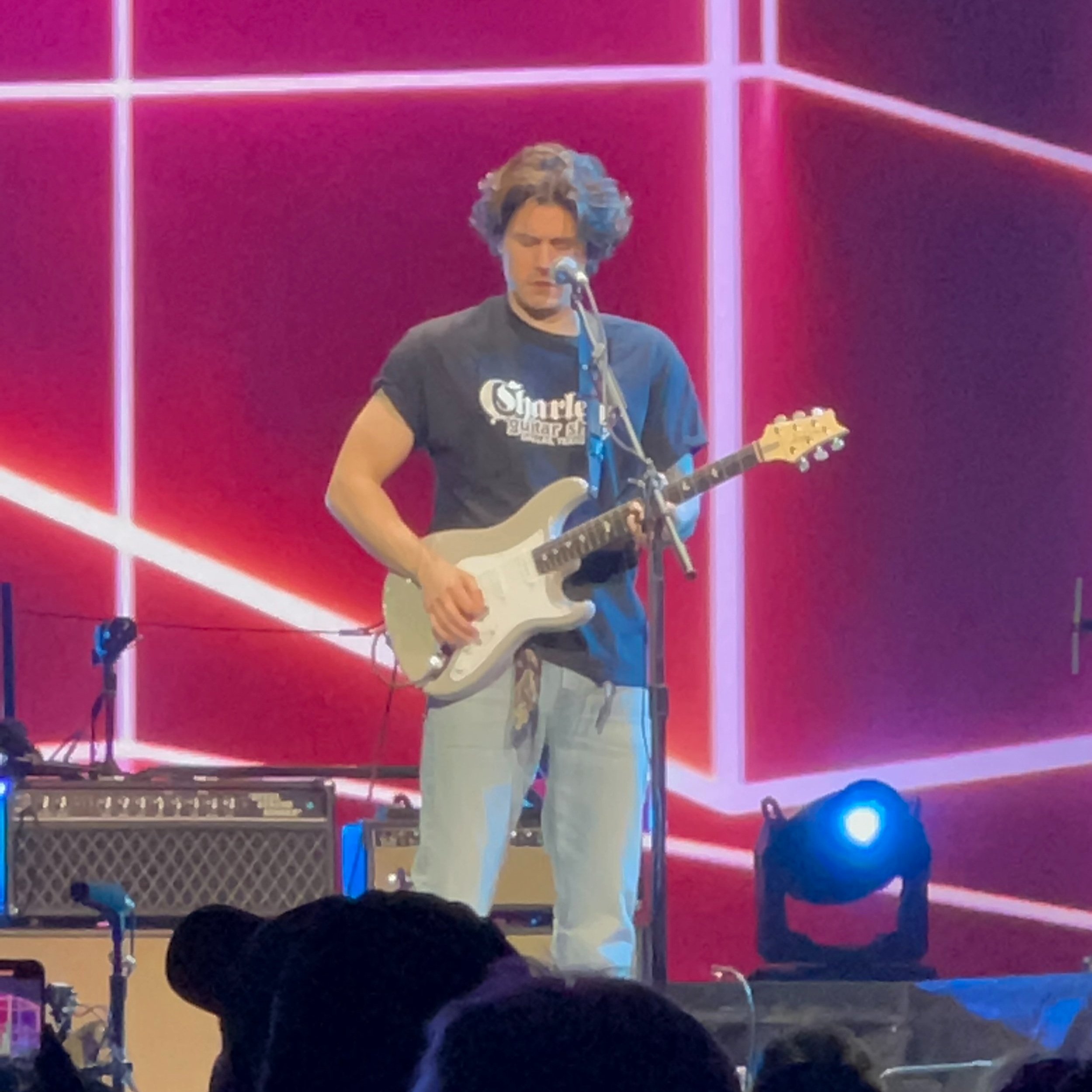
I should be watching the concert in front of me. I can’t. I can’t focus on anything but the couple across the aisle. A diminutive pair, the man is wearing a short sleeve white shirt with a blocky black floral print. His jeans are skin tight. His hair is slicked back. I am across the aisle from him in a full arena, but I am convinced I know exactly what he smells like. He is glued to the woman in front of him, and she loves it. Her jeans are also painted on, so tight around her thighs and backside that I’m sure the couple can feel one other’s tiddly bits through the fabric.
They’re swaying to the beat, then without warning, they’re grinding. This isn’t too crazy given we are in the middle of a John Mayer concert. We all feel the various grooves in our own ways. During, say, “Your Body Is A Wonderland,” this level of grinding is to be expected. But that song is not what is playing.
I find myself looking over again and again. At first, I chalk their horniness up to not knowing the song. It has a sultry beat, and to be fair, it wasn’t one of his most mainstream hits. Probably because of the heavy imagery. “Belief” is intense.
What puts a hundred thousand children in the sand?
Belief can, belief can
What puts the folded flag inside his mother's hand?
Belief can, belief can
If you just heard the funky bass, you might expect a sexier song. That has to be what is happening here. They heard the riff and got to crushing.
But then I see it: their mouths moving. Oh no. They are mouthing right along with the rest of us. They know the words, and don’t seem to care. The woman even pulls her phone up and films them together singing along. The grinding has reached a fever pitch. I am convinced that somewhere down in the darkness of the fabric, they’ve achieved full penetration.
Like I said, we are all feeling the music in our own way. Every single song so far, I have sung out loud, at the top of my lungs. I have lifted my hands. I have danced. I am proudly wearing a hat I got from the merch stand even though it does not match my outfit whatsoever.
It’s 2022, twenty years after my first John Mayer concert. On August 27, 2002, my mom dropped me and a friend off at the now-demolished Bronco Bowl to hear this new John Mayer guy play his music. We were in the cheap seats, though in the 3,500 seat venue, no seats were really that bad.
I had first seen John — yes I address him by his first name, not because we are friends (yet!), but because he has been with me, at least sonically, throughout every era of my life. Also I made him laugh when I met him a few years back, so we’re cool.
I had first seen John back in March 2002 on the short-lived but funny Late World with Zach, hosted by a pre-The Hangover Zach Galifinakis. By that time, John had released 1999’s Inside Wants Out, his debut EP. It had some good jams, but his first major hit was “No Such Thing” from 2001’s Room for Squares. That's the song that hooked me, up well past midnight watching VH1 on a Friday night. Yeah, I was a super cool high school sophomore.
After hearing him perform the song on TV, I did what any self-respecting music lover did in 2002: I went straight to Limewire and downloaded every song I could find. Then, in an early aughts show of loyalty, I drug myself to CD Warehouse and paid full retail price for both the EP and the album.
I wore Room for Squares out in my blue Sony Discman. Fifteen-year-old Heather could not get enough of the songs like “Why Georgia.” In retrospect, singing about a “quarter life crisis” sounds far bleaker at 15 than it did for John's 24 years at the time. Still, I felt every chord in that song in my still-growing bones. Hearing it live was more than I could handle. I left the Bronco Bowl show a changed woman - or, rather, kid, teenager, whatever.
It wasn't my first concert ever. I had seen the Backstreet Boys live and watched pop acts at KISS FM’s End of Summer Bash before. My mom had taken me to a Bon Jovi show. But this was the first concert where the music felt like mine. John was up there letting us know it was okay not to be the coolest kid in school. Even if it wouldn’t all turn out perfect, it would be okay. We’d make it out alive, and there would be art and freedom and music on the other side.
At 15, I needed to hear it would all be okay from someone who had recently been there. It didn’t always feel like things would work out. I felt, like so many of us do when we’re that young, that it was a requirement for me to become fundamentally different from who I was to survive. I tried on goth clothes — all safety pins and fishnets and combat boots. I tried on funny t-shirts. I tried on cool clothes from Rue 21 and hand-me-downs from my sister. None of them ever felt like they fit.
The feedback I got back from other kids didn’t help matters much. I know now I was not alone in bearing the brunt of teenage judgment. Still, at the time, it stung. The boy who told me he would be my boyfriend only if I would “lose a hundred pounds and get cool.” The girl who told me my crush on a cool classmate would go permanently unrequited because he liked “soccer girls, you know? Girls in soccer shorts.” This was shorthand for girls whose thighs didn’t touch when they walked.
I had an inkling that maybe I wasn’t completely bankrupt when it came to love interests or self-actualization, but I couldn’t be sure. I thought it was possible I had something to offer even if no one was biting yet. I was suspicious that, despite all evidence, there was something there, like I was flush with cash in a foreign currency with nowhere to exchange it and no way to spend it.
John on VH1 that late March night felt like a call from the other side. It was a message from my home planet.
I’d like to think the best of me
Is still hiding up my sleeve
I thought, Sameeeeee.
But wait, there was more.
Something's better on the other side, he promised. Like a late night infomercial, I was ready to open my wallet and make however many easy payments to buy whatever he was selling.
Those transmissions were key. For me — for all of us who were listening — we got the message. It’s fine, he told us. Or, at least, it will be fine someday, and someday is maybe not so far off. He sang about high school, but even better, he sang about his ten-year reunion.
He had made it out. He was on TV. He was singing me songs on stage at a concert.
I am invincible as long as I’m alive, he sang, adding in live versions of the song, You are invincible, we are invincible, as long as we're alive.
I did not feel invincible at that time. I actually felt pretty worthless. But that became a mantra, even if I didn’t know what a mantra was back then. I just knew I could sing it over and over and maybe if I sang it enough times, it would make it true.
The truth is I’m not invincible. John isn’t either. Neither are you. Maybe the better word would have been “impervious,” but that doesn't sound as good in a pop song. I worse those lyrics like armor. I had his music, and so I was invincible — from mean comments or from being told I wasn’t good enough or from that sinking feeling that I was still cooking and not done yet.
When my ten-year reunion came around, it was time to put his promises to the test. Everything was not perfect, though, to be fair, he had never promised that. It was better though, that much he was right about.
It’s vindicating to hear him now, knowing he was right all along. Something better was, indeed, on the other side. Not just for me, but for him, too. Twenty years later and we are both still here. Far from the Bronco Bowl’s 3,500 seats, he has filled up the 20,000 seat American Airlines Center.
I’m not surprised when he leaves “No Such Thing” off the set list. Really, with all the incredible songs he has written in the interim, no one can blame him. He throws us old timers a bone, though. He tells us he knows the oldies are important to us. He recognizes that they got us through high school and college and that they’re part of our lives.
For us, he plays “Why Georgia”. I sing along, arms outstretched, palms up. Now, singing about a quarter-life crisis, I realize crested the hill where the lyrics went from bleak to fitting to now impossible. Even with modern medicine, I don’t see myself making it to 140 years old. Still, it feels good to hear this one live again. He medlies “Georgia” into a cover of “Forever Young” and “Shouldn’t Matter But It Does” off his newest album, Sob Rock.
I am happy to hear the new stuff. Unlike the chumps nearby who hoot and holler at “Your Body Is A Wonderland” and look around confused during the new songs, I like the most recent record. Paris and I chose one of the tracks “Carry Me Away” as our first dance. A new song for a new era, this one makes no promises of the future. It’s focused squarely on the present, on promises realized.
You know I need you, and that’s for sure,
You’re just the kind of crazy I've been looking for.
We sway together, Paris with his arms wrapped around me. Just over a month married and still in the honeymoon phase. There's nothing left to promise, nothing I have to wait for. It’s all right here.
Along with the couple making love in their seats beside us, there are thousands of other people in the arena singing and clapping along. Some as old as me or even older. Others are younger — college kids, high schoolers. In the lobby, we see a tiny boy, in maybe second grade, wearing a Sob Rock ball cap and matching t-shirt so long it nearly touches his ankles.
As we leave the arena, I feel so grateful for the show. So grateful that John is still making music — not just for me, but for all of us. All of us who hoped for something better on the other side and who have now crossed over. Whether we've been hoping for twenty years or just found out today. Legions of us pouring out the doors onto the streets, feeling invincible and so very happy to be alive.
***
This piece first appeared in Sunday Morning Hot Tea. Subscribe so you don’t miss another piece.

Real Characters
For awhile in the late twenty-teens (what do we even call the years between 2010 and 2019?), I was miserable. Just absolutely down-in-the-dumps, ready to drive my car into a highway median. I didn’t want to die, exactly, but I just wanted to shut it down for awhile, spend a little time laid up in a hospital bed, away from life.
I finished law school (whoopee) and passed the bar (huzzah), yet neither of these accomplishments magically solved all my problems. Shocking, right? I was in a relationship where I felt utterly alone. I worked a job I was good at and where I liked the people, but I didn’t feel particularly fulfilled. I hadn’t started doing comedy again. I was just sort of floating.
One of my only escapes was my notebook. It was an extra large black Moleskine with ruled pages. I don’t remember when I got it. The first few pages are nonsense, just bits and scraps of ideas and thoughts. The first real dated page is April 19, 2016.
I took that notebook and a Pilot Precise V5 in either blue, black, or pink ink if I was feeling wild, and sat at a Starbucks every morning from 7am until 7:55. When my time was up, I would head to work around the corner. I started at the Starbucks in Addison, Texas off Belt Line Road and the Dallas North Tollway. Then, when my office moved, I switched to the one at Preston Road and Alpha. On Fridays, I went to the Original Pancake House where I sat at the bar and had three gluten-free pancakes alone. I called it Pancake Friday. It was one of my most sacred joys.
Neither the restaurant or Starbucks themselves were important. They didn’t need to serve coffee or breakfast. They just needed to be anywhere but my home.
In those pages between the soft black covers, I didn’t usually write stuff like this — stories about my life or true stuff. Instead, I wrote fiction. I wrote suspense novellas and romance novels. I wrote ghost stories and love stories and disaster stories. I was out of my head for an hour a day, somewhere I desperately no longer wished to be.
Sitting in a Starbucks that often, I came across my fair share of characters. Real weirdos and oddballs. Two men with loosened ties, so early in the day, arguing about politics. A man in a work shirt with a name tag that read Freddy sketching the baristas’ faces on a store-copy of the Wall Street Journal. A frazzled lady in sweatpants and no shoes, leaving her car running to come in and grab her drink.
Mostly I would ignore them, but sometimes they were so disruptive or interesting, I just couldn’t. When that happened, I wrote about the strange people around me instead.
This particular morning I remember is cloudy and gray. I’m sitting in my usual table in this shotgun-style Starbucks. It’s the table furthest from the door. My back is to the window, my left arm so close to a rack of coffee mugs I could hit them, and I am facing the pick-up counter. I am wedged in my corner so I can either focus on my work or spy on everyone. The perfect spot.
It has been raining for several hours, but the man in the bright orange shirt sitting one table removed from me is wearing white-framed sunglasses indoors. His brown paper bag from Trader Joe’s is filled with paperback books.
Just a few minutes ago, he had placed his order, then headed back out into the rain to retrieve the load from the trunk of his enormous white Cadillac parked straddling the lines in the parking lot. I am impressed that the rain did nothing to his spiky, blonde hair. His skin looks impenetrable, either by water or anything else. It is as thick as the covers of the book he has retrieved from his car and just as weathered.
He is now standing beside his café table, facing the bar - the same direction as me. In a few seconds, I decide he is a weirdo and that I am going to watch his every move as a writing exercise. So engrossed in his own business, he has no idea, with my pen in my hand, I am taking notes on him.
He has started to remove each book from the bag in turn. Once out of the bag, he first removes the dust jackets of the few hardcovers, wiping their fabric covers with brown paper Starbucks napkins. After wiping them, he stacks each one on top of the last, careful not to knock over the single shot of espresso in the tiny white ceramic cup on the table. One by one, he separates yellowed magazines from the books.
“Tsk tsk,” he says at one book, as if it has been naughty and disappointed him. He resumes whistling a tune that falls in rhythm with the Billie Holiday song on the speakers above. But then, he deviates from the piped-in music's beat with his own offbeat snaps. Without warning, he has started whistling rapidly, repeating whistles that almost exactly match the tone and speed of the Starbucks food oven announcing another breakfast sandwich is done.
“Ecto spimadorium perfectum,” he says and slams a book down.
Jenna, a pretty brunette nurse in fuchsia scrubs, has been waiting at the café table beside him. When she realizes the unsettling behavior beside her, her body tenses up like water dropping on a paper straw wrapper.
“Jenna, I have your grande peppermint mocha,” the barista says. Jenna snatches it from the bar, looking over her shoulder to be sure the man in the orange shirt has stayed with his stack of books.
“Thanks,” she says. Before the word is over, she’s gone, out the door and into her Kia.
“You talk like my brother sometimes,” one barista says to another, pulling a shot from the espresso machine.
“I know!” cries the man in the orange shirt, answering an observation that was not directed at him. “Don’t mix us up!”
Over the scream of the steam, the burble of the espresso, and the voices of the drive-through employees, the baristas do not notice.
The books are now all removed from the paper sack and standing in three stacks on the small round café table. The man in the orange shirt pushes his white sunglasses up on his face further and sits down to go through each one, page by page. With the delicate way he handled them and the time he spent wiping off the covers, I figure they must be pretty valuable.
He makes it three pages in the first volume before he begins tearing pages from the first book, each tear on beat with the horns in “New York, New York,” which has begun playing above us. Ok, I guess I was wrong.
An older gentleman, about sixty years old, with red, tired skin and a mop of gray hair walks in. He is bent at the waist and walks head down, straight toward the pastry case.
“I want a piece of that coffee cake,” he says, pointing into the case. “Not an end piece.”
The barista at the register does not have the chance to say “Hello,” “Good morning,” or “I have poisoned all the pastries.”
The older man follows his head, bent at the waist, past the glass case toward the register where he orders a drink. Just as he starts to speak, the milk steamer goes off and I miss what he ordered. No matter, I can wait.
This man appears fairly normal from the waist down – wrinkled linen khakis and brown leather shoes with sensible socks. But he has topped off his outfit with a mint green sports coat, just as wrinkled as his pants. His white button down is split in the middle with a necktie. It has thick candy-cane stripes, alternating periwinkle and dark burgundy. His black-framed reading glasses are down low on his nose, which only cause his head to point down further as he looks over the top of the rims to see.
The older man turns and passes by the man in the orange shirt just as the latter is mid-page rip.
“Pardon me, sir,” the man in the orange shirt says.
My heart races. They’re going to talk.
“Yes?” the older man replies over the rim of his glasses.
“I just wanted to compliment you on your ensemble.”
“Thank you,” the older man says, unfurling his newspaper and settling down at the café table one removed from the man in the orange shirt.
“Are you a haberdasher?” the orange-shirted man asks. A fair question, given the ensemble. He could be a haberdasher or a farrier or a cobbler, whatever occupation he could get in the era from which he has time-traveled.
“No,” the older man says, without looking up. “And it’s quite unusual for me to be dressed this way.”
It is quite unusual for anyone to be dressed that way. Did he wake up, find some dirty khakis from the laundry bin then say, “Oh no, no clean sport coat. Better grab my trusty ol’ Kentucky Derby outfit instead”?
The man in the orange shirt is so impressed by the ensemble he has paused ripping the books.
“The combination of colors, that dark wine color on your tie. The mint jacket,” the man in the orange shirt says, trailing off. I expect him to do a chef’s kiss motion. He doesn’t. He just starts ripping pages again.
When the older man says, “Thank you,” I realize his voice sounds exactly like Charles Grodin. I smile and write that in my notebook.
“I just wanted to say top of the morning to you, and thank you for your fastidious approach to fashionability,” the man in the orange shirt says.
“Thank you,” Charles Grodin repeats. He presses his face down toward his newspaper. Soon, the barista calls out his order. It’s go-time. I am so excited to hear what this bizarre time traveler has ordered. I hold my pen at the ready.
“Venti non-fat latte for Ross,” she says.
Venti? Non-fat? Latte? For Ross? I desperately wanted to hear, “Earl Grey in a mug for Arthur” or “Extra hot Americano for Winston” or “Verona pour over for Clarence.” Anything but this.
Let’s be clear, I’m not hating on a non-fat latte. That’s fine. I am also not judging the fact that he got a venti. Some days are venti days for sure. But that coat calls for something whimsical and Ross - ugh, Ross - has let me down.
Ross ditches his newspaper and walks head-first toward the bar to get his drink. He returns and shuffles through the pages of the paper once more before leaving. He takes all sections with him and leaves behind only an advertisement for Sprouts Grocery Store. My illusion of him is wrecked. He’s not some eclectic haberdasher. He’s a doofus in an ice-cream colored jacket who doesn’t like vegetables.
“Thanks again,” Ross says to the man in the orange shirt.
By this point, Orange Shirt is intermittently snapping, flipping through an ancient Highlights for Children magazine, and conducting an invisible orchestra.
“You’re a modern inspiration,” Orange Shirt says to Ross’s back as he walks out.
They both were modern inspirations. Taking me out of my own head for awhile. Giving me a chance to track their every move. Two oddballs just feet away from the normal girl at the far table, eavesdropping on strangers, scribbling page after page in her notebook until the ink runs out. Just a couple of characters haunting this Starbucks, so early in the day.
***
This piece first appeared in Sunday Morning Hot Tea. Subscribe so you don’t miss another piece.
My Application to be a Female Motorhome Travel Companion
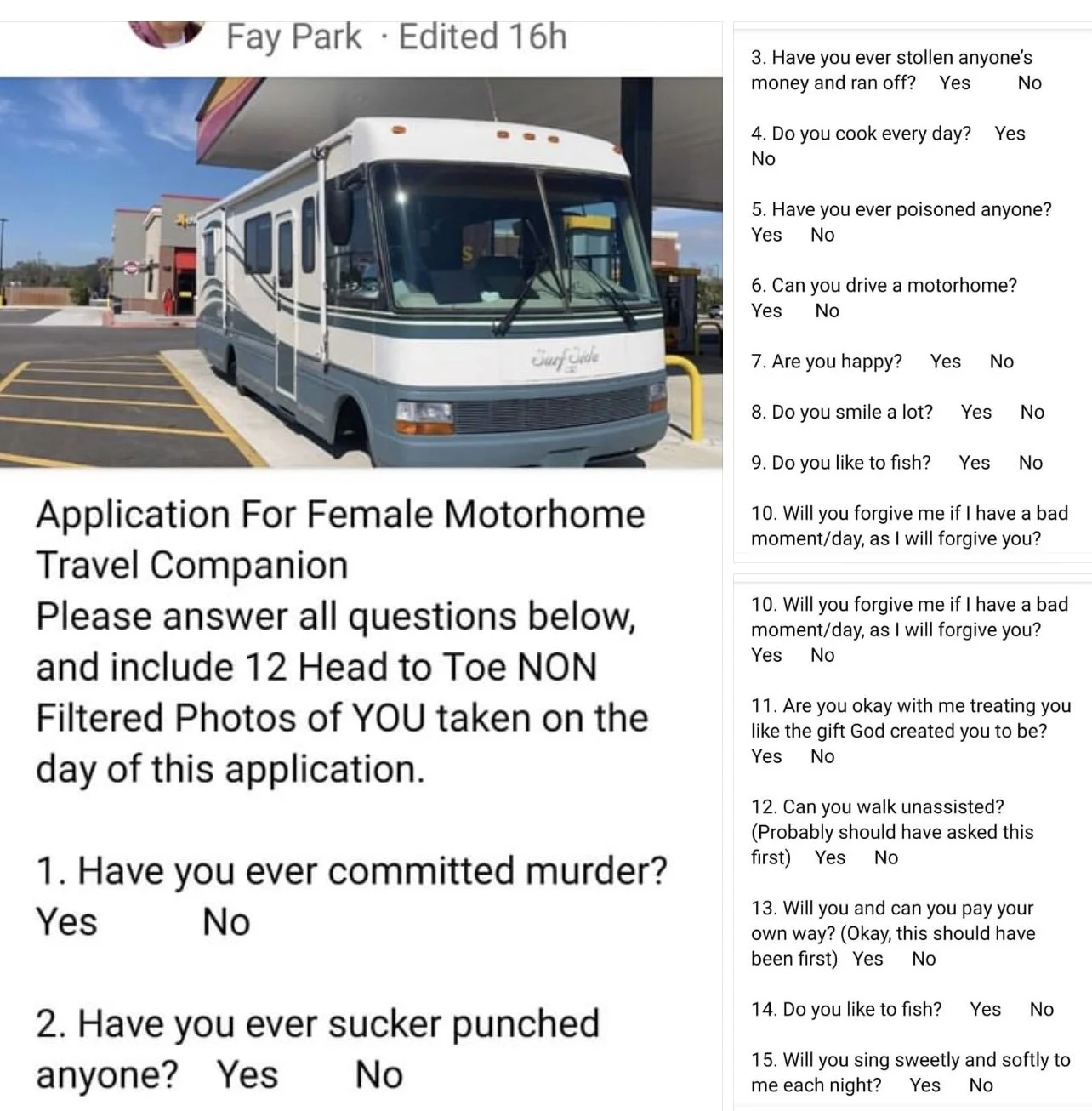
This was a post on someone's NextDoor neighborhood app that has been screenshot and shared online. The questionnaire follows a photo of a motorhome parked at a gas pump outside of a combination Pilot truck stop/Hardee’s restaurant, the worst gas station/restaurant combo. Everyone knows the best combo is the TA/Taco Bell Express or the Exxon/McDonald’s if you’re in a pinch.
The post is titled Application For Female Motorhome Travel Companion. It reads: “Please answer all questions below,” then includes the following demand: “12 Head to Toe NON Filtered Photos of YOU taken on the day of this application.” This is a newsletter, so you get the answers to all questions below, but I’ll spare you the 12 head to toe non-filtered photos. I am in jeans and a black t-shirt. I just ate scrambled eggs and breakfast potatoes in an airport hotel restaurant at 6AM. You can visualize what I’ve got going on.
I think I would be a great fit for this job because I’ve been traveling a lot recently. I wanted to know if I could make the cut as a motorhome mama. There is no better way to measure myself than against this gentleman’s metrics of success.
Question 1 – Have you ever committed murder?
Wow, starting off strong. No, sir, I have not yet committed a murder. That’s the problem with your question. You didn’t ask whether I would be willing to commit a murder. You only asked if I have already done so. I have not.
Hang on a minute.
You didn’t specify why you were asking this.... Did you need someone with prior experience? Was the right answer to this question actually yes?
Question 2 – Have you ever sucker punched anyone?
Now I am worried the right answer to this question is yes, too. I have not sucker-punched anyone as I would define it. One time, someone slapped me in the face and called me a “whore” at a bar when I was 19. I told him if he touched me again, I would – and I’m not super proud of this but it’s true – “grab you by the nuts and twist until I felt a pop.” I must have heard that from a movie. I felt like Dirty Harry when I said that.
Despite my very clear warning, he slapped me again. Yes, I grabbed his nuts. No, I didn’t feel a pop, probably because I have early onset wrist weakness from a lifetime of typing. He did drop down to his knees, though, then ran from the bar. It was a whole scene.
I don’t consider this a sucker-punch given that I provided him with proper notice. So, no.
Question 3 – Have you ever stollen anyone’s money and ran off?
I have to point out the stollen is original to the question and not me. I am ashamed that my answer to this question is yes. When we were little kids, probably in third grade, my childhood best friend, Marila, and I found a wad of cash up at the local recreation center. It was hidden back in some bushes, if I recall correctly. It was as if someone had stuffed it back in there to hide it from whoever they stole it from.
Considering there is no honor among thieves, Marila and I made off with the loot. We biked a few minutes up the block until we got to my house and hid in the garage. Some big kids came looking for us. Turns out, we were right. They had stolen the money from somewhere else and had hidden their riches in the bushes. When the boys tried approaching my garage, my mom came out and yelled for them to get out of the yard and go home.
Thanks to our unwitting accomplice, they scrammed. We stashed the cash – a whopping six dollars in crumpled ones – into my brown glass owl piggy bank. I’m sure later we spent it on candy at the Diamond Shamrock gas station near Marila's house.
Question 4 – Do you cook every day?
No. If I am forced to cook, I boil gluten-free noodles, melt a pad of butter in them, and sprinkle them with the kind of parmesan “cheese” that comes in packets crammed in the side of your pizza box. Now baking on the other hand?
I don’t do that either. Sorry.
Question 5 - Have you ever poisoned anyone?
I can't help but feel like this is related to question 4 and comes from a place of personal experience. Either that or this is entrapment. Are you the FBI, sir? If you are, you have to tell me.
Question 6 - Can you drive a motorhome?
I am not trying to be too picky here, but I feel like you should have put this question up higher. No, I have never driven a motorhome, but I have a lot of self-confidence so I think we'll be good. By that I mean I’ll be like, “I got this!” Then I’ll take the wheel, pop a curb at best or skim your roof on an overpass at worst. But I will have driven it.
Question 7 - Are you happy?
Good lord. Wow. Coming straight for the gut punch. You know, are any of us truly happy? I like to think I am. Happiness is a transitory feeling, though. I don't think anyone is truly happy all the time. Maybe content, joyful. If happiness is achieved through doing fulfilling creative work and sharing it with others, then yes, I am happy. If happiness is a Hardee’s Monster Angus Burger in a truck stop parking lot in your SurfSide RV, I’m afraid I’ve been living life wrong.
Question 8 - Do you smile a lot?
Ah, I see where you're going. Number 7 was not about my true happiness and fulfillment. You want to know if I'll shut up and smile. I do smile, but I rarely shut up. I laugh a lot, usually when I am happy or amused, but also when I’m nervous.
I got in trouble for laughing once in grade school. I attended a public elementary school in Mesquite called Rutherford. It was built next to cow pastures and fields. As the houses popped up beside it, the amount of students outnumbered the space to hold us. Soon, the fifth and sixth grade classes were relegated to portables. This was a soft word for mobile homes turned into classrooms. The floors were lined with linoleum tile, and the walls were covered in inspirational posters like “Hang in there!” and “If you can dream it you can do it!”
In fifth grade, we switched classes for each subject, so we got shuffled around between portables a lot. For instance, during our lesson on our changing bodies, girls were ushered into one portable with my home room teacher, Mrs Kralik. A woman of 60 with a cropped gray haircut, Mrs. Kralik exclusively wore knitted sweaters and long jean skirts. To teach us about the inner workings of our personal sexuality, she showed a short video about penises and vaginas and periods. When it ended, she explained the most important thing to remember was that puberty changed our hormones and changed hormones made you stink. So wear deodorant.
A student raised her hand.
"Mrs. Kralik, how are babies made?"
"Just wear deodorant. That's all you need to know."
To be fair, that was not bad advice. It’s just not as all-encompassing as one would hope in order to prevent teen pregnancy or STD transmission.
The boys were shuffled into Mr. Shirley’s class. Mr. Shirley was the science teacher, a round man with a crescent of gray hair framing his bald head. He wore white short-sleeved button-downs with brown striped ties and filled his front pocket with ball point pens. I have to believe he purchased his ensemble all together from Party City in a plastic bag labeled ‘90s Science Teacher at a Public School. He kept a shelf of hissing cockroaches and lizards behind his desk. In the top drawer of his old metal desk, he kept Jelly Bellies. Not plain, store-brand jelly beans. Jelly Bellies. The real deal. Raw and loose in the metal drawer. If you answered a question in his class correctly, you’d get to go and rifle through the drawer and get you a Jelly Belly.
The day I got in trouble for laughing was in late January 1996. On this day, I would not be getting a Jelly Belly. Our lessons on wearing deodorant behind us, this was a solemn day. All home room classes gathered in Mr. Shirley’s room. My class was last to enter, so while some kids sat in desks, we were forced to stand crowded in one corner of the room. Mr. Shirley cut the lights and rolled a black metal cart with an enormous tube TV strapped on top.
“Ten years ago,” Mr. Shirley started, “the Challenger space shuttle took off.”
Took off. That’s what he said. He said it took off. Technically this was true. Technically, the Titanic set sail. Technically, JFK visited Dallas. Technically, I went to Disney World in sixth grade. Saying it like that really buries the lead. It leaves the story unfinished when you fail to mention the sinking, the shooting, or the pants-pooping on the way to the airport.
That's how he set us up. He told us, "The Challenger took off."
“Now, here is a video of that day,” he said.
He pressed play. A video began and introduced the crew. As you would expect, they focused a lot on Chrysta McAullife. A teacher chosen for the mission, the announcer said.
How cool, I thought. She worked so hard teaching her kids, and now she gets to learn firsthand what space is like!
I should reiterate that on this day in January 1996, I was nine years old. I still believed in Santa. I thought the basket on the front porch each year was from the actual Easter Bunny and not our kind neighbor.
So there I stood in the back of the class, engrossed in this lovely story of a woman fulfilling her dreams. Beep, beep, beep went the count down. Three, two, one.
You know what happens next. What was once a sleek spaceship erupted into a huge fireball on the screen in front of us.
Silence.
Then laughter.
I began to laugh. Hard. I couldn’t control it. Couldn’t explain it. I was sad. I was confused. I was laughing. All I know is Mr. Shirley took me by the arm and drug me out of the dark portable. My eyes blinded in the sun outside the door, he questioned me.
“Why did you laugh?”
I had no reasoning. I could only spit out facts.
“She worked so hard. She got to go to space," I said.
“She almost got to go to space,” he corrected.
That afternoon after school, Shirley decided to call my mother and squeal on me. She normally had great deference and respect for teachers, so I expected her to take his side.
“She laughed? At a video of the Challenger explosion?” my mom asked, repeating his complaint back to him. Then she hit him with the money question.
"Did she know?”
“Know what?” he asked.
“How it ended? Did you tell the kids before you started the tape what would happen?”
He was forced to confess he had not.
“Well there you go,” she said. She hung up the phone.
Yeah so anyway, I do smile a lot.
Question 9 - Do you like to fish?
I don't like to do anything that's a whole deal. Like having to get the tackle box, the worms, the hooks, the vest (you HAVE to wear a vest when you fish, otherwise what are you doing?) It seems like a whole deal. To fish the right way, I feel like I have to invest in all the various accouterments needed to fish properly. I’m not doing that.
Question 10 - Will you forgive me if I have a bad moment/day, as I will forgive you?
First you have to forgive me for looking at this question with my eyes narrowed and my lips pursed. This sounds like you are asking for pre-forgiveness for acting rude toward me. I will consider forgiving anyone, but I am not going to give you or anybody else a free pass.
Question 11 - Are you okay with me treating you like the gift God created you to be?
Honestly that's the only way anybody is allowed to treat me. Glad to hear you are on the ball already!
Question 12 - Can you walk unassisted? (Probably should have asked this first)
I got stuck in the Jungle Cruise boat at Disneyland and Paris had to pull me out so you tell me. Also — this? This is what you “should have asked first”? I think you did all right with the murder and punching questions right off the bat.
Question 13 - Will you and can you pay your own way? (Okay, this should have been first).
Yes. While I do respect equal contributions in a partnership, again, let's reevaluate your priorities. You definitely should clear up the murdering and the poisoning before worrying about splitting the check at Hardee's.
Question 14 - Do you like to fish?
My answer has not changed. So sorry. But if you're asking twice, maybe THIS should have been your first question.
Question 15 - Will you sing sweetly and softly to me each night?
I will sing for you, but these pipes are at and always stay at eleven. I don't do softly. I can hit you with some Fleewood Mac, some Lady Gaga. I can hit like 65% of notes in Katy Perry songs. I also do a pretty inauthentic Bon Jovi impression. But these pipes don't come for free. If you want me to sing to you AND not murder you AND try to fish, I will require compensation. Even then I make no promises on the murder question.
Well, sounds like I am not cut out for the motorhome mama lifestyle. That’s ok. Even if I can hack it in the SurfSide, I know a great guy who will drive me all over the state of Texas. He’ll also pull me out of a canopied tramp steamer piloted by a trusty skipper when I get stuck. Plus, he’s already accepted my application.
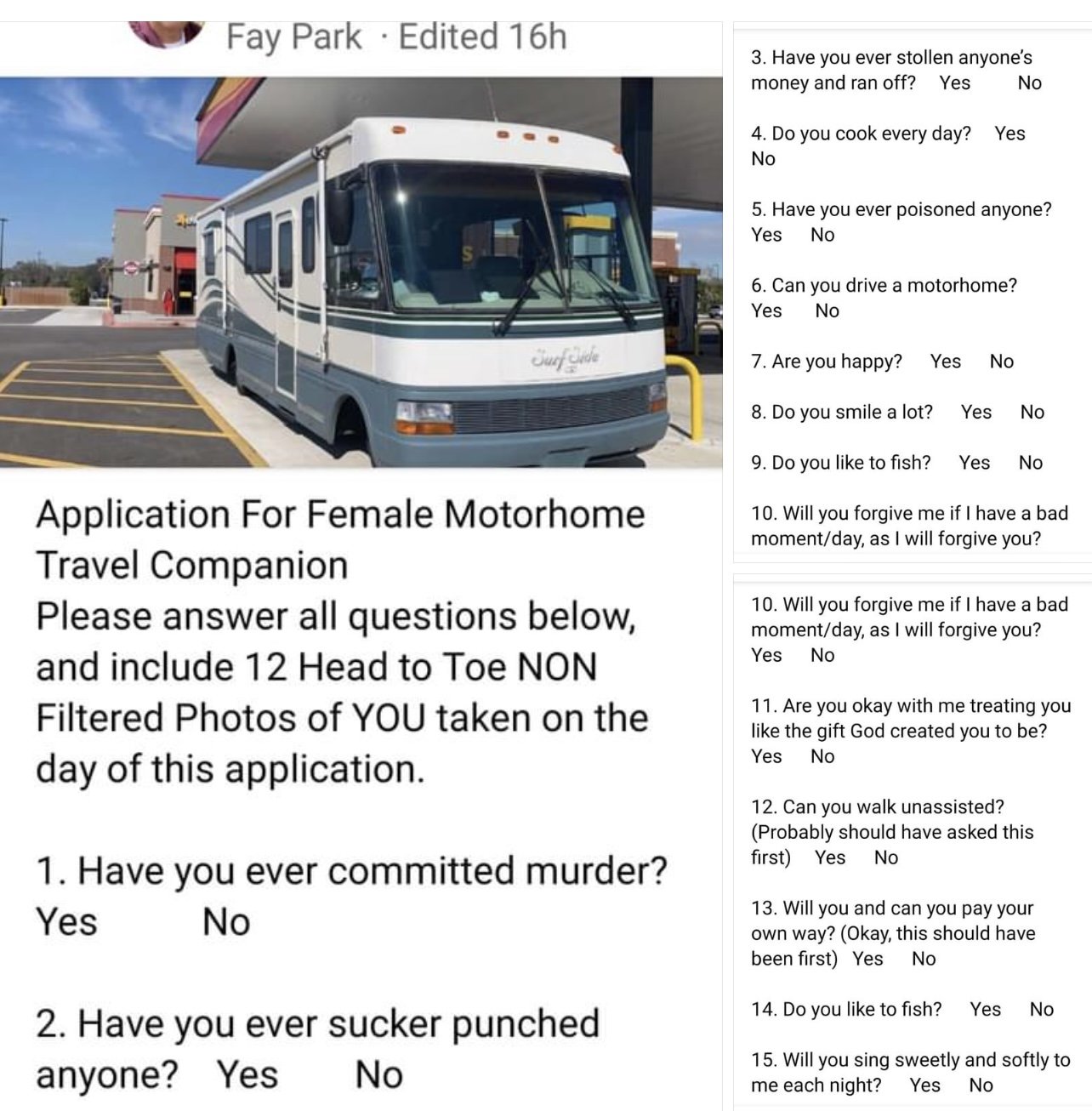
If you think you’re cut out for the road life, I’ve included a screenshot of the post below.
***
This piece first appeared in Sunday Morning Hot Tea. Subscribe so you don’t miss another piece.
The Gifts We All Give
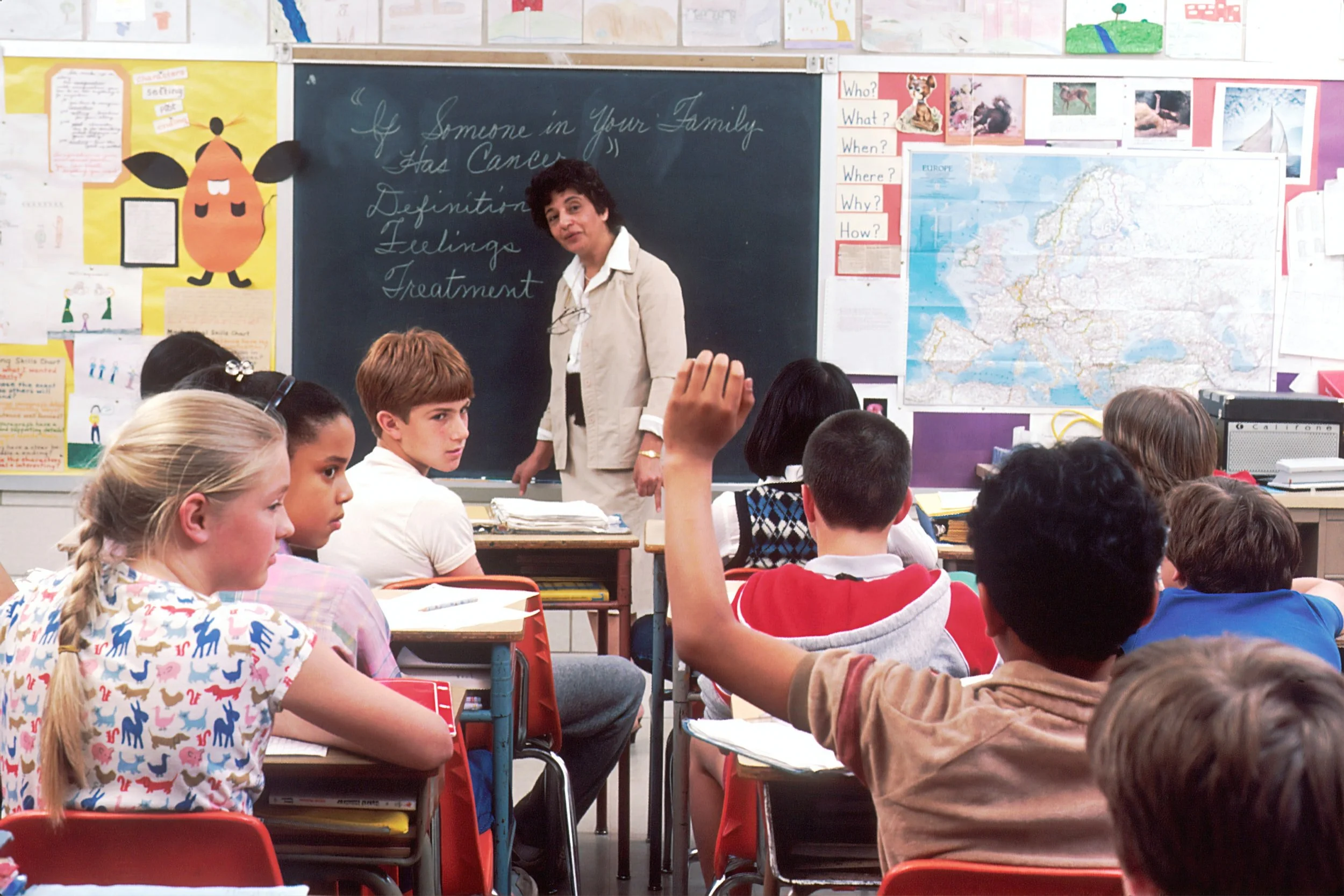
This week, Paris and I caught up on the new TV series Abbott Elementary. If you’re not watching that show, you may be the only one. The runaway hit has been compared to Modern Family and has grown almost as fast. I’ve laughed out loud while watching and teared up at times, too. It follows new and veteran teachers at an underfunded Philadelphia public school. I won’t give anything away, but one story arc involves a program for gifted students.
The efficacy and equity of these programs have been debated by education experts and scholars. I am neither an education expert nor a scholar, so I’ve got nothing to contribute to that debate. What I can contribute is my experience in these programs and how I related to Miss Teagues, the protagonist on Abbott, a former “gifted kid.”
They chuck these labels on you early. In kindergarten, my tall, lanky redheaded teacher, Miss Lacey, pulled my mom aside. She said that while my math scores left something to be desired, my verbal scores were high enough to suggest “gifted” classes. That put me into the first and second grade ABLE classes, the designated “gifted” classes at my elementary school. That acronym was the first in a series of several that would define my education.
I have no clue what we did differently than other first and second graders. I remember a girl peed her pants in first grade, leaving a warm puddle in the curve of the blue plastic chair. In second grade, a boy pooped himself, forcing him to waddle out of the classroom wearing a full pair of steaming sweatpants. Why was there so much defecation and urination in these classes? If we were the “gifted” kids, why couldn’t we find the bathrooms on time?
By third grade, the not-quite-ABLE-to-use-a-toilet kids were mixed in with everyone else. Instead, on Wednesdays, a bus would get us and take us to the QUEST Program. I have no idea if this was an acronym or not, but I wouldn’t put it past them. We rode around to other schools, picking up other gifted kids, and were dropped off at Rugel Elementary on the other side of town from me.
I looked it up, and my old school district still does all these programs, including QUEST. That one promises to train students “in critical thinking, problem-solving, and decision-making.” Let me tell you some fun things that happened on the bus to QUEST. A girl threw my New York Yankees hat out the window over a highway overpass. I have still never replaced it. I poked another girl in the eye using a bit from Three Stooges. We stomped our feet on the floor of the bus in unison until the bus shuddered to a stop. We were convinced beyond a shadow of a doubt that our foot stomping caused the bus to break down. In reality, it was probably just an old bus. We didn’t care the real cause. All we cared was that we got to miss class and joke around with each other while we sat at a stop sign waiting for backup.
Each year of QUEST, from third through sixth grade, was themed. One year, our theme was “decades” while another it was “mysteries” then “animals.” Killer themes, really. At the end of each year, we had a capstone project we were required to complete in line with the theme.
For the decades year, we had to come up with an invention. Mine was a Beatles trivia board game because I was obsessed with the Beatles at the time. For the mysteries year, my mom helped me carve a scale model of the Titanic from floral foam because I was obsessed with the movie Titanic and Leonardo DiCaprio. For the animals year, I didn’t even make anything. My mom had made a plush humpback whale for my sister’s science project years earlier. I dusted that baby off, took it in, and passed with flying colors.
Once we were in middle school, we no longer got bussed off to QUEST. Instead, they segregated the school’s “teams” into the gifted kids, who they called “The Trailblazers,” and the others. The Trailblazers were in the AT classes - the acronyms keep coming, buckle up. Not sure what AT stood for - maybe Advanced and Talented? As for the other teams, I can’t recall what they were called. It was probably something like the Yeah Y’all Are Heres.
It’s hard being labeled at all, but I imagine being labeled as “aiiiight” has got to do something to a kid’s psyche. Even if you don’t overtly label them “average” or “regular,” kids understand how the inverse of concepts work. If you point to one group and say, “They are gifted and talented,” the kids on the other side of the hand can finish the sentence for themselves. At least give them that much credit.
At the end of eighth grade, the middle school students were invited to apply for the Renaissance English classes in high school. This was also known as GT - gifted and talented. I did this, with the encouragement of my middle school teacher, Mrs. Shurtleff. Seemed like a lot of work. Didn’t want to do a project to apply. Didn’t want to get rejected. Was not stoked about a summer reading list of any length, much less one so long it required a cart to shop for.
But Mrs. Shurtleff had read my ironic short story about a woman getting repeatedly hit by a bus (a thinly veiled piece of Backstreet Boys fan fiction, by the way). She thought I had the chops to succeed and needed to be challenged. Also, she mentioned that those classes got to go on dope field trips like Washington D.C., Disney World, and New York. Making a collage folder and writing some essays didn’t seem like too much work when bad ass spring breaks were waiting on the other side.
Once in the class, I learned it was more than just English. We learned art, literature, culture, history, architecture, music, and all the things you need to be a well-rounded human (and not sound like a total yeehaw at a dinner party). It was transformative. We were treated like small adults, given deadlines and projects with leeway on completing them. As for the trips, they were not school funded. Our teacher, Mrs. Muhl, empowered each of us to self-fund our trip with plenty of fundraising opportunities throughout the year. Money - or lack thereof - didn’t stop us from going if we wanted. She would encourage us to be enterprising and to earn the money ourselves rather than relying on parents.
We also got permanent hall passes, which was one of the best benefits of the whole program. If you got to school early in the morning, the teachers on hall monitor duty would usher you into the cafeteria where you could eat or do your homework in near silence. Not if you were a GT student. Several of us had magical pink hall passes with no date on them. These let us move past the hall monitor and make a hard left down a hallway to Mrs. Muhl’s room rather than be herded into the cafeteria.
All this to say, being a “gifted” kid included with it a collection of amenities that went beyond an ordinary learning experience. Abbott Elementary explores this concept, the disparity in experiential learning, and all the benefits of being labeled “gifted” heaped on only those kids. The gifted kids in the show get a hands-on learning experience. A class full of – Ms. Teagues struggles to find the word - “…regular? non-gifted? re-gifted?” - students walk by and see all the fun their counterparts are having. They beg their teacher to give them the same experience.
Being on the other side of the fence, we noticed the disparity, too. We knew we were getting VIP treatment, but without the benefit of maturity and experience, we felt entitled to it. Now, with hindsight and distance, it’s clear how harmful that disparity was and is.
Yes, in the “real world” there are actual VIP sections - closer concert tickets, better airplane seats, faster entrance to nightclubs. But that’s all for grownups. Grownups know why they get those things - they paid more for better seats, accumulated airline loyalty miles, or know the doorman. When you’re a kid, it’s not easy to identify why some kids get the velvet ropes and trips to Disney World while you’ve got to stand outside and wait to be let in.
On the flip side, all those perks come with strings attached. Senior year, they handed out some packets to us. They just had numbers on them, no names. We were told to fill them out as best we could. They were to be anonymously evaluated by a team at the higher levels of administration. The goal? To filter out future leaders of our fine city for the “Leadership Program.” There were five of us selected from my school. The commitment wasn’t much. We drove over on something like the last Friday of each month and learned how not to act like trash.
Seriously. They trained us on how to wear suits and how to choose our “power color.” They trained us on fine dining, teaching us which forks went where and which glasses were for wine or water. My group spectacularly failed at fine dining day. One of us said, “There better be steak,” not knowing the program’s director was standing behind him. We all got a talking to for laughing at what was arguably a great joke. Turns out that’s considered “rude,” but it was hilarious. It was also prescient. There was no steak. That’s what was really rude.
I know there were other lessons - probably how not to pick your nose or scratch your balls in public - but clearly they didn’t stick. Don’t get me wrong. Again, the perk was nice. Even without steak, we still got a free training meal and a few hours out of class.
The double edge sword of this was the pressure of expectation. We were The Chosen Ones, like the little green alien in Toy Story. The claw got us, and we believed we were ascending to a better place. Weeeee.
Except… chosen for what?
For every echelon, there was always some place higher to go. Even being in this group wasn’t enough. Amongst the GT students, there was still a race to the top 10% of our class. Then that wasn’t enough. You had to be one of the top 10 people of our class. After that, it became a race to where we’re going next, what we were going to be. College applications and acceptances. Big plans and pipe dreams. Achieve, achieve, achieve. “What’s next?”
It wasn’t enough for me to get a bachelors in creative writing. My senior year of high school, I declared to no one in particular that I would be getting a Ph.D. in the subject. I said this not knowing that was the tits-on-the-bull of degrees for what I ultimately wanted to be – a writer. I said it because it was terminal. The highest achievement. The most I could do. Plans have, of course, changed, but there are days I get pangs. Stupid, I know, but it was drilled into my brain matter. Achieve more. Do more. Be better. Live up to your potential.
Rather than a Ph.D. In English, I got a different kind of doctorate (I guess??) For what? To help people, sure. To demystify the law for folks when and how I can, yes. But also because it was what came next, what I was supposed to do after undergrad. I’m a comedian and podcast host. My job is not J.D.-required, much less even J.D.-preferred. It helps some days when we’re breaking down constitutional law, but it’s not much help when we’re proving the existence of dragons (THEY WERE REAL! I WILL FIGHT YOU!)
Even with the success of the show, I can’t help but feel some days like it’s still not enough. There’s an itch to do more. To achieve that next thing. I was talking with my writer friend, Victoria, the other day, about the idea of societally imposed timelines. It’s an odd, melancholy feeling of looking at your peers - in whatever arena, be it professional, personal, or educational - and feeling out of step.
I took five years to graduate from undergrad and four for law school. The normal route is four and three years, respectively. I also took a year off after college to work at Navy Pier selling tickets and giving tours on boat rides. As I started law school, I noted via social media that a high school classmate of mine was just finishing their law degree. Same gifted cohort. Same graduating class. Same hometown. So far “ahead” of me as I was just starting. I was rattled.
Of course, I forged ahead and finished anyway, however “late” and on whoever’s timeline. I achieved what I did in my law practice and now joke with my former colleagues that I am “retired” from practicing. The other day I researched a magical creature for several hours while drinking coffee in my PJs with no bra on. Truly living the dream.
Christie and I say to each other every day how absolutely grateful we are to do the job we do. Saying that again and again is the only way for me to combat that weird voice in my head that still whispers, You are not enough. Get an MFA, it tells me. Get an LLM in entertainment law. Achieve more. Put more on up on the wall.
The trick is to drown it out with gratitude. To remind myself that I am, as we all are, exactly where we’re meant to be for the journey each of us are on. The only person I need to be better than is me yesterday, and even if I’m not, that’s fine, too.
As for my “regular” classmates from all those years ago? That label is bullshit. They’re all gifted in their own ways. They’re artists and musicians and engineers and teachers and comedians. They’re dancers and coaches and moms and dads and counselors and realtors and human beings.
I am creeping up on twenty years out of the hallowed halls of John Horn High School (in 2025 - I have some time!) I realize it is time to cast off the pressure that has accumulated over the decades. As transformative they were, it is pathetic to have held onto these labels for so long.
But also, it was pathetic to hold on to them back then, too. It was pathetic for any of us to ever think we were “better” than one another when, in reality, we were always just different. Some of us were experts at what a test could pick up. Some of us were experts at something you couldn’t even test for.
In an ideal world, all students would get to relish in those creative, satisfying, exciting ways to learn. They would all get those perks, the trips, the hands-on training. And if you didn’t get them when you were in school, don’t worry. The perks weren’t even that good anyway. I told you, we never even got any steak.
***
This piece first appeared in Sunday Morning Hot Tea. Subscribe so you don’t miss another piece.

Spa Day
The most dangerous taco I ever had was a Taco Diner in the West Village in Dallas. I love Taco Diner. They serve Mambo Taxis, which are maybe my favorite drink. A Mambo Taxi is a frozen margarita with sangria swirled in it. It's what you order when you want to get drunk on top of being drunk. I had started in on a couple of tacos alongside my Mambo Taxi when I bit down on something hard.
I peeled open the corn tortilla and found a whopping piece of plastic lying beside the chicken tinga. It was sharp on one end and about the size of a pinky finger. I slipped it out of the taco, having avoided lancing my tongue, and finished the rest of my plate. Can't let a little thing like jagged industrial material get in the way of a meal at the Taco D. After I had sucked down the last of my drink and paid the check, I called the server over.
“I don’t want to bother you, but just in case it happens to someone else, you should know that there was a sharp bit of plastic in my taco.” I held up the prison shiv I had just eaten around.
“Totally fine, no big deal. No worries. Just wanted to let y’all know in case someone else happens to eat some plastic.”
Her eyes got huge, and she drug the manager over. I repeated myself, and again emphasized how it was not a big deal and I was only telling them for safety purposes. They were horrified, apologized, and tried to comp my meal. By then it was too late. I let them keep the evidence and slipped out.
I could be fed components of a serving dish and still just eat around it. I don’t even complain. I only feel bad when I have to bother someone about it, which I felt compelled to do that day just in case someone else wasn't as discerning of an eater as me. Honestly with the way I take down tacos, I’m surprised I even noticed.
It’s the same when it comes to personal services. I have gotten my fair share of massages over the years. I could tell you it’s because of back problems or for health and circulation benefits. The truth is that they feel good and I like to get them.
I have enjoyed wonderful massages and also endured horror shows. Rarely do I complain, and everybody always gets tipped. I also understand the irony of complaining about a massage. Once I received a real half-hearted massage. As I lay there on my stomach, eyes closed, drooling, half-asleep, I thought, “Wow, how lazy.”
Again, I thought it. I would never say it. I get up. I pay. I tip. I leave. I just request a different person the next time I go.
I am not a fuss-maker. I watch a lot of those public freakout videos where someone is screaming at McDonald’s workers and could never imagine being that way. I chalk it up to my not wanting to hurt anyone’s feelings. Perhaps, yes, my feedback could help them improve, but also — could it? I have no idea how to comment intelligently on massage technique. I figure sometimes it’s just not a good fit.
On Valentine’s Day this year, I got a text from my dear friend, Meagan. She asked if I’d like to go get a foot-only massage at a reflexology place. Her pals from book club had recommended it and had wonderful things to say.
She and I met in the parking lot just before our appointment time. I jumped in her passenger seat while she finished up a quick drive-thru dinner.
The massage “spa” is a slim storefront in a strip mall beside a local pizza chain and a personal training gym. The gym’s wide windows and bright lights offer zero privacy and an excellent view of their wall art. One wall reads, “Strong people are harder to kill.”
It looks like my kind of gym because everyone inside there on Valentine’s Day looked like beginners. It looked like maybe the owners had stapled flyers to telephone poles reading, “Have you been beat up your whole life? Come to our gym where we’ll make you harder to kill.” We won’t make you invincible or immortal. You still will be killed, but it won’t be convenient for your murderer.
I look past Meagan down at the storefront where we are due to check in in about three minutes. Through the glass, I see a guy standing behind a small counter looking at his phone. The lobby is empty except for an enormous poster of a person I should 100% recognize from history class but don’t. Here's the thing — I have not been in a history class in like fifteen years. A lot of stuff has happened to me since then.
Since I can’t remember, I say to Meagan, “Is that the king of China?”
She laughs through bites of her chicken nuggets. Totally fair. It was a dumb question.
I pull out my phone to Google it. Google never laughs at me. Maybe, sure, it offers a gentle, “Did you mean...?” but I never take that as snarky. It always feels like it is being helpful without being a know-it-all, while still knowing it all.
If it came back with, “Really, Heather? King of China?? Did you mean Emperor of China?” then I would get my feelings hurt.
The current leader of China is not an emperor. That’s a shame because emperor is such a better and more boss title than king or president. The current guy is the president/leader/commander of the military, and his name is Xi Jinping. I know that because I watch CNBC sometimes during the day to feel like I work in an office but without all the other people around. I know the man on the poster is not him.
My brain jumps to the Beatles song “Revolution” and its warning of the consequences for “carrying pictures of Chairman Mao.” I always thought they were saying “chemin.” That's not a word, I know, which made it all the more confusing.
Remembering the song, I say to Meagan, “Oh yeah, that’s Chairman Mao. From the Beatles song.”
“Remind me again, what did he do?” she asks.
I Google him. One of the top subjects the articles about him is millions of people dying. I know for sure that there has got to be more to it than that, but I also know it takes more than three minutes to grasp the breadth and depth of international politics and the history of a whole country.
“Just because they put up his picture does not mean they support all that,” she says. She is right. I have since learned that the appeal of Mao's image is an evolving phenomenon.
“True,” I say. “Plus, you never know who owns what. Take this pizza place for instance.” I point to the storefront we're facing. “It could be run by fascists, but how would we know?”
I survey the man behind the counter on the phone jotting down a pizza order. He has a chest-length beard that must smell like pepperoni at the end of the night. He is wearing a faded T-shirt with Cartman from South Park dressed like a police officer. Words printed across his chest read, “Respect my authoritah!”
“Unless they deliver your pizza with the pepperonis in a very specific shape, there’d really be no way of knowing,” I say.
By now the man from inside the spa has walked outside. With his phone in one hand, he uses his free hand to pop a cigarette in his mouth. Then, with the same free hand, he somehow both blocks the wind and lights his cigarette with a plastic Bic lighter at the same time. I am impressed. It is like a sleight of hand magic trick.
We get out of the car and walk towards the door. Noticing us, he holds the door open and stamps out his cigarette.
“Thank you. I am so sorry,” I say, apologizing for my presence. I wonder what we just interrupted. Was he swiping on dates? Checking his crypto balance? Maybe looking up “The best of David Blaine street magic” on YouTube? I don't know. All I do know is that he had just lit that smoke and we interrupted him.
He is neither annoyed nor overly friendly. Still, I apologize for intruding into his well-lit business with an unlocked door and a neon sign in the window saying “WELCOME, PLEASE COME IN.” Even with a sign like that, I’m like “Are you sure? You're sure it's ok if I come in?”
The clerk pushes his shoulder length hair behind his ears. I can see his T-shirt through his black unzipped hoodie. It's a cat wearing sunglasses in space. I always thought space was dark, but then again I’ve never been. Maybe the cat knows something I don’t.
He checks us in for our pre-booked appointments. Meagan and I take a seat under Mao’s watchful eyes.
The lobby is small, only four chairs and the small counter, plus a barrel fountain that sounds like Niagara Falls. The clerk leaves us and walks through a door. He jostles a sign on the door that reads, “Please do not make noise. Services are in progress.”
Meagan had asked for us to be placed beside one another. Peeking through the door, I am now realizing this won’t be a chatty pedicure-style encounter. It is going to be a silent couple’s massage situation instead.
“You think they'll let me bring my Sprite in?” she asks. I consider the flickering fluorescent lights, the smoking, the sign that demands tips in cash only.
“I think you'll be just fine,” I say.
The door to the services room opens. A college-age couple steps out. He is in pressed khakis and a crisp navy polo. Either dressed for a date or has finished a day at the local private Christian school. I look at his feet. Boat shoes, no socks. God bless the poor soul who had to touch those things. His date is a lithe blonde in a slinky black dress. Her hair is mussed. They both look ravaged — their eyes dreamy and sleepy.
Meagan and I exchange glances, hoping they just got really, REALLY good foot massages, and that’s all, right?
The front door opens. A woman dressed in scarves and Birkenstocks pushes past the couple and takes a seat at the end of the row. With her arrival, the lobby shrinks to the size of a shoe box. She gives the clerk her name and sits back, arms crossed.
Peeking through the door again, I see one woman and one man, each in polo shirts embroidered with the company’s name on their chests. I can see the whole services room and note that there is no one else in a polo.
I start to do the math. Three clients. Two providers. One guy whose smoke break I’ve already ruined.
The man in the polo waves Meagan and me into the back room and gestures to two chairs beside one another. He brings wooden buckets of water to each of us. Each bucket is covered in a plastic foot bucket condom. The plastic is thin, thinner than a Ziploc bag. I try to convince myself if it can hold water, it can keep residual foot funk from getting to me. Unless they use the same foot condom for every person. I would have no way of knowing.
It is important to share with you that I am wearing yoga tights this night. Not cotton leggings, but spandex yoga pants. The kind that fit snug around your ankle. This, it would turn out, was a miscalculation.
When I was in high school, my boyfriend once took a long look at my naked body as I was lying on his bed. It was just after he had fumbled his way through what was technically intercourse, but with the benefit of hindsight, I now know was just enthusiastic flailing for the length of a Sugar Ray song.
He's going to tell me I'm beautiful, I thought, noticing his gaze.
Oh, you precious 18-year-old idiot. No, no he is not.
“You have got some of the biggest calves I have ever seen on a girl,” he told me.
Wow.
For years after that, I would ask friends, “Do my calves look big in this?” which is a completely unhinged thing to ask. My calves are fine. He must have been hanging out with a crowd who skipped leg day. Let me know if they need a gym. I know a place that can make them harder to kill. They probably do leg stuff over there, too.
Even knowing he was just an ass and my calves are average, I can still be a little sensitive about them sometimes. I’ve had to retrain my brain, and things like skinny jeans and yoga pants can make me second guess myself.
Upon delivery of the water bucket, Meagan leans over and starts rolling up her yoga pants. It’s a quick motion. She is done in twenty seconds or less. If there were some kind of contest for this and an underground betting ring formed in response, I would put my money on her every time.
I also want to reiterate that the yoga pants I am wearing are super tight. The holes at the bottom are made for feet and ankles only. They're not made for calves. If your calf is the circumference of your ankle there is a term for that. It's called a cankle. Or maybe that's when your ankle is the size of your calf. So in this case, it would be a reverse cankle. I'm not sure, doesn't matter. But these thick calves of mine were not going quietly into those foot-sized holes.
I start with a thumb-tuck/yank move and manage to get the right leg up. When I go for the left, we stall out about 80% of the way. For a second I think maybe I'll just leave it there, but my mind races to the circulation I have just impeded with the tight stitching of these pants.
I remember a commercial I heard for deep vein thrombosis. It wasn't mentioned specifically, but yoga pant mishaps have to be a leading cause. I think of the lawyer commercials that play during daytime TV. Have your calves been trapped in an ankle hole? You may be entitled to compensation.
By this point, Meagan is lying back, covered with a gray bath towel they give you so you can get cozy. I try to lie back, but my calf dough, half-squeezed out through the black spandex, is starting to hurt.
I can't leave it here. I have to go further up. To go further up, I am going to have to snap some stitches. The real enemy isn't the fabric of the ankle hole. It's the thread. I hook my thumbs in and pull.
There is a small Bluetooth speaker playing calming spa music. The rushing rapids of the lobby fountain are clear as a bell through the cracked door. The Birkenstocks lady is deep in the throes of relaxation just ten feet away. I snap the threads. They pop, and I swear the sound echoes off the tile floors like a record scratch.
With my leg meat free, I finally lie back. The man in the blue polo approaches Meagan. He points to a kitchen timer set for 60 minutes. She gives the thumbs up.
I look around and do the math again. Two polo shirts. Two massages that have begun. And me.
I give Meagan a look before her massage begins.
“At least you can write about this later,” she says.
The clerk from the front desk comes into the back room and sits in front of me. He pushes up the sleeves of his hoodie.
Not only have I interrupted him from his break, but he is now going to have to put his hands on my feet for a whole hour. I stop myself from apologizing again. I wonder but do not ask - if he’s back here, who is manning the front desk?
I look over to Meagan to see whether she is going eyes-open or eyes-closed. I can’t decide what to do. She has her eyes closed. I lie my head back and decide to go eyes closed, too. Not soon enough, though. Before I close my eyes, I catch the clerk’s face. His eyes are rolled toward the ceiling in an expression I take for full irritation.
This is my worst case massage scenario. I don’t want to bother this man. Yes, I get that this is his job and this is what he does, at least on a substitute basis. But my people-pleasing kicks in and I am overcome with guilt.
For a pinch hitter, he does a fine job. He presses down on - what I think - are pressure points. It lasts the full sixty minutes. A massage is almost always relaxing, except when you feel guilty about your very existence.
It must have been good because at one point I catch myself snoring a bit. The sound wakes me back up. A few minutes before it ends, they go and get towels to rub the lotion off. Whoever washed my towel skipped the fabric softener. For a second, I wonder if it is a special exfoliating towel. He rubs one leg then the other.
Ah, he got all the dead skin off, I think. Then he heads back for leg one and starts going at it again. At this point, only live skin is left. How many layers does it take to get to bone?
When the timer beeps, it's pencils down. I sit up and try to pull my pants back into shape. For Meagan, it's one quick move and she is ready to roll. I yank mine back down with a determined motion, ready to leave this man like we found him as soon as possible. We pay and head out to her car.
For a few minutes, we sit together as I make notes in the small notebook I carry with me for just such an occasion. Meagan asks if I fell asleep during the massage.
“Yeah, for a second,” I say. “But I woke back up. Why?”
“I wasn't sure if the snoring was you or your guy. When I opened my eyes to check, I saw him with one hand on your foot and the other texting,” she says.
For the first time, I relax.
He must have felt compelled to message a friend and alert them to the situation: I have never seen yoga pants this tight around someone's calf. I am honestly concerned.
Whoever he was texting probably asked if the calves were big or the pants were small.
It's not the calves, he must have said. They're normal size. It's the pants. The ankle holes weren't made for this.
Down the way in front of the spa, I see the clerk out front again. He’s got his phone in one hand. He lights another cigarette with his other, takes a deep drag, and sighs.
***
This piece first appeared in Sunday Morning Hot Tea. Subscribe so you don’t miss another piece.
Oh Baby
One summer morning, my mom rounded the corner of our hallway and found me, her youngest child, just ten-years-old on the toilet, in turn guzzling soda and grunting.
"What are we doing now?" she asked, looking from the two-liter bottle of Sprite on the counter to my legs dangling from the toilet.
"I thought if you ate or drank while on the toilet, it would immediately come out," I said, pants gathered around my ankles. I had taken several gulps from the bottle beside me, and no matter how I bore down, nothing came out but a few trickles.
She had found me in similar scenarios before. One time, when she found me sitting at our coffee table, covering my face in watercolor paints while wearing a floor-length vintage lace nightie with a Marvin the Martian T-shirt over it, she said nothing. Any time she walked into my room, she was likely to find me sitting on the end of my blue velour inflatable sofa having a full-on conversation with the air.
To clarify, I wasn't talking to myself. I was giving an interview to David Letterman and his studio audience.
Given my track record, there was nothing surprising about my Sprite/toilet experiment.
"That's not how that works, ding dong," she said walking away. She added over her shoulder, "Don't waste all the Sprite."
I was offended at her flippant dismissal. How dare she challenge my scientific inquiry? I didn't have a lot to go on. I went to public school in the conservative state of Texas, so anything below the waist was explained “because God.” And my parents weren't much help. They relied on the schools for the explanations. Meanwhile, I ended up with a series of electronic children over the course of my youth, none of whom possessed or explained realistic human bodily functions.
The first of these was a doll called "Baby Alive" I received a few years before the toilet test. Rather than a lifeless, plush Cabbage Patch doll, Baby Alive did just what real kids do – eat, drink, and soil themselves. The only thing this doll didn't do was grow up to resent me.
She came with a mechanical mouth, and a little bowl and spoon from which you fed it "food." The food was small packets of powder that, when mixed with water, formed pastes in such appetizing colors as beet red, grass green, and a putrid yellow that you would then force feed into the doll's gaping maw.
Baby Alive did not have a sophisticated digestive tract. I had to change the doll's wet diaper immediately after eating because Baby Alive, much like me in my 30s, almost instantaneously evacuated her bowels and bladder after every meal. The substance shot out of the quarter-sized hole in her bottom the same color as it had gone in. So after a delicious meal of red paste, Baby Alive produced a veritable crime scene in her pants.
When I ran out of food packets, mom informed me that we would no longer replenish the food supply. Doll food rations were expensive. The box warned against feeding the baby anything but the pre-approved packets, which was a pretty good racket for Hasbro.
From that day forward, my Baby Alive subsisted on water only, which made being a parent seem pretty cheap and easy. The commercial's catchy jingle had promised an experience "so real." However, reality would have necessarily involved government intervention when I fed my child only water, then eventually nothing. I ended up leaving her nude and abandoned in a plastic crib, exposed to the elements, batteries corroding, forgotten for years in a space beneath the treehouse in my parents' backyard.
Later, I would get a Nano Baby. This was an egg-sized electronic "game." It had a gray square screen on which a cartoon baby would appear, asking to be played with, fed, or changed. I should mention there was no off-switch, and without proper attention, Nano Baby would simply die. As it was only a toy, you could reanimate your dead Nano Baby by jamming a paperclip into its reset port in the back.
One trick to avoiding the death/regeneration cycle of my Nano Baby was to leave it in my mom's care. That meant that even when my sister and I were at school, she had not even one moment of peace, forced to feed, play with, and change a digital dependent during what was her only time alone during the day.
I received my third robot child for one week during my sophomore year of high school. Prior students in health classes at our school took home flour sacks covered in nylon pantyhose. Not my class. We got a fresh crop of Ready-or-Not Tots, infant size robots that used computer chips to track how we treated them. We had to soothe it when it cried, feed it, change it, and wake up with it during the night.
The Ready-or-Not Tot sat mostly upright, with a forlorn look on its face, arms outstretched. Its rubber expression said, "Love me or you'll get a C." The mold that the manufactures had used for the face made it appear as if, at some point, this creature was sentient but had now realized its horrible fate. Doomed to be stuffed into lockers, forgotten in backpacks, left crying in the trunk of a car — forever ignored by teenagers while they made out in dark parking lots.
A week after adopting our plastic children, we were to return them to Mrs. Gragg, the kind, soft-spoken child development teacher. She would then plug the child into its base, and the baby would give us a grade.
I received my Ready-or-Not Tot the same week I was taking driver's ed. While my mom sat for Ready-or-Not Tot, I attended class in a strip mall storefront, wedged between a Blockbuster Video store and a Cici's Pizza Buffet. Our teacher, who I'll call Pam, was a round woman with unnaturally bleached hair who barked at us like a drill sergeant. I'm not sure if it was the room or her or the Blockbuster next door, but the classroom always smelled like freshly popped popcorn.
Night after night, Pam began class by following the state sanctioned video-then-workbook format. Then, without fail, whenever we got to the discussion portion, she would veer off course.
Now, looking back as an adult, I understand Pam a little more. Allowing 15-year-olds on the road is, for the most part, a terrible idea. I've also come to understand that once you have experienced the wrenching grip of tragedy, it is hard to function without that tragedy then coloring everything else you do.
But we all have to soldier on and not let that tragedy pour out of us at every occasion. If we don't, we become that one person at the party, you know the one, who has to be handled with kid gloves lest we give them the opportunity to let the story slip out.
Pam was that person.
And her trigger for telling that story was driving.
Also cars.
Rules of the road.
The road itself.
Yellow lines.
Curbs.
Basically everything we covered in the class set her off.
If they gave awards for enduring human tragedy, Pam would win by a mile. Not only did she seem to suffer from some popcorn-related odor issue, she had lost nearly everyone close to her to one common foe: decapitation.
Her teaching method relied heavily on personal anecdotes. Every cautionary tale she shared with the class of apprehensive soon-to-be drivers ended in decapitation. I tried researching the statistical likelihood of being decapitated but could not find any reliable statistics. If we are going by Pam's numbers, the chances are about one in five.
Each lesson was introduced by a happy but stern woman on a tube TV that Pam wheeled in from the back room. After the video, we were given worksheets with blanks that corresponded to the video.
The proper following distance is ______ feet behind the car in front of you.
Pam would rush through the workbook answers, then launch into an anecdote about a family member, friend, or friend of her son. Each of lives had been cut short by that vicious and all too common beast: decapitation. The cause of death in each case was decapitation, and the cause of each instance of decapitation was a lack of attention to the Texas Department of Public Safety's guidelines.
"My son knew a boy whose name was Kevin," she began one day when the subject was tailgating. "He drove a beautiful black Camaro. He followed a semi-truck too closely, much closer than the 150 feet suggested by the Texas DPS. When the semi stopped, Kevin's car went right underneath. Kevin was decapitated," she said.
The class stared at her. No one spoke.
"So," she concluded. "Don't follow too close."
In reality, a far more likely result of following too close is a rear end collision. Everybody's heads remain attached to their respective bodies and, at most, you will probably be sued by the other driver. It may require everyone to go to court, testify, and be forced to take a day off work. Your insurance premiums will probably go up. A real pain in the ass, and I suppose, only slightly less painful than decapitation.
During the chapter about stopping to render aid, Pam shared another story.
"My husband and I were driving home when we saw an SUV on the side of the road in a ditch. As we approached, we noticed it was the McNally's car. They were a family from our church. As I opened the door to look inside, I found the whole family. Everyone in the backseat had been decapitated."
Everyone? I thought. In the backseat?
I had so many questions but said nothing. It wasn't my place to question her. I couldn't even drive a car, not legally at least. And she had sat front row to the worst driving had to offer. Maybe she really did see decapitated bodies in the back of that SUV. Maybe she stumbled upon some crime scene, the work of some lucky serial killer who had found himself the perfect hiding place: right in Pam's sight where it could be brushed off as, not a crime, but the result of yet another case of reckless disregard for the rules of the road.
After five solid evenings spent in that strip mall store front, the classroom portion was over. Another student and I were then scheduled to spend a few hours with Popcorn Pam behind the wheel getting on-the-road experience.
When we arrived at the school that Saturday, we were surprised to find that Pam was absent. Trevor, a 20-something substitute instructor was there instead. He took us cruising around our hometown in the driving school's tan Saturn sedan. We went through the motions, making the requisite turns and doing our assigned parking jobs. The other student was behind the wheel when Trevor asked our opinion of the classroom portion.
"That lady, Pam, is a nut," I said.
There was a long pause.
“Oh really?” Trevor asked.
“Yeah, she always smells like popcorn and every story ends in decapitation,” I said.
"Well she's my mom, so..." Trevor said, trailing off. The student driving sucked in air, and I slumped in the backseat, ashamed.
Aside from some awkwardly mumbled instructions, we were all silent for the remainder of the lesson. I felt so guilty for insulting his mom, but how was I supposed to know he was her son? His head was still attached to his body.
I burned with shame. This woman had opened herself up, shared tragic stories with us, and my inclination was to mock her. I imagined someone mocking my mom and felt myself get angry. I looked at Trevor as he remained quiet. If someone were to come after my mother, I wouldn't be so passive.
Despite my blunder, Trevor gave me a passing grade on the driving portion. That, coupled with the five evenings of lectures on all the possible beheading scenarios that accompany driving, got me my license.
During this time, my mom cared dutifully for her plastic grandchild. At the end of the week, when Mrs. Gragg plugged Ready or Not Tot into its base, the report revealed my mom had done an A+ job. The machine indicated that the baby was never neglected or ignored. Mrs. Gragg announced that my baby had been cared for perfectly, proving that my mom was indeed ready and capable of raising a child.
None of my three pretend-children made me want kids. All three were unfeeling nuisances I saddled my mom to care for. Maybe that's the real lesson – not in my interaction with the fake babies, but in my mom's interaction with me.
The real test for when I'm ready to have kids will be when I'm ready to love a creature as she loves me: patient and kind, caring but realistic, ceaselessly supportive. Either that, or I should just hurry up and have one now while she's still around to lend a hand and help keep me from needing to press the reset button.
***
This piece also appeared in Sunday Morning Hot Tea. Subscribe so you don’t miss another piece.
Happy Phil McKinney Appreciation Day
Happy early Valentine’s Day and Happy Galentine’s Day! In the past couple of days, I’ve had a couple of people tell me that they don’t care for Valentine’s Day all that much. Either it bums them out because they are single or they resent the holiday for being invented and perpetuated by the greeting card companies to sell treats.
To that, I offer an alternative. On February 14, instead of celebrating Valentine’s Day, I urge you to celebrate Phil McKinney Appreciation Day. Phil McKinney is my dad. His birthday is February 14. He died in September 2017, but that is not the most relevant part of him. The most relevant part of him is that he never, ever let a person get away from him without them knowing exactly how much he appreciated them. He never, ever spent a day without making someone smile.
For me, he told me how much he loved me and how much he appreciated me all the time. Getting off the phone was at least a 15 minute dance. We’d say, “I love you” then talk about something else for a few minutes. Then we’d say, “I love you” again, then talk about another thing - so the cycle continued.
I would get calls and voicemails from him telling me he was just thinking about me and wanted to say hello. It wasn’t even important that I answered. Sometimes I’m glad I missed the calls because now I have a collection of recordings of him telling me how proud he was of me and just how much he loved me.
For strangers, he walked away from interactions after making them laugh or making a genuine connection with them. I will never forget how he made the person at the State Fair of Texas, whose job it was to sell storm windows, crack up with a quick bit. He stood between the storm windows, and when the heat lamp activated - the one meant to show how thick the storm windows were - Daddy shook back and forth like he was being electrocuted. After a beat, the guy tasked with selling the windows bent over laughing.
He remained genuinely curious and never stopped learning. Once he got access to the internet, he perused articles on whatever topic struck his curiosity.
“I read the whole Wikipedia article about sharks,” he once told me.
With each technological innovation, he was awestruck and grateful. When we would FaceTime, he would marvel at the ingenuity.
“This is just like Star Trek.”
So all this weekend through Monday, if you feel like you’re alone or like you hate Valentine’s Day, that’s ok. It’s not just Valentine’s Day. The real holiday - the one I celebrate instead - is Phil McKinney Appreciation Day.
If other people celebrate Valentine’s Day with red, heart-shaped candy boxes and bouquets of flowers, I challenge you to celebrate Phil McKinney Appreciation Day how Phil McKinney lived —
Tell everyone you love that you love them. Tell everyone that you’re proud of that you’re proud of them. Make someone laugh. It can be a quick joke to a grocery store clerk, a fun inside joke shared with your co-worker, a silly game with your partner or your kid. Doesn’t matter - it just needs to be joyful, funny, and done with generosity. Remain curious and eager to learn. Read a whole Wikipedia article on a topic you’ve always wondered about. Take a second to be grateful for the tiny super computer you carry with you in your pocket each day.
Additionally, in honor of this weekend’s great holiday, I offer you the piece below I wrote not so long after he left this earthy realm. It’s called “Counting the Days It Rains.” It has to do with missing him and football and celebrating him in tiny ways, all of which seem relevant given that it’s both Super Bowl Weekend and also his birthday.
So this week, I bid you a Happy Phil McKinney Appreciation Day. I love you. I am proud of you. I hope you make somebody - even just one single person - smile however you can. And go learn something new about sharks.
xoxo,
heather
***
Counting the Days It Rains
You can never miss someone all at once. Maybe that's better so we don't die of broken hearts. I miss my dad in subtle, simple ways that come on suddenly and rush around me like a north wind and hit me in my bones.
I miss him with something simple like the smell of gasoline on my hands after filling my car up. When I was a kid, I'd take any chance I could get to go with him anywhere – to the gas station, to the auto store. Rubber car floor mats and 10W40 oil and gasoline smells remind me of being waist-high in an auto parts store, overwhelmed by the aisles of foreign objects, containers of fluids, and car tires. The pressure gauges were my favorite. I loved sliding the plastic indicator in and out like a slide whistle.
Fall weather and rain remind me of him. He kept a huge calendar on the cork board in the kitchen where he tracked when it rained. He would write “RAINED TODAY” in the little white squares on the month's page. “RAN SPRINKLERS” on others, to track the amount of moisture on the grass.
Football season makes me miss him. Although, I believe when we truly love someone, any word can be related to them in a linked chain of thoughts. In improv, they call it A-to-C thinking – “A makes me think of B, which makes me think of C.” It is supposed to help you get to a more creative idea. But when we miss someone, it’s a cruel trick that lets your brain jump from garage door to dad. Some memories are a direct route, though. Football is one of those.
At the State Fair of Texas
Daddy would watch any football game, old or new, but he particularly loved the Dallas Cowboys. He and I would talk about games on the phone the day after they happened. I should rephrase that so as not to overstate my football knowledge. He would talk; I would listen. He omitted any jargon and told me about plays in plain terms. I did the same with the law. He was interested in the legal system, always desperately wanting to be chosen for a jury. Complex cases fascinated him. I loved explaining legal issues of procedure or jurisdiction to him. Much like my explanations didn't make him a lawyer, his explanations never made me a football expert.
He particularly loved cold fronts and weather changes, even when they blew leaves into the garage. So when I woke up this morning and a cold front had blown through, it made me miss him again. To help with that, I turned on a Dallas Cowboys podcast. I had no clue what I was hearing. Maybe the more I listen, the more I'll learn. Maybe I need to make flashcards.
Cars are another thing that make me think of him. When I left work on my first day back from bereavement leave, I scraped my car on a pole. My first instinct was to grab my phone and call him. But I couldn't. So instead, I called mom, then my brother-in-law. But those calls didn't help, so I wept the whole drive home.
In the garage, I pulled myself together and reminded myself that my parents didn't raise a helpless damsel in distress. They raised me. So I mashed the Google button on my phone and said desperately into the microphone, “I scratched my car. What do I do?”
The pleasant AI voice reading from the first page of search results said, “Most scratches can be removed with whitening toothpaste.” I grabbed a roll of paper towels and some Windex to clean the spot. The scratch was huge. My car had basically hugged a concrete pillar as big around as a tree trunk. I went inside and brought back a tube of Crest Whitening with Scope + Cavity Protection. I was not sure whether the cavity protection would help, but I thought for sure it couldn't hurt.
Using a soft cloth, I went to work. There, on the concrete floor of the garage, in my dress pants and blouse and leather work shoes, I slathered my car in toothpaste. With both hands, I rubbed in vigorous circles over and over. The white streaks on my car’s blue paint started to fade. The scratches lightened then disappeared. Little by little, the door panel returned to its smooth surface. It smelled minty fresh and would no longer be susceptible to cavities, tartar, or plaque.
The heat from the engine and the humidity from the open garage door had sweat pouring down my face and back. But I worked through it, determined not to be incapacitated by my grief. I couldn't bring my dad back by rubbing toothpaste into my car door, but I could ensure he did his job before leaving. He and my mom raised a woman capable of helping herself with a little muscle and sweat, a Google search and the last half of a tube of Crest.
That's how I'll remember him. With every problem I fix myself, every cold front blowing through, every football game and Valentine’s Day, and by counting the days that it rains.
***
This piece first appeared in Sunday Morning Hot Tea. Subscribe so you don’t miss another piece.
Religious Phanatic
It's 9:30 AM on a Friday. I am lying in bed, phone in hand. I've been in this position for nearly two hours. By this time, I have caught up on celebrity gossip, scrolled Reddit and Twitter, and finished my daily Wordle (yeah, I’m one of those people). I have moved on to Instagram when I see a post that feels like a personal attack.
It is from a writer I deeply respect. Above the caption is a lovely photograph of a stack of books on a desk with a floral arrangement. The caption is a promise the writer has made to herself: the next time she finds herself mindlessly scrolling social media, she vows to pick up a book instead.
Oof.
I shut off my phone and burn with shame. I am a completely worthless bag of bones. I have just wasted - wasted - the entire morning online. I have lost at least an hour and a half that I will never get back. Sure, I am now caught up on the Kim/Ye feud and how Pete Davidson has been responding, but at what cost?
Wallowing in a never ending pool of ugh what is wrong with me?, I head for my Zen tarot deck. I don’t even shuffle the deck. I remember one of the cards that has made me feel better so many times in the past. Labeled “Guilt,” it shows a woman pulling her hair out with both hands, a pained expression on her face.
Hard relate.
I pull out the book and flip to the card’s description.
We all seek to be better - love more, be more aware, be more real to ourselves. But when we punish ourselves for our failures by feeling guilty, we can be locked into a cycle of despair and hopelessness about ourselves and the circumstances we are in. You are absolutely okay as you are, and it is absolutely natural to go astray from time to time. Just learn from it, move on, and use those lessons not to make the same mistake again.
I feel better. Forgive myself a little. It's like this any time I get to feeling down. Grab the deck. Pull a card. Read the description. Feel better.
In early 2019, I found this deck, the perfect intersection of two of my interests - Zen and tarot. It’s not exactly based on the traditional tarot, but it has a “major arcana” and “minor arcana” with different suits and face cards. Each card correlates to a relevant Zen teaching. It is a great way to start the day with a bit of reflection on a Zen concept in a randomized fashion.
I set my routine and have hardly wavered. I think of an issue I’m having. I put my hands on the deck and concentrate. I shuffle the deck three times. Cut it three times. Pull a card. Read the accompanying description. Then I write in my notebook about the concept and how it relates to me and my problem.
For three solid years now, this has worked for me. I have recommended this deck to friends and family. I’ve written about it here and talked about it on the show. If I’m feeling particularly frustrated about something, I’ll go pull a card and meditate on the concept.
I’ll be the first to admit, none of the advice is particularly groundbreaking, but the concepts on the cards dovetail with the other books I’ve read on the subject. My first foray into Zen was Writing Down the Bones by Natalie Goldberg. Then I moved on to stuff by Cheri Huber and Bernie Glassman. That’s the extent of my study - read about it, journal about it, try to remember to put it into practice in my everyday life.
The deck is just another way to keep up with my daily practice. One of the cards, for instance, is labeled “Courage.” The image is a daisy growing up out of a crack in some stone. The accompanying write-up says, in part:
When we are faced with a very difficult situation we have a choice: we can either be resentful, and try to find somebody or something to blame for the hardships, or we can face the challenges and grow.
The seed cannot know what is going to happen, the seed has never known the flower. And the seed cannot even believe that he has the potentiality to become a beautiful flower. Long is the journey, and it is always safer not to go on that journey because unknown is the path, nothing is guaranteed. Nothing can be guaranteed.
There was no danger for the seed, the seed could have survived for millennia, but for the sprout many are the dangers. Great is the cross to be carried, but a dream possesses the seed and the seed moves.
The same is the path for Man. It is arduous. Much courage will be needed.
Makes you feel all warm and fuzzy, right? Well, it does for me at least.
After reading the Guilt card, I feel better immediately. When I'm in the shame spiral like the one I'm in from wasting all this time on social media, I turn to the deck. It’s salve for my soul.
Grateful for the thoughtful, helpful words that have shaken me from my self-flagellating freak out, I decide to Google the author. In all these years, I have never stopped to wonder who compiled these Zen teachings for me into one convenient deck.
I take out my laptop and type in the name printed on the deck's guidebook.
No.
No, no, no, no no.
I see his face. I recognize his name — his old name, the one before he changed it to what is printed on the book.
Osho, formerly known as Bhagwan Shree Rajneesh. Of the Rajneesh movement. From the Netflix series Wild, Wild Country.
My stomach drops.
I have accidentally been following a cult leader for the past three years.
I never watched the Netflix series, but a quick skim of his Wikipedia page paints a grim picture: rigging elections, poisoning salad bars, attempting to murder U.S. attorneys.
Like I said, this deck is not my only source of spirituality. But it is something I use a lot. A lot a lot. Why does it have to be written by this guy?
I am torn. Do I throw away the deck? It has helped me so many times over the past three years. I have yet to pull a card instructing me to try and murder an elected official or rig a municipal election. If there’s a “poison all your local salad bars” card, it hasn’t popped up in my shuffling.
In an effort to understand my teacher, I have since watched the series on Netflix. It’s one of the more popular true crime shows released in the past few years, but it has somehow slipped past my radar.
Produced by the Duplass brothers, it details the journey of the Rajneesh followers into Oregon. The Wikipedia page was not wrong. They took over a small town, faced some violent pushback, and in retaliation, started poisoning nearby residents. They even planned to kill the region’s U.S. attorney. The move toward violence was allegedly helmed by one of the leader’s most ardent followers, Sheela.
Formerly known as Rajneesh, the leader eventually started going by Osho, the “author” of this book.
Once I watched the full series, I felt a little better. But only a little. Osho, for his part, always claimed Sheela was the one spearheading the violence. He said he had nothing to do with it.
Not surprisingly, Sheela claimed they collaborated on it all. She ended up pleading guilty to the crimes and serving time in federal prison before moving to Switzerland. Osho was deported after accepting an Alford plea, in which he maintained his innocence but conceded that there was sufficient evidence that a judge or jury may find him guilty.
Osho eventually died of heart failure in India in 1990. The Osho materials I have - the tarot deck and accompanying guidebook - were published in 1994. Leftover followers took over the Osho Foundation and began publishing things in his name. Someone cobbled together bits and pieces of his teachings, formed them into a deck, and created the accompanying book.
I am not sure if this information makes it better or worse.
After finishing the series, I was relieved at one realization. For all the comfort I’ve gleaned from the deck, I’m never going to become a true follower of this movement. First of all, I would absolutely die before living in a commune with other people. I couldn’t hack it in a church camp bunk for two weeks. There is no way I’m going to live with people who chant while being voluntold to do outdoor manual labor.
Plus, their whole deal was wearing red robes and renouncing worldly possessions. I look absolutely terrible in red, and you will pry my iPhone from my cold, dead hands. Biggest deal breaker - poisoning the salad bar. I am from Mesquite, Texas. Salad bars and buffets are absolutely sacred. Messing with the ranch at the Golden Corral is a the worst thing a person could do. Folks should be able to scoop their mushy mac and cheese with reckless abandon and face only the usual danger they willingly undertake that comes along with choosing to eat at the GC.
Feeling defeated by the new knowledge of my former guru, I put away my Osho deck. I reach for a new one: my Philly deck. I shuffle the cards three times. Cut the stack three times. I pull the top card.
The Fool.
It’s a beautiful illustration of the Philly Phanatic. The corresponding booklet reads:
Chaos, New Beginnings
This silly monster is unaware of how foolish he can look, perched wildly on top of a flooded Citizens Bank Park in the blazing sun. Embrace the parts of yourself that are full of blissful ignorance, fresh starts, and idiotic mirth, and you will thrive as a true Philadelphian.
I don't think I'll ever be a true Philadelphia — too much snow and too many Eagles fans — but the rest of the card sure fits.
I now know the awful truth about my Zen cards. It doesn’t change my view of Natalie Goldberg or Cheri Huber or Bernie Glassman or any of the other Zen books I have. But this discovery gives me pause. Makes me think about whose interpretation I’ll follow going forward. Where I’ll source my comfort from, how I’ll see my problems.
At least I know the Philly Phanatic won’t let me down. He’d never poison a salad bar or break federal laws.
Yeah, maybe he got into a fistfight with Tommy Lasorda, but that was self-defense.
The lesson then, I suppose, is that no leader is wholly infallible. Not even the Philly Phanatic.
Silly monster, indeed.
Knowing what I know now, I have no choice but carry on. To pull a new card. To remain unaware of how foolish I can look. To wholly embrace the parts of myself that are full of blissful ignorance, fresh starts, and idiotic mirth.
***
This piece first appeared in Sunday Morning Hot Tea. Subscribe so you don’t miss another piece.
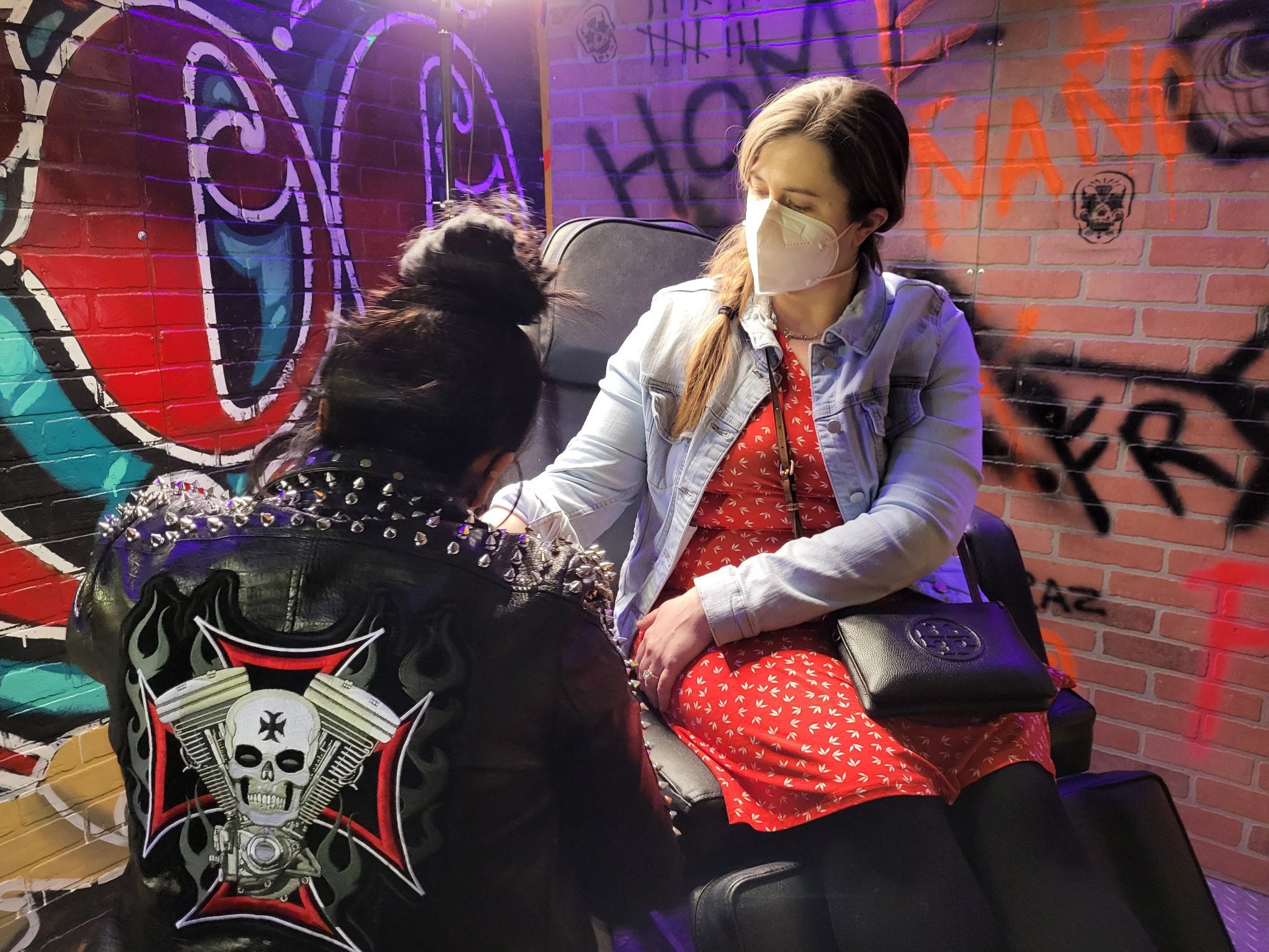
I Went to the Prison-Themed Parking Lot Circus So You Don’t Have To
For the first time in probably a decade, I hear the opening guitar riff of Will Smith’s 2002 hit song “Black Suits Comin’ (Nod Ya Head),” the theme song for the film Men in Black II. It should be noted that I am not watching Men in Black II as I am hearing this. I am not even watching men in black. Instead, I am sitting front row, stage right, watching six men in orange prison jumpsuits completing complex aerial feats.
One of the prisoners with long braids grasps hands with another. His partner is wearing tall orange socks printed with Bart Simpson heads. The partner is shaved bald but for a single braided rat tail sprouting from the top of his head that hangs down to his shoulder. The pair make eye contact and nod at one another then catch eyes with a third guy. The third fellow is smaller, wearing a white tank top, his prison jumpsuit rolled down to his hips.
On the speakers above us, Will Smith is now outlining the plot of Men in Black II. It is lyrically irrelevant but provides a catchy beat for the prisoners’ moves. As the chorus hits, the smaller man runs forward, hits a trampoline, flies in the air, and lands his feet on his comrades’ intertwined hands. The three of them wobble together, stabilizing themselves by moving further and further back, toward the edge of the stage. Toward Paris and me.
I'm in danger, I think, but just in time, the smaller guy jumps down. The men set themselves up for another stunt. Another group of three on the other side of the stage do the same. In between their stunts - either in an effort to hype the crowd or because this song just slaps that hard - the men dance. Not particularly well, but with a lot of joy.
The man with the rat tail and Bart Simpson socks is the best dancer, naturally. He is enthusiastic and entertaining to watch. Still, he never smiles. Instead, he stares with a scowl and vicious eyes at what little audience has assembled here in this pop up circus tent in the parking lot of Town East Mall in Mesquite, Texas on this Friday night in January 2022.
I'm not sure if he is scowling because he hates Will Smith or because he is dedicated to staying in character. His character is a dangerous prisoner at Alcatraz, after all. Not much room for smiling. Though Alcatraz closed nearly 40 years before Will Smith hopped in the studio to lay down this righteous track, the song plays on. As it ends, the prisoners on stage raise their right fists in the air, and the lights go out.
My fiancé Paris and I found ourselves in those premium circus seats that night because of the impulse I have to keep tabs on my hometown. There is a Facebook group for residents of Mesquite, and though I haven’t lived there since 2005, I remain a member.
“Why did I wait 45 minutes in the Whataburger drive-thru last night?” one post read. The question was directed at the lack of staffing at a local burger joint. It was not meant as a request for insight on the author’s life choices, though conclusions could be drawn. Other posts are innocuous. Questions about new city ordinances, or like another I saw this week, inquiries into the goings-on of town: “Any good garage sales in the area this weekend?”
The post that caught my eye was a photo of the mall parking lot. It pictured a white tent, fenced off with barbed-wire. The orange marquee lights across the big top read, “ALCATRAZ PRISON.”
The poster wrote, “Looks like this just arrived at Town East Mall?”
No one in the comments knew the tent’s back story, so I searched and found the circus’s website. The site warned that the show was “intended for a mature audience.” It promised “a gripping narrative, amazing aerial and acrobatic artistry, sensual cabaret dancing, Broadway style musical, and side-splitting comedy.”
All that. In one show. The description read like a Golden Corral had decided to forego the buffet format and instead put all the menu items in a slop bucket and serve it to the customers all together, all at once. And the servers are naked.
At the bottom of the page, I found a link to the show's Instagram page. A man in horn-rimmed glasses with shiny, dark side-parted hair had filmed a video of himself, streaming from a dark mall parking lot in Frisco, Texas.
“Live from Stone Briar Mall, it's Saturday night!” he said, mimicking the announcer from Saturday Night Live.
“With Steve!” He flashed a smile that told me he was Steve. Finding himself alone outside the barbed-wire fence behind him, he panned to a Toyota Corolla parked nearby.
“And this white car!” he said.
He launched into a pitch for the show, hitting many of the website's talking points. Then he entered the tent, still streaming, and turned the camera to show a father/son duo hopping across a highwire wearing orange jumpsuits. It was causal. It was bizarre. It had almost nothing to do with Alcatraz. It was the only way I wanted to spend my Friday night.
With just hours before showtime, I jumped online to buy tickets. The seating chart showed only a handful of the 1,000-some-odd seats had been sold. I winced, imagining Steve performing to an empty parking lot at Town East Mall. I chose two seats on the front row in an entirely empty section to the right of the stage.
After a quick dinner at the nearby Buffalo Wild Wings, Paris and I arrived at the back of Town East Mall. We parked between two stores: JCPenney, where almost all of my "nice" clothes had been purchased for the first twenty years of my life, and Macy's, formerly Foley's, which was our family's storefront of choice for pick-ups and drop-offs during parent-free trips to the mall in middle school.
All at once, Paris and I find ourselves at the threshold of Cirque Alcatraz.
Walking in, we pass a rusted white school bus with "ALCATRAZ PRISON" printed on the side — nevermind that Alcatraz is an island and nobody is getting there by bus.
Paris pulls back the white vinyl that serves as the door. We step inside, bumping into a prison guard holding a Canon digital camera. He doesn't speak. Doesn't welcome us to the show. It's prison, after all, so get against the wall. He points to a wall plastered with White Bulger and Roy Gardner's mugshots, two famous Alcatraz inmates.
The guard snaps our photo and says nothing. We aren't given a number or any instructions on how to retrieve it later. We just move on to the next guard who scans the tickets on my phone and points to my left.
“You need to go that way,” she says, pointing to one of the larger tent's entrances.
We go the other way because we spot the tattoo booth. A black binder sits on a table, filled with airbrush tattoo templates. A woman with a jet black ponytail wearing a studded black leather jacket is bent over airbrushing a soccer mom's forearm.
Yet another guard, this one in a black nylon jacket with a faded Ringing Brothers logo points to the binders.
“There are many designs,” he says.
Paris and I flip through the stencils. Some say words like “love” and “peace.” Others are images - a deer, a butterfly, a bird. Some of the stencils have two designs on one piece of plastic to save space. I spot one of these that reads “FUCK” in block letters up top and “End is Forever” in script below, with a crown hanging from the R. I slip that one out and wait my turn. Paris continues to flip through, looking for a design that would go best on his neck.
I make eye contact with the guard.
“Are you from this town?” he asks. I tell him I was born here, but now I live a few minutes away.
“It is a very nice town,” he says. I thank him. “I've been traveling with circuses for many years. All over the world,” he says.
I note how faded the old Ringling Brothers logo on his jacket is, how dirty it is, too.
“You know where is my favorite place I've ever been?” he asks, then pauses, leaving me to guess.
“Here?” I say, confused.
“Savannah, Georgia,” he says at the same time.
“Oh,” I say. “That makes more sense.”
He tells me how beautiful Savannah is. How the trees are green and the buildings are old and beautiful and how the people are the nicest people he’s ever encountered. I tell him I'll have to visit some day.
What a friendly prison guard, I think as Paris hands him $10 cash for the tattoos.
On the way to our seats, we stop at a posted sign.
“WARNING,” it reads before listing off what we are about to see. The list includes “vulgar language, extreme simulated violence, sexually suggestive content, and drug use." Jesus. It warns that if we have epilepsy or PTSD, we should turn back now. Finally, an important heads up: “Our actors may touch you.”
Suddenly I regret getting front row seats.
The round stage juts into the audience so there are spectators on three sides. Our seats, it turns out, are not only front row, but are also aisle seats, directly adjacent to a stage entrance.
We about to get touched tonight, I think.
Between our seats and the stage, down below, I can see the painted lines of the parking lot we’re in. Paris leans back in his plastic seat, and the entire row tilts with him. The floor beneath us, black painted plywood, creaks under our weight. The room is bathed in blue light. Smoke billows in. I hope it’s part of the show. A haunting song begins.
“Spooky music,” I say.
“That’s the soundtrack to Insidious,” Paris says.
A few minutes after showtime, a prison siren finally sounds. The room goes red. Guards climb the light-rigs around the stage up to platforms above the audience.
A voice comes over the speakers. He calls us maggots. He tells us to look around for the nearest exits and not to smoke. He says there are no bathrooms and if we “need to take a piss” we should do it where we are. It’s a joke, of course, but I look at some of my fellow audience members and wonder whether they may be tempted by this directive.
The opening riff to “Welcome to the Jungle” begins because of course it does. The music is so loud my head feels like it’s underwater. Guards and prisoners descend on the stage. They stage-fight until only six prisoners are left. Those six grab long chains from backstage and start jump roping, just like in real prison.
They do push-up jumps and duo-jumps and Double Dutch with a second chain. They black-flip through the chains, somersaulting between each swing, never missing a beat. They ditch the chains and start launching each other in the air, doing stunts that would put any cheerleading squad to shame. By the time the song ends, I am exhausted from having watched them.
Suddenly, a spotlight. It’s Steve from Instagram accompanied by a man I later find out is his comedy partner of nearly twenty years, Ryan. They do their bit, joking with the audience, doing crowd-work, and I start to hate them a little. I cringe for them, for the things they’re having to do. But then, I see Ryan break. He genuinely laughs at something Steve says. I recognize that laugh, the kind that happens on stage when you love your scene partner.
They launch into a musical number, the Broadway-style entertainment we'd been promised. The thing is -- they’re good. They can both sing well, and whoever wrote this little Rodgers-and-Hammerstein-style ditty about dropping the soap knew what they were doing. Prison jokes aside, it is a song about being best friends, and Steve and Ryan, professional circus clowns, singing as Steve and Ryan, the wrongfully convicted prisoners, certainly are.
After the song, they leave the stage, but not before Ryan does a pratfall and announces for no reason in particular, “I landed on my own balls.”
They’re followed by a contortionist with a long brassy ponytail and jet black roots. She bends her body in ways I haven't seen since The Exorcist.
I wonder if they have a physical therapist who travels with the show. Then I look around at the near empty tent. I debate referring her to my chiropractor whose practice is in Mesquite (Hi, Dr. Doughty!) but then remember they're leaving Sunday. They're headed from Mesquite to Grand Prairie, then on to Houston.
Once she has untangled herself, the contortionist is replaced by a juggler. He throws balls around for the duration of a nondescript heavy metal song then does a backflip and leaves.
In the darkness, someone rolls a desk on stage. A guard enters with a chair. He sits at the desk, rolls up his sleeve, and grabs a rubber hose. Things have escalated quickly.
“Is he about to do heroin?” I ask.
“The poster warned us there was a drug scene,” Paris whispers back.
“White Rabbit” by Jefferson Airplane serves as the soundtrack to his (hopefully) faux injection. The lights then go out and a colorful spotlight comes up on the desk in pink, green, yellow, and orange. We are to believe the heroin has made the guard hallucinate.
“Does heroin make you hallucinate?” I ask Paris.
“Not that I know of,” he says.
“Must be a bad batch,” I say.
The guard opens the desk, and a clown pops out. Its face is painted white with big red lips, and its head is covered in a jester cap that is just a little too big. It is also wearing a matching one-piece clown suit. The guard throws the clown around in a human ragdoll/contortionist routine.
The song heads for a crescendo when, apropos of nothing, the clown strips off its clown suit to reveal it has been a hot lady under there this whole time. Orange bra and panty set. Sexy black garters with fishnet thigh-highs. Clown face. Every high prison guard's dream.
“I did not expect it to be a sex clown,” I whisper to Paris as the sex clown climbs on the desk and begins to gyrate.
“Always bet on the sex clown,” he says as the lights go down and the song finishes.
Some more guards roll out a dolly carrying a man dressed as Hannibal Lecter from Silence of the Lambs - complete with a brown leather facemask and straight jacket.
“But Alcatraz closed in 1963,” I whisper to Paris.
“Yeah, and Hannibal Lecter was fictional,” he says back.
After the guards remove his straight jacket (rookie mistake), Hannibal runs off, shooting a couple of guards with a stolen gun along the way. We never see him again.
Steve and Ryan are back. After some back and forth that includes meta-commentary on the light cues and the spotty functionality of Ryan’s headset mic, Steve ends up face-down on a table covered with a sheet. Ryan begins retrieving increasingly larger objects from Steve's rectum - single cigarettes, an entire carton, a bouquet of fake flowers, a plunger, a board game.
Steve says he feels like a Muppet, which prompts what we believe is an improvised riff about what it would be like to have sexual intercourse with Kermit the Frog.
“You think this was scripted?” I ask Paris. He looks at me and says nothing.
Across the stage in the section opposite ours, I spot three teenagers sitting side by side. They are wholly unimpressed with the stuffed butt bit. One is texting on his phone, while the other two sit with their faces drawn up in scowls that look like they have smelled a fart. Behind them are rows and rows and rows of empty seats. Hundreds of them.
On stage, Steve makes a sound like Curly from The Three Stooges. His gurney has started rolling downstage toward the audience.
“Oh, oh, oh,” Steve cries out in a tone that indicates this wasn’t part of the bit.
“Someone could die tonight,” Paris says as a show photographer jumps from the crowd to stop the runaway bed.
From that moment on, the stakes became sky high. Sure, they had a website. A lot of them had been at this for decades. They drove their show around in tractor-trailers wrapped with their logo that looked legit. But also, this is a parking lot circus. Things could go wrong.
The next act is another juggler. Framed by strobe lights and backed by more copyright-free rock music, he performs a routine that could land him on stage at America’s Got Talent. He juggles clubs at first then moves on to disks the size of Frisbees with head-size holes in the center.
He tees himself up to juggle five of the disks. He tries throwing them all high in the air with the goal of catching them and putting them around his neck one by one. He gets three. One clatters to the ground. Another rolls off toward the audience and ends up beneath the stage.
Undeterred, he goes to the bent metal cart he had wheeled out on stage and grabs four more. He tries the trick again. A look of trepidation creeps on his face. My stomach hurts. It’s not the Buffalo Wild Wings from earlier. I am so nervous for him. He throws all seven in the air and misses two again. I burn with him and feel the look of disappointment on his face as he scrambles to retrieve the fallen disks.
The juggler pauses. He loops all the disks around his forearm and shuts his eyes.
Later, in the car on the way home, Paris will ask me whether I thought this next part was staged. At first, I will say no, but then I will concede that it could have been. I don’t care, though, and Paris didn’t either.
With eyes closed, the juggler takes three deep breaths. The crowd is silent. Then, with no prompting from either the juggler or the announcer, something amazing happens. We begin to stomp in unison. We clap, too. Everyone hoots. We whoop. We scream. The sound of our unified clapping and stomping makes the relatively empty tent sound full. I put down my pen and notebook and cup my hands around my face mask.
"You can do it," I scream through the layers.
The juggler opens his eyes, a new resolve has come over him. He begins to juggle all the disks, then tosses them high in the air - higher than before. Higher than I thought possible. I realize there is nothing more that I want in that moment than for him to crush the trick.
One by one, in an instant, he catches each of the disks. He loops each one around his neck, then reaches back out to catch the others. Paris and I are screaming. We grasp hands. We look around. All the people in the crowd - even the annoyed teenagers - are screaming. We rise up out of our seats, overjoyed for this man. He smiles. He bows. He leaves, triumphant.
The acrobats return and perform their routine to the theme from Men in Black II. When they finish, they huddle together in a circle. I hope the hug is real and they’re best friends off-stage, too.
At intermission, I pay $15 to take a photo with them. When I ask them how we should pose, the most prolific flipper tells me through a plastic face shield, “Whatever you want.”
“Give me the usual,” I say.
They surround me on either side while the best flipper uses his hand to pantomime choking me.
The highlight of the show’s second half is Steve’s strip tease. When the poster out front warned of “sensual cabaret style dancing,” I never imagined this. After a quick-change bit, Steve ends up in his white Hanes briefs. “Bad to the Bone” pumps through the speakers behind him. Steve dances across the stage and comes directly to me.
He props a leg up on the barricade separating me from the stage. He rubs his nipples. We lock eyes.
I've been doing improv comedy since high school. I’ve performed my share of strange bits in near-empty rooms. Sure, it’s never been in my thinnest undergarments, but I feel connected to Steve in this moment. A fellow clown, doing his best. I put down my notebook. I woo. I raise my hands above my head. The more I scream, the more he gyrates. He thrusts harder. I notice that he is not wearing special stage-underpants but just your run-of-the-mill, straight-out-of-the-package kind of drawers.
Still, I play into it. As he thrusts, I fan myself in overexaggerated motions for the rest of the crowd to see. After a few moments of back-and-forth, I throw my head back, spent. Steve smiles. He heads out into the crowd to find another victim.
He finishes the strip tease, and he and Ryan leave the stage. The guards bring a huge box out. The walls of the box fall down and reveal an electric chair. Inmates gather in a circle around the chair, and I think this is probably not the protocol for executions.
Ryan is brought back on stage, and the guards pull a black executioner's hood over his head. Within seconds, he seated, strapped in, and put to death by electric chair. Steve puts his face in his hands. His shoulders shake from crying.
The guards drag the chair, body and all, off-stage. More guards enter moments later, carrying a coffin. An audience member stands, removing his hat and placing it over his heart as the coffin passes. I love Mesquite. The guards do a lap around the audience then head backstage.
“Enter Sandman” begins. The six-pack of acrobats is back. This time they brought a swing and take turns jumping from the swing into a fall-bag. I see one of them mouthing the lyrics and wonder how many times he must have heard this song by now. They move the fall bag, and when one of them flips in the air, the rest gather round and catch him. It’s so exciting, it really makes you forget that a man died by electrocution just moments earlier.
The acrobats roll their swing and bag off stage, and Steve returns, now alone. Ryan is dead.
But then - a spotlight.
It’s Ryan! He’s an angel now. Steve asks if Ryan is his guardian angel.
Ryan says, “Bibbity bobbity boo, bitch.”
The line kills. The audience eats it up. Steve asks whether he’ll become an angel when he dies, too. The show has taken a dark turn.
“Of course,” Ryan says. “You're a --” he pauses, drawing a square in the air front of him with his index fingers.
“A square?” Steve asks.
“No, a cunt,” Ryan says.
“What?” I yelp. Paris belly laughs.
“Are you laughing at that joke? I don't get it,” I whisper.
“No, I'm laughing at you,” he says. “And all this.” He gestures around.
He was right to laugh. It was absurd. All of it. I had a lot of notes.
You can’t fit that many things in a human rectum. Heroin doesn’t make you hallucinate. Most clowns aren’t sex clowns. Prison guards don’t let prisoners loose from their straight jackets for no reason.
Alcatraz didn’t have death penalty facilities. They weren’t electrocuting anyone over there, at least not on purpose. Ryan never would have been executed and never would have turned into an angel.
The prison grounds couldn’t have accommodated a trapeze setup or a high wire. They never gave the inmates trampolines or swings or Bart Simpson socks. Alcatraz closed in 1963. How could these inmates have choreographed their routine to a song from 2002 by an artist who wouldn’t even be born until five years after the prison had closed?
I stopped myself.
After all, we weren’t at Alcatraz. Not the real one anyway. We were at Cirque Alcatraz. At Cirque Alcatraz, you let it all go. You clap your hands. You stomp your feet. You nod ya head and just enjoy.
***
This piece first appeared in Sunday Morning Hot Tea. Subscribe so you don’t miss another piece.
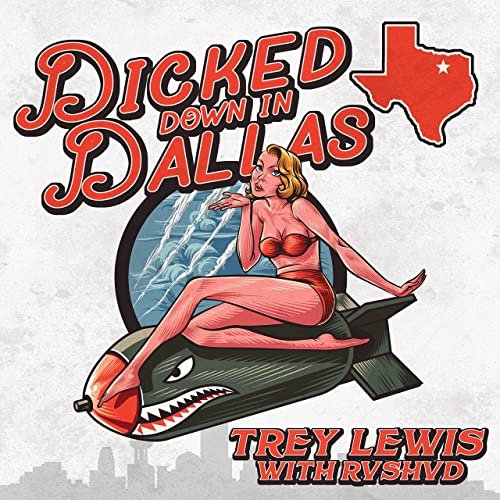
In Defense of “Dicked Down in Dallas”
As I was researching our most recent Sinisterhood minisode, I decided to search Spotify for some songs about Dallas that I may not have heard before. Up popped Willie Nelson’s “Dallas,” an old favorite. Then I scrolled to Alan Jackson’s “Dallas,” a hit by anyone’s standards. Of course, Spotify offered me the theme song to the TV show Dallas. A hype song, but not what I was looking for
Then I spotted it. Sitting at the bottom of the search results was a tune by someone named Trey Lewis. A name and a song that I had never heard before. Familiar with Willie’s contribution and already tired of Jackson’s before the chorus even begun (Sorry, Alan, but it’s no “Chatahoochie,”) I clicked play on the new song.
Once the opening chords began, I fell in love. It’s a modern country classic. The strum of the guitar. The hit of the bass. The lyrics - pure poetry. Given the song’s liberal use of swears, I’ll issue a warning to you now - by proceeding further, you will see some naughty words. If you choose to listen along to the song while reading this - which I highly recommend - you’ll hear a lot more.
As I listened for the first time, I became outraged. It had nothing to do with the curse words. I sat there, hurt, wondering why no one in my life - not anyone who knows me personally nor anyone familiar with the podcast - ever bothered to send this song to me. After poking around on Google, I found that it went viral on TikTok in December 2020. That was a full year before I ever heard it. How dare you all let me down so hard?
Late to the party though I may be, I’m asking you to put aside any preconceived notions you may have based on the song’s title or the obscenity of the lyrics. Free your mind, open your heart, and join me on a journey into the majestic beauty of “Dicked Down in Dallas,” a song celebrating the beauty and independence of female sexuality.
“Dicked Down in Dallas” primarily catalogs the sexual exploits of a specific woman. Though the list of acts and geographic locations is long, at no point does the narrator ever slut shame her. He lists the various sex acts she engages in - including being “analed in Austin” and “buttf**ked in Boston” - but never assigns a moral value to her acts. He also doesn’t name her or directly identify her.
In the second verse, he veers into possible judgement, saying, “I wonder what her Daddy’d say,” speculating, “Maybe he’s the one to blame.” Given the narrator’s morally agnostic discussion of her actions throughout the rest of the song, I hesitate to jump to labeling this a judgment. Instead, I see this as a comment on the patriarchy’s harmful oppression that the woman (the “dickee” in this song) and every other female-identifying person has to suffer. If she wants to get “tore up in Tyler” and be free to “drop[] it like a tailgate,” she should be able to do so, without her actual “Daddy” or the proverbial “Daddy” of society judging her. And if either her father or society as a whole were so inclined to judge, their harmfully antiquated views of female sexuality make them “the one[s] to blame.”
In addition to the original song, there is a remix featuring singer Rvshvd (pronounced “Rashad”) that includes a bridge not in the initial version. The bridge offers the greatest simile in the history of music, as sung by Rvshvd himself. He observes the female protagonist to be “Poppin’ that cooter like a cap gun.” Who, except a poetic genius, would ever think to compare the enthusiastic way a female uses her sex organs with the white hot fire of a non-lethal fire arm?
The remix offers up a few additional lyrics that, upon first blush, appear to toe the line between acceptance and judgment. Rvshvd comments, “I’m a little concerned,” regarding the woman’s many exploits. However, his concern should not be read as judgment. Any of us, with the knowledge that a friend was getting “nasty in Nashville” to the point that “everyone knows her name” would express our concern as to whether she was getting nasty in the safest way possible (e.g., with the proper prophylactic measures in place).
It is also relevant to note that this song was released at the height of the COVID-19 pandemic. Rvshvd’s expression of concern was therefore more likely regarding her adherence to proper CDC guidelines and social distancing measures than any concern about her chastity or reputation.
The COVID concern is even more likely given his description of her generous lovemaking style as being “like a little league team, everybody gets a turn.” With that many participants engaging in the process, guidelines must be observed for everyone’s safety. Hopefully with everyone tested, masked, and vaxxed, she can run through that train with nary a sniffle.
The most beautiful part of “Dicked Down in Dallas” is the narrator expressing his ongoing interest in the female protagonist’s return, all the while acknowledging her otherwise full dance card. This is expressed perfectly when he sings, “Now I’m the one on my knees/Praying she’ll come back/Give me that sweet ass” despite his already knowing well that “she is getting dicked down in Dallas.” Fully aware of her myriad exploits, the narrator still wants her. This flies in the face of misogynistic expressions (both in real life and online) that classify a woman with a robust sex life as being impure or sexually undesirable.
The narrator here is not disgusted by her past (or present, for that matter). Rather, he reaffirms over and over his ongoing romantic interest in the ingenue, though she is “putting [him] through hell/f**king someone else.” If he were making a judgmental statement and planned to reject her for her sexually robust behavior, he would no longer express an interest to have her back. He could save the strain on his knees and quit praying for the return of her sweet ass.
The catalog of her various acts is not paired with any moral judgment. The only behavior for which he expresses a disdain does not involve her sexuality at all. Instead, it is her thoughtlessness as she took off “like a bat out of hell” headed out to begin (or continue) her sexual walkabout. The only thing he complains about is her series of abrupt departures without offering sufficient goodbyes.
His silence as to the moral value of her sexual escapades is proper given the pair’s ambiguous relationship status. Though the narrator is disappointed that she “left [him] all alone in Montgomery tonight,” nothing in the song points to the couple having an exclusive monogamous relationship. On the contrary, he laments that she “didn’t think twice about Amarillo” and that “Denver all but once crossed her mind.” If the narrator was the one left alone in Montgomery, but not the one left in Denver or Amarillo, then he has knowledge of other sexual partners in those towns who had suffered the same fate as he.
Yes, she may have made it with him in Montgomery, but he has no ownership over either the dickee or her body. Absent an agreement between the parties, he has no grounds to object to her behavior. Given the ambiguity of their relationship, that only affirms the beauty of “Dicked Down in Dallas.” He is in emotional turmoil at the natural end of their non-monogamous tryst, yet he never passes a negative judgement on her behavior.
He is able to express his feelings, voice his disappointment, and lament the ache of her absence but has progressed beyond the misogynistic need to lash out at the woman who has caused his heartache. The easiest path would be to sling mud, call names, and label her an unchaste woman. Yet, instead, he presents the reality as it is and expresses his feelings on the situation without assigning a moral value to her behavior.
The exaltation of the female protagonist is well deserved. There has not been a harder working character in a song since Dolly Parton’s “9 to 5.” She is traveling the country, which is a hassle in and of itself. Not only that, she is also getting tore up left, right, and center all along the way. This includes “suckin’ off ol’ what’s his name” in the Lone Star State as you are trying so hard to well as being both analed in Austin and buttf**ked in Boston. The singer's choice to name two seemingly similar acts in two different ways may be in an effort to delineate between two different acts, or merely a device to achieve poetic alliteration. In either case, it only further proves her endurance and ability to withstand great physical challenges.
Not only is she busy fogging up windows of all kinds (“Chevy’s, ‘Yotas, and Fords”), she is driving cross country in order to do so. Driving is exhausting. Driving AFTER you’ve been dicked down? That’s a super-heroic feat. Not to mention the price of gasoline and the general wear and tear on her car. And her ass.
At first blush, it would be easy to label this song vulgar and a transparent attempt to slut-shame a man’s ex. However, when the lyrics are examined, we see it is a highly evolved work of poetry, celebrating the female body’s capacity for hard work and difficult feats. It also gave us the phrase “poppin’ that cooter like a cap gun,” and for that I will always be grateful.
***
This piece first appeared in Sunday Morning Hot Tea. Subscribe so you don’t miss another piece.
9/11/2002
It was the fall semester of my sophomore year in high school. 2002. A weird time for anybody - being a sophomore in high school and all. But also a weird time for being an American - being post-9/11 and all.
My school was especially hard to navigate as far as cliques was concerned. I was in theater, so I had my theater friends. And I was in gifted/talented English, so I had my GT nerd friends. The one clique I desperately yearned to be a part of was the most visible clique of all - the Christian kids.
As far as cliques go, the Christian kids weren’t terribly exclusive. The only requirements to join were (1) offering your eternal soul to Jesus, and (2) attending weekly meetings. But, like so many religions throughout the centuries, the Christian cliques in my school had separated into schisms.
In one corner, wearing orange T-shirts on worship-day Wednesday, was the crew from Mimosa Lane Baptist Church. And in the other corner, wearing royal blue T-shirts on worship-day Wednesday was the group from Sunnyvale Baptist Church. Warring gangs in a battle for teenage souls.
I wasn’t raised religious. I didn’t have a yearning for the Lord’s word. I just wanted one of those T-shirts. I wanted to be part of the sea of a thousand shirts, swimming with one school or the other. Didn’t matter which one. I wanted to belong.
My family went to church service about once a year (some years) at a small shack of a place behind the nearby elementary school. The preacher there was all fire and brimstone. He was a thousand-year-old man in an even older suit, yelling until he was red in the face about damnation. He punctuated each sweat-soaked sermons with an “Amen,” that was called back to him from the folks in the pews.
My mom’s best friend, Lillian, was the one who invited us to attend that church with her. Lillian was a foul-mouthed redhead about ten year’s my mom’s senior. She wore large, round glasses the diameter of a coffee mug and had a mouth permanently drawn up in a skeptical smirk. Her cheeks were sunken from years of wrapping her lips around cigarettes, and she was the first person I ever heard say the word “fuck” in real life.
“Sometimes the only thing that will help is a good use of the word ‘fuck,’” Lillian told me. Once, when she had dropped a 64 oz. can of Wolf Brand Chili on her toe, she told me the only thing that got her through the pain was a good “fuck.”
I took this lesson to heart. In middle school, when I slammed my finger in my locker door, the only thing I could do was grumble a good “fuck” to the shock of the kids in earshot.
Our middle school sat in the nexus of two neighborhoods - old Mesquite, where I lived, and the newly developed and more affluent Creek Crossing. When the new houses were built in Creek Crossing, the city had to build new schools to serve the influx of residents. First, they built grade schools, and a middle school soon followed. When they drew the lines determining who went where, my street and its solidly built but much older houses ended up drawn into the new middle school zone.
Some of the kids in Creek Crossing had not heard the word “fuck” on TV, forget about real life. Certainly never from another kid. I was willing to say it, though, along with any number of other curse words I had learned from my favorite show, South Park. This reputation made me the proud recipient of seven - yes, SEVEN - Bibles the first year of middle school. A few shy, religious kids, no doubt prompted by their well-meaning parents, scurried up to me at various points throughout the day before Christmas break. They thrust the Bibles toward me with a quiet, “Here you go. Merry Christmas.”
By high school, none of the many Bibles I had received had managed to cast the cursing demon out of me. It was no wonder then that I had not been invited to one of the two ultra-popular religious cliques. At first, I rebelled. I told myself I didn’t want to go to either of their nerd churches. They sounded boring. And dumb. But these were just lies I told myself to feel better. The truth was I yearned to be invited. I ached to wear one of those T-shirts on Wednesdays. I decided what I wanted most of all was to go to the orange church.
Yes, the orange church was where most of my friends attended. But I also made that church the focus of my desire by process of elimination. I didn’t want to go to the blue church because of some stories I had heard from its attendees. They had scared me straight into camp orange.
A blue-shirt-wearing classmate told me how she got fingered by her boyfriend in the church bathroom during Wednesday night services. Another attendee described trying anal sex for the first time in the cab of her boyfriend’s truck in the blue church parking lot after a different Wednesday night worship service. Both attendees felt comfortable performing these sex acts because, according to them, neither of those counted as “sex” in the Lord’s eye. It didn’t seem to factor into the equation that the acts were performed on church property.
Not wanting to be penetrated in any way, God-approved or not, I decided that the blue shirt church was not for me.
After waiting all of freshman year, finally, a few weeks into the fall semester of our sophomore year, it happened. An orange-shirted classmate invited me to Wednesday night worship service. I was in.
On Wednesday, September 11, 2002, I begged my mom and she agreed to drive me to the evening worship service at the orange shirt church.
Once inside, I felt still in a room swirling with laughing, shiny, blonde kids. I had walked in on a warmup game. Lesson number one: you’ve gotta warm up for worship! Groups of teens were challenged to throw plastic fish into assigned baskets. Unfamiliar with most Bible verses, I was left to assume that this game had something to do with scripture.
Listen, I said I RECEIVED Bibles as gifts. I never said that I had studied those Bibles. For all I knew, there was a passage saying, “And then the Lord sayeth onto the crowd, ‘Throw thine fish into thither basket, m’lords and ladies.’” That’s what the Bible sounds like, right? Like something from a Renaissance faire?
That was another reason I wanted to be recruited into the T-shirt gangs – the Bible references. I could have listed off the whole cast of The Dick Van Dyke Show. I could have given you the entire track listing of every Beatles album. If you needed someone to recite Monty Python and the Holy Grail, I was your girl. But when it came to understanding the reference of a cool kid’s “Abreadcrumb & Fish” Abercrombie & Fitch Christian parody shirt, I was outmatched.
High energy games like fish-in-a-basket were a great marketing ploy to get kids in the door. If you wanted to recruit the school’s best and brightest (who, in turn, would bring in the street rats like me), you had to throw some fun and games in there. I don’t blame them. Competition for souls was high. In our small town of Mesquite, there were easily 20+ churches all vying for attendees. If you could do like orange shirt church and recruit the coolest kids - your baseball stars and football stars and soccer stars - the rest would come.
Amidst the chaos, I saw a sandy haired guy in his early twenties take the stage. He put the mic to his mouth and asked if maybe we wouldn’t mind finishing up our games and could we please, um, possibly take our seats?
I had never even begun the game. Not understanding its purpose, I had lied to my team and said I had to go to the bathroom. Instead, I wandered from my assigned group of smiling Hollister models and crept to the back wall where I watched in silence as everyone else played.
Behind the leader who couldn’t lead, a group of kids I recognized as musicians from school took the stage and started grabbing instruments. The projector lit up. My classmates began to play, and the dough-faced leader took the microphone from the stand.
“Everybody, let’s take a seat,” he said. I complied, taking a seat about halfway up the room, dead center.
Of the fifty or more teens in the room, I was joined by only about five more. The rest were too wrapped up in the Holy Spirit of competition to obey the youth pastor’s commands.
He surveyed the room, pressed the mic closer to his lips, and motioned for the sound engineer at the back of the room to crank up the volume.
“LET. US. PRAY,” he shouted.
The room fell silent as if he had flipped a kill switch within everyone’s brains all at once. I looked over each of my shoulders in turn. Everyone – every single human person around me – had dropped their heads in a bow and now stood silent and still. Feeling like my head was very obviously the only un-whacked mole, I bowed down, too, and prepared for my moment with the Lord.
Face with the full attention of the crowd, the youth leader began his prayer.
“Lord, may we please ask for all these children - your children, Father God - to come to order and have a seat?”
I was no expert, but this seemed like a petty request to ask of the one Almighty God. I didn’t know Him that well, but I couldn’t imagine God was that much of a micromanager. But, like sheep in the proverbial flock, the other kids came over and filled in the pews around me.
“Thank you, Lord,” the youth leader said. I was impressed. God had moved these teenagers to sit down. Truly moved by the power of prayer. Praise the Lord. The youth leader began his sermon.
“The events of this day one year ago are, I’m sure, imprinted on all of your minds just like they are on mine. You remember where you were and who you were with when you watched the news of the attack.”
He was right. I remembered that day as clearly as I remember it all these years later. I was brushing my teeth and listening to the Kidd Kraddick in the Morning drive time radio show. My mom had turned on the local news. We listened to Kidd and watched the footage on ABC News. There it was - what would become an iconic image of the World Trade Center, billowing smoke, flaming across the bright blue New York sky.
“My God,” I said, toothbrush still in my mouth. “That pilot is such an idiot. The building is huge. How could anyone have run a plane into the side? Don’t they have computers on board or something?”
My mom shook her head and told me what we’d all soon learn was the truth: “That was no accident.”
At thirteen, I didn’t really grasp what a terrorist was. Before that day, terrorists were bad guys in movies – your Hans Grubers, British and sinister, wearing suits and doing heists. Now, terrorists were very real, right there on TV, the impact of their carnage evident in images that would be printed in history books.
In those initial moments, I couldn’t grasp all the lives that were lost that day. All the moms and dads and daughters and sons and friends and neighbors who wouldn’t come back home. Watching the smoke billowing back into the building, I never considered people who were suffocating, burning to death, trapped in those walls. Those realizations came with time. As it unfolded in real time, I still had the benefit of innocence.
Little black dots began streaming down the screen. Those were people. Jumping. I couldn’t fathom why they would jump. Just wait, I thought, naive and hopeful. Help is on the way.
The morning of 9/11, I stood watching Good Morning America, while listening to Kidd Kraddick try to carry on and offer some sense of hope. Then another plane entered the frame.
Watch out for that building, I thought. It was too late. Just like that - one minute you’re hurtling through the air in a pressurized cabin or sitting at your desk trading stocks or whatever and the next you’re engulfed in flames.
I don’t know if I screamed. I can’t remember if I cried. I know my mom, clinging to some sense of normalcy, drove me to school that day. I rode along, eager to board my school bus for a scheduled field trip that would never happen.
A year to that day, I then found myself in a church pew, surrounded by a venerable who’s-who of our school. I was following the crowd, sure. Thirsty for a t-shirt, admittedly. But I was also looking for answers. I was looking for God, the great and powerful deity, the Awesome One, subject of the music advertised on late night commercials.
I thought surely He dwelled within the walls of this, the trendiest church, where His most cherubic-faced followers gathered to raise their arms and praise Him. I was there to seek Him and expected that He would offer me an answer as to why something like 9/11 could have happened. These, the coolest of kids of our school, would help me receive his message.
Pastor Chet/Chad/Brad adjusted the microphone cord and continued his sermon. The assembled teenage band behind him strummed their instruments in a quiet soundtrack to his words.
“On a day like today, we want to be thankful. Thankful to be together. Thankful for the first responders – the heroes – who put their lives on the line that day, one year ago.”
The teens around me were not thankful. Or at least, if they were, they were too chatty to recognize it. I struggled to hear him over whispers and giggles. His eyes darted around, and he went back to his tried-and-true trick.
“Let us pray!” he commanded once again. The students responded. Again, their heads dropped in immediate silence.
“Lord, please give these students some patience. Father God, we ask you to give these students the self-control not to talk while I am talking,” he said.
My head popped up from its bow. I stared up at Chet/Chad/Brad. There he stood, nearly a teen himself, fresh out of whatever school qualifies you to be a youth pastor, asking God once again to use His almighty power to step in and do some crowd control.
Now standing in reverent silence, he finished it off with an “Amen!” With the full attention of the crowd, he got into the meat of his message.
“You all remember last year, when those terrorists got into the pilots’ cabins and crashed those planes. Before the terrorists got in there, those planes were headed to their destinations. And they would have made it if not for those terrorists.”
Yikes, I thought. Coming on a little strong with the terrorism reminders. Still, I was patient. It wasn’t easy to discuss this kind of thing. He continued.
“I want you to think about that. About those terrorists overwhelming the pilots. You are like those airplanes,” he said.
Oh no, I thought. Don’t do it. Don’t do it.
He did it.
“You are a plane scheduled to go to the ultimate destination,” he said, pausing for effect. After he looked across the crowd and found us sufficiently attentive, he whispered into the microphone: “Heaven.”
My eyebrows shot up. I checked the faces of the students around me, but no one else seemed to be reacting.
“Jesus died so all of you could go to your destination. He bought that plane ticket for you. But your destination is not guaranteed. Just like all those people on the planes on 9/11. The devil – he’s like those terrorists. He wants to derail you and keep you from your destination. The devil is banging on the door of the cockpit of your soul. You cannot let him in. Once he’s in your cockpit, he will crash your plane right into those flaming Twin Towers of sin.”
My eyes were wide, but I wasn’t staring at Pastor Chet/Chad/Brad. I was staring through him. I remembered watching the towers burn just a year before. I remembered watching the memorials and fundraisers on TV in the months since. Families torn apart. Widows and orphans heartbroken. I remembered hearing about the heroes – both the first responders at the crash sites and the passengers in the planes who fought like hell to keep the attackers at bay. My eyes adjusted, and I looked in front of me at this chucklehead, using their deaths as some weird lesson.
Aside from being distasteful and patently offensive, the metaphor also didn’t work from a rhetorical standpoint. The “Twin Towers of sin” is nonsense. No one in those people in towers deserved to be there when that happened. “Letting the terrorists in the cockpit” was an equally shitty selection of words, implying that if only those folks in the planes had fought harder, things would have been different. That they let the terrorists in.
I was mostly disgusted that I came for existential answers to big questions – Why are there terrorists? Why does God let bad things happen? How do we heal and move forward? And got this pile of shit instead. Rather than provide me any answers or even comfort, this peach-fuzzed bobblehead with a microphone turned a once-in-a-generation tragedy into a cautionary tale about bare-knuckle boxing the devil.
His speech was more patronizing than any plastic fish game and more disgusting than anything that happened in that other church’s parking lot.
I don’t remember what else he said that night. I do remember walking to my mom’s minivan in a line of headlights later that night. I slinked into the front seat.
“How was it?” she asked.
“It sucked,” I said.
“Oh really?”
“He told us not to let the devil break into the cockpits of our souls and crash our planes into the Twin Towers of sin,” I said.
She laughed.
“Well at least you tried,” she said. “Did you get a t-shirt?”
“I don’t give a fuck about a t-shirt,” I said.
***
This piece first appeared in Sunday Morning Hot Tea. Subscribe so you don’t miss another piece.