


Legal Question: Too Squat to Handle - Squatters Rights
This week’s question is from Madeline Ramirez via the form. Madeline asks:
I recently watched an episode of Fresh Off the Boat in which the mom, Jessica, had to deal with renters/squatters on her rental property. The squatters referenced Squatters Rights to keep her from calling the police/evicting them. If you own property and find someone living there illegally/without your knowledge/without paying rent, at what point can’t you kick them out? How accurate are the squatter-scenarios we see in the media, and what is the extent of squatter’s rights in reality?
Thanks for asking, Madeline!
What are Squtters Rights?
This is a great question, and one that comes up in first-year Property Law classes in law school. Squatters’ rights are legally known as Adverse Possession. The laws vary by state, but for the most part, there are similar requirements across states. In Texas, the law governing adverse possession can be found in the Civil Practices and Remedies Code at Section 16.021 et. seq.
In order for a non-owner to claim ownership over a piece of land, there must be “an actual and visible appropriation of real property, commenced and continued under a claim of right that is inconsistent with and is hostile to the claim of another person.”
Let’s break that down.
1. Actual and Visible Appropriation of Real Property: This means that the “squatters” would have to actually be on the land they’re claiming in a visible way. This means the squatter can’t be hidden from view and must be visibly on the land so that the owner would have a chance to notice them there.
2. Commenced and Continued Under a Claim of Right that is Inconsistent with and Hostile to the Claim of Another Person: This means that when the possession of the property began and as it continued, the squatter claimed ownership over property that was legally owned by someone else.
Case law in Texas has added a few more requirements on top of that. The requirements are as follows with a little explanation next to each.
1. Actual possession of the disputed property - The squatter has to “actually” possess it – the squatter can’t just want to claim the land. He or she must actually be on the land. Additionally, they can’t just be there for a day or two (see below for time requirement).
2. That is open and notorious – Like we said above, they have to be obviously on the land, not hiding out and sneaking around.
3. Peaceable – The squatters can’t threaten physical violence to keep the owners out.
4. Under a claim of right – The squatters must intend to claim the land for themselves.
5. That is consistently and continuously adverse or hostile to the claim of another person – This means the land land legally belongs to another person, for instance, based on deed records. Squatters must also be on the land “continuously” for the statutory time. If they leave and come back, the clock resets. They also can’t try to claim land they abandoned.
6. For the duration of the relevant statutory period – There are various time frames and what a squatter can do based on how much time has passed. The timing goes up to ten years, but the squatter can attempt to assert some rights after just three years in Texas.
If the squatter has a document - like an old deed - that purports to give them land, they can try getting ownership in just three years. If the squatter has paid property taxes, has some kind of documentation, and has cultivated the land, they can try getting ownership in 5 years. Otherwise, the default timeline is 10 years. In cases where the owner is disabled, the law makes the squatter wait 25 years.
If you own property and find someone living there illegally/without your knowledge/without paying rent, at what point CAN’T you kick them out?
You usually would NOT be able to kick out a squatter if they have a successful claim of adverse possession. The time frame would depend on the rules above (or whatever rules apply in your state).
If it’s been less than three years, you can try to get them off your land. You can’t use force to remove anyone, but you can file an eviction lawsuit.
In Texas, you’d have to deliver a notice-to-vacate to the squatters, giving them a three-day notice that they need to leave. If they refuse to leave after three days, then you can head to your local Justice of the Peace court and file an eviction suit. Usually your case will be heard within a month or less. Because the squatters have no legal right to be there, absent a successful claim of adverse possession, the court would likely rule in the landowner’s favor and kick the squatters out.
How accurate are the squatter-scenarios we see in the media, and what is the extent of squatter’s rights in reality?
In 2020, a formerly homeless man in Oakland, California named Steve DeCaprio successful petitioned a court to become the legal owner of an abandoned house. He began squatting there three years before going to court, during which time he spent time and resources in fixing the place up.
The prior owner had died, and none of the heirs had attempted to claim the home. As such, after the required time period under the law, DeCaprio was able to petition the court and claim the house for himself. He is now the legal owner of the property.
On the flipside, Heidi Russell, a woman in New York City, found herself in a nightmare scenario when the roommate she let stay with her for a few months refused to leave. The Cut covered the strange case where the temporary roommate who Russell tried to boot after 2 months stayed for more than a year. The owner of the apartment couldn’t get rid of the woman due to strict renters’ rights under New York law and the CDC’s eviction moratorium, according to the New York Post. Though Russell secured a warrant of eviction, it remains on hold due to the pandemic.
Something similar happened recently to a California couple. Tracie and Myles Albert closed on a home worth over $500,000 in Riverside, California in January 2020. Sounds like a dream, right? It would be, except the previous owner refused to leave for FIFTEEN months, during which time the new owners had to pay the taxes and fees. The Alberts had purchased the home for cash with their entire life savings, so for over a year, the previous owner had the cash in his account and continued to live in the sprawling 4-bedroom home with a view rent-free. It wasn’t until a news story broke on the situation that the squatters finally left on their own.
In the case of Russell and the Alberts, the squatters were able to stay, not because of squatters’ rights, but because of the CDC’s eviction moratorium. An attorney interviewed by The Sun said he handled several cases similar to the Alberts’ where previous owners – not renters – were being allowed to stay in homes they no longer owned.
The CDC moratorium is different from squatters’ rights. So far, it has helped millions of renters avoid eviction and homelessness during the pandemic. According to the nonpartisan research and policy institute Center on Budget and Policy Priorities (CBPP), “An estimated 10.9 million adults living in rental housing — 15 percent of adult renters — were not caught up on rent, according to data collected April 28–May 10.” The moratorium, which expires on June 30 in Texas, is the only thing standing between those people and eviction.
While squatters’ rights require more than what you sometimes see on TV, you can see how they bend both ways. If a home would be otherwise abandoned as in the case of Steve DeCaprio in Oakland, it may be a good thing to have a squatter come in, improve it, and in the process, avoid homelessness. In other cases, they can cause a real-life nightmare where homeowners are denied enjoyment of their own property like the cases of Heidi Russell in New York or the Alberts in California.
Thanks again for asking, Madeline!
Got a question? Submit it here. They can be legal what-if questions, questions on current events, or questions about the legality of actions in TV shows or movies you’ve seen. I never ever want to answer your personal legal questions, so don't send those. Love you, but I don’t do that.
***
This piece first appeared in Sunday Morning Hot Tea. Subscribe so you don’t miss another piece.

Legal Question: Raging Abe Simpson and His Misguided Miscalculation in “The Unenforceability of the Flying Hellfish Agreement”
This week’s question comes from Paris via asking me on the couch and me responding, “If you really want to know, you should fill out the form on the website.” Paris asks:
“Is the Tontine agreement made in The Simpsons Season 7, Episode 22 legal? Abe Simpson and Monty Burns enter into a contract where the last surviving participant becomes the sole inheritor of valuables. Is that legally possible?”
Great question, Paris! Spoilers ahead for those of you who missed this episode when it aired 25 years ago this week.
In case you haven’t seen The Simpsons episode in question, it involves a pact made between nine of Springfield’s men who served together in World War II in Germany as part of a crew called The Flying Hellfish. In the present day (1996), Grandpa Simpson checks his mail and receives notice that someone named Asa Phelps has died. Grandpa yells, “The seventh Hellfish has died!” Then remarks how he is one step closer to “the treasure.”
Grandpa meets Monty Burns in the cemetery for Asa’s sad and poorly attended funeral, where the men each put keys into a monument. A door opens to reveal a box. Inside is a list of nine names, six of which are crossed off, including Sheldon Skinner, Arnie Gumble, Iggy Wiggum, Milton “OX” Haas, Etell Westgrin, and Braff McDonald. Grandpa Simpson crosses off Asa Phelps, leaving only Mr. Burns and himself on the list.
Burns tells him, “Seven gone. As soon as you’re in your press-board coffin, I’ll be the sole survivor, and the treasure will be mine.” Mr. Burns refers to their “gentlemen’s agreement” saying that the crew swore on their lives to uphold it. The two men keep referring to the treasure as the “Hellfish Bonanza.”
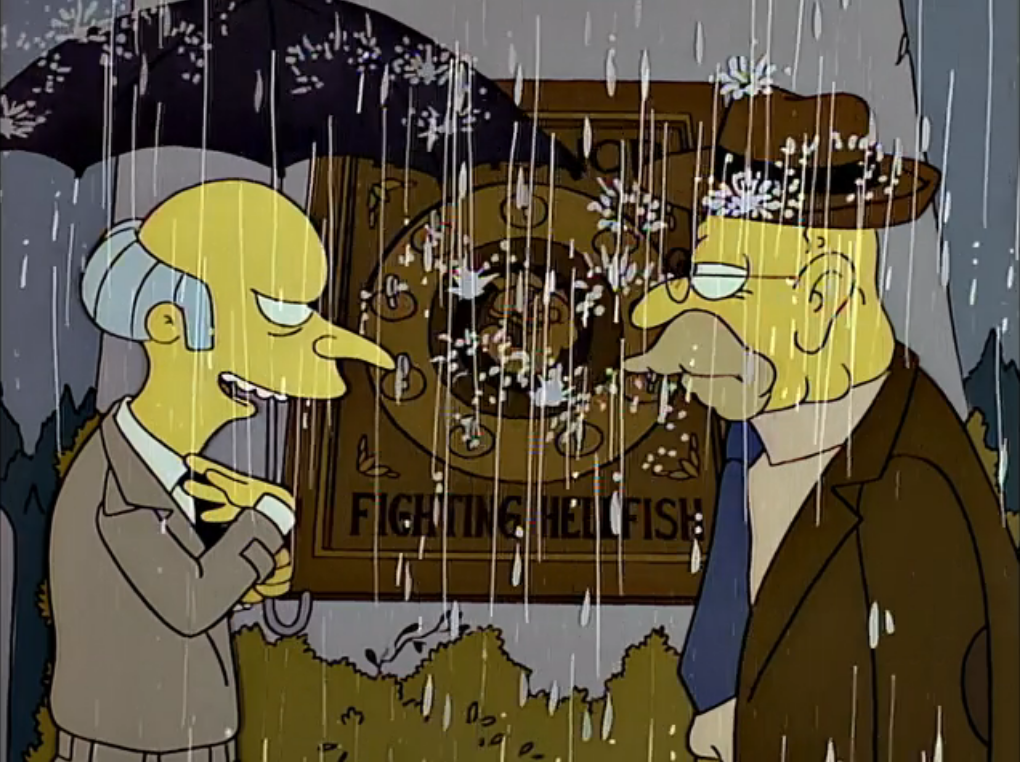
“Seven gone. As soon as you’re in your press board coffin, I’ll be the sole survivor and the treasure will be mine.”
That “Bonanza” was made up of priceless paintings by what looks like a Rembrandt with mentions of Monet and Botecelli, that they had taken from a German castle. When the group of men found the paintings during the war, they figured that immediately selling the stolen loot would get them busted. To lay low, the group agrees to hold the paintings in a “tontine” suggested by Mr. Burns.
Ox, one of the soldiers, explains the scheme as, “Essentially we all enter into a contract whereby the last surviving participant becomes the sole possessor of all them purty pictures.”

Fast forward back to 1996 where Grandpa and Bart retrieve the paintings from under the waters of Lake Springfield. No sooner have they come up for air, the paintings are stolen by Mr. Burns. Grandpa Simpson catches up to Burnsy and “discharges” him from the Hellfish. Grandpa says this ouster also kicks Mr. Burns out of the Tontine, so Grandpa declares himself entitled to keep the paintings. His victory doesn’t last long. Soon U.S. government agents show up to return the paintings to the descendants of their rightful owner.
WHAT IS A TONTINE?
A tontine is, not surprisingly, a real thing. Writers for The Simpsons are always bringing in real historical and cultural references. Invented in the 1600s, tontines were ways for people to obtain payouts based on their own mortality. They were also used as investment plans often run by the government in order to fund large scale projects, similar to how municipal bonds are used today.
In a tontine, the government/organizer sets up the structure and maintains the money. People called “subscribers” put money into the scheme. The subscribers receive payments of interest while the pot of money grows. Then as each person dies, the share of the pie and payouts become bigger based on the fewer number of remaining participants. Finally, the last person to survive would be entitled to the payout of the remainder once the rest of the participants died.
The setup is not quite the same as what the Flying Hellfish used it for, but it is similar. This investment structure was invented by and named for a banker and politician from Naples, Lorenzo de Tonti. Though he later had to seek political asylum for participating in a revolt, his name remains tied to the financial setup he created so many centuries ago.
Tontines were popular throughout the years and eventually made their way to the United States. However, in 1905, tontines had devolved into something more similar to a Ponzi scheme. An investigation by the state of New York put restrictions on tontines after an executive of a life insurance company was misusing money from the tontine accounts to fund his lavish lifestyle. This misuse made tontines appear risky, so they became subject to heightened regulation.
COULD THE FLYING HELLFISH USE THIS SET UP FOR THEIR PAINTINGS?
Not likely. Tontines don’t normally hold property. They hold money and pay out dividend-like payments. Instead, what the men may have created was more like a trust. Under the law, a trust is an arrangement whereby a person (a trustee) holds property as its owner in name only for the benefit of one or more beneficiaries.
Under Oregon law, a trust need not be evidenced by a trust instrument. That means that a trust can be created by speaking the trust into words. The initial “trust” may have been created back in Germany, but the men acted in accordance with the trust for years in Springfield. Arguably, it would be governed by Oregon law. Yeah, the Simpsons live in Oregon.
Whether it was a “tontine” in the strict sense of the word or a trust, the Flying Hellfish “tontine” is still an oral contract to which all nine of the Flying Hellfish agreed. The major problem with this oral agreement is a law called the Statute of Frauds.
The Statute of Frauds requires that certain agreements must be in writing to be enforceable. For instance, if an agreement cannot be performed within one year, it must be in writing to be enforceable. Since the agreement was contingent on the deaths of members several years apart, the contract would likely be void under Oregon’s Statute of Frauds law. This means that if the agreement was not in writing, it would not be a real agreement.
The biggest issue with determining legal title to the Hellfish Bonanza is the court’s abhorrence of illegal contracts. Even if it were in writing, it’s based on the underlying illegal act of stealing paintings.
Oregon courts have held that, “If the consideration for the contract or its agreed purpose is illegal or against public policy on its face, it will not be enforced.”
Because the underlying consideration for the Hellfish contract was stolen paintings, the contract is based on illegal consideration and “against public policy.” Contracts are usually considered “against public policy” if they are harmful to society or citizens. Awarding ownership of stolen paintings to one of two thieves would be both illegal and against public policy.
If Mr. Burns or Grandpa Simpson wanted to argue in court that either of them was entitled to the paintings, they would not likely be successful. They are fighting over stolen property, based on an oral contract that does not satisfy the Statute of Frauds. The court wouldn’t likely award the paintings to either man.
Even though Mr. Burns and Grandpa Simpson’s tontine was probably not enforceable, real life tontines are trying to make a comeback. According to the Washington Post, there is a growing set of lawyers and economists that think tontines are the future of retirement savings plans in America. They’re overwhelmingly more popular than annuities, which require participants to bet on their own lives. Tontines allow people to bet against the lives of others, which people seem more enthusiastic about.
In countries throughout Africa, a version of tontines that work like “peer-to-peer savings circles” are an important source of capital for small businesses that would not otherwise have easy access to capital to scale up in size. So while they would not be a good way to hold stolen paintings in trust for the benefit of stubborn old men unwilling to die, tontines are real and are still used to this day.
Thanks for the question, Paris! If you have any other questions, I expect you to submit them through the form and not ask me directly. (Kiddddding!)
Got a question? Submit it here. They can be legal what-if questions, questions on current events, or questions about the legality of actions in TV shows or movies you’ve seen. I never ever want to answer your personal legal questions, so don't send those. Love you, but I don’t do that.
***
This piece first appeared in Sunday Morning Hot Tea. Subscribe so you don’t miss another piece.
Legal Question: WandaVision and the Rights of Robots
[SPOILER ALERT – This will have spoilers for WandaVision. If you haven’t finished the show, save this for another day when you’re done.]
This week’s question comes from Megan R. via the form.
Megan asked:
“No spoilers but on WandaVision, I saw Vision’s name next to Wanda’s on a legal document for a house. Could a robot own a house?”
Excellent question, Megan!
If you haven’t watched WandaVision and you really like Marvel stuff and/or television, I’d highly recommend it. As a fan of The Dick Van Dyke Show, I particularly enjoyed the references to 1960s sitcom tropes. I also love my college improv teammate and friend, Asif Ali, and will watch him in anything. He absolutely crushed his role in this show!
Now to the question. The document Wanda was seen holding was a deed for a piece of land in Westview, New Jersey. A deed is used to transfer land between owners. The person receiving the land is called the Grantee. The one transferring the land is called the Grantor. After the deed is signed, the parties record it with the county clerk, and the transfer is done.
The deed in the show listed the grantees as “Wanda Maximoff AND The Vision.” We do not see who the Grantor was. Presumably, it was the former owner of the house, but the internet has some fan theories about who gave her that deed and whether it’s from some evil doer or future villain.
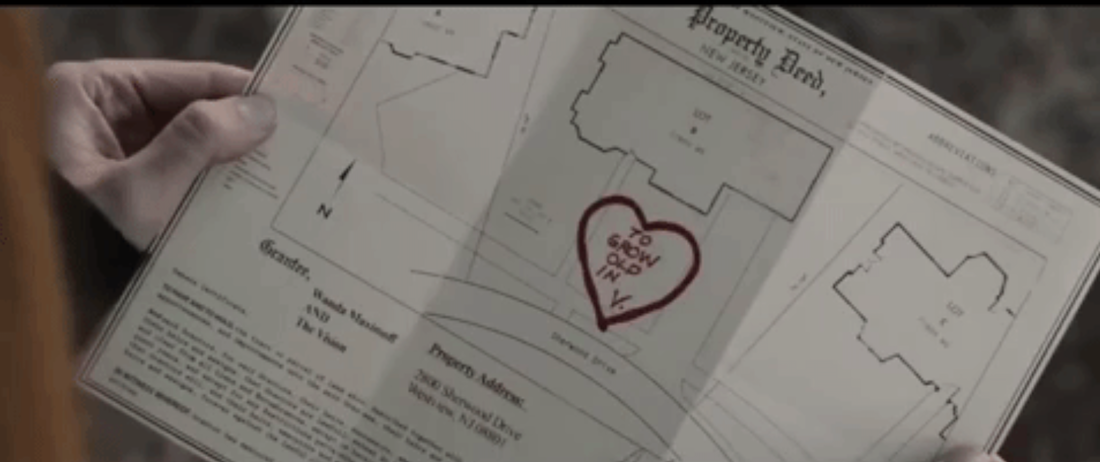
TBD on whether you can write love notes on a legal document. I wouldn’t personally recommend it.
CAN VISION OWN A HOUSE SINCE HE’S A ROBOT?
Not to sound like Comic Book Guy, but first of all, Vision is not just a robot. According to the MCU Fandom Wiki, “Vision is a synthezoid made from vibranium… and given life by the powerful artifact known as the Mind Stone.” Synthezoid means an android (a robot designed to resemble a human) that is “made partly or entirely of synthetic, organic-like materials.” He’s a robot with fake people guts. AND FEELINGS!

It me.
Let’s go point by point and decide whether Vision is a human or robot.
In an early episode of WandaVision, we see Vision chew a piece of gum. He’s got a human-like mouth, but when he swallows the gum, his inner gears grind to a halt. LOL A MULTI-BILLION DOLLAR ROBOT WAS STOPPED BY GUM! Somebody keep that lady from the retirement home parade away from him! While he can chew gum, he apparently cannot digest it. Can any of us? One point for the human category.
The MCU Fandom Wiki also says that synthezoids don’t sleep because they run on internal batteries. This brings along with it some disturbing visuals of Wanda, a human, sleeping soundly while Vision stares blankly at the ceiling. Yikes. That is definitely creepy robot behavior. One point for the robot category.
In Captain America: Civil War, the United Nations ratified the Sokovia Accords, which purport to regulate the Avengers. Vision is one of the “enhanced individuals” who “signs” on to the Accords. If he’s merely a thing and not a human, they would not need or want his signature. Another point in the human category.
He is made of vibranium and has a bunch of wires inside him. He can walk through walls and fly. He’s got a metal Ken-doll situation going on downstairs. Another point in the robot category.
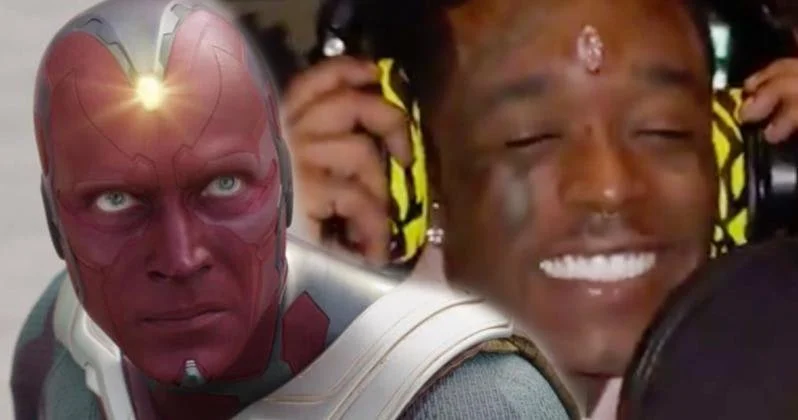
So we’re at a tie. Even if Vision is a robot, he is no ordinary one. He’s kind of like a robot+, especially since he was “given life” by the Mind Stone. The Mind Stone is a magical gem as old as the universe. It sits in the middle of Vision’s forehead, which, if rapper Lil Uzi Vert is any indication, is a very convenient place to put an irreplaceable gem.
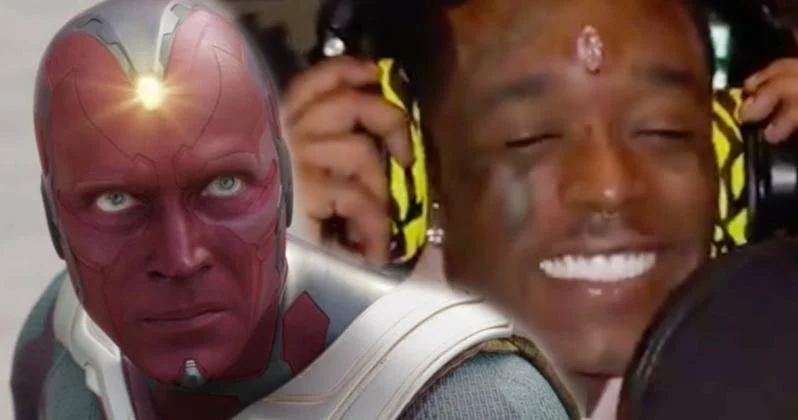
I’ll just put this priceless stone right here out front for safe keeping.
Then, when Thanos rips off Vision’s Mind Stone in Avengers: Infinity War, Vision dies.
Sooooo…. Vision is a partially synthetic being that has been given life and can be killed and can feel feelings and sign documents? Sounds human-ish to me! But human-ish is not human, which means he doesn’t have rights, including the right to own property … right?
DO ROBOTS HAVE RIGHTS?
This is a decades-old discussion of legal theory that took me down some philosophical rabbit holes as I was researching. As a basis, when we think of rights, we tend to think of the rights of people. Heck, the U.S. Constitution starts off “We the people.”
But non-humans also have rights - namely, animals and corporations. Why is it so unthinkable that someday robots may have rights?
According to legal scholars and even a UK Supreme Court Justice, the idea of robots having rights is not too far off. Yes, this thought is disturbing. I, for one, don’t want to see these unstoppable horror machines given rights any more than you do.

“KILL ME”
The question really comes down to personhood. If a “person” has rights, what do we mean by “person”? Does that mean human beings only?
When we refer to the rights of corporations to sue, be sued, or to enter into contracts including for real estate transactions, we call that “corporate personhood.” Further, in 2010, the United States Supreme Court determined that corporations have First Amendment political rights to buy ads in all American elections in the Citizens United v. FEC decision. This means a non-human corporation has the rights to constitutional First Amendment protections. Nevermind the fact that the Constitution begins “We the people.”
If a corporation can have property rights, the right to sue, and the right to free speech, can’t we let this synthezoid and his human lady friend own a frickin’ piece of land?
IF VISION CAN’T OWN THE LAND – DOES WANDA OWN IT OUTRIGHT?
Let’s say you’re a monster who doesn’t want to see Vision and Wanda own this land together. Or, even if you do, too bad. Vision is dead.
In that case, who owns the land? For that we turn to basic property rights.
As with most legal questions, the answer is: it depends. If the wording of the deed includes language that the land is owned by the two as “joint tenants with rights of survivorship” then the land will pass to the surviving co-tenant/co-owner – Wanda.
If the deed does not use that phrase, then it means that the property was owned as tenants in common. This is a different type of ownership scenario where the parties own their halves separately. Therefore, the share belonging to the deceased co-tenant (Vision) would pass to his heirs.
Who are Vision’s heirs? He and Wanda weren’t legally married. Their kids were figments of her imagination (OR WERE THEY? TBD!) He has no parents because he was Frankenstein’ed together by several creators.
So who gets the land then?
In 2017, the EU Parliament wrote a report to the Commission on Civil Law Rules on Robotics that proposes a concept of robot rights/liabilities similar to that of corporations. The determination was that “the responsibility must lie with a human and not a robot” in determining liability. I would argue that property rights would pass much the same way: to the robot’s owner.
Ok then, who “owned” Vision? Wanda? S.W.O.R.D.? S.H.I.E.L.D.? Nobody?
And, for that matter, is Vision even dead?
White Vision is out sailing through the sky trying to find himself, a reassembled synthezoid made of old Vision’s parts who has been endowed with old Vision’s thoughts and memories. After the Vision vs. White Vision fight and the Ship of Theseus conversation, perhaps White Vision is Vision now. He’s the only Vision still standing. the WandaVision Vision was contained to the Hex and went poof right along with it when the Hex was taken down.
In the WandaVision post-credits scene, Wanda hears the screams of their kids as she’s meditating. If their kids are alive out there in some alternate universe and weren’t totally destroyed when the Hex went down, then is the WandaVision Vision out there, too? And if so, what does that mean for White Vision? All this comic book universe talk is all giving me double vision. (See what I did there?)
CONCLUSION
I say Vision should have the right to own land. Corporations aren’t people, and they own land all the time. Plus, with the way robots are evolving, there may soon come a time when machines that autonomously create will be given rights over their creations, paving the way for robot property rights. Until that time, it doesn’t make much sense to say no to a being with unlimited power and a wife who is the most powerful Avenger. Probably won’t end well.
Thanks for the question!
Got a question of your own? Submit it here. They can be legal what-if questions, questions on current events, or questions about the legality of actions in TV shows or movies you’ve seen. I never ever want to answer your personal legal questions, so don't send those. Love you, but I don’t do that.
***
This piece first appeared in Sunday Morning Hot Tea. Subscribe so you don’t miss another piece.
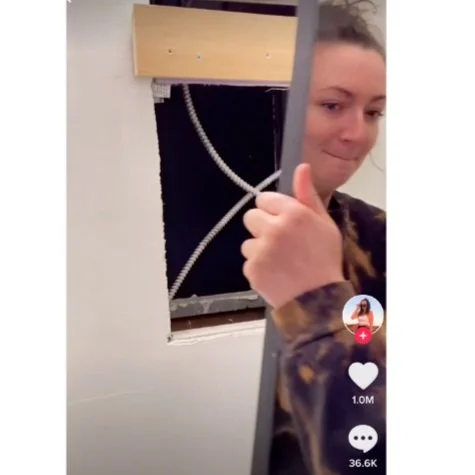
Legal Question: Bathroom Mess (Viral Apartment Hole TikTok)
A Mess in the Bathroom
This week’s question comes from Shannon via text.
Shannon asked, “Can a landlord be sued if there is an open and unlocked void behind your bathroom mirror that goes to an abandoned apartment?”
Excellent question, Shannon. Let’s jump in! Or should I say, climb in??
THE BACKSTORY
By now, many of you have seen the viral TikTok of user @samanthartsoe who discovered her bathroom mirror was a portal to another apartment unit. First, she noticed a burst of cold air coming from the bathroom wall. She stood beside the door jamb, and her hair noticeably moved from the force of the air.
Once she determined her mirror was also a source of cold air, she removed the mirror to reveal A BIG ASS HOLE! (Not to be confused with a big asshole, which you may not be shocked to find in your bathroom.)
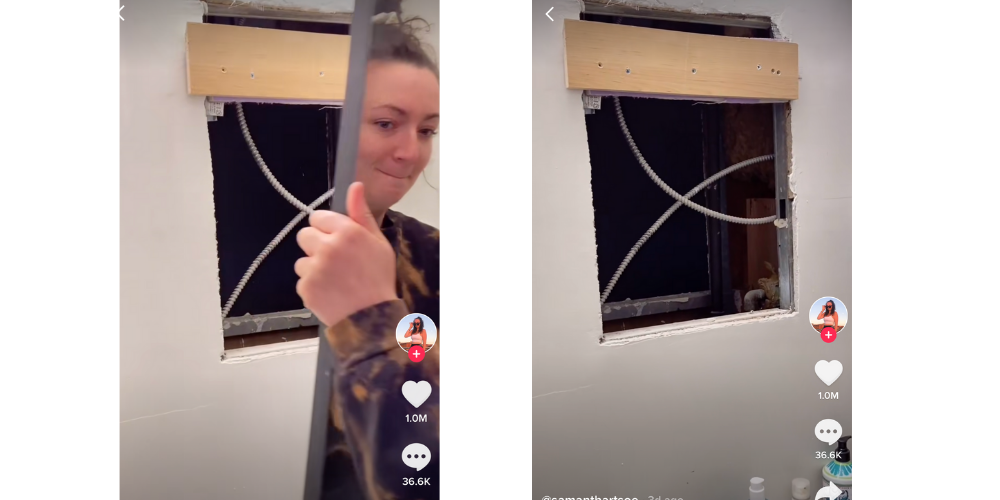
Left, she removes her mirror. Right, what she found behind it. Images from @samanthartsoe on TikTok
She then assembled some friends to watch as she climbed through the hole herself and asked them to stick around just in case. Uhhh yeah, not sure your mortal friends can save you from the actual Candyman who you are doomed to encounter in the hell dimension inevitably through that hole.
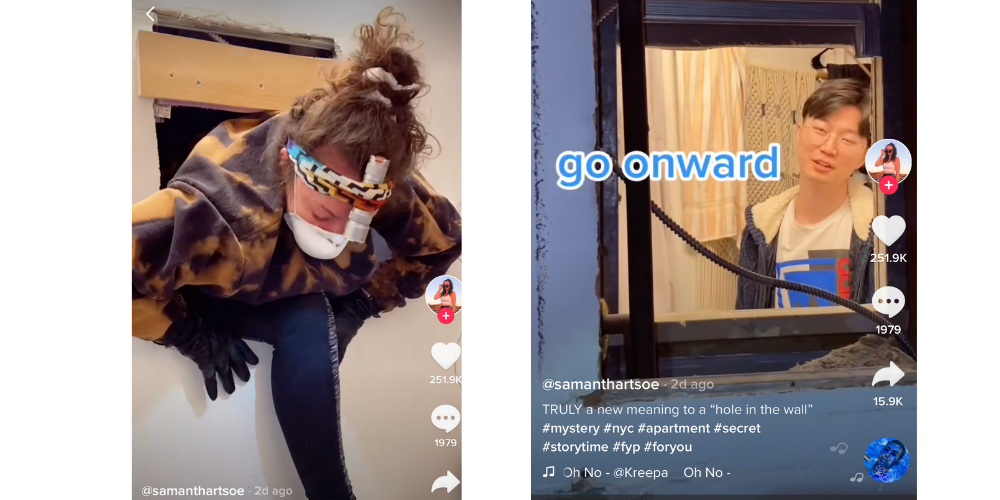
Left, she climbs through the portal. Right, her buddy, John, offers words of support. Images from @samanthartsoe on TikTok.
On the other side of her mirror, Samantha discovered an entire apartment. It was not furnished or even finished out. Trash bags littered the floor. There was, however, a non-dusty water bottle that Samantha called “signs of life,” leading viewers to conclude that someone had recently been in there. Yikes!
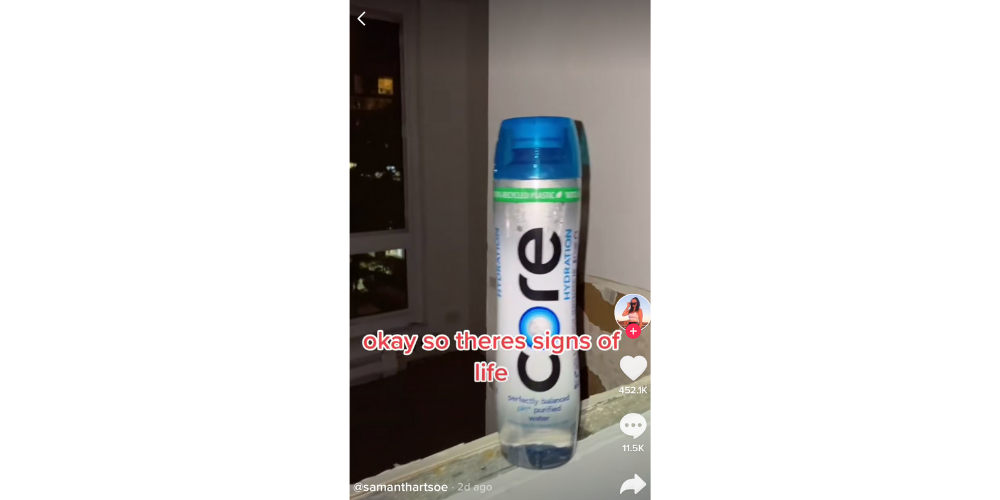
Girl run. NO. Image from @samanthartsoe on TikTok
In the end, she made it out of the apartment and back to her place safely. The video concludes with Samantha saying, “My landlord is getting a really fun phone call tomorrow,” and a note that she is “cementing this mirror down.” Fair enough.
What a nightmare! But now the question…
CAN YOU SUE YOUR LANDLORD FOR THIS?
As always, you can sue anybody for anything. Whether and to what extent you can sue your landlord varies by state. Our bathroom wall adventurer is located in New York City (NEW YORK CITY?!) so she’s governed by New York law.
Under New York law, an owner of a rental property must “keep all and every part of a dwelling … in good repair, clean and free from … [any] other thing or matter dangerous to life or health.” This is similar to the law in Texas, where I practice, that says a landlord has a duty to repair a condition that “materially affects the physical health or safety of an ordinary tenant.” As you can see, the standards are a little different, but in general, landlords have a duty to repair certain apartment conditions.
That begs the question — is a giant hole in the wall a threat to her life or health meaning Samantha’s landlord is required to fix it?
Based on the case of Ruthie Mae McCoy, I sure think it is. Ruthie Mae was a tenant at a Chicago housing project who was murdered in her unit after reporting to police that men entered the place “through her medicine cabinet.”
Ruthie’s story is heartbreaking for several reasons, not the least of which is the fact that police later concluded that Ruthie Mae was right. Her attackers did indeed climb in through her medicine cabinet. A Chicago Reader story on the subject included tales of multiple other residents in Ruthie Mae’s building suffering home invasions where perpetrators climbed through medicine cabinets in order to access adjacent apartments.
Those of you who have watched the movie Candyman may recognize the name Ruthie. The original author of the Chicago Reader story explained how parts of Ruthie Mae’s story ended up in the film. Even though it was based on a British short story, Candyman contained some real slices of Chicago life, including a story similar to that of Ruthie Mae.
NOW HOW DO YOU DO GET THEM TO FIX IT?
Let’s agree that the giant hole constitutes a “thing or matter dangerous to life or health.” What can our brave TikToker, Samanatha, do about it?
The first step is always to make a request to the landlord or building super to repair the condition. The NYC Rent Guidelines Board outlines the next steps. If you ask the landlord/super and get no response, the RGB suggests contacting the owner. If there is still no action after that, a tenant can sue in court.
In New York, if the landlord refuses to act, a tenant can sue a landlord to make repairs to their unit using an action called an HP or “Housing Part” case.
A tenant can get the forms they need online from LawHelpNY, which provides free legal information. There is even a step-by-step online form that will pre-populate the complaint and provide information on how to serve it to the landlord and file it with the court. The documents needed are an “Order to Show Cause Directing the Correction of Violations” and “Verified Petition in Support of an Order to Show Cause.”
Once the action is filed, the city inspector should come out and make a report of the conditions in need of repair. The tenant can then use that as evidence in their case against the landlord.
If a condition in an apartment is “urgent and dangerous” to a tenant’s health or safety (like, idk, AN ENORMOUS HOLE IN THE WALL THROUGH WHICH MURDERERS COULD CLIMB???), a tenant can ask the court to go forward without a city inspection. Though a city inspection report is helpful evidence, I’m thinking video footage of a tenant climbing through and showing the extent of the hole is pretty strong, too.
Once the tenant files their claim, they will appear in Housing Court at a hearing, and the judge will decide on the case. The landlord will either be required to fix all of the condition, part of the condition, or not fix anything if the tenant is found to have caused the issue.
In Texas, the process is somewhat similar, but like I said, laws vary by state. If you find yourself in a state other than New York faced with a hell portal in your powder room, check out your local legal aid organizations who sometimes provide free online resources or may be able to provide help via phone.
SO, WHAT SHOULD SHE DO??
Samantha’s idea of calling her landlord is a good first step. The idea of an attacker climbing in through a mirror hole is not far-fetched, so the landlord should take immediate steps to fix it. If not, she can certainly take them to court. Though, I think the several million views on TikTok may put a little pressure on the landlord to make things right without having to go through all that.
Whatever she does, I would also advise that she not stand in front of the mirror and say anything five times in a row. Better not to risk it.
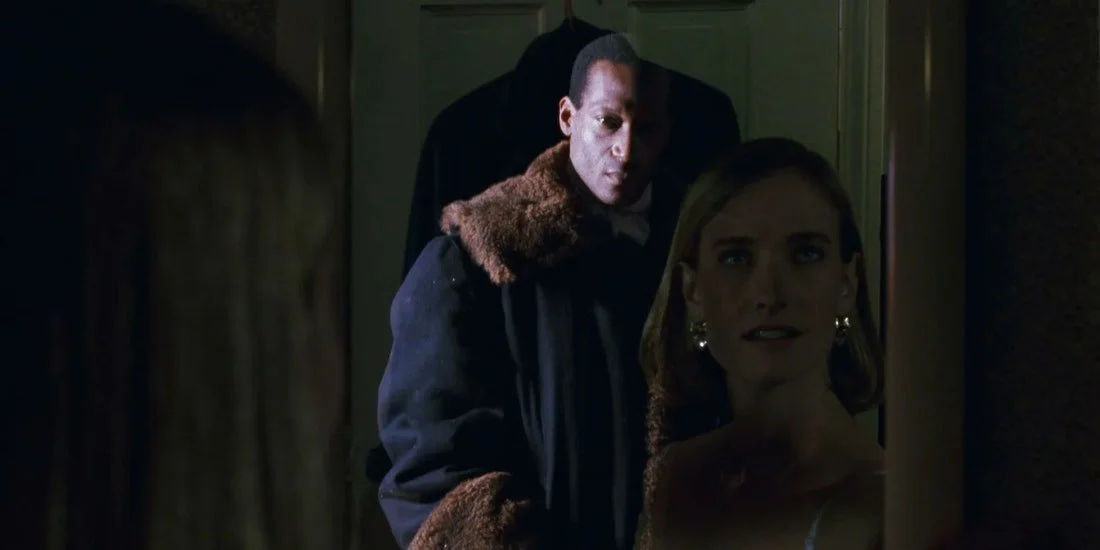
We know how this ends. 😬
Thanks for the question, Shannon! And thanks to Shannon Joyce (different Shannon) for tagging me in the Chicago Reader story about Ruthie Mae McCoy on Twitter.
Got a question? Submit it here. They can be legal what-if questions, questions on current events, or questions about the legality of actions in TV shows or movies you’ve seen. I never ever want to answer your personal legal questions, so don't send those. Love you, but I don’t do that.
***
This piece first appeared in Sunday Morning Hot Tea. Subscribe so you don’t miss another piece.