


Gold Standard Girlfriend
The most cosmopolitan friend I have is my former coworker, Meagan. When I recently texted her the link to a Louis Vuitton Neverfull with hot pinking lining at 1AM, asking, “Is this cute or tacky? I am too influenced by Lisa Vanderpump,” she replied thoughtfully the next day.
“It’s not tacky, but it’s v basic,” she wrote. She then sent a link to a sleek, leather laptop bag, telling me, “These are v gorgeous and cool girl and would fit your laptop without looking like a basic Highland Park mom.”
Meagan and I got close when we both worked together at a large law firm in Dallas. A crew of us who joined the firm during the same two-week stretch in July 2018 have all since lateraled (attorney talk for “switched jobs”) to various other places but have still stayed in touch.
When we both started at the firm, I never expected Meagan and I would be friends. The first day I saw her, I was incredibly intimidated by her. She had bob-length short hair with blond highlights. She drove an Acura SUV. She carried her things in a sleek leather bag. She worked out with a personal trainer and wore high heels from fancy department stores.
I wore none of these things and did none of these things.
I rarely wore makeup to work and kept my hair pulled back in elastic ties. The one pair of heels I could stomach wearing were LifeStrides Comfort Pumps I bought at Marshall’s. When they wore out, I bought three more pairs on Amazon for $15.99 each, willing to run them down, throw them out, and start again with a fresh pair. I worked out to YouTube videos, if at all, and drove a beat-up Volkswagen Beetle.
The most cosmopolitan thing about Meagan was that, despite these superficial differences, she never once made me feel like I was less than her for being the scrappy little ragamuffin I was. In fact, she made me feel not only like I could attain the level of high-quality life that she enjoyed, but indeed I deserved that as well.
She would slip into my office around 9:30am, carrying a paper cup from Merit Coffee, a San Antonio coffeehouse chain that had just opened a Dallas location. Yes, we had free machine-coffee in the break room, but Meagan liked her Americano from Merit. In the ballerest of baller moves, she walked around holding piping hot coffee in a cup with no plastic lid. A full 20 ounces of black coffee and espresso (if that’s what an Americano is?? I actually drink Pumpkin Spice Lattes because, see above, I am basic), not a lid in sight. NO LID. NO FEAR.
The boldness was honestly incredible and a micro example of her overall confidence and poise. Not only did she dare to carry her coffee that way, but she did so successfully. White pants? Not a drop. Coral-colored blouse? Flawless. I sipped free break-room coffee from a work-issued thermal mug, lid tightly affixed. She, on the other hand, would sit kicked back in the guest chair in my office, steam rising from her cup, casually fielding panicked questions from me about what guy I was dating.
First, it was a situationship I was in, with someone who Meagan regarded at the time (and who I regard now with the benefit of hindsight) as not worthy of my attention. My bird-in-the-hand mentality had me death-gripping onto something that never served me.
“What should I do about this dude?” I asked her.
To Meagan, the solution was clear: Shut it down. Move on. Demand more. After a little more foot-dragging, I finally did.
A few months later, after some mediocre and downright bad Bumble matches, I matched with a gorgeous filmmaker with a great sense of humor.
“Holy shit, look at this guy,” I told her, showing her a photo of my now-fiancé, Paris. “He’s super hot. What is happening? How did we match?”
“You deserve someone like that,” she said. “Why wouldn’t you date a hot guy like him?”
This was a great question. I mean, I hadn’t ever really done it before. Some folks date those who are out of their league. I vacillated between very much in-my-league to way-below-my-league for many years, owing to a debilitating lack of self-esteem.
“I think I am going to go out with him,” I told her.
“You absolutely should,” she said. Then, over the next few weeks, she helped me decide on responses to his texts.
When I started looking for a new-to-me car and began eying a luxury pre-owned SUV, I got mixed input from friends and family. Frugal folks in my life balked at this, but not Meagan. I pulled her around to the other side of my desk one afternoon to show her the car I had chosen. Low milage. Well-maintained. High quality.
“I love it,” she said. “It’s perfect. You deserve it.”
Later, when I showed her a laptop backpack I thought I may want to buy, an upgrade from the beat-up shoulder bag I schlepped my things around in, she didn’t skip a beat. She knew – we both did – I was making big law money at the time. I could afford something a little nicer than what I had. Even so, I wasn’t going for some Kardashianesque Hermès Birkin bag. It was a classic piece from Tumi with a five-year warranty.
Meagan never pushed me toward ostentation but instead taught me to appreciate and value quality in all areas of my life. The question was never, “Is this trendy? Is this cool?” It was always, “How was this made? What is it made of? Who made it?” For it was these qualities that would tell you whether something would last.
When she was poached from our law firm by one of the largest and most well-known companies in the world, it was no surprise. A person like her values quality because she is quality. A person like her stands out as the best and is therefore coveted by the best.
At the time, the law firm job was the best job I had ever had, at least by conventional measures. I had never made as much money, enjoyed such perks, worked on such sophisticated matters, or had that much prestige attached to my name. Still, I hated it but I clung tight. Like the situationship, it was yet another bird-in-the-hand.
Meagan enjoyed all those same benefits working with me at the firm. Perks and prestige aside, when that other job came calling, she left with no hesitation. She had the law firm bird in the hand and found it lacking. She recognized what she deserved and took the leap, negotiating a deal for herself with the new company over and above the initial offer.
I could never, I thought at the time.
“They’re going to pay for that?” I would ask her about some benefit she would be receiving.
“For sure they are,” she replied, unshakable.
Even after she left, she remained steadfast in ushering me toward just exactly what I deserved. When a news story would break about a deal in the podcasting industry, she never failed to send it my way.
“That’s going to be you,” she said, speaking into existence what I quietly hoped for but thought may not be possible. “Soon,” she added.
I had the bird in my hand – the ultimate lawyer job – and felt guilty for having an eye toward leaving to pursue what I truly wanted to do. Hearing that my dream was possible, from someone like her, was huge. All those busy hours, those nights and weekends at the firm, I knew weren’t going to do anything to move the needle in my direction of full-time creative work.
When I started looking around to leave, she was the first person I texted the new job posting to. I found a fellowship – a 9-to-5 opportunity to get paid doing the only thing I really loved at the firm, pro bono work.
“It’s perfect,” she said, and pointed out that the set hours would give me time to grow the show.
I leapt. I applied. I was offered the fellowship and let her know I was selected.
“Of course you were,” she said.
No matter the news I called her with – the podcast was picked up by a network, we were signed by a talent agency, I am quitting work to do the show full time - each time, she would frame my trajectory and the show’s success as an inevitability rather than a fluke.
There are people in this world who will see for us a life we would never want for ourselves. They may pressure us into their ideals or bully us with their expectations.
Then there are others who see us for who we are and for what we have at the present moment.
Best and rarest of all, there are the Meagans of the world. Few and far between, these are the ones with sky-high visions for themselves and for the people they love. These rare ones see for us not what we are or what they think we should be. Instead, they knock aside our fear, our self-imposed limitations, and the foolish expectations of society. They open our eyes to what we deserve. They open our hands so we can let go of that for which we have settled. Through their examples and encouragement, they help us actualize what we were meant for and live the life we truly deserve.
And if we are really lucky, they’ll stop us from impulse-buying a silly shoulder bag that would make us look BASIC AF.
***
This piece first appeared in Sunday Morning Hot Tea. Subscribe so you don’t miss another piece.

Thanks, Heather
Watching Buffy, my 60-pound dog, lying in the sun on the back porch earlier today, I got an idea. I would head outside and do yoga on the patio. Don’t get me wrong, I didn’t actually do it. It was sort of muggy outside, and I had just eaten some leftover pizza, and anyway the blankets on the sofa were so cozy.
The last time I did yoga outside was a virtual class during summer 2020 for my friend Elyse’s birthday. I am not great at yoga anymore as I’m out of serious practice. I’ll do Yoga with Adrienne videos on YouTube after I go for a run, but I can’t genuinely say I am a practitioner.
I used to do tons of yoga in college in my movement class as a theater major. The moves were the same as the virtual yoga class last year, but they sure felt easier back in college. Probably in part because I had more limber joints but also probably because I was forced to participate back then in order to earn a grade. At this point in my life, I would not have otherwise been interested in a virtual yoga class, except for the fact that Elyse invited me. I will do almost anything she asks me to.
Elyse started out as my boss at Seadog, a tourist boat company located on Navy Pier in Chicago. No matter how much time we spend together as equals and friends, my brain is still faintly wired to say “yes ma’am” when she asks me to do something. When I first met her, I was fully intimidated by her. Knowing her as well as I do now, her tyrannical management style back then was one-part joke and one-part reality.
She had to maintain a certain demeanor in order to manage a team of her peers while still being friends with some of us. That’s never an easy line to walk. Being new and not in on the joke when started working there, I mostly avoided her. I had two reasons for this: (1) I thought she was way too cool to ever want to be my friend, and (2) I assumed she did not know my name since I didn’t exactly interview for the job.
As we worked together over the next few years, we got closer. She tells me now that she liked me from the very start, but I had no idea because of her buffer of aloofness. The day I knew she actually liked me was when she showed up to the ticket booth back office with a brown package stuffed under her arm. It was a small parcel, no bigger than a clutch purse, with foreign writing on the front. It was 2009, and the news was in full swing warning us about the impending pandemic – the Swine Flu.
“It’s Tamiflu,” she said, clutching the package to her chest. “The city is rationing it, and it will run out. It’s what the doctors are prescribing to fight the Swine Flu.” She kneeled down in front of the company safe in the corner of the office and spun the dial.
“I am putting this in the safe,” she said. “Now only you and I know it’s in here, so if it goes missing, I know it was you.”
This sounds harsh, but everything she said kind of was. It was also really funny.
“I don’t want your Swine Flu medicine,” I said.
“You’ll want it if you get Swine Flu!”
“If I get Swine Flu, are going to let me die or will you share your illegal flu drugs?” I asked.
“If you get Swine Flu and I don’t,” she said solemnly, “I will think about possibly sharing some of it with you.”
I asked why the front of the package looked so strange. I could read her name and address scribbled on with a pencil, but the return address was in a language I didn’t recognize.
“It’s from a Turkish online pharmacy,” she said. “It’s the only place that is still selling it.”
“How do you know it’s really Tamiflu?” I asked. She considered this for a moment before shutting the safe and locking it.
Like most great things in life, I stumbled into the job at Seadog. I showed up on July 4th weekend, one of the company’s busiest times. My intention was to pick up an application and take it home to complete it. Knowing the ticket booth always needed sales agents, my friend, Chris, one of the tour guides, suggested I come by and apply. Instead, I ended up ringing up tickets that very day.
I was in need of work after having quit my previous job at a fancy restaurant in Chicago’s West Loop/Fulton Market area called Carnivale. I was a hostess there and absolutely hated it. My prior restaurant experience was at the Magic Time Machine in Dallas, where the standards were low and nobody took themselves too seriously. How could we? The servers dressed in Party City costumes that reeked of barbecue sauce. This was the real mystery – not the costumes but their smell. Barbecue sauce was only one condiment of many in the place, but somehow its sweet smoky scent wove its way into the polyester fibers of every character’s suit.
That prior experience as a hostess at a high-volume restaurant got me in the door at Carnivale, though the experience was not actually relevant. Were they both restaurants? Yes, sure. Were they both busy? Undoubtedly. That was where the similarities ended.
The contrast between the two was stark. Carnivale had an on-staff sommelier. Magic Time Machine served trash-can punch dyed with food color in Mason jars poured over a hunk of dry ice. On our first day at Carnivale, they had us taste several menu items and pair them with wine. At Magic Time Machine we’d eat day-old fried shrimp from a giant metal bowl between serving tables.
During orientation, the Carnivale managers asked me to pair wines with foods. At this point in my drinking career, I was only an expert at discerning the differences in various flavors of Smirnoff Ice. That was about it. I couldn’t tell you a Kim Crawford from a Kim Basinger. Still, they asked. I somehow remembered red with beef, white with fish from a TV show and got the job. As a reminder, I was applying to be a hostess where all I did was walk folks to their tables.
The work wasn’t too bad, and the pay was ok. Our direct manager for the host stand was a compact and neatly groomed man named Randy. He was originally from Tennessee, a fact we bonded over as my dad was as well. Randy was efficient but patient and chose to solve problems rather than dwell in them.
Another manager who I’ll call Antonio had the opposite attitude. Dressed like a night club manager in a made-for-TV movie, Antonio would pick a problem to death, wasting time repeating how a wine shipment was misordered or how someone got sick and called off. Rather than remedy the situation and move on, Antonio constantly complained and looked like a huge douche while doing it.
I did my best to avoid him, but when Randy took off two weeks for a vacation, that left us at the host stand with Antonio. At the beginning of a shift one night, I stood poised beside the host stand ready to walk people to their tables in a J.Crew dress. Antonio approached, eyed me up and down, and addressed me.
“Why do you always appear so…” he paused, looking up to search his brain. “What’s that word? Oh yeah, disheveled. Why do you always look so disheveled?”
I didn’t think I looked disheveled. I thought my dress was nice, even though I had gotten it at a thrift store. It was a soft yellow cotton fabric with a floral pattern and hit me just below my knees. He walked off before I could answer. This led me to believe his question was indeed a statement masquerading as a question and warranted no response.
Another time, I stood beside my fellow hostess, Bianca, a wide-hipped single mother of two who always wore the same plain black slacks with a different floral blouse each shift. She was friendly and soft-spoken. The two of us would chat between helping guests. This day, Antonio walked toward us, eyeing us up and down. Rather than speak to either of us, he directed his question to Mackenzie, the lithe, bleach-blonde head hostess. Mackenzie was pleasant enough but rarely addressed us underlings except to say something like “Four to table 54.”
“When did we stop hiring cute girls for hostess?” Antonio asked. Bianca and I exchanged a glance between one another. Mackenzie shrugged.
“Randy has been doing the hiring,” she told him, while looking down and marking tables on a clip board.
“Ah,” Antonio said with a tone of understanding. “Yeah, makes sense. He’s so gay.” This was not a statement of fact, as in Randy is a gay man. It was a comment that Randy was so gay, so gay, in fact, that he hired – what? Non-cute girls? The exchange happened so fast. As quickly as he had approached, Antonio was gone. Bianca and I stood in silence, waiting for the next guests to arrive.
When did we stop hiring cute girls? I wanted to think it was right after me, but based on the stink eye, that probably wasn’t what he meant. He had to know we heard him. He just didn’t care. This man was well over 40, with black wires of chest hair springing out from his lavender wide-collar shirt buttoned a hole or two too low. Who made him the arbiter of cuteness?
When the July 4th weekend schedule came around, I noted they had scheduled me for July 3rd, after I’d specifically told them I was not available. I had requested the day off so I could go to Six Flags Great America with my boyfriend and a couple of our pals. If I was going by the Carnivale schedule, I would not be riding rollercoasters that weekend, but would instead be insulted and forced to walk guests to tables.
I decided to be an adult and address the problem head on. As soon as the schedule was released, I went to the restaurant before my shift and approached Antonio in the downstairs manager’s office. I told him I could not work on the 3rd.
“Yes, you can. You’ve got to,” he replied.
“I actually cannot be here, though,” I said. I was surprised he didn’t press me for a why or ask me to explain where I’d be instead. He probably imagined I’d be rifling through a dumpster for clothes or attending a meet up for West Loop Uggos.
“If you’re not gonna be here on that day then you cannot work here,” he said.
“So you’re firing me?” I asked.
“No, no,” he said. “You can work here, but if so, you’ve gotta be here on the 3rd.”
“But I can’t. It is impossible for me to be here on that day,” I said, as if going to Six Flags was a surgery or a funeral.
“Well then you gotta quit,” he said.
“Ok,” I said and turned to walk out.
“No wait,” he said. You smug bastard, I thought. Bet you never thought I’d call your bluff.
“You gotta do it in writing,” he said. “Gotta give me a writing that says what day is gonna be your last day.”
The only other job I had quit on non-mutual terms was a now-defunct bookstore called Bookstop in my hometown of Mesquite. My high school buddy, Jeff, a hard worker who graduated as our class’s valedictorian, had recommended me for the position. I like books, so I thought it would be a good fit.
What I failed to consider was I don’t like organizing – books or anything else. A bookstore is nothing more than a constant organizational project. When people pick stuff up, they never put it back where it goes. I know I sure don’t, and I didn’t back then, either.
Our manager at Bookstop was a guy in his mid-30s named Matt, who spoke so fondly of his X-Box that I came to believe the two were in love. Matt was only liked two things – his X-Box and the acronym that summed up his managerial philosophy.
“KYS!” he spat at me on my first day. “Know what that means? Know-Your-Store.” KYS, in Matt’s mind, meant memorizing where every book went. Nahhh, my dude. That was not going to happen. The magic of working in a bookstore is that you can put the books anywhere you want, and nobody will figure it out until someone comes looking for them.
Bookstop had an unusually high standard for dress code, which I found strange for a place that also sold pornographic magazines. Is it less embarrassing to buy a titty mag from a teenage girl if she’s in business casual dress rather than just casual? Is there something particularly shameful about forking over your dollars for a nudie book if the junior in high schooler behind the register doesn’t have on leather shoes? Either way, I think those customers were too preoccupied with their purchases to give a shit if I was wearing jeans or not.
During my short tenure in the stacks, I was a terrible bookstore worker. I guess “terrible” is a relative term. Bookstop’s parent company, Barnes & Noble, probably wouldn’t have liked me much. I, on the other hand, thought I was doing a public service.
When kids would come in with a $10 bill to buy Of Mice and Men or The Scarlet Letter, I assumed it was for mandatory school reading and not for funsies. When the total rang up $10.83 with tax, the kids would hang their heads ashamed. In response, I would hit the Teacher Discount button and knock 10% off, bringing the total to just under $10. I figured teachers wouldn’t mind if I extended their discount to students in need. I also felt comfortable giving the discount as it made me a teacher to these kids, with the lesson being “never pay retail.”
A woman called in one day and asked if we had a study guide for a nursing exam. We did. It was something like $69.99. She asked if we’d put it on hold for her so she could come in later and get it. I put a post-it note on the front with her name on it and set it beside the other pick-up orders. All she had to do was walk in later and pay. A few hours later, a little boy no older than eight-years-old came through the door.
“My mom said you have a book for her,” he said. “Her name is Penny.”
“Where is your mom?” I asked. He gestured out the glass doors to a beat-up minivan double parked with the engine running.
“She’s with my baby sister,” he said.
I reached on the shelf and handed him the enormous tome, bigger than a phone book and nearly twice the size of his head.
“Is this it?” I asked, expecting a third-grader to confirm that it was indeed the most recent edition of the nursing licensure exam book. He nodded and walked toward the door without paying. I didn’t stop him. Right before he exited the store, he stopped in his tracks, realizing he had forgotten something.
“Thank you,” he squeaked then passed through the double doors.
I didn’t get fired for letting that kid walk out with the nursing book. Nor was I fired for all the times I inappropriately discounted books based on a strict moral code I developed within my own mind, though I did it all the time.
“Are you a teacher?” I’d ask the polite customers. It was the only discount button that didn’t trigger a manager’s approval or require a coupon.
“No, I work in construction,” someone may say.
“No, I work at JC Penny in the mall across the street.”
“No, I am only 10 years old.”
Well, you guys all taught me something today: this place fucking sucks, so you get a discount, and you get a discount, and you get a discount.
I held Bookstop the entity accountable for Matt the persons’ behavior and felt I was punishing the entity appropriately with my discount train. Matt once reprimanded me because my lace-up suede shoes were not “business casual” in his opinion. I pointed out that my feet were not visible behind the counter. He did not care. In what I can only assume was a power move caused by his small penis, he had me clock-out, make a 40-minute round trip drive home, change shoes, and return. I don’t think I need to say this, I just want to: I did not respect Matt.
When I quit Bookstop, it was for much for the same reason I would later quit Carnivale. Matt scheduled me to work the night of the homecoming game when I had specifically asked off. I had just come into my own in high school and finally started participating in social activities. Now this jabroni who got his kicks from exerting authority over teenagers was going to try and power play me over the one night I asked off? I don’t think so.
I told him I wouldn’t be there that day. In response, he asked for my formal resignation. MY FORMAL RESIGNATION. From a retail job. Not having my typewriter handy, I took a post-it from his desk. On the post-it, I wrote:
I quit.
Thanks,
Heather
“You know, Jeff really vouched for you,” Matt said, trailing off. Ok yeah, I felt bad for making Jeff look bad (still do, sorry bud!), but Matt sucked. Also, I was 16 and wanted to eat nachos and not-watch a football game with my friends in a stadium on a Friday night which was my constitutional right as a teenager in Texas.
I left the post-it on his desk, walked out, and never went back. The store closed for good later. It was several years after I worked there, so I don’t think it was my fault. Even I did somehow cause the closure, the building has since been turned into a Genghis Grill, so you’re welcome, Mesquite.
Years later, at 21, I wasn’t intimidated to do at Carnivale in Chicago what I had done at Bookstop in Mesquite. When Antonio told me he required a written notice with a firm end date for me to quit, I took a cocktail napkin from a nearby counter and wrote:
I quit. My last day was last Tuesday.
Thanks,
Heather
“It has to be posted on that bulletin board for two weeks,” Antonio said as I was still writing. I walked across the room and pinned my wrinkled napkin to the corkboard with other announcements. A disheveled note from a disheveled girl.
“Take it down whenever you like,” I said.
I didn’t leave Carnivale because they wouldn’t let me go to Six Flags just like I didn’t leave Bookstop because they tried to keep me from attending the homecoming game. I left both places because nobody should have to be abused for $5.15 an hour, or $7.25 an hour, or any amount of dollars per hour.
I never knew how my life would change after pinning up that wrinkled napkin in Carnivale’s basement.
When I ambled up to Seadog on my first day, I couldn’t guess how the raven-haired, chain-smoking, fast-talking manager would become one of my closest lifelong friends. I couldn’t know that she would never call me disheveled, but she would absolutely tell me when jeans looked terrible on me. She would never chastise me for not knowing where books went but would threaten me not to reveal to anyone the hidden Turkish flu medicine she panic-bought from the internet. She would never make me work when I needed to be somewhere else, but her presence would make me want to come to work, just so I could hang out with her.
I couldn’t know that I would keep working there until she left, and even after that, too. I couldn’t know how important she would become to me.
When I first met her, Elyse was just a woman in a white tank top, skinny jeans, and high heels, who hired me in five sentences: “You’re Chris’s friend, right? What’s your name? Heather? Can you start today? Why are you wearing that?”
I never guessed how that would lead me, thirteen years later, to doing yoga on a video-chat during a global pandemic. Neither Elyse nor I could have known that the world would look like this. Still, when COVID first hit and the world shut down, there was something so comforting about sitting scared on a video chat with her, laughing about past times, and wishing we remembered the combination to that old safe.
***
This piece first appeared in Sunday Morning Hot Tea. Subscribe so you don’t miss another piece.
You Might Be
People have been sending me frog pictures recently. Well, not just me. They send them to the show, post them on our Facebook group, and tag us in posts containing frogs on Instagram. We’ve seen cartoon frogs, real frogs, and frogs with macromutations resulting in eyeballs in their mouths. Most recently, we got a picture of a nude frog, though aren’t they all? This one was standing on its hind legs, its little froggy bottom on full display.
These photos started pouring in after we did an episode on The Loveland Frog Man. After the episode aired, two things happened. First, we were informed that we incorrectly pronounced the town’s name, saying “LOVE-land” throughout the episode. Native Lovelanders apparently say “luv-l’nd.” I issued an official statement on the next episode explaining that I say LOVE-Land because (1) I’m from Texas and that’s just how I talk, and (2) saying “luv-l’nd” before “Frog Man” misses the opportunity for a really great rhyme, and that is marketing 101.
Second, we started getting these frog pics, including the one of the little nudie frog booty. Confused comments on the tushy photo indicated to me that most folks were unaware that frogs had butts. I’m sure, of course, they knew that frogs had something back there. After all, every living creature has a built-in exit route. But people seemed amused and surprised at his little cheeks all popped out at the top of his skinny legs beneath his bulbous figure.
I, on the other hand, was not surprised at all. I learned about frog butts as a child. It happened when I stumbled onto a bootleg audio cassette that belonged to my Mam-maw, my grandmother on my mom’s side. My dad’s mom, Granny, sent religious literature and admonished us for never going to church. Mam-maw slipped me swigs of her piña coladas and gave me fun stuff like this stand-up comedy cassette.
I have no clue where she got the tape. The handwriting on the label was decidedly mannish and didn’t match the curly cues of her cursive style. A widow of nearly 20 years at the time and never having dated or remarried after my grandfather’s death, it likely came from a handyman or neighbor or person she met at the grocery store.
Mam-maw never met a stranger. She made every person she met feel heard and loved immediately. This created a swath of people who considered her to be their grandma, too, even though biologically she was nothing of the sort. My selfish little heart thought love was a limited quantity item, and so I believed if she had these hangers-on, she would necessarily have to love me less. This meant I had to hate them. Mam-maw taught me the opposite was true. She had an ever-expanding heart, and no new arrivals were going to bump me out. Her capacity to love went hand-in-hand with her generosity. She was generous with everything – her affection, her attention, her ear, her limited funds, and just about any item in her house.
“It’s only stuff,” she once said to quell my protests as she was forking over her wedding band to a ne’er-do-well cousin who once came knocking.
Given her generosity, it is no surprise I ended up with her bootleg comedy tape. I confess, I can’t remember much about how I got it. Maybe I asked for it, thinking it was a music cassette like my beloved Simpsons Sing the Blues album. What I do remember is taking it home and putting it in the enormous silver stereo that sat on a wooden entertainment center in our living room. I put my head next to the speaker and pressed play.
The tape began with an announcer’s voice.
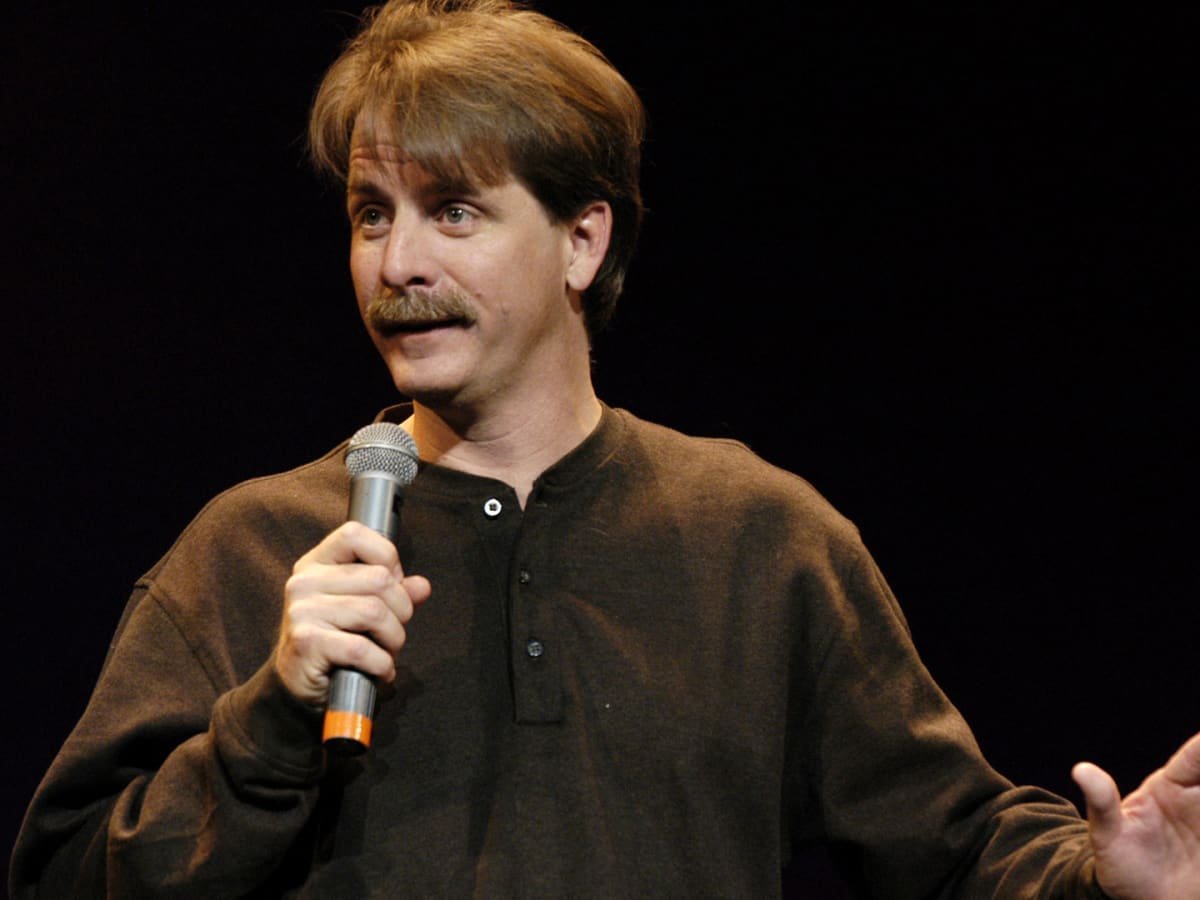
“Ladies and gentlemen, Mr. Jeff Foxworthy.”
A crowd screamed and a twanged voice thanked them very much. The tape was Jeff Foxworthy’s 1993 album You Might Be A Redneck If… recorded live at the Majestic Theater in Dallas. Foxworthy, then in his 30s, waxed poetic about how good it was to be in Texas and how crazy Southerners talked. He hails from Georgia, but his opening bit about words like yunto, as in “We goin’ tomorrow. Yunto?” and jeetyet as in, “You hungry? Jeetyet?” absolutely killed with the Dallas crowd. It was jokes about my people told in front of a crowd of my people.
He then launched into his signature “You might be a redneck” bit before he covered the difference in single life and married life, and the roles of men and women in relationships and society. You know, all the things a girl in grade school really related to.
I wasn’t a total comedy beginner. I was raised on The Dick Van Dyke Show and Seinfeld. I understood that comedy writing was a job, a real career people really did. I understood that stand-up comedy existed. I just thought it existed only in the state of New York and only in 2-to-5-minute increments before a sitcom began. Listening to Jeff Foxworthy’s voice for the duration of a full cassette tape – both sides! – recorded in my hometown, talking like my family and my neighbors, describing what our life was like, gave me hope.
It wasn’t all about my family. He also talked about fishing and belt buckles and boots, things that were a little more country than we were. In so doing, he let me feel a comfortable distance from the butts of his jokes. Still, he wasn’t necessarily mocking any of his subjects. His bits were an exaggerated celebration, and based on the audience’s cheers, a relatable and enjoyable celebration at that.
It wasn’t unusual for me to sit and listen to a voice coming through the stereo speaker. Throughout my childhood, we spent every school day morning listening to Kidd Kraddick in the Morning, a local drive-time DJ who eventually became nationally syndicated. From Kidd, Kellie, and Big Al, I learned you can be funny with your friends behind a microphone as your job. That part I understood.
The only thing missing from the radio show was an audience. My family and I may have been laughing while eating Eggos in the comfort of our living room or in our mini-van in the drop-off line at school, but the DJs never heard us. Listening to the Foxworthy tape, my tiny ear pressed against the black fabric of the speakers, I heard the immediate whoops and hollers resulting from Foxworthy’s jokes. I heard the subtle laughs that bubbled up after a particularly clever line. I heard crowdwork.
I had no idea what it looked like inside the Majestic Theater the night he performed this set. Like the radio shows, it was just a voice emanating from a void, except with an audience behind him. I think I just imagined him performing in a black void of nothingness, unable to conceptualize what a full-blown theatrical stand-up show should look like. I kept that mental picture of him in the void inside my head for years, until I finally caught one of his specials on TV.
Soon, I sought out other stand-up shows. That’s when I first watched Lewis Black and Dave Chappelle and Adam Ferrara. It’s why I later bought and memorized Shut Up, You Fucking Baby, David Cross’s 2001 album, and why I, along with almost everyone else I knew from high school, bought Dane Cook’s 2005 album Retaliation.
I studied the differences in their voices. The rhythm of their jokes. I learned timing and setups, though I didn’t know I was learning. I was enamored with the act of standing up with a microphone and making audiences laugh, but none of them made me feel like I could do something similar as much as Jeff Foxworthy did.
To this day, my family – namely my mom – quotes several of his jokes, including the one about frog butts. The same joke that popped into my head when I saw those little green cheeks and made me turn his comedy on. The bit actually appears on 1998’s Totally Committed, a spin-off of sorts from Foxworthy’s previous redneck-heavy material. The redneck talk is still there. It’s just phrased in a different way.
Listening back now, the material in both specials holds up. More esoteric minds than mine may consider it a bit hack, but I’d challenge them to come up with a more memorable metaphor for what childbirth looks like than “a wet Saint Bernard trying to come in through the cat door.”
I’ll concede the path of marriage jokes and “men versus women” is well trodden. It’s also still true, and relatable as hell. Though they seem like we’ve always known the phrase, when he first debuted “You might be a redneck, it was revolutionary. He built an entire career, an empire even, on these observations. They resonated so much because they were largely true. Believe me, I know. I’ve lived some of them. He also provided the shoulders on which my current favorite comic, Nate Bargatze, stands. A much more evolved form of the schtick for sure, Bargatze makes me actually cry-laugh with his specials no matter how many times I’ve watched them. But he is undoubtedly inspired by Foxworthy. I’m sure others are, too.
Whatever anyone feels about Jeff Foxworthy, I can say this much: he made me laugh back then and managed to do it again today when I revisit his material. Today’s laugh came out a little different. It wasn’t based in the wonderment I held for him back when I was a kid. It was the type of laugh rooted in nostalgic recognition. Like jokes you heard from your schoolteacher. So clever and exciting at first, then by the tenth or twentieth time they’re delivered, you see them coming and slide into them like slippers.
Listening back now, I almost have the Redneck album memorized. I can finish the lines, not because the jokes are predictable, but because I was so changed by them. Could a setup like “If you’ve ever had to haul a can of paint to the top of a water tower to defend your sister’s honor…” ever be so easily forgotten?
For me, these jokes were transformative. I will always hold a spot in my comedy heart for them. Jeff Foxworthy was one of my earliest teachers, delivering lectures through those wood paneled speakers in my parents’ living room from each side of that tape. Lifelong lessons that made me who I am - like how to speak in your own voice, how to pull comedy stories from your own life, and just exactly what a frog’s butt looks like.
***
This piece first appeared in Sunday Morning Hot Tea. Subscribe so you don’t miss another piece.

Vocal Coach
I promise this newsletter is not all about people who die. However, this week is going to be about another person who has died. We lost my high school speech teacher, Coach Copeland, this week. He was a mainstay in my hometown. A beloved football coach. A family man. And a damn fine comedian.
I only had him for one semester. I don’t even know if he would have recognized me if we would have seen each other again. Doesn’t matter to me if he would have remembered me or not. I remembered him.
He started every class with this poem that he recited from memory. If I’m not mistaken, I believe he even had the saying stitched onto a throw pillow which he kept in his classroom. It went:
“This is the beginning of a new day.
God has given me this day to use as I will.
I can waste it or use it for good.
What I do today is very important because I am exchanging a day of my life for it.
When tomorrow comes, this day will be gone forever, leaving something in its place I have traded for it.
I want it to be a gain, not a loss.
Good not evil.
Success, not failure, in order that I shall not regret the price I paid for it.”
It was cheesy at the time, but it really stuck with me. I mean really stuck. Every single one of those words live in my brain to this day. I cannot remember where I put my keys or what I had for dinner. I constantly forget to reply to texts. I will forget people’s birthdays and my own age. But somehow, I can remember every word to this poem from my tenth-grade speech class from 2003. When I heard Coach died this week, I wanted to know more about the source of this mantra, this prayer, that began each of our classes.
Growing up in the conservative Christian town of Mesquite, Texas, I assumed this refrain was from the Bible. If not, I figured it was at least Bible-adjacent. Turns out that assumption was incorrect. It is the words to a poem formerly called, “A Salesman’s Prayer” – later renamed “A New Day” by a Texan accountant/car salesman named Heartsill Wilson. Because of course it was.
Even if the words weren’t from the Bible, I have absorbed them like gospel. I think about them when I’ve lied lazily on the sofa for a full day, or when I’ve spent eight hours helping clients. I’ve traded a day of my life for this day – was it worth it? In both cases, yes. I think sofa-lying time is just as important as productivity time. Self-care, baby!
Coach Copeland was also the first person to share with me this Teddy Roosevelt quote:
“It is not the critic who counts; not the man who points out how the strong man stumbles, or where the doer of deeds could have done them better. The credit belongs to the man who is actually in the arena, whose face is marred by dust and sweat and blood; who strives valiantly; who errs, who comes short again and again, because there is no effort without error and shortcoming; but who does actually strive to do the deeds; who knows great enthusiasms, the great devotions; who spends himself in a worthy cause; who at the best knows in the end the triumph of high achievement, and who at the worst, if he fails, at least fails while daring greatly, so that his place shall never be with those cold and timid souls who neither know victory nor defeat.”
Again, I remember most of this quote verbatim, yet I couldn’t remember the route I took on my walk earlier today. It meant that much to me. Whenever I am faced with criticism, which as the podcast grows, is becoming more frequent, I plan to turn back to this quote. Not just the words, but the person who taught it to me.
Coach Copeland was, to put it plainly, a real hoot. He had a leather face with deep crevices cut into it from decades squinting his striking blue eyes toward a football field. He had a laugh that sounded wicked but pure. When something got him tickled, his cheeks and eyebrows would draw up, and he would wheeze from deep in his belly.
My career is lawyering, but my passion is storytelling – on the show, in writing, with friends and family. I love a funny story well told. The semester I spent in Coach Copeland’s class was less a speech class and more a masterclass in storytelling.
In addition to his inspirational quotes, he captivated us with his Vaudeville-style pun stories. He once told what I have learned is called “the longest joke in the world.” It involves a talking snake and a lever that could bring about the end of the world. He told the whole, long-ass thing and held everyone’s attention to the very end. He got a laugh, too. Not an easy feat with a crowd full of high schoolers.
These long stories would’ve been completely obnoxious except for that infectious laugh that got even a room full of teenagers on his side. Side note: I don’t know how teachers do it. Kids and teenagers are scary to me. But Coach Copeland came in with cool confidence. A man like that, with his polo shirt and a face open and kind but weathered, you just knew. He had seen some shit. He wasn’t afraid of our dumbasses. He commanded respect, and he commanded the room. He also seemed to get a real kick out of us, too.
Aside from those two quotes and a few of the pun stories, I don’t remember a single thing I learned in that class, not from the books anyway. Everything Coach Copeland taught us was by virtue of his presence. I learned to be a great speaker because I got to hear him speak. His comedic timing, delivery, and unshakable commitment to the bit all stuck with me.
I’m sure we also had to do speeches in there. That was the name of the class after all. I just can’t remember any of them. What we learned the most was from just listening, which is a lesson in itself.
Miss you, Coach.
***
This piece first appeared in Sunday Morning Hot Tea. Subscribe so you don’t miss another piece.

I Love You, You Monster
On the Pulaski stop of the orange line, headed toward Chicago’s Midway Airport, a man stepped into my train car wearing no pants. From the waist up, he was quite dapper, wearing a beige sport coat, a matching button down, and a dark tie, neatly knotted. His hair was a bit wild, a mess of black wiry strands pointing in all directions. He had a thick dark mustache. From the waist down, however, he wore only white underwear, dark dress socks, and finely shined leather shoes. It was business on the top, no pants party on the bottom.
He stepped onto the train and began to sing, which I only knew by the movement of his mouth. I couldn’t hear him with my headphones in my ears. All I could hear was the Dallas traffic and weather from an MP3 recording of The Russ Martin Show on Dallas’s 105.3FM.
I gripped my pink iPod Mini and turned the dial up, drowning out the pantsless man even more. At the time, I think the guys on the show were blowing something up or shoving fireworks down their manager, Gavin’s, pants. Probably pulling the cork from a bottle of whiskey, letting the small squeak and glug noises play into the microphone.
Nobody on the train ever noticed the times I doubled over laughing or cried from homesickness while listening to the recordings of this show. How could they? There were more pressing things, like today, a man with no pants singing an Italian aria.
Earlier that year, at 20 years old, I had headed off to Chicago for college, ready to leave the city of Dallas in my dust. Goodbye, you trash heap, I thought as I pulled away from my hometown in a red Dodge Ram dragging a U-Haul trailer behind me. I will never, ever come back.
It only took six months, maybe a year before the nostalgia and intense homesickness set in.
I should preface this by saying I love Chicago. It’s an amazing place with wonderful people. It’s one of my all-time favorite cities. Talking about Chicago, for me, is like talking about an ex who you parted with on really good terms, but who you know, ultimately, is not right for you. But damn, you had fun while you were together. And no hard feelings, but you’re just really happy with who you’re with now. That’s the love triangle between myself, Chicago, and Dallas.
The first few months up there were a whirlwind. I loved every single thing, from the snow to the busses, to the people on the busses, to the comedy theaters, to all my new cool friends with their Midwestern accents. I loved the food and the museums and the parks and the random street performers and the cyclists who took extremely dangerous risks with their lives. I even loved the nude cyclists who rode, balls out, down Michigan Ave.
Then I noticed the winters were too cold. There was never any parking. Traffic was horrendous. I couldn’t get cream gravy ANY FUCKING WHERE. No place served Dr Pepper. Tex Mex did not exist there except at one single Uncle Julio’s off the North/Clyborn red line stop, which was only just ok. Everybody loved the Bears. Nobody gave a shit about the Cowboys. Pretty soon, it started to feel a little lonely.

Heaven on Earth and yet WHERE IS MY GD CREAM GRAVY?!
In my desperation for a little piece of home, I figured out that I could listen to Dallas radio. For a recurring donation to the Russ Martin Show Listeners Foundation each month, I got access to an archive of MP3s of previous episodes of The Russ Martin Show.
I loaded up my iPod, and when I pressed play, I was not on a crowded bus or trudging through slush, a thousand miles away from home. I was in the treehouse with Russ and Dan and the gang. I was laughing at their less-than-appropriate jokes and clinging to every single word of the traffic report. 635, 35, 75, 30. My highways. My traffic.
I listened all the time, not just on my commutes. When my boyfriend and I broke up, I began living alone, but not really. By myself in an empty apartment, I would turn the guys’ voices up on my stereo. Neighbors probably thought a fraternity had moved in, with constant sounds of men laughing, the squeak of whiskey bottle corks, explosions, and that opening guitar riff of “You Shook Me All Night Long” by AC/DC, which always finished off the show.
Russ was a polarizing figure in Dallas radio. Sometimes, he was flat out silly. When beloved Dallas icon Big Tex was set ablaze, Russ gave him a dramatic church eulogy backed by “Amazing Grace” on bagpipes. Sometimes he used a voice changer to become “Little Russ,” a child version of himself that asked inappropriate questions under the guise of innocence. He tortured his old boss, Gavin, by sticking fireworks down Gavin’s pants, putting sheetrock up over the man’s office door, or straight up stealing his pants in well-choreographed but real-sounding bits.

As Russ said, he was taken by a fire that burned him nekkid. RIP!
On Fridays, he left airtime open for local no-kill shelter Paws in the City to adopt out homeless pets. When police officers or fire fighters were killed in the line of duty, like the 2016 mass shooting in downtown Dallas that left five officers dead, Russ wrote checks to the families via his foundation to cover funeral expenses, mortgage payments, and other immediate needs.
On the other hand, he sometimes said racist, sexist, and homophobic things. Some coworkers hated him and claimed he was a tyrant with a horrible attitude. He was arrested and pleaded no contest for domestic violence. He struggled with substance use and health problems.
And this past weekend, he died.
I’ll be totally honest. I had not listened to the show in earnest in many years. On one of the episodes after Russ’s death, Dan, a co-host who has taken over as the de facto leader, mentioned Russ’s waning health in the past few years. Russ had stopped performing every day, and the show’s time slot had been cut down from four hours to just two.
Tuning back into the treehouse this week, you can hear how the guys were shaped by Russ. At the same time, it is apparent how they have evolved beyond him. For one, Russ absolutely hated crying and showing emotions. But this week, when one caller choked up, Dan told him, “Let it flow, buddy.” The guys talked about telling their guy friends how much they loved one another. They listened as widows of fallen police officers spoke about how much the foundation’s support meant and cried along with them.
It’s hard to reconcile my love for someone who meant so much to me, who was a constant companion when I felt so desperately alone, with the flip side of his personality and his actions off the mic. When I heard he died, I was devastated, remembered all the times the show made me laugh, and began replaying my favorite bits in my head. For the people he hurt, his death probably felt like a sigh of relief, which is fair. We all have our own experiences with the people who shape us.
This week, Alfie, another member of the crew, played one of my favorite bits. It’s from a time Russ went on a rant backed by an instrumental version of “God Bless Texas” by Little Texas. I remember hearing this bit while I lived in Chicago and playing it so often I once had it memorized.
It had faded from my brain over the years, but when I heard it this week, I started screaming in my office. When my boyfriend, Paris, walked in and asked what was happening, I burst into tears.
“They’re playing it,” I said.
The rant begins, “I am Dallas!” and reads like a love poem to our city. A truncated version appears below.
“I’m the flying red horse.
I’m the majestic Dallas skyline.
I’m the Dallas Morning News. (I was the Herald.)
I’m Central Expressway. I’m Schepps Dairy.
I’m the Old Red Courthouse.
I’m Union Station.
I’m the reflecting pond in front of City of Dallas.
I’m the star that glistens on the chest of Dallas police officers.
I’m White Rock Lake.
I’m the Dallas Mavericks. I’m the Dallas Stars. I’m the Dallas Cowboys (muffled).
I’m the pissy city council. I’m the lack of city management.
I’m buffalo-sized potholes.
I’m the Dallas North Tollway. I’m Big Tex. I’m Southwest Airlines.
I’m the zoo where the gorillas run free!
I’m the West End. I’m the great Tom Landry Freeway.
I’m the freaks in Deep Ellum.
I’m SMU. I’m Love Field.
I didn’t have nothing to do with Kennedy.
I’m the dead bodies at the bottom of the Trinity.
I’m Reunion Tower. I’m the Adolphus. I’m that lipstick building on Stemmons.
I’m John Carpenter, LBJ, Marvin D. Love. I’m RL Thornton.
I’m the strength that took us from John Steely Dan’s cabin to the shining star of the Southwest.
I’m the sights. I’m the sounds. I’m the smells. I am its essence.
I am Dallas.”
He spoke with a self-deprecating reverence for our town, and it softened my heart. When I first heard it a thousand miles from home, I thought, That’s our town! That’s my town.
From Russ I learned the magic of getting on a mic and putting on the show you want to make. I am a better comedian and podcaster because of the hours I spent in my empty apartment in Chicago listening to him. I was also a lot less lonely because of it, too.
One of the best compliments I can get is from people in faraway places, even other countries, saying they want to come visit Dallas because of the things we talk about on the show. When I get on a mic now and talk about my town, I try to do so with that same unassuming pride I learned from Russ. It’s like, look, we know parts of it suck, but, dammit, its ours and we love it anyway and we’re doing our best to be better. It’s how we feel about Dallas and how I feel about Russ.

She ain’t much, but she’s ours.
You can never replace your hometown. And a hometown may not even be the city where you were born. I’m talking about the city that made you, the one that shaped you. It’s who you are. You can play pretend, sure. Try to adopt a new one. But no matter what, your hometown will always be in you, even if you try to move away or turn it off.
The years taught me that no matter where I lived or how hard I’ve tried, I am Dallas. Russ was, too. Rest easy, boss man.
***
This piece first appeared in Sunday Morning Hot Tea. Subscribe so you don’t miss another piece.