

Legal Question: Road Hazards and the Efficacy of Caution Signs
This week’s question comes from Lauren via the form. Lauren asks:
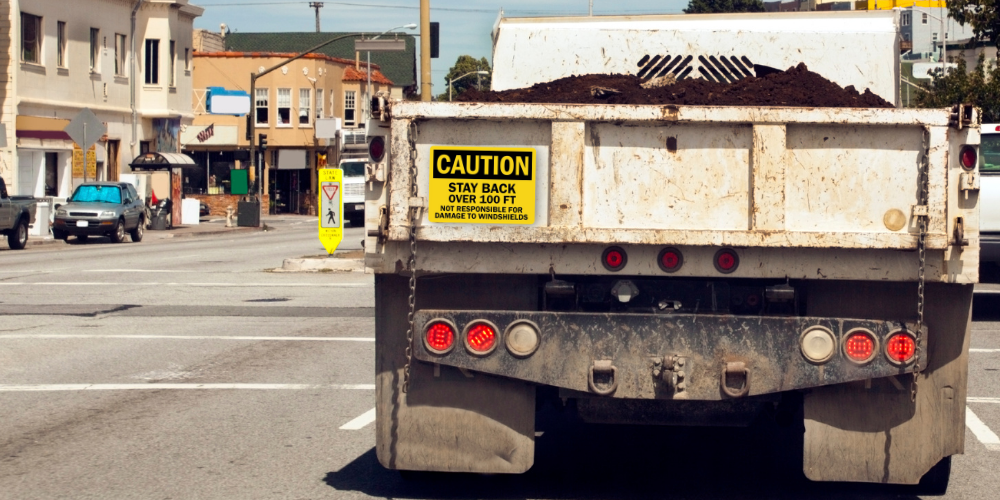
“Landscaping trucks with open tops and just a thin tarp or net over the top always have signs on the back saying it’s not their fault if something falls out of their truck and damages your car. Is that legit? If so, what the heck?! They speed down the highway leaving trails of gravel bouncing off the road and windshields. Are the signs just there to scare people out of coming for them? And why don’t they just use a tarp/net that’s actually the right size to cover the top? That last part might not be a legal question, but it seems like a super easy solution.”
Excellent question, Lauren!
The short answer is – those signs are bullshit. They’re basically there to scare you out of coming after them. But they also have a purpose.
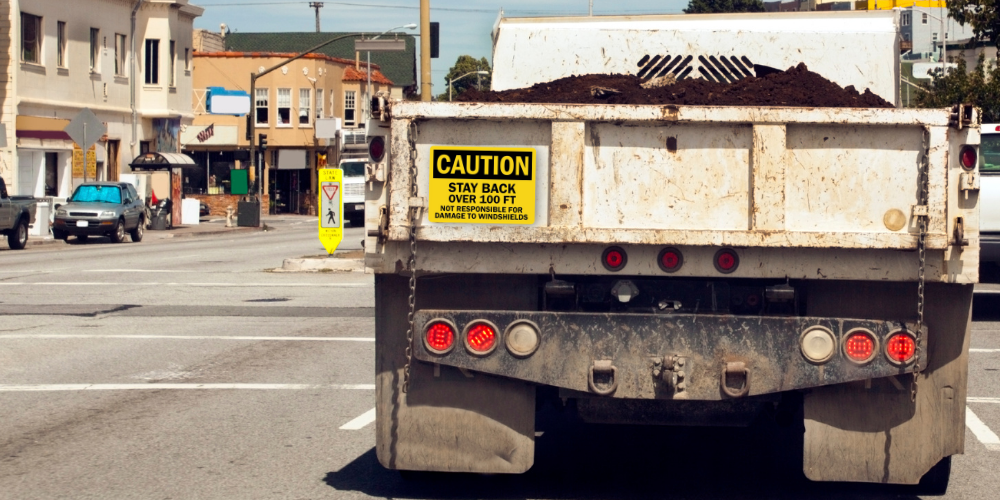
A friendly warning or an attempt to shirk responsibility?
Car accidents in general are governed by the laws of negligence. Laws vary based on jurisdiction, and since I’m based in Texas, I’ll use its laws in this answer. But overall the rules of negligence are fairly similar across states.
NEGLIGENCE
There’s a whole law school class called Torts that covers, in part, the idea of negligence. Not to be confused with delicious tortes or tortillas, torts are wrongful acts that cause somebody to suffer loss or harm, resulting in legal liability to the wrongful actor. Negligence is one of these “torts,” and it is the basis for most car accident law.
To succeed in claiming somebody like the driver of a truck full of flying objects is responsible for damages, you have to prove the elements of negligence. These are:
Duty – (lol duty) – This is the standard of behavior we are all supposed to adhere to. For instance, when you’re driving, you shouldn’t be breaking laws like speeding or distracted by a cell phone. You also have a duty to secure objects on your truck, possibly by using a tarp/net that is appropriately sized.
Breach of Duty – This means that the wrongdoer/truck driver failed to adhere to that standard of behavior. For instance, he was speeding and swerving or failed to secure his objects in the way a reasonable truck driver should.
Causation – Lots of times this is called “cause in fact” because you’d have to prove that the injury you suffered – hopefully just something like a smashed windshield, but even something as serious as injury or death – was “ in fact” caused by the trucker’s failure.
Proximate Causation – You also have to prove that the trucker (or a reasonable person) would have known that leaving things loose in the truck bed, combined with swerving and speeding, would have caused something like your smashed windshield. The key here is whether the resulting damage was foreseeable.
Damages – You have to prove there was actual harm done to you – like your windshield was damaged or you were physically injured.
You need to prove all these things to win your case against a truck driver whose errant objects flew out and smashed your windshield.
IS THE SIGN LEGIT?
Like I said, the sign is partially to scare people off, but it also has another important use. When hearing claims of negligence, courts use a concept called “comparative negligence.” Because you’re out on the road driving, you also have a standard of behavior you should adhere to. Basically, you should also be driving safely, legally, and free from distractions. If a truck in front of you is losing gravel or leaves, and you were following closer than the law allows, you could be breaching your duty of care.
When two parties both act in a way that contributes to the accident, the court has to allocate responsibility in order to figure out who is going to pick up the tab for the damages. Some states do this with a rule called “contributory negligence.” This rule is harsh because if a defendant (accused wrong actor) can prove that the plaintiff (injured party) was in ANY WAY also at fault, then that plaintiff cannot recover ANY money at all for the damages caused by the defendant. Pretty rough, right?
Texas is one of a majority of states that use another standard called “comparative negligence.” Rather than being completely screwed if you contributed to the accident in some way – perhaps, for instance, by following too close despite being warned by a sign – you could still recover damages.
What a judge or jury would have to decide is how much at fault you were for the accident. How close were you? Did you see/read the sign? Were you given enough warning to back up? Were you following closer than the Texas Transportation Code allows? Texas law says a driver has to maintain an “assured clear distance” between themselves and the car in front of them so that the driver can stop without hitting the other vehicle.
The “fact finder” – either a judge or a jury, depending on the type of trial – would then decide what percent liable each driver was.
Perhaps they determine that you were following a safe distance, so far back that you couldn’t even see the sign. In that case, you may be 0% comparatively negligent. What if, instead, you were close enough to see the sign and see the loose rocks before they flew your way? The fact finder may say you were 25% liable. In that case, if your replacement windshield cost $1,000, you would only be entitled to ask the truck driver for $750.
If, however, you were tailgating the truck to the point that your front plate nearly touched his bumper, your dash cam shows the sign clearly in your view, and the tarp is seen clearly whipping in the wind, then a fact finder may say you both were at fault – maybe 50%/50%. In that case, you can ask for $500 of the $1,000 cost for your replacement windshield.
The only hiccup really happens when you’re found to be over 51% responsible. In that case, you can’t get any compensation for your damages. This is known as the 51% Bar Rule. Texas is one of 21 states that follows this rule.
WHY DON’T THEY JUST USE A TARP/NET THAT’S ACTUALLY THE RIGHT SIZE TO COVER THE TOP?
You’re totally right. They should! If they did, and something unforeseeable happened, like a normally reliable tarp randomly ripped, then the driver probably wouldn’t be liable. The driver could argue they behaved as a “reasonably prudent person would under the same or similar circumstances,” which is the degree of care we should be operating under.
Some professions have a bit higher duty. In this case, the driver would need to be acting the same as another reasonably prudent truck driver – for instance, by securing the cargo and ensuring no loose debris is flying off their truck.
So if the driver was acting right – securing the cargo and driving safely – and something still happened, then that’s what we call a good ol’ fashioned accident, and it’s what insurance is made for.
As we always say, you can try to sue anybody for anything, it’s just a matter of whether you will win. Likewise, you can always try making a complaint to a company or its insurance for the actions of its drivers, signs or not. You may face roadblocks (see what I did there?), but you sure can try. When trying to make a complaint, it is always good to have evidence like the company name, the truck’s license plate, truck number, description, etc. It also may rise to the level of criminal action if the negligence is egregious and damaging enough. Stay safe out there!
I hope that answers your question, Lauren! Thanks for sending.
Got a question? Submit it here. They can be legal what-if questions, questions on current events, or questions about the legality of actions in TV shows or movies you’ve seen. I never ever want to answer your personal legal questions, so don't send those. Love you, but I don’t do that.
***
This piece first appeared in Sunday Morning Hot Tea. Subscribe so you don’t miss another piece.
Legal Question: Can You Sue Yourself?
This week’s question comes from Cara:
“This question was inspired by a line in your Santa Clause analysis...can you sue yourself? Is it legally possible? And if so, why might someone do it?”
Great question, Cara. This is one of those technicality-type questions. The short answer is yes. It’s kind of like that Spiderman meme:
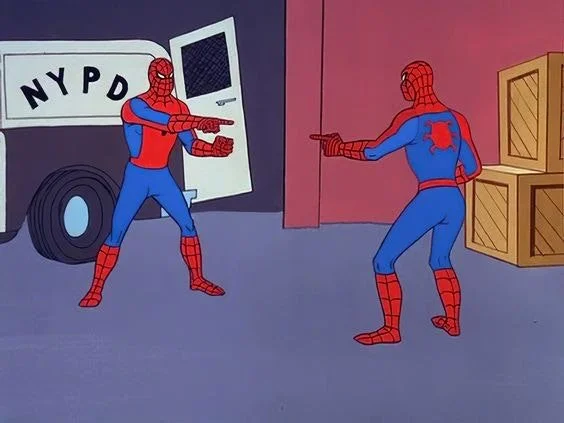
It is legally possible to sue yourself because of the concept of “capacity.” There are two kinds of capacity in the legal world - one deals with the mental state required to sign a contract or make decisions. We’re not talking about that one today. The capacity we are concerned with is “a specified role or position” that a person holds.
You can think of capacity as different hats. Each hat is a different role. If you have more than one hat, you can put on one hat, sue yourself, then put on the other hat to be sued. Let’s look at an example.
In 2016, a woman named Barbara Bagley sued herself in a personal injury lawsuit. She was driving a car with her husband as a passenger, and they crashed. Sadly, Barbara’s husband died from his injuries in the accident. Barbara then decided to seek financial compensation for the loss of her husband by suing the driver involved - herself.
Barbara brought the lawsuit in her capacity as a spouse who lost her husband. Wearing her grieving widow hat, Barbara sought compensation for all the love, affection, and wages she lost when he died. Wearing her driver hat, Barbara was sued for negligently causing the accident. This seems like a stupid idea until you realize who defends negligent drivers and pays any legal judgments against them: car insurance companies.
So Barbara the grieving spouse was suing “herself” as the negligent driver, though really that second “Barbara” was covered by the insurance company and its $$ DEEP POCKETS $$.
And you know what? It worked! The court ruled in favor of Barbara the grieving spouse based on the language used in Utah’s Wrongful Death and Survival Action Statutes. Despite the insurance company arguing that it was an absurd result, the Utah Supreme Court allowed the grieving widow to collect from herself as the negligent driver (and, therefore, the insurance company) based on the plain language of the statute. Words matter!
So while you cannot sue yourself in your own capacity - and why would you? You’d have to pay yourself back! - you can sue yourself if you do so in a different “capacity,” especially if it is supported by a statute. At least you can in Utah because Utah is a wild and hedonistic paradise with no rules!*
* Please note, I have never been to Utah.
I hope that answers your question, Cara! Thanks for sending.
Got a question? Submit it here. They can be legal what-if questions like the one above, or questions about the legality of actions in TV shows or movies you’ve seen. I never ever want to answer your personal legal questions, so don’t send those. Love you, but I don’t do that.
***
This piece first appeared in Sunday Morning Hot Tea. Subscribe so you don’t miss another piece.
Legal Question: Kevin McAllister: Attempted Murderer or Hero?
This question comes from LeeAnn via direct message.
“Would Kevin on ‘Home Alone’ get in legal trouble for setting all those booby traps? Or would he be let go with self-defense? Aren’t you allowed to protect your house? Can you also find out how his dad paid for a whole fucking family to go on that vacation?”
This is an excellent question. There are tons of great legal analyses of the Wet Bandits’ actions in Home Alone, so I won’t rehash all those thought experiments. Instead, I will answer the question by focusing on the oft-cited Castle Doctrine and how it could apply in this case.
First we should cover a couple of things. Home Alone, like other John Hughes movies, is set in the Chicago area, so I’ll look at Illinois law for this. Kevin is an 8-year-old kid. In Illinois, children that young aren't usually tried as adults, absent some pretty heinous facts. Judges apply a factors test to determine which juveniles are tried as adults, but that's outside the scope of this, and anyway, I have a lot of issues with children being tried as adults. (For further reading, check out the book Just Mercy.)
So instead of asking whether he is able to be tried for the actions he committed, we’ll just focus on the culpability.
Illinois has its own version of the “castle doctrine,” a type of home defense law you may have heard about in the news. The Illinois version is more limited than other states, but it generally says that a homeowner is justified in using force against an aggressor when the homeowner reasonably believes that force is necessary to stop the aggressor’s entry to the house.
The caveat to this law is that the use of deadly or particularly violent force is allowed ONLY if the aggressor’s entry is made in a “violent, riotous, or tumultuous manner” and if the homeowner believes the deadly force is necessary to prevent violence to him or someone else in the house. It can also be justified if the homeowner reasonably believes that deadly force is necessary to stop the commission of a felony in his house.
Short version: you can attack someone who is trying to break in, and you can attack someone SUPER HARD if they roll up on you violently and you think the force is the only way to stop them from hurting you and yours OR if you think they're trying to bust in to commit a felony.
What is NOT allowed under Illinois law is the general use of unattended booby traps. A man in southern Illinois in 2018 used a spring gun booby trap to prevent burglars from entering his shed. When a potential burglar opened the shed door, the spring gun went off, killing the potential burglar. The homeowner, William Wasmund, was convicted of first-degree murder and sentenced to 30 years in jail.
But what about the Castle Doctrine? Wasmund’s defense attorney actually argued that his client was justified under the Castle Doctrine. However, the jury found it was inapplicable because Wasmund was not home at the time of the shooting. The gun was a trap set in advance, not meant to defend against any specific party. That meant the trap could have shot anyone, not just someone who was trying to enter in a “violent, riotous, or tumultuous” manner.
Taken together - the Wasmund case, the Illinois Castle Doctrine, and the facts of the movie - all mean that Kevin McAllister was justified in his actions.
The key difference between Kevin and William Wasmund is that Kevin was home and actually heard Harry and Marv specifically say that they would be coming by to burgle the house at 9PM on Christmas Eve. It wasn’t until right around 9PM that he pushed aside his mac and cheese and got ready. He poured the water on the outside steps, held his BB gun at the ready, and set out the other various traps in the house, meant specifically for the Wet Bandits.
First, hearing them attempt to break into the house outside the back door, Kevin shot Harry in the penis with the BB gun. This was justified as it was after Harry stated his intention to come into the house to commit burglary. Then Marv breached the dog door in an attempt to enter and Kevin shot this bandit in the face with the same BB gun.
This level of force - a shot with a toy gun - is not likely to cause death or great bodily harm, so Kevin was definitely justified at this point. This is true even though Kevin shot Marv in the face. He shot Marv between the eyes with a toy gun. The earlier scene showed how Kevin was an accurate shot, proving that he shot where he intended, not meaning to cause great bodily harm.
Same goes for the icy stairs. Side note: icy stairs would normally be a liability nightmare for homeowners who could be forced to pay for any resulting slip and fall injuries. However, the Illinois Castle Doctrine specifically releases a homeowner of liability for any force used against an “aggressor.” So Harry and Marv wouldn't be able to sue the McAllisters (or their homeowners’ insurance) from any injuries resulting from those wacky but painful-looking slips
Then Marv breached the basement door where he was hit in the face with an iron. Again, Kevin did not set this trap randomly. It was specific to the Wet Bandits to protect against the felonies they would commit inside the house. Same goes for the heated door handle, the tar on the stairs, and even the stomach-turning nail that slides into Marv’s bare foot. (I remember laughing at that as a kid, but as an adult, I had to look away. Disgusting!) These traps were all set at the time Kevin was home, intended specifically to protect him from the Wet Bandits who had expressed their intent to enter the home and commit a felony inside.
Yes, even the blowtorch that burned Harry’s head would be justified under the Illinois law. By this point, Harry had burst through the door in a violent manner and expressed his desire not only to commit a felony inside the house, but also his desire to harm or possibly even kill Kevin. In short, he was asking for the torch to the head.
Once the Wet Bandits entered the house, Kevin still had the right to use force against them to “terminate” their unlawful entry of his dwelling. Further solidifying Kevin’s case, as he is running up the stairs, Harry threatens to “snap off” Kevin’s “cojones” and “boil them in motor oil.” Sounds like a threat to me!
The important point to focus on is when Kevin’s force increased from regular force to a more serious level of force likely to cause death or great bodily harm. Kevin increased the level of force only after the Wet Bandits not only breached the house in a violent, riotous, or tumultuous manner, but had also made it clear that they were ready to harm him physically and commit a felony inside.
So, as a reminder, under Illinois law, you can’t just open your front door and shoot at someone who is attempting to breach your house. The factors for use of deadly force must be present: (1) the aggressor must attempt to enter in a “violent, riotous, or tumultuous manner” and the homeowner has to reasonably believe that the deadly force is necessary to “prevent an assault upon” himself or someone else in the house, OR (2) the homeowner must reasonably believe the deadly force is necessary to prevent the commission of a felony.
Those Wet Bandits were coming in hot, and Kevin did what he had to do to ward off their attacks.
As for how the dad afforded the trip? He didn’t! In an early scene, Kate, played by the living icon/angel/legend Catherine O’Hara says that her brother-in-law was transferred to Paris for work, missed the family, and paid for them all to travel to Paris for the holidays. As for how Mr. McAllister afforded that bad ass house? According to a novelization of the book, he was “a successful businessman” and Kate was a fashion designer, hence the mannequins.
I also need to point out that John Candy’s lines were the funniest part of the movie, and they were all improvised. He was also totally screwed by the filmmakers, only being paid $414 for those lines of solid gold, despite the movie grossing $477 million at its initial box office run.
I hope that answers the question. Thanks, LeeAnn!
Got a question? Submit it here. They can be legal what-if questions like the one above, or questions about the legality of actions in TV shows or movies you’ve seen. I never ever want to answer your personal legal questions, so don't send those. Love you, but I don’t do that.
***
This piece first appeared in Sunday Morning Hot Tea. Subscribe so you don’t miss another piece.