


Legal Question: Recuse Me, Please
This week’s question is from Frank via the form. Frank asks:
I was watching The Trial of the Chicago 7 and was wondering. Could you file to have a judge removed from your case?
Hi Frank! This is a great question; thanks for asking. I have not watched this movie, but I am somewhat familiar with the case.
BACKGROUND
To summarize for those of you who haven’t seen the movie or heard of the case – the trial of the Chicago 7 or the Conspiracy 8 (or the Chicago 8… they had a lot of monikers) took place in Chicago from September 1969 to February 1970, following the protests and subsequent riots of the Democratic National Convention. The defendants were charged with conspiracy and crossing state lines to incite a riot.
The judge in the case was named Julius Hoffman. The trial was lengthy, with something like 180 witnesses testifying. One of the eight defendants had the case against him declared a mistrial, so that’s why they’re sometimes referred to as “the Chicago 7.” The judge didn’t declare a mistrial in the case of that defendant right away. First, he had that defendant bound and shackled in the courtroom as well as dragged away and beaten in another room.
After the trial, at which the defendants were acquitted of conspiracy but convicted of inciting a riot, the judge sentenced the defendants and their attorneys to jail time on charges of contempt. Judge Hoffman gave defense attorney Kunstler four years in prison for addressing him as "Mr. Hoffman" instead as "Your Honor." Defendant Abbie Hoffman (no relation to the judge) received 8 months for laughing in court. Defendant Hayden was sentenced to one year for protesting the treatment of co-defendant Seale (the one who had been shackled). Defendant Weiner received two months for refusing to stand when Judge Hoffman entered the courtroom.
At the time of the trial, Judge Hoffman was 74 years old and had been on the bench for sixteen years, having been appointed by President Eisenhower. He was later part of an expose on the judicial bench where he was accused of "acting erratically and abusively from the bench." Despite this, he continued to preside over ongoing cases until his death in 1983.
The depiction in the Netflix movie is, by most accounts, not all that different from what happened in real life. Eventually, the contempt convictions were vacated as were the convictions for conspiracy and other charges. The United States Court of Appeals for the Seventh Circuit found that the judge had demonstrated a "deprecatory and often antagonistic attitude toward the defense." That’s a real flowery way of saying he threw their asses in jail because he had beef with them.
Now, on to your question. I’ll speak in terms of federal judges since the Chicago 7 trial was in federal court. Rules vary by state for state and local judges.
Could you file to have a judge removed from your case?
Under federal law (28 U.S.C. § 455), any federal judge “shall disqualify himself in any proceeding in which his impartiality might reasonably be questioned.” Sounds super great, right? Wrong. That’s not something that happens every day. People overestimate their own abilities all the time, judges included. Where someone else may believe the judge is biased, the judge could disagree.
When that happens, what do you do? File a motion for recusal. However, be aware that it is difficult to get a judge to recuse on motion unless that judge agrees. This is because the bar for disqualifying a judge is high. Just because a judge has past experiences or political preferences, or even if the judge has interacted with the attorneys or parties before, he or she is still qualified to sit on the bench.
In some states, judges are elected, and their political leanings may be well known. In the cases of federal judges, they are appointed, usually having been sponsored by a senator from their home state. You’ll sometimes hear, “Judge So-and-So, a Clinton appointee” or “Judge Thus-and-Such, a Bush appointee.” The speaker is usually implying some type of political affiliation or likely ruling based on the administration under which each judge was appointed. This political leaning does not disqualify a judge from presiding over a case absent certain behaviors on his or her part.
Those instances where judges “shall” recuse themselves are listed in §455 and include things like having a spouse or family member involved in the case at issue, having served as a lawyer for one of the parties, or having a financial interest in the case. That last one is interesting given the Wall Street Journal report that 131 federal judges “failed to recuse themselves from 685 lawsuits from 2010 to 2018 involving firms in which they or their family held shares.” Yikes.
So what if a judge won’t recuse himself and your motion to recuse is denied? The Judicial Conduct and Disability Act of 1980 and the Rules for Judicial-Conduct and Judicial-Disability Proceedings govern the complaint process. It begins with filing a complaint against the offending judge. The circuit chief judge over the judge at issue then reviews the complaint. If it is determined the complaint has merit, the circuit chief judge would appoint a special committee to review the complaint. The committee then files a report with the judicial counsel, who then issues an order.
Federal judges can also be impeached, a formal process by which a judge could possibly be removed from the bench. According to the Federal Bar Association, 66 federal judges have been investigated for impeachment since 1776, with 15 of those being impeached, and 8 actually being removed from the bench. Some examples of conduct that led to impeached judges being removed include:
Soliciting and accepting bribes;
Perjury;
Sexual assault;
Conviction of income tax evasion;
Practicing law while sitting as a judge;
Improper business relations with litigants; and
Intoxication on the bench.
As you can see, none of those are really “acting like a dick to the defendant.” Is that conduct bad? Yes. Clearly, Judge Hoffman was not behaving so badly as to be removed from the bench by federal standards, but he exhibited extreme bias against the defense attorneys and defendants that disqualified him from ruling on their contempt charges. That is why his contempt convictions were overturned on appeal.
The Seventh Circuit’s decision vacating the contempt charges essentially said the defense attorneys’ interaction with the judge was so pernicious that Judge Hoffman would have necessarily been biased. The appellate court found “[J]udge [Hoffman] was the recipient of numerous and unprecedented attacks and insults by both trial counsel. These attacks would have affected any judge personally.” Owing to that, it was impossible for Hoffman to be unbiased and should have recused himself. The defense attorneys and defendants should have stood trial for contempt before another judge.
What does this tell us? Judges have great power. Appellate judges have event greater power because they can overturn the actions of out-of-control judges. When a federal judge misbehaves, the processes of complaint and impeachment are available. When a state judge does it (at least in Texas and other jurisdictions where judges are elected), make sure you get to the polls, organize, and when a judge is not upholding the law, get someone to run against him and replace him at the next opportunity.
I hope that answers your question, Frank! Happy Franksgiving!
Got a question? Submit it here. They can be legal what-if questions, questions on current events, or questions about the legality of actions in TV shows or movies you’ve seen. I never ever want to answer your personal legal questions, so don't send those. Love you, but I don’t do that.
***
This piece first appeared in Sunday Morning Hot Tea. Subscribe so you don’t miss another piece.

Legal Question: Can Your Lawyer Give an Interview About You?
This week’s question is from Amanda M. on Instagram. Amanda asks:
I just watched a documentary called Bodysnatchers of New York. I wondered about the defense lawyer in the documentary. In it, he recounts conversations he had with his client. Can he do that? Doesn’t that violate attorney-client privilege? The client is not dead, and he is participating in the documentary.
Great question, Amanda! First of all, this documentary is pretty pretty wild. For those interested, it covers the 2005 case of Biomedical Tissue Services which was shut down by the FDA for illegally harvesting body parts from individuals who did not consent to be harvested.
One of the people interviewed on the documentary is Mario Gallucci, lawyer for Dr. Michael Mastromarino, the mastermind of the parts-harvesting scheme. Mastromarino eventually pled guilty to body stealing, forgery, grand larceny, and enterprise corruption for harvesting over 1,600 bodies over the course of five years.
In the documentary, Gallucci speaks freely about the case, reminiscing on how he reacted when Mastromarino first approached him with the subpoena from the Kings County, New York district attorney’s office.
Throughout the documentary, Mastromarino laments what has happened and emphasizes how badly the media got his story wrong. He cries because “I really am a good person,” and says how upset he is about the version of the story that his kids heard in the news.
This footage is juxtaposed with footage of victims’ family members describing what Mastromarino did to their family member’s bodies, including selling bones and replacing them with PVC pipe. I SAID IT WAS WILD!
Can Gallucci participate in the documentary? Doesn’t that violate attorney-client privilege?
Let’s first address what the “attorney-client privilege” is exactly. It is a rule of evidence that keeps lawyers from testifying about their clients. Since Gallucci was giving an interview on the documentary, the attorney-client privilege would not apply. What would apply, however, is Gallucci’s ethical obligation not to reveal confidential client information.
The New York Professional Rules of Conduct dictate in Rule 1.6 that “A lawyer shall not knowingly reveal confidential information, as defined in this Rule, or use such information to the disadvantage of a client or for the advantage of the lawyer or a third person.”
The rule provides for a few exceptions:
If the client was informed and consented,
The disclosure is in the best interest of the client and is reasonable under the circumstances or customary in the profession, or
A few other exceptions including to prevent reasonably certain death or substantial bodily harm or to prevent the client from committing a crime.
Gallucci may have been able to participate in the documentary because Mastromarino gave his consent to have Gallucci talk on camera. Based on the poor-pitiful-me act that Mastromarino put on for the camera, he probably participated in the documentary in an effort to clear his name. Perhaps he thought letting his lawyer speak on camera would also help his crusade to repair his reputation. A swing and a miss, sir.
It could also be that nothing that Gallucci said counted as “confidential information.” One carve-out to the definition of “confidential information” is “information that is generally known in the local community or in the trade, field or profession to which the information relates.”
In his interviews, Gallucci explained that he and his colleagues were told by Mastromarino that what he was doing was perfectly legal. He also describes how Mastromarino turned himself in and what evidence the prosecutors used as the “smoking gun” that caused Mastromarino to plead guilty.
Those things would be “generally known” given how public this case was and how widely reported it had been in the media. If information is generally known, then it is not confidential and the lawyer may freely disclose it, according to the New York State Bar Association’s ethics opinions.
Gallucci also explains the severity of an “enterprise corruption charge” aka state-level racketeering. He outlines the process of DNA testing conducted in the case that sealed Mastromarino’s fate. Both of these pieces of information would fall into the other carve-out of what is not “confidential information” – that is “a lawyer’s legal knowledge or legal research.”
Although we lawyers have a duty of confidentiality to our clients, that only extends to certain information that falls under the definition of “confidential information.” If Gallucci kept his comments to publicly known details and general legal knowledge, he wouldn’t be violating his duty to Mastromarino.
Then again, Mastromarino may have given Gallucci the green-light to participate in an effort to help this real-life Dr. Frankenstein clean up his reputation. If you watch even 5 minutes of the 45-minute documentary, you’ll see that didn’t quite work.
Thanks for asking, Amanda!
Got a question? Submit it here. They can be legal what-if questions, questions on current events, or questions about the legality of actions in TV shows or movies you’ve seen. I never ever want to answer your personal legal questions, so don't send those. Love you, but I don’t do that.
***
This piece first appeared in Sunday Morning Hot Tea. Subscribe so you don’t miss another piece.

Legal Question: Your Honor, I’ve Got to GO
This week’s question is from Frank via the form. Frank asks:
What does a lawyer do if they have to take a dump during a hearing? Like what options do you have to call for a recess so you don’t soil yourself?
Great question, Frank! I just had a hearing in Hood county this week. Luckily it only lasted about 20 minutes, so I was able to make it through with no need to slip out for a dump. However, as a person who constantly has to go to the bathroom, this thought has crossed my mind a lot. A LOT.
My initial instinct would be that you simply ask the judge, “Your honor, may we have a short recess?” This should work, unless the judge is frustrated or doesn’t quite understand what you’re getting at.
Not wanting to lead you all astray, I decided to consult with an expert, Julie Aguilar. Julie is a family law attorney and regularly tries cases. I go to Julie for all my family law questions or any time someone asks me for a referral to a family law attorney.
Today I had to audacity to ask this D Magazine Best Lawyers Under 40 honoree just what one does when a turtle head starts poking out during a hearing. She obliged because she is infinitely patient and wonderful. She said that my “May we have a short recess?” idea should work. But, she suggested, if the request for a recess didn’t work, an attorney could then ask the judge for a quick side bar to discuss “an urgent matter.” At that point, you would tell the judge that nature was calling.
I asked another excellent litigator I know, Ian Ross Phillips, the same thing. He confirmed that asking for a recess should work. Attorneys could also discuss scheduled bathroom breaks with the judge and opposing counsel before the jury was brought in. That way the breaks could be at convenient times like after a witness has been questioned or before the witness is cross-examined by the opposing side.
Phillips also said that jurors are normally instructed to alert the bailiff with a note or signal if they need to use the restroom during proceedings.
God bless friends who answer late night texts like “What if you have to poop in trial???” Love you guys.
WHEN GOING TO THE BATHROOM GOES WRONG
Whether to go on recess is up to the judge’s discretion, but denying a party access to a jury trial simply because a lawyer was squatting a grumpy down the hall is an abuse of discretion.
An attorney in Texas had an unfortunately-timed bathroom break in 2018. The suit at issue was a custody battle where a grandmother, having lost her daughter to cancer, was fighting for the right to see her grandchildren. The case was set for a pre-trial conference at which the attorneys and all parties were scheduled to appear before a judge at 9:00am.
The notice of pre-trial conference informed the parties that failure to appear would constitute a waiver of a party’s request for a jury trial. This means if they missed the meeting with the judge, the grandmother would lose the chance to have her case heard by a jury.
What happened next is the stuff of my nightmares as a lawyer.
The grandmother’s lawyer answered the docket call at 9:00 am. This means he went in and informed the court coordinator that he was there. He then left the room, and accounts vary whether he went to the bathroom or to another court room. He then came back at 9:25 and let them know he had returned. He left again at 9:35, telling opposing counsel and the coordinator that he had to go to the bathroom. The coordinator told him, “Hurry up.”
He didn’t hurry up enough for the judge’s liking. The judge called the case at 9:39am, just four minutes later, while the lawyer was still out launching his sea pickle. Four minutes is definitely not enough time to get any bathroom business done, let me tell you.
Nonetheless, the judge marked down with the coordinator that neither the lawyer nor his client appeared. The judge considered this momentary absence as “not appearing” and set the case for a non-jury trial. The lawyer’s morning constitutional lasted around ten minutes, and he returned to the court at 9:50am, horrified to learn he had missed the conference.
The lawyer asked the court to reconsider several times, but it refused. The lawyer was forced to file for mandamus relief on his client’s behalf. Mandamus is when you ask a higher court to look at a case and require a lower court judge to do something they are obligated to do. To obtain mandamus relief, a person must show both that the trial court clearly abused its discretion and that the person has no adequate remedy at law, such as an appeal.
The Fourteenth Court of Appeals took up the request for mandamus and determined that the judge’s removal of the case from the jury docket was an abuse of discretion. It was over a year before the lawyer finally got relief for his client. That didn’t take the sting away from him. He told the ABA Journal, “I could have died of embarrassment reading the opinion. But I cannot afford to dwell on it. Instead, I will take advice given by my late grandmother: ‘Pick up the pieces, and move on.’”
Here’s a piece of advice from my mom, “Go to the bathroom before you leave.”
Great question, Frank!
Got a question? Submit it here. They can be legal what-if questions, questions on current events, or questions about the legality of actions in TV shows or movies you’ve seen. I never ever want to answer your personal legal questions, so don't send those. Love you, but I don’t do that.
***
This piece first appeared in Sunday Morning Hot Tea. Subscribe so you don’t miss another piece.
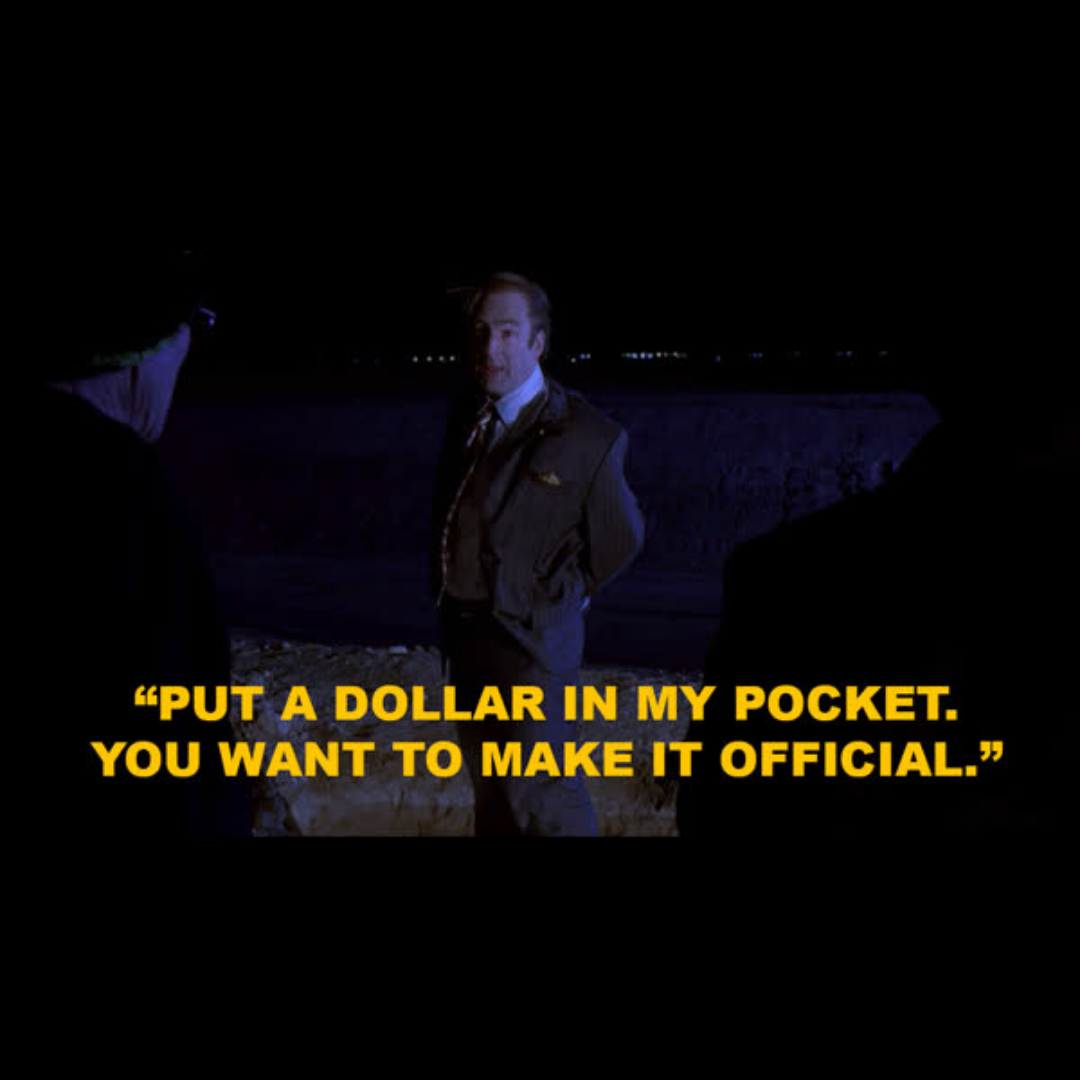
Legal Question: If You Give a Lawyer a Dollar
This week’s question is from me watching a lot of Breaking Bad. No real spoliers below, but if you are concerned about me ruining a 12-ish year old show, by all means skip. Along those same lines, I am only on season 3, so don’t email me any spoliers please.
On to the question:
Does giving a lawyer a dollar make everything you say subject to attorney-client privilege?
While watching an early episode in Season 2, we see Saul Goodman speaking with Jesse and Walt. He’s tied up, kneeling on his knees, and tells Walt and Jesse to “put a dollar in my pocket” so they could start an attorney client/relationship thus making any meth-dealing info the pair told him subject to the attorney-client privilege.
As we watched, Paris asked whether what Saul did was necessary.
Great question, Paris! I thought I told you to use the form next time you had a question like this?! Anyway, thank you for insisting that we watch Breaking Bad. I am very much enjoying it!
Quick note: I don’t live in New Mexico. I live and practice in Texas, so I’m going to answer with references to Texas rules of evidence and professional conduct, though I’m sure New Mexico’s rules are similar. I’ll also refer to federal rules because – this may come as a surprise to you – drug-dealing across state lines is a federal offense.
What kicks off the attorney-client relationship?
Walt and Jesse didn’t even need to give Saul a dollar to start the relationship. Attorney-client privilege and confidentiality extend even between a lawyer and a person who is considering hiring that lawyer for legal work. Information given to the attorney even before money changed hands is subject to confidentiality and, without careful clarification, can inadvertently create an attorney-client relationship.
Once you and a lawyer are in an attorney-client relationship, that lawyer is subject to a LOT of responsibilities. Keeping you informed about the status of your problem, providing you with diligent and zealous representation, not having sexual relations with you (sorry!), etc. So we try our best as lawyers not to even set up that relationship in the first place, or at the very least, clarify the parameters of that relationship and when it ends as soon as possible.
This may be why your lawyer friends are hesitant to give you off-the-cuff legal advice (that and the fact that we hate it and it’s annoying and anyway you haven’t even talked to us since that freshman biology class we had together like 15 years ago and now you’re DMing us for legal advice? Really?)
But I digress.
The exchange of money is not necessarily required to begin an attorney-client relationship. Even just asking for and being provided with legal advice can possibly make the information exchanged subject to confidentiality and privilege.
That being said, it sure feels cool and clandestine to hand somebody a dollar and be like “You’re my lawyer now.” I know. It’s happened to me before. And it was cool as hell.
What is the attorney-client privilege?
The attorney-client privilege is outlined in the Texas Rules of Evidence at Rule 5.03 and the Federal Rules of Evidence at Rule 5.01. These rules say that a client has a privilege to refuse to disclose and to prevent any other person from disclosing confidential communications made to facilitate the rendition of professional legal services to the client. People governed by this privilege include the lawyer, the lawyer’s representatives, and other lawyers the client’s lawyer consulted with.
In addition, the Texas Rules of Professional Conduct generally require lawyers to keep confidential any information provided to us in the course of representation or giving legal advice. In fact, the communications that are protected by the attorney-client privilege are only those that the client or attorney makes for the purposes of providing/obtaining legal services AND that are confidential.
The communications have to be confidential to be protected. If you’ve ever accompanied a friend or a family member to a lawyer’s office and the lawyer makes you wait outside in the waiting room, this is why. Having non-client third-parties in the room can waive the privilege.
This set up of confidentiality and privilege is important. If we’re going to give you competent and thorough legal representation, we need to know what we’re working with. If you’re paranoid that we could rat you out to the cops for what you tell us, you may withhold information and, in turn, we may give you bad advice.
It’s a bit like going to the doctor (by the way, lawyers LOVE equating ourselves with doctors. We can even call ourselves “Doctor” by Texas professional standards, but when a lawyer calls themselves “Doctor” most people substitute in the word “douche bag” so most of us don’t do that).
When you go to the doctor, she will listen to your symptoms then prescribe a treatment to you – either a medication or a course of action. If you don’t tell her all the other medicines you’re taking, she could inadvertently prescribe something that kills you.
We lawyers need to know allll the facts of a given situation to advise you of all the possible outcomes and courses of action available to you. That absolute honesty includes telling us about crimes you may have done. If you go confessing crimes to your lawyer, then your lawyer is called on the stand and forced to testify against you, that would eliminate the whole purpose of lawyers in the first place.
Instead, the Rules of Evidence, both state and federal, and the Rules of Professional Conduct require attorneys to keep the information our clients tell us to ourselves.
But not always.
Exceptions to the Attorney-Client Privilege and Confidentiality
So you found your Saul Goodman. You paid him his unnecessary dollar or even just asked him for legal advice, which requires him to keep your info private. But then he helps you commit a crime or series of crimes. It’s all privileged because he’s your lawyer, right? Wrong.
The attorney-client privilege is not absolute. The Rules of Evidence lay out specific exceptions to which the privilege does not apply. One of these is called the Crime/Fraud Exception. If the lawyer’s services were “sought or obtained to enable or aid anyone to commit or plan to commit what the client knew or reasonably should have known to be a crime or fraud,” the communication is no longer privileged
Because Walt and Jesse were seeking Saul’s services, not to help them navigate having been charged with a crime, but to continue to commit those crimes and get away with it, the privilege does not apply. Walt and Jesse could not assert the privilege and keep Saul from testifying.
As recently as 2016, a pair of lawyers were required to disclose confidential information that would otherwise be protected by the attorney-client privilege in a case of tax evasion. A man had used the lawyers’ services to write a tax protest letter, appeal the results of an audit, and allegedly engage in other sneaky tax-hiding behavior to the IRS and Tax Court.
Because the lawyers’ services were used to aid the man in his tax evasion, the court required the lawyers to produce the incriminating evidence they had about their client.
In an interesting twist of loyalty, the man insisted that the lawyers continue to represent him even after they were required to reveal information about him to the Department of Justice. I would say they sound like very good lawyers, but then again, their client was sentenced to 70 months in jail for the ordeal. Who knows, maybe they were just really good friends.
As much as we love him, Saul is a serial violator of the rules of professional conduct, except the rule of confidentiality. As for his illegal behavior, of course it’s against the law. It’s also against the Rules of Professional Conduct, one of which is, basically, don’t do crime. The exact language is a little more flowery, but you tell me if it boils down to anything other than “don’t do crime.”
A lawyer shall neither “engage in conduct involving dishonest, fraud, deceit, or misrepresentation” nor shall he “commit a serious crime…or any other criminal act that reflects adversely on the lawyer’s honest, trustworthiness, or fitness as a lawyer.”
I may be a prude, but I think money laundering and/or facilitating connections between a meth cooker and meth distributor fits squarely in that definition.
Amongst other pretty obvious ethical concerns, there is also some concern about representing both Walt and Jesse. In fact, at one point, Jesse even asks Saul, “Yo, whose lawyer are you?” when Saul jumps at the chance to offer Walt a deal that he previously offered to Jesse.
It is just as important to know when someone is your lawyer as it is to know whether someone has a duty to keep your confidential information confidential, or when you as a client can assert privilege and keep your lawyer from testifying against you.
Don’t let Saul fool you – it doesn’t take a dollar for those rules to apply. And once they do, they can stop applying if your lawyer jumps into the criminal bed with you, so to speak.
Thanks for asking and for forcing me to watch Breaking Bad, babe! I am loving it!
(PS – For realskis, don’t send me spoilers because I already accidentally saw some when I was researching this, and I am actively trying to forget them so I can be surprised when I see the finale, please and thank you.)
Got a question? Submit it here. They can be legal what-if questions, questions on current events, or questions about the legality of actions in TV shows or movies you’ve seen. I never ever want to answer your personal legal questions, so don't send those. Love you, but I don’t do that.
***
This piece first appeared in Sunday Morning Hot Tea. Subscribe so you don’t miss another piece.
Legal Question: Drunk on the (Legal) Job
This week’s question comes from Nancy aka my mom. HI MOM!!!!!
“Should your attorney be sober and present? What do you do if you suspect that your attorney is shit-faced?”
She included a link to this article: Rudy Giuliani had three triple Scotches in 90 minutes hours before infamous hair dye-dripping press conference, ex-Overstock CEO claims as he unloads on Donald Trump's 's***-faced' lawyer
Excellent question, Mom! The image of Rudy Giuliani sweating bullets, brown substance pouring down his temples, will be seared into our collective memory for years to come. I imagine my children will someday ask, “Was that a real thing that really happened?”
“Yes,” I’ll be forced to answer. “It was all too real.”
According to a witness, America’s Mayor “imbibed heavily hours before” that press conference. The witness also wrote that, “Almost every evening, and many early afternoons, Rudy was s***-faced.” Granted, many times, Rudy was not in court. Still, lawyers are held to certain ethical standards regardless of where they are. Let’s address each of these questions in turn.
Should your attorney be sober and present?
In short, yes. It’s generally a good idea to show up to work sober, lawyer or not. However, there is an unfortunate history of lawyers coming to court completely wasted or even sleeping during trials and facing few, if any, consequences. The Marshall Project, a nonpartisan, nonprofit news organization covering criminal justice issues, collected ten stories about lawyers engaged in PWI – practicing while intoxicated – and the unfortunate outcomes for their clients.
Case after case shows marginalized people convicted of crimes with completely drunk lawyers as their only defense. And the worst part? Appellate courts upheld the convictions, leading, in many cases, to the defendants being executed.
This is primarily because the standard for “ineffective assistance of counsel” is incredibly high. Outlined in the 1984 Supreme Court case Strickland v. Washington, in order to overturn a conviction due to bad lawyering, a defendant has to show (1) that their trial lawyer’s performance fell below an “objective standard of reasonableness” AND (2) “a reasonable probability that, but for counsel’s unprofessional errors, the result of the proceeding would have been different.”
Usually defendants have no problem proving the first half when their attorneys acted egregiously. It’s the second part that trips them up. Many appellate courts say, sure, your lawyer literally walked into the wrong court room and had a BAC of .11, but there is no probability that the case would have gone differently had he been sober. Sorry! Conviction upheld.
It is important to note that Rudy was not providing criminal defense in his role as our former president’s lawyer. He was giving speeches outside of a landscaping company and farting during a Michigan hearing. (NOTE: Farting in court is not illegal, and if I have anything to do with it, it never will be!)
Whether he was in court or not, Rudy is an attorney licensed to practice in New York, and, as such, his behavior is governed by the New York Rules of Professional Conduct. One rule that may apply to his allegedly being drunk at the press conference is Rule 8.4(h) which states, “A lawyer shall not… engage in any other conduct that adversely reflects on the lawyer’s fitness as a lawyer.”
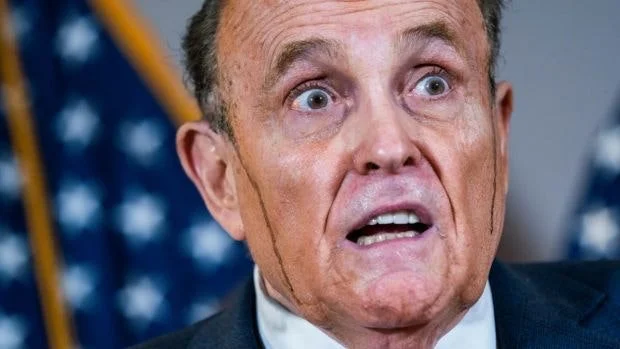
Does this conduct adversely reflect on his fitness as a lawyer? You tell me!
But wait, you may say. That presser didn’t happen in New York! It unfolded on live TV from the headquarters of the Republican National Committee in Washington. What business does New York have disciplining actions that happened in Washington? Good catch, gumshoe! That doesn’t necessarily matter for attorney discipline.
Rudy flew around the country doing all manner of wacky things, but where’re he roamed/farted, the NY Rules still applied to his conduct. New York’s Rule 8.5 states, “A lawyer admitted to practice in this state is subject to the disciplinary authority of this state, regardless of where the lawyer’s conduct occurs.”
Which brings us to the second half of the question – What do you do if you suspect that your attorney is shit-faced?
Attorney oversight in New York is meted out by four intermediate courts across the Empire State. One scholar has argued that this separation of authority creates inconsistent application of the professional rules. That same scholar also read hundreds of attorney disciplinary cases over the course of several decades and found two things: (1) not only did it take an excessive amount of time for decisions to be rendered, but (2) after the courts found misconduct had occurred, it was incredibly difficult for the public to see the disciplinary records of those lawyers.
In short, the system is flawed.
The whole reason that lawyers are held to a higher standard than everyone else is the great power we wield and authority we command. If the strict standards of professional conduct are meant to protect the public, they should be more expediently implemented to achieve that goal. And once they are implemented, the public should be able to easily access the results.
Giuliani may have some time before being disbarred due to the slow turning of the wheels of attorney discipline. However, the process is already moving for ol’ Rudy. New York state Sen. Brad Hoylman has filed a complaint with the appellate division, citing Giuliani’s “rampant and egregious violations of the Rules of Professional Conduct,” as well as his “complicity” in the insurrection on January 6.
Additionally, a group called Lawyers Defending American Democracy (“LDAD”) also filed a 49-page complaint with the attorney grievance committee on January 29, citing Giuliani’s prior behavior, including times he has “invoke[d] and abuse[d] the judicial process, lie[d] to third parties in the course of representing clients, or engage[d] in conduct involving dishonesty, fraud, deceit, or misrepresentation in or out of court.”
The latter half of the LDAD complaint is an appendix of Giuliani’s public statements in chronological order with screenshots and hyperlinks. It cites the claims Giuliani made at the hair-dye presser but makes no mention of his allegedly inebriated state.
The New York State Bar Association, a voluntary professional organization, has also taken steps to remove Giuliani, but not for his alleged drinking. That investigation is for his role in the January 6 insurrection as well as “hundreds” of complaints that came in since the election. But the NYSBA doesn’t actually discipline lawyers. It is a voluntary association, so its investigation is more ceremonial than disciplinary. Nevertheless, the NYSBA calls it a “historic inquiry” which sure makes it sound important.
In short, lawyers shouldn’t show up to work drunk. At minimum, it likely violates the rules of maintaining the integrity of the profession and providing zealous advocacy for our clients. If you suspect your lawyer is drunk? You can make a complaint to the bar. The process varies based on what state you’re in. The likelihood of appealing on a claim of ineffective assistance of criminal defense counsel, though? Pretty low, unfortunately.
On more somber note, as many as one in five lawyers is a problem drinker – twice the national rate, according to the American Bar Association. If you’re a lawyer, judge, or law student who is struggling with alcohol, there are resources to get help. Most state bar associations provide a “lawyers assistance program” that provides confidential help for dealing with substance use issues. If Rudy really needs help with his drinking, let’s hope he gets it sooner than later.
I hope that answers your question, Mom! Thanks for sending. I love you!
Got a question? Submit it here. They can be legal what-if questions, questions on current events, or questions about the legality of actions in TV shows or movies you’ve seen. I never ever want to answer your personal legal questions, so don't send those. Love you, but I don’t do that.
***
This piece first appeared in Sunday Morning Hot Tea. Subscribe so you don’t miss another piece.