
Legal Question: The Cost of Naming Your Juice
This week’s question is from Aaron via the form. Aaron asks:
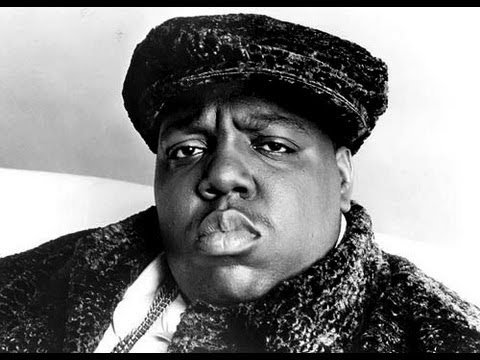
In the song “Big Poppa” Notorious BIG attempts to entice a girl to rendezvous with his crew at the bar around 2 with an offer of “cheese, eggs and Welch’s grape.” Did he have to pay Welch’s for the use of their brand in his lyrics? Do music artists fall under the same rules as movies and tv about product usage?
Great question, Aaron!
I’ll start off by saying the following is a simplified explanation of use of trademarks. I love them, but intellectual property attorneys rank up there with tax attorneys in the “UM ACTUALLY” camp of lawyers. They can’t help it, they’re specialists! Think of me as your local primary care physician and think of IP lawyers as brain surgeons. Their area of law is incredibly intricate, which, naturally, leads them to hang their hat on technicalities. It’s why we love them and why we pay them the big bucks to watch our artistic backs.
So here’s the quick and dirty on using brands in songs.
Two laws govern the use of trademarks in media – the Lanham Act and the Federal Trademark Dilution Act (FTDA). The Lanham Act protects trademark holders from, among other things, trademark infringement, trademark dilution, and false advertising. The FTDA creates a way to sue in federal court to protect famous marks from unauthorized use; to prevent others from trading upon the goodwill and established renown of such marks; and to prevent dilution of the distinctive quality of such marks.
The purpose of both of these laws is to protect the commercial use of words and symbols. The law that runs counter to those laws is a big one – the First Amendment. Since the government “shall make no law …abridging the freedom of speech,” courts have been hesitant to bar speech simply because it mentions the name of a brand.
The test courts use to balance the protections of the Lanham Act against the free speech guaranteed by the First Amendment was originally created in a lawsuit from Ginger Rogers, the famous movie star and dancer. It’s now known as the Rogers test.
The Rogers test poses two questions to determine whether the Lanham Act wins when it is pitted against the First Amendment. The first question is whether the offending work’s use of a trademark has some artistic relationship to the work. The second question is whether that use explicitly misleads consumers.
In Rogers, the Second Circuit Court of Appeals held that the Lanham Act “should be construed to apply to artistic works only where the public interest in avoiding consumer confusion outweighs the public interest in free expression.” The court refused to ban someone from using a name or brand in a work simply because it was protected by a trademark. The use had to ALSO be confusing to consumers in order for the court to bar the speech.
The Ninth Circuit adopted this standard in its ruling on that one-hit-wonderful song “Barbie Girl”.
In the Barbie Girl case, the use of the trademark “Barbie” did not “explicitly mislead as to the source of the work” and did not “explicitly or otherwise, suggest that it was produced by Mattel.” That was enough for Mattel to lose at an early stage of litigation – because the use of the trademark in the song did not mislead a listener as to the source of the work or suggest it was produced by the owner of the trademarked item. Nobody heard that song and thought Mattel wrote it or sang it.
The Barbie Girl decision also applied the other law, the FTDA. One of the exemptions to the FTDA that allows someone to use a trademark is non-commercial use. But that begs the question — Is using a trademark in a song commercial or non-commercial? A song like “Barbie Girl” is art (just barely), created to express Aqua’s feelings on Barbie. But it’s also a product that’s being sold – back then, via CD singles at the local Sam Goody.
The court determined that when a song’s commercial purpose is “inextricably entwined expressive elements,” the song should be allowed to enjoy full First Amendment protection. Since the creative expression of Aqua singing about being undressed anywhere existed alongside the purpose of selling records, the Ninth Circuit held that the song “Barbie Girl” was not purely commercial speech. Therefore, Mattel lost and couldn’t prevent the monstrosity of “Barbie Girl” from continuing its onslaught against our ears.
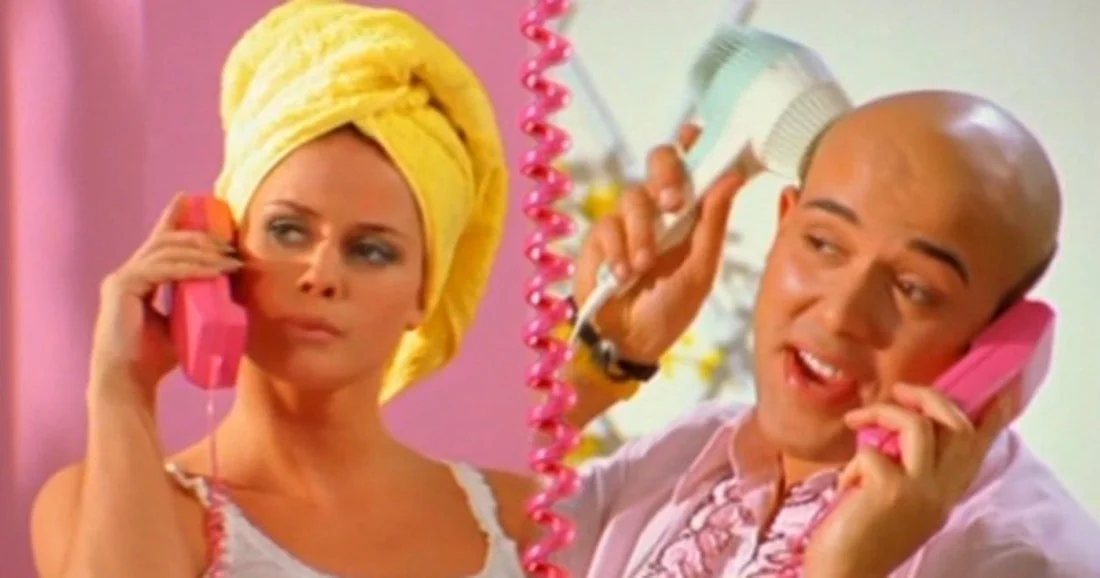
The use of the trademark is not illegal but being forced to listen to the song should be.
The Rogers test was recently applied to protect video game maker Activision Blizzard when it used AM General’s Humvee military vehicle in its Call of Duty video game. Is using a trademarked car in a video game commercial or non-commercial?
Because the Humvees were there to make the gameplay more realistic, the court concluded that was “artistic expression” sufficient to satisfy the first question in the Rogers test.
As to the second question, the court held that the Humvee was not “explicitly misleading” and also, even if it was a little bit misleading, “an artistically relevant use will outweigh a moderate risk of confusion where the contested user offers a ‘persuasive explanation.’” Activision Blizzard explained their use of the Humvees persuasively: Humvees are the kind of vehicles that the real military uses, so they chose to use those vehicles to be as realistic as possible.
Despite these lawsuits, many brands actually like being mentioned in hit songs. Taylor Swift frequently name drops brands in her songs, including Polaroid and Band-Aid, which benefits the brands and sometimes leads to partnerships.
When Katy Perry released “Harleys in Hawaii” she did not inform Harley-Davidson of the song’s title in advance. Still, the company relished the opportunity to access a younger generation of riders and even provided motorcycles for us in the music video. The real illegal action in this song is that it wasn’t a bigger success. That song fuckin’ SLAPS!
There are really two ways for an artist to get in trouble by mentioning a brand in their songs. The first, as we discussed above, is mentioning a product in a way that would confuse consumers that the brand was responsible for the song.
The second way is mentioning a brand or product in a bad light. For instance, I would not recommend writing a song called Taco Bell Gives Everyone Diarrhea Every Single Time They Eat There. Just like people can sue for untrue statements about them that cause harm, corporations can also sue for defamation. Taco Bell would have to show that the published material has caused or is likely to cause financial losses. That may be a stretch given that Taco Bell = diarrhea is a meme. Doesn’t mean they couldn’t still try.
This is why a banger like “Combination Pizza Hut and Taco Bell” can exist in all its glory. It is not making a negative statement about the conjunctive restaurant chains, and no one would be confused into thinking that YUM! Brands wrote or sang that song.
Since Biggie mentioned using Welch’s grape juice as a way to seduce women to rendezvous with him in the middle of the night, we can assume this is a positive mention as he believes it to be a delicious pairing with his T-bone steak and cheese eggs. Is it “cheese (COMMA) eggs”? Like, is he eating a T-bone steak, cheese, AND eggs, then pairing it all with Welch’s grape juice? Or is he eating a T-bone steak and eggs MIXED WITH cheese to pair with the Welch’s? The world may never know.
But at no point would anyone think that Welch’s grape juice wrote that song. Just listen to it. Only Biggie could come up with such effusive lyrics and such dope beats.
I hope that answers your question, Aaron!
Got a question? Submit it here. They can be legal what-if questions, questions on current events, or questions about the legality of actions in TV shows or movies you’ve seen. I never ever want to answer your personal legal questions, so don't send those. Love you, but I don’t do that.
***
This piece first appeared in Sunday Morning Hot Tea. Subscribe so you don’t miss another piece.
Legal Question: FACE/OFF - Privacy Issues and Deepfakes
This week’s question is from Julissa on Instagram. Julissa asks:
So I’m seeing with all the apps you can use to swap your face with a celebrity’s face there are now TikToks of people just using the app and doing funny videos while pretending to be a celebrity like @deeptomcruise for example. My question is what kind legal protections exist to protect your likeness and how it can and can’t be used? Thank you!!!
Thanks for asking, Julissa!
As a lawyer fighting scams, I think Deep Fakes are the next biggest threat to scam victims, especially seniors. One way I tell seniors to try and avoid romance scams or celebrity scams is to ask to video chat with the person reaching out to them. Now, if scammers can put a celebrity’s face onto their own and pretend to be someone they’re not, how can we keep ourselves safe?
As a person who has seen Face/Off, I am equally as concerned about facial transplant surgery. But this question is about deepfakes, so let’s go with that.
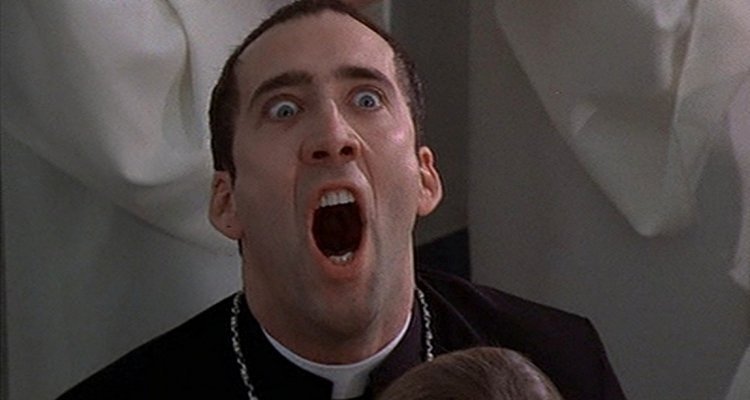
It's Like Looking In A Mirror Only… Not.
What are Deep Fakes?
In case you are not familiar, the term “deepfake” can refer to manipulated media, either photo, video, or audio, that creates a false piece of new media. Scientists (or scammers) can use a special type of computing system to analyze photos, videos, or audio of a person to determine how to recreate them in the new media. For instance, when creating a deepfake video, the program may track what mouth shapes are linked to various sounds in order to mimic them.
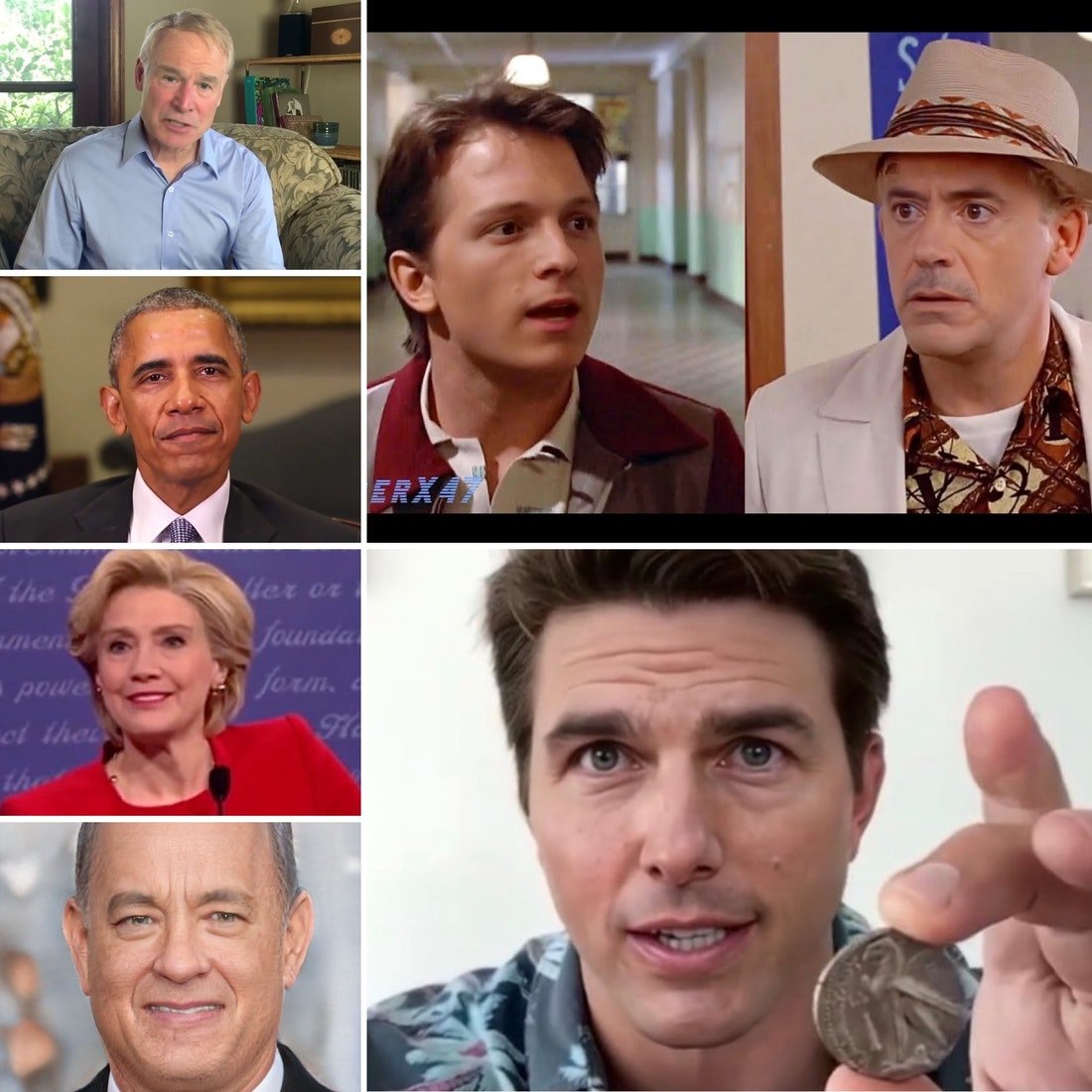
These algorithms work best where there is tons of footage of a person – Tom Cruise, Tom Hanks, Tom Holland. Also other famous people not named Tom like Barack Obama, George W. Bush, and Hilary Clinton.
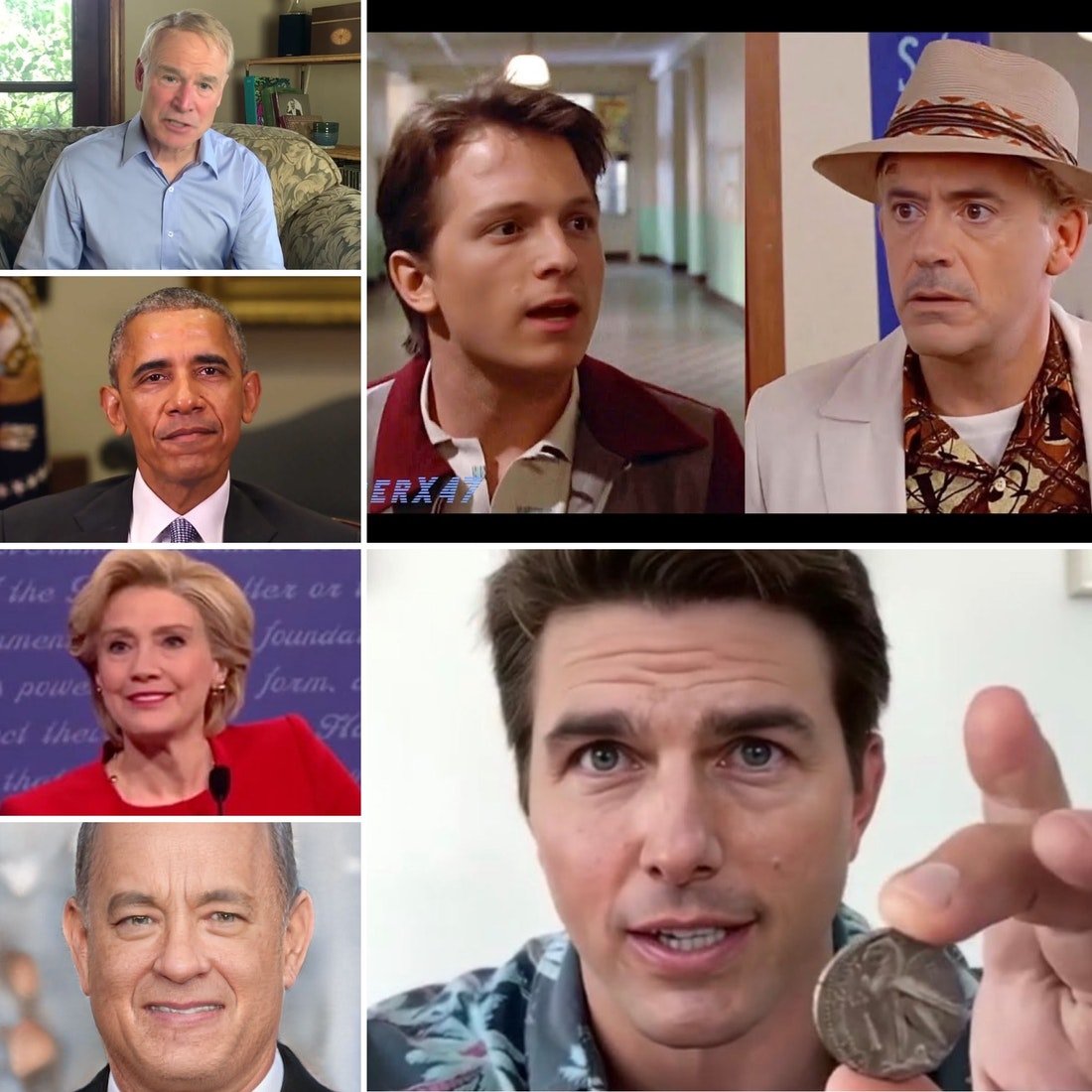
None of these are real. NOTHING IS REAL!
It’s funny to watch a person who appears to be Tom Cruise fall down in an upscale store. Believe me, I’ve laughed at it. But it is scary how much cheaper and easier it is becoming to create more and more credible deepfakes. There are even apps now that allow you to perform a deepfake live during a video chat, making my advice to always ask for a video chat pretty useless.
Just compare the 2018 Barack Obama deepfake linked above with the 2020-2021 Tom Cruise deepfakes from TikTok. The Obama video is fun to watch, especially knowing it’s Jordan Peele behind the fake, but you can tell there’s something just beneath the surface that’s not quite real. On the other hand, the Tom Cruise videos are so spot on that the creator made a breakdown video just to show how it was done and calm people’s fears.
There is also this incredibly realistic and funny, but wildly inappropriate, video created by the South Park guys featuring our most recent former president and a handful of other celebs including Julie Andrews and Michael Caine. The voices are clearly silly exaggerations, but to my untrained eye, the videos seem flawless.
What kind legal protections exist to protect your likeness and how it can and can’t be used?
The good news is we don’t need to rush to make a bunch of new laws to keep up with this new technology. Good old fashioned common law can serve to protect you from being victimized by deepfakes in most cases. There are a couple of torts (tort = a reason for suing someone) you could use to recover after being the victim of one of these videos.
One such tort is called “false light.” False light is recognized in some states, though not Texas. According to the Restatement (Second) of Torts, when you sue someone for false light, you have to prove:
The defendant/deepfaker published the information widely (i.e., not to just a single person, as in defamation);
the publication identifies the plaintiff/you;
it places the plaintiff/you in a "false light" that would be highly offensive to a reasonable person; and
the defendant/deepfaker was at fault in publishing the information.
False light claims can be similar to defamation claims, which is actually why Texas doesn’t recognize false light as a cause of action. Texas courts have said that behaviors that other states would recognize as “false light” are covered under Texas defamation laws. Any expansion, the courts said, would have an impermissible chilling effect on free speech and run afoul of the First Amendment. So in Texas, someone may try to sue a deepfaker for defamation.
When bringing a claim for something like defamation, the law distinguishes a private figure from a public one. Private figures are ordinary, non-famous citizens. If a citizen who has no public persona sues for defamation, they would only need to claim that the bad actor was negligent regarding the truth or falsity of the defamatory statement at issue. On the other hand, public figures would have to prove that the bad actor knew the statement was false, or recklessly disregarded whether it was false.
This makes it particularly hard for politicians, who are generally considered to be public figures, to recover under defamation suits. However, if a deepfake is “fake” by its very nature, would it be so difficult to prove that the bad actor knew it was false? They created the falsity themselves.
New laws may also help politician-victims of deepfakes. In Texas, we now have our very own anti-deepfake law. In 2019, Texas became the first state to outlaw political deepfakes by statute, making it a crime to create videos “with intent to injure a candidate or influence the result of an election” that are “published and distributed within 30 days of an election.” California passed its own version of the bill in 2019 as well.
Some have warned that these laws are unconstitutional, but because the laws are new they have not yet been challenged.
It’s not just political videos to worry about. A 2018 study cited by the MIT Technology Review found that 90% and 95% of deepfake videos are not whimsical Tom Cruise gaffs or political videos but are, instead, nonconsensual pornography. Then, about 90% of those videos are nonconsensual porn featuring women, both famous and non-famous. Current revenge porn laws don’t cover deepfake pornography made without the subject’s consent.
Even so, other laws may be effective in stopping nonconsensual deepfake porn. Creators of these harmful videos could find themselves subject to criminal penalties like harassment, cyberbullying, or even extortion for making and distributing these videos without the subjects’ consent.
Can celebrities sue for deepfakes?
Not easily. Jay-Z found himself the subject of vocal deepfakes. The iconic rapper has such a unique way of rapping/speaking that a YouTube channel called Vocal Synthesis was able to upload videos of him supposedly rapping the “To be or not to be” soliloquy from Hamlet and the lyrics to Billy Joel’s “We Didn’t Start the Fire” (shout out Billy Joel!) Both videos were vocal deepfakes.
Hova’s legal team issued Digital Millennium Copyright Act (DMCA) take down notices to YouTube to remove the videos for violating copyright, but their requests failed. Why? You can’t copyright someone’s manner of speaking.
Both Jay-Z’s Shakespearean monologue and the Billy Joel bit would fall under Fair Use parody anyway, as would things like the Tom Cruise deepfakes showing a mad cap Cruise tripping and falling. Things change when someone tries to make money off the sound-alikes, though.
It doesn’t have to be a fake video posted online, either. In the late 1980s, McDonald’s introduced the Mac Tonight, moon-headed crooner who played piano and invited customers to enjoy late night meals. His singing style was a little too close to the then-deceased singer Bobby Darin whose estate sued McDonald’s for trademark infringement, causing McD’s to nix the commercials.
In a completely unrelated turn, Mac Tonight has since become an alt-right white supremacist meme because we apparently can’t have nice things. You’re welcome for that bizarre rabbit hole.
Along those lines, Texas and other states recognize the Right of Publicity – that is, the right of a person to make money off their name and likeness. It is actually considered a property right under statute. This law would protect someone from having a deepfake of them used for commercial purposes.
Under Texas common law, an individual could also make a similar claim for “misappropriation” which courts have broken down into three elements:
that the defendant/deepfaker appropriated the plaintiff's name or likeness for the value associated with it, and not in an incidental manner or for a newsworthy purpose;
that the plaintiff can be identified from the publication; and
that there was some advantage or benefit to the defendant.
So if (1) a deepfaker appropriated your name/likeness for the value – that is, to make money, (2) the fake media is identifiably you, and (3) the deepfaker is advantaged or benefitted by the deepfake, you could possibly prevail on a claim of misappropriation.
What can we do to stop deepfakes?
To sum it up, civil causes of action like defamation, false light, right of publicity, and misappropriation should work to protect most deepfake victims from having their faces used for inappropriate or commercial purposes. However, things like Fair Use/parody and high bars of recovery for defamation of public figures may make that difficult in some cases.
Criminal laws prohibiting harassment, cyberbullying, and extortion may also be used to help victims of deepfakes. However, the most common use for deepfakes – nonconsensual porn – isn’t explicitly covered by current revenge porn laws, not yet at least. States like Texas and California have passed deepfake laws to try and prevent meddling in elections by criminalizing deepfakes, but those laws may be on the constitutional chopping block by courts if ever challenged.
Of course, we don’t want to criminalize parody videos or restrict speech. Watching Tom Cruise slip and fall in a fancy store is hilarious. WE MUST PROTECT IT AT ALL COSTS!
But should there be some protection for the public from these tricky videos, photos, and audio? Probably, considering a company lost $243,000 when scammers used a deepfake voice to mimic a CEO’s voice and demand the hefty funds transfer. With the increasing accessibility of the technology and the unceasing motivation of scammers to steal money by any means possible, this is only the beginning.
Next time you watch a video, ask yourself, like Shakespeare would: “doth mine eyes deceive me?” Is that Shakespeare or was it the bard Shawn Carter? 🤔 Either way, we can’t trust photos/video/audio we see on the internet. We can ONLY trust what we see in person. If we see someone in person, we know it’s them and not an imposter, right? RIGHT!?!?
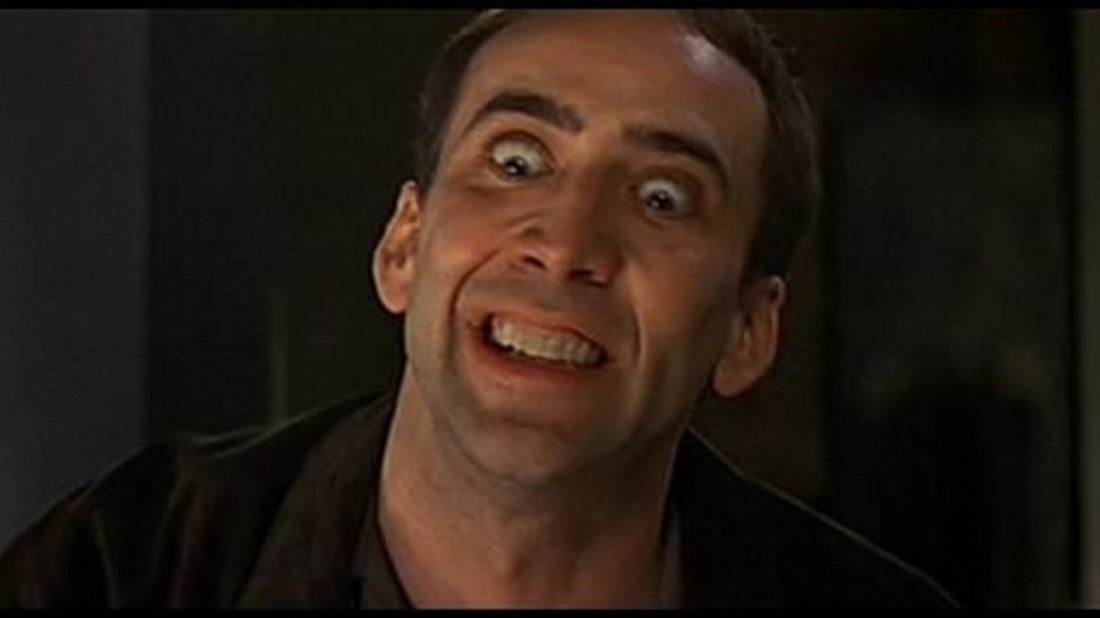
I want to take his face...off.
Oh no.
Thanks for the question, Julissa!
Got a question? Submit it here. They can be legal what-if questions, questions on current events, or questions about the legality of actions in TV shows or movies you’ve seen. I never ever want to answer your personal legal questions, so don't send those. Love you, but I don’t do that.
***
This piece first appeared in Sunday Morning Hot Tea. Subscribe so you don’t miss another piece.
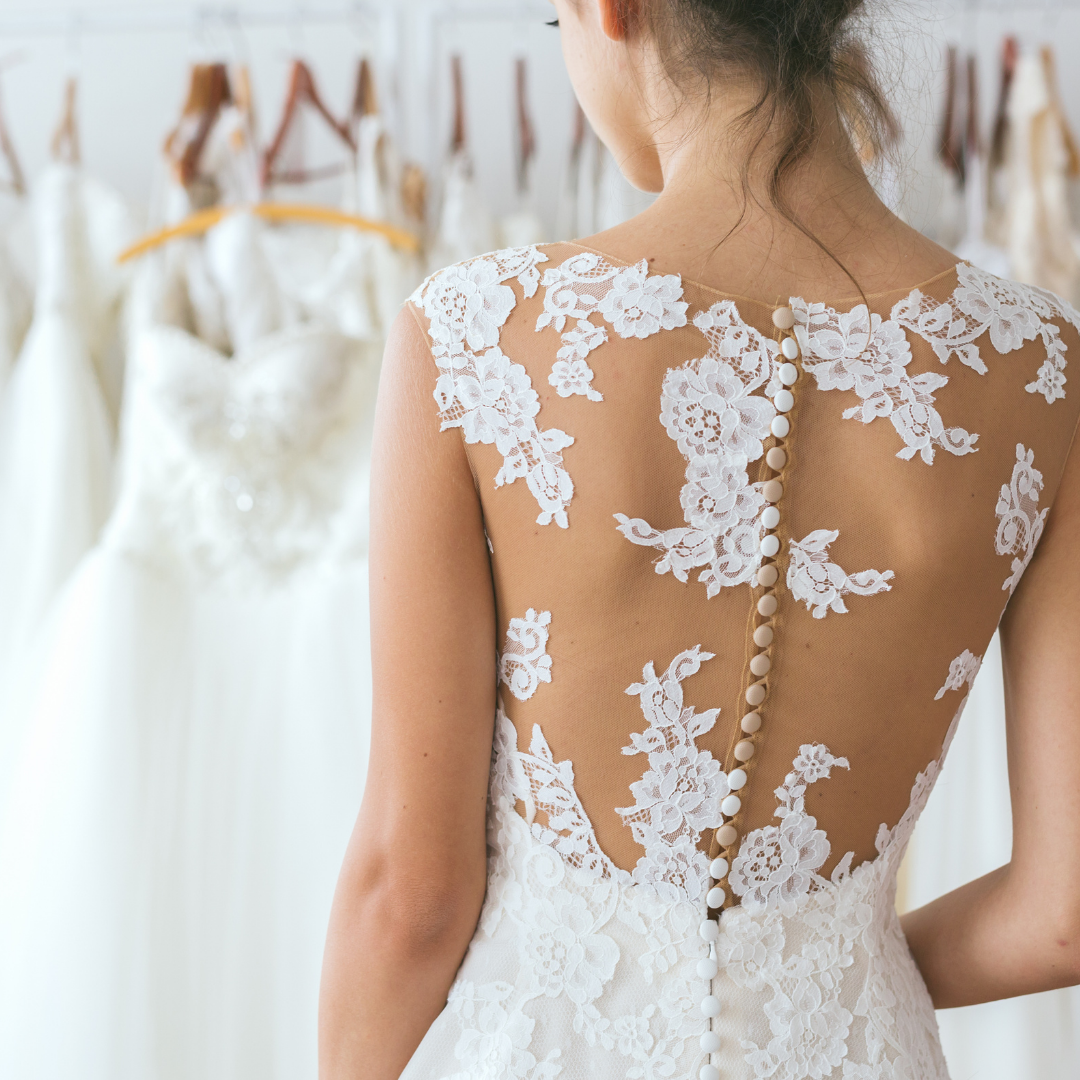
Legal Question: Something Borrowed - The Downside of Trading Your Name for Cash
This week’s question comes from Abby via the form. Abby asks:
“So I'm not sure if you have heard or are following anything happening with the wedding dress designer Hayley Paige. From her account, the company JLM Couture has taken all rights to her name, including her presence on social media. I've tried reading the court doc that JLM posted in their Instagram bio but it's all gibberish to me. Is what they're doing justified? What is their claim to her name anyway?”
Excellent question, Abby!
Here’s a short-ish run-down of the situation going on in the wild world of wedding gowns. For a longer play-by-play, check out this piece from Business Insider.
On July 13, 2011, budding wedding dress designer Hayley Paige Gutman signed an employment agreement with JLM Couture, a bridalwear manufacturer. At just 25 years old, Gutman was offered the opportunity of a lifetime – design bridal gowns for a heavy hitter dress manufacturer and receive their support and compensation in exchange.
In an email at the time of signing, JLM wrote to Gutman, saying, “Attached is a signed contract. Hayley please confirm you have reviewed this with your attorney.”
Gutman responded, “Thank you for sending! I have reviewed with my attorney accordingly.” She’s now saying that email was a lie, and she never hired an attorney to review the agreement. Honestly, that may be the case.
If I had reviewed her employment contract, I would have had a couple notes. First of all, the language in her contract is pretty broad. It gives JLM the exclusive rights to use and trademark the name “Hayley Paige” and variations thereof as well as “the exclusive world-wide right and license to use her name ‘Hayley’, ‘Paige’, ‘Hayley Paige Gutman’, ‘Hayley Gutman’, ‘Hayley Paige’ or any derivative thereof” during the stated term of the employment contract and for two years thereafter.
Even if you’re not a lawyer, you can imagine that “exclusive right” and “exclusive world-wide right and license” are pretty broad and sweeping. That means only JLM can use those names or decide who else can use them.
The rights also last for the entire term of the contract PLUS two years. So, she should have been real sure about what she was giving up – in this case, her name – even though she was being compensated for it.
That compensation came in exchange “for the assignment of the Designer’s Name and the Trademarks” to the Company. She literally traded her name for compensation. This is a big decision. Huge! Not one to undertake without representation.
To really finalize the deal, JLM had Gutman sign a trademark registration acknowledgment, confirming that she had transferred all trademark rights in the name “Hayley Paige” and any derivatives thereof to JLM and that she consented to the registration of the trademark “Hayley Paige.” After that, JLM actually owned her name for use in business.
Over the next few years, Gutman created a brand around herself and her designs, posting them across social media including on Instagram under the handle @misshayleypaige. The Instagram gained over a million followers as fans followed her posts about her dog, her personal life, and especially her bridal gown designs. She became more and more well known and even appeared on the wedding show Say Yes to the Dress on TLC.
In late 2019, after extending her contract through August 2022, Gutman created a TikTok using @misshayleypaige on which she posted mostly personal content. JLM’s CEO Joe Murphy then allegedly asked her to post brand-approved content only.
Instead, she changed the password to the 1.1 million-follower @misshayleypaige Instagram account, locking out JLM’s social media manager who had been assisting with the account. Over the next few months, she removed some posts regarding JLM and her bridal line and took two influencer deals to make money posting about unrelated third-party products on the account. One was a salad dressing company and the other was whey protein. She also removed references to JLM in the account’s bio.
JLM and its CEO Joe Murphy didn’t seem to care for this too much. They requested login credentials to the @misshayleypaige accounts. According to JLM, Gutman allegedly ignored or refused these requests. In response, JLM sued Gutman on December 15, 2020 for a long list of stuff, including trademark infringement and dilution, false designation of origin, unfair competition, conversion, trespass to chattel, breach of fidelity, breach of contract, breach of fiduciary duty, and unjust enrichment.
Since then, a federal court has granted a temporary injunction giving JLM control over all of the @misshayleypaige accounts. JLM also sought the court to order the-designer-formerly-known-as-Hayley-Paige from “publicly disparaging JLM” and from “continuing [her] social media bullying campaign” against JLM. The court denied this part of the request as it would constitute “prior restraint” in violation of Gutman’s First Amendment rights.
On April 9, 2021, JLM announced that a new designer would be creating the gowns under the Hayley Paige line. That person? Not named Hayley Paige. She is Francesca Pitera, a former designer for Monique Lhuillier who had prior experience with JLM on another line.
With that injunction, Gutman has been restrained from using her own name in business and is enjoined from using the @misshayleypaige social media accounts. Now to answer the questions…
Is What They're Doing Justified?
It would appear so. It super sucks that she gave away the rights to her name in that contract. I have no clue in what universe you would negotiate a deal to assign the “exclusive right” and “exclusive world-wide right and license” to your name without a lawyer. I do not live there. I get that she was 25 at the time, but in the eyes of the law she was still grown and able to make that agreement.
When I was 25, I was just starting law school. I don’t think I would have even trusted myself to sign something like that without a lawyer. Bless her heart, as we say in Texas, but the language of that contract is mega-broad and she agreed to it.
In another provision of the contract, she agreed that any other “works” conceived of or developed by her in connection with her employment with the Company are “the sole and exclusive property of the Company.” In the court’s opinion, the term “works” includes the Instagram and TikTok accounts she created after her employment term began.
Because her contract required her to assist with advertising, the creation and use of the accounts to promote the brand fell under “employment” and were “works for hire” belonging to JLM. It appears from the language in the court order that she operated the account as an extension of her duties at JLM. She got input from JLM and its employees on what captions to use and on responding to DMs. Therefore, the court said, the social media pages were created by Hayley Paige the employee for work purposes and therefore belonged to JLM.
Gutman argued that the accounts were created for her personal use rather than business use. However, there was internal communication that indicated she mixed in the personal stuff as a marketing tactic, rather than as a form of personal expression. She stated in an email that she needed a social media director to help with the account to “maintain the balance specifically on the @misshayleypaige account . . . [because] I think it’s important that we do not dilute this Instagram with too much promotion/advertisement so that we can maintain the aesthetic and personality of the brand.”
Were the cute dog and fiancé photos really to express her joy? Or were they posted to avoid “diluting” the page with promotion/advertisements to preserve the aesthetic of the brand? The court decided it was the latter.
In its order on the temporary injunction, the court concluded that she assigned “Hayley”, “Paige”, “Hayley Paige Gutman”, “Hayley Gutman”, “Hayley Paige” and any derivative thereof to JLM. The court also concluded that the language of the contract “unambiguously encompasses” both “misshayleypaige” and “@misshayleypaige,” which are derivatives of “Hayley Paige” because they only add the word “miss” to the beginning.
So yeah, at least according to the federal court and based on the language of the contract, they are justified in claiming use of those accounts.
What is Their Claim to Her Name Anyway?
They paid for it. Not only did she receive a base pay and additional sales volume-related compensation, she is also entitled to receive a further percentage of “net revenues derived from the sale of goods” sold under her name and the other Hayley Paige trademarks for ten years following the termination of her employment with the company.
This means even after her contract ends in August 2022, she is entitled to receive payments based on future sales that use her name for another full decade.
Is that compensation worth it to give up your name? I don’t know. I wouldn’t shake on that deal, but everybody is free to make whatever deals they want to make. Maybe JLM will sell an ass load of Hayley Paige wedding dresses and Gutman will never have to work again so it will all have been worth it. On the other hand, maybe they’ll sell a bajillion dresses, but even then she may not feel like it is enough compensation to warrant losing her name.
The real rub is that, as it stands, she is pretty much bound. Absent the court undoing the contract (which I doubt will happen given the court’s language in the preliminary injunction docs) that’s the deal she made and that’s the deal she’s gotta live with. This is especially true since the contract does not include a provision permitting Gutman to terminate it on her own (“unilaterally”). She’d have to get JLM to agree to releasing her. Otherwise, her actions may be considered repeated breaches of the terms of her agreement, subjecting her to having to pay damages or to further injunctions.
The answer to all this is probably negotiating a settlement. From JLM’s perspective, it looks pretty bad to be doing this, even if they are within their rights under the law. The @misshayleypaige account currently under the control of JLM has turned its comments off, attempting to avoid online backlash. JLM also claimed in its complaint that some bridal boutiques have quit carrying the line due to the legal drama.
For what it’s worth, Gutman has counter-sued JLM, claiming (1) JLM “willfully failed to pay and/or unlawfully deducted Additional Compensation due to” her, (2) she was defamed by JLM in private and in public, and (3) JLM CEO Joe Murphy sexually harassed Gutman and others and created a hostile work environment.
If they don’t settle, then at least Gutman will get her day in court. Until then, she’s known on Instagram as @allthatglittersonthegram where she recently put out a request for suggestions on an all-new name she plans to choose for herself.
I hope that answers your question, Abby! Thanks for sending.
Got a question? Submit it here. They can be legal what-if questions, questions on current events, or questions about the legality of actions in TV shows or movies you’ve seen. I never ever want to answer your personal legal questions, so don't send those. Love you, but I don’t do that.
***
This piece first appeared in Sunday Morning Hot Tea. Subscribe so you don’t miss another piece.
Legal Question: The Case of Snoop and the Stolen Gin & Juice
This question comes from Aaron:
“In the song Gin and Juice, Snoop Dogg claims that ‘I got me some Seagram's Gin, everybody got their cups but they ain’t chipped in.’ What steps would he have to take and what would be his burden of proof in order to recoup his money from them in court?”
Excellent question, Aaron. I think this one is particularly relevant given that we are close to New Year’s Eve, a time for partying and revelry. It’s also a time for fools to roll through parties with empty cups and no funds to chip in.
Your question is really two-fold, so we’ll address each part in turn. First, let’s talk steps Snoop has to take to recoup his money.
When you sue someone, you have to choose the proper venue. We discussed this a little bit in regards to The Santa Clause. Let’s assume that everyone involved in this incident is located in the LBC, or Long Beach, California, where Snoop would likely be hosting the party. Long Beach is located in Los Angeles County, California, so that county is where he would sue.
Next, he has to decide which court is proper. Though Snoop probably throws major blowouts, I'm going to assume that the amount of Seagram’s at issue is worth less than $10,000. California has two venues for individuals to resolve small disputes of less than $10,000: Small Claims Court and Limited Civil Courts. For several reasons, including fewer rules, no lawyers, and all partygoers being located in California, Snoop may want to sue them in Small Claims to make things easier. However, under California law, he would not be able to do that.
Snoop is asking a judge to determine the rights and obligations of the parties - Snoop’s right to recoup money and the gin-drinkers’ obligations to pay for the gin - meaning he would be required to file in Limited Civil Court. Because the Limited Civil Court requires the parties to follow procedural rules and rules of evidence, I would advise Snoop to hire a lawyer to help navigate the system.
Before filing the suit, Snoop should make a written demand the money from those who took the gin then document his demands. This is usually done through letters, sent certified mail, return receipt requested, to prove that the letters were delivered to the intended recipients.
For efficiency’s sake, Snoop would not want to sue each cup-holder individually. He would have his lawyer pursue one lawsuit and join together several defendants. This is permissible under California law since the suit is “arising out of the same transaction, occurrence, or series of transactions or occurrences” and because “question[s] of law or fact common to all these persons will arise in the action.”
He would also be unsure until all the facts were proven at trial as to who drank what and how much. In that case, the California Code of Civil Procedure would also permit him to join defendants together since Snoop “is in doubt as to the person from whom he is entitled to redress.” Since he is unsure, Snoop “may join two or more defendants, with the intent that the question as to which, if any, of the defendants is liable, and to what extent, may be determined between the parties.” This is something he would have to ask the court’s permission to do.
When filing the suit, Snoop’s lawyer could sue on several counts:
(1) breach of an oral contract - he was to provide gin, and they were to provide cash in exchange;
(2) “unjust enrichment” which requires him to prove (a) defendant’s receipt of a benefit, i.e., gin, and (b) unjust retention of the benefit at the expense of another, i.e., they never paid Snoop; and
(3) conversion - the civil action for theft. For conversion, Snoop would need to prove that (1) he owned the gin; (2) the drinkers interfered with his ownership by knowingly or intentionally taking it/destroying it (by drinking it); (3) that Snoop did not consent to their drinking it; (4) that Snoop was harmed by the taking of his gin; and (5) that the drinkers’ conduct was a substantial factor in causing Snoop’s harm.
Before the trial, Snoop and the defendants would then exchange information and answer questions posed by each side in a process called “discovery.” The court will also make them attend a mandatory pre-trial settlement conference, in order to see whether they could work out their problems before trial.
After the pretrial steps, if Snoop and his lawyer still want to sue these avaricious gin guzzlers, he has the burden of proving the elements of the above claims and all the related facts, including who drank what and how much. This brings us to the second part of Aaron's question - Snoop’s burden of proof.
California Civil Jury Instruction Number 200 is particularly helpful for this question. In plain terms, Snoop would have to prove to the jury that the facts of his case are “more likely true than not true.”
This standard of “more likely true than not true” is known as the “preponderance of the evidence.” This is a much lower standard than in criminal cases where the standard is “beyond a reasonable doubt.”
Some lawyers explain “preponderance of the evidence” as having to prove something was 51% probable, as in, if it is 51% more likely that something happened based on the evidence presented at trial, Snoop should win. That's a pretty low standard. Snoop would likely be able to prove his case with plenty of evidence given that, according to the song, “This type of shit happens all the time.”
And if he wins, he can ask the judge to make the other side pay his court costs and attorneys’ fees, making those some pretty costly cups of gin and juice.
I hope that answers the question. Thanks, Aaron!
Got a question? Submit it here. They can be legal what-if questions like the one above, or questions about the legality of actions in TV shows or movies you’ve seen. I never ever want to answer your personal legal questions, so don't send those. Love you, but I don’t do that.
Got a question? Submit it here. They can be legal what-if questions like the one above, or questions about the legality of actions in TV shows or movies you’ve seen. I never ever want to answer your personal legal questions, so don't send those. Love you, but I don’t do that.
***
This piece first appeared in Sunday Morning Hot Tea. Subscribe so you don’t miss another piece.