


The Most Shameless Women This Country’s Ever Seen
I’ve been watching a lot of Real Housewives of Beverly Hills recently. I never really liked reality shows before. I only started watching because we were covering the Erika Jayne/Tom Girardi scandal on Sinisterhood.
This is only for work, I told myself when I pressed play. I don’t like these shows. I am not the type of person who likes these shows. I’m better than those people.
What a fool I was.
After two episodes, I found myself talking back to the screen. I would grab Paris’s arm as he zoned out beside me.
“Can you believe she said that?” I asked.
He could not believe it, mostly because he wasn’t paying much attention and wasn’t invested in the storyline.
Eventually, I caught up on the most current season. Then Christie and I finished our two episodes on Tom and Erika. Time to stop, right?
Wrong. I didn’t stop. I couldn’t.
I went back and started from the beginning: Real Housewives of Beverly Hills, season one, episode one. This show is now at eleven seasons, with over two-hundred episodes total. At forty-five minutes per episode, that is a 150+ hour time commitment I’ve just signed up for.
It’s ok, I’m ready.
In addition to Real Housewives, I have been knee-deep in videos of televangelist Gwen Shamblin-Lara. She ran a strict religious sect that ticks a lot of boxes that make it sound like a cult. The “diet” she peddled was basically an eating disorder in a WWJD bracelet.
There are some connections to draw between Gwen and the Housewives – decadent homes, gross displays of wealth, lots of make-up, tall hair. For all their overlap, though, I categorize the two separately.
For one, the Housewives don’t bring religion into it. Though, some people may say Bravo is a religion, and Andy Cohen is the messiah. But it’s TV. You can turn it off at any time. They’re not asking for money or donations. They’re not selling anything, except their ancillary products, but honestly who is running out to buy Kyle Richards’s newest emoji muumuu?
Though not as harmful as a cult, there is criticism of the Real Housewives shows. One critic wrote that the show “sets unattainable expectations of what is desired of a woman” and that it “subliminally hints to citizens nationwide that this is the average standard of living.”
Uhhhh... agree to disagree. At no point while watching any of Beverly Hills have I ever thought, Gee, I am a terrible woman because I don’t have lip implants or a Bentley or a flat stomach. In fact, I relish in not having those things, imagining the toll it takes to get and maintain them. Me? In a Bentley? I once backed a rental car straight into an electric pole in an otherwise empty parking lot in broad daylight. Not a great plan to put me behind the wheel of a $380,000 car.
I’d also like to give myself and the other people who watch these shows some credit. We’re not completely detached from reality. We know those expectations are for famous TV people and not for us, or at least I do. I am watching to satiate my curiosity about what it would be like to have those things.
As for it “hinting'“ to us that the TV lifestyles are “the average standard of living nationwide”? Nah. I, for one, understand that my standard of living is quite different than the standard of living for Kelsey Grammer and his ex-wife, Camille. All of their many houses were bought with Frasier money. I do not have Frasier money. None of us do. Not even Kelsey Grammer anymore after he cheated on Camille without a pre-nup and got that flight attendant pregnant. Oops!
But the key word is “average” and is right there in the critic’s sentence. Average people don’t create hit sitcoms. Average people don’t have houses all over the world. Average people don’t have four nannies for two kids. In fact, I watch these people precisely because they’re not average. If I wanted to see average people fighting with each other, I’d go to the Golden Corral buffet in my hometown on a Sunday morning after church when they set out the fresh mac ‘n cheese.
This desire to peer over the fence doesn’t involve just any fence. We want to peer over a nicer fence into a fancier yard. This is why shows like Jerry Springer are no longer popular. Average people are boring – we’re average! So who gives a shit if any of us are quarreling with our neighbors? It’s much more interesting if people are fighting in a 17,000 square foot house with dramatic chandeliers and an enormous backyard.
Just like I don’t yearn to live in the monkey habitat at the zoo, I don’t wish to attain those things I see on television. Frankly, their whole lifestyle seems exhausting. In the pre-COVID episodes, I was floored at the amount of precious time they all spent air-kissing each other on the cheeks. With the hours wasted fake-smooching every human being who entered a scene, they each could have painted the entire Vanderpump mansion once-over or learned to play the harp or actually played tennis on their superfluous tennis courts.
If it’s not aspirational, then, why do we watch? We’re nosey, plain and simple. At least I am. We also like to eavesdrop, even when those talking know we’re there on the other side of the camera. We also like peeping through windows into giant-ass houses, and this offers us a way to do that without being charged with a felony. It’s the same reason why browsing Zillow is a form of pornography. It’s easy to blow hours breezing through images of fabulous mansions and judge the heinous décor they’ve chosen. Doesn’t matter whether it’s on an app or on my television screen.
The show also speaks to that penchant for schadenfreude that we all harbor to some extent. The higher someone is the farther they fall. The current legal situation with Erika Jayne from the more recent seasons is a perfect example. What does it say about us who have watched her extravagant lifestyle, now knowing the money that paid for that lifestyle may not have been hers all along? It may have belonged to widows and orphans and people who have sustained serious, life-long injuries and extreme pain. Now that we see her losing everything, a part of us – the part that thinks she maybe knew what was going on and is helping cover it up – thinks, Serves you right.
Critics be damned, I also like Real Housewives because I like seeing powerful women do whatever the hell they want. Lisa Vanderpump wants to set a photo of herself and her little alopecia-afflicted Pomeranian, Giggy (RIP!) as her iPad background?
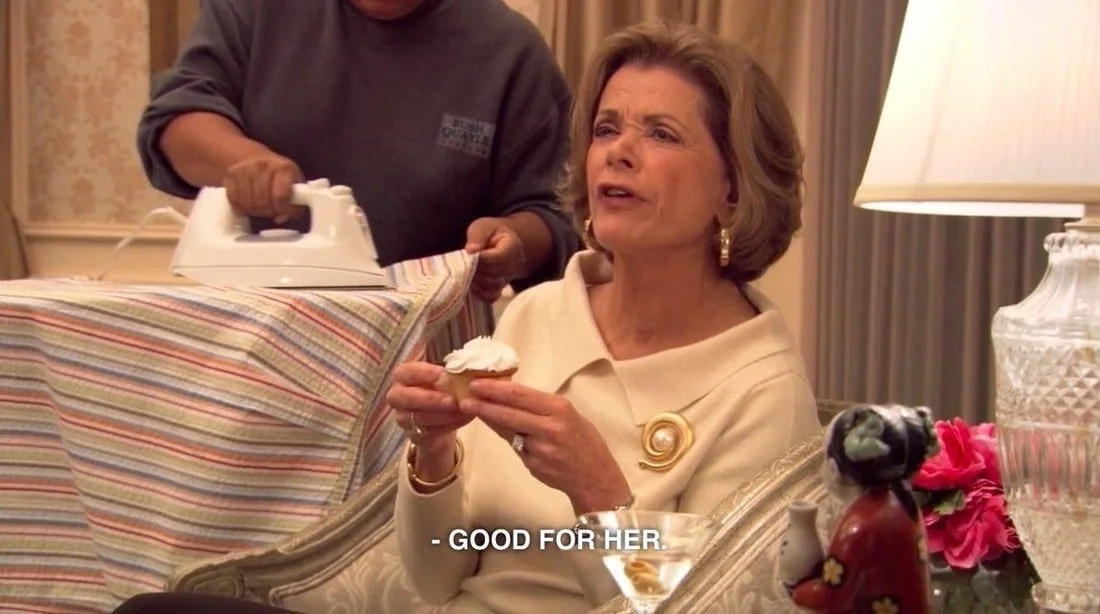
Lucille Bluth would have made an amazing Real Housewife. RIP to a Legend.
Being an eccentric with her money is Lisa Vanderpump’s right – it’s all of their rights.
In Season 11, Dorit dresses like she got trapped in a Louis Vuitton fabric factory and sewed her way out.

Tell me i’m wrong.
Ok, girl, do it!
I get a strange feeling watching these earlier episodes of Beverly Hills. Shot between 2011 and 2013, I am watching these women, some of whom are only marginally wealthy, spend like mad and behave erratically, and it’s all caught on camera.
Meanwhile in 2008, only a few short years earlier, we all watched Britney Spears do similar things, and we labeled her crazy. We let her get essentially locked up – yeah, we. All of us. Now we’re all responsible for getting her out and letting her live whatever decadent life of retirement she wants.
What was it that flipped in our perception of women in those years between 2008 and 2011? One guest who appeared on season two of Beverly Hills told the cast that she spent $25,000 on a fairly plain-looking pair of sunglasses, and no one locked her up. I can guarantee she doesn’t have near as much dough as Britney, either. A cast member named Taylor dropped $60,000 on her daughter’s fourth birthday party. No conservatorship there.
There are ten franchises of this show, the first of which began airing in 2006. Throughout them all, the women behave wildly – crying, screaming, blowing sums of money, even struggling with mental health issues and substance use issues – but none of them were placed in restrictive legal arrangements. None of them were treated like Britney.
Was it because they weren’t as powerful? Weren’t as well known? Did we think they were only behaving that way because they were on camera? In some cases, we know they were genuinely struggling. Erika’s legal issues sure are real, as were Kim Richards’s substance use issues and Taylor Armstrong’s struggle to break free of an abusive marriage.

The story behind this meme is dark af.
But, when a powerful woman like Britney Spears dared behave as if she were “mad,” her dad stepped in and subjected her to a structure that ACLU attorneys call “civil death.” Isn’t it the God-given right of each and every one of to behave a little mad from time to time? Isn’t that how we learn our lessons – through trial and error?
Where was August Coppola when his baby boy, Nicholas Cage, dared blow his $150 million fortune like a James Bond villain? He bought an actual live crocodile, a shark, a haunted mansion, a grave, and a really old and extremely expensive comic book, among other things. Where was David O’Russell’s dad when he blew up on camera, kicking a trash can across the room and calling Lily Tomlin a c-u-next-Tuesday? Or when Christian Bale flipped shit on a whole production crew?
These behaviors were wild, eccentric, and smoothed over with a simple apology. If unpredictable outbursts are a sign of an underlying condition necessitating that someone must be totally controlled, where were these dudes’ parents with their court orders?
You may be asking, But wait, Heather, doesn’t Britney Spears have some sort of mental disorder that requires her to be constantly monitored? Great question – yes, she does have a diagnosed disorder, but it’s not something that requires her to be stripped of all her rights. She has openly discussed having bipolar disorder, a diagnosis she shares with Tim Burton and Francis Ford Coppola, both of whom don’t have their dads controlling their bank accounts or reproductive organs. [For more information, please allow me to recommend several hours of Sinisterhood that cover her diagnosis and the conservatorship in general (1, 2, 3, 4).]
Christie brought up an excellent point in our most recent #FreeBritney update episode. When a woman dares behave outside the norm or live and struggle openly with a mental health diagnosis, the conclusion is often to control her and revoke her rights.
She drew a parallel to the treatment of women back in 1864, when women were admitted to the Trans-Allegheny Lunatic Asylum at such a rapid rate that the institution quickly filled up. Some of their afflictions? “Domestic trouble, seduction, egotism, indigestion, menstrual derangement, childbirth, laziness, reading too many novels, masturbation, and desertion of husband.” These acts of defiance were treated as mental conditions that required them to be controlled into submission, via medication, being locked up, lobotomies, or worse.
We see those same acts of defiance in the women of Real Housewives who go on television and live their lives of “domestic trouble, seduction, egotism, indigestion,” etc., acts that would have landed them in an asylum not so long ago.
So if women are no longer being locked up for out-of-bounds behavior, are we in a post-feminism society? Hardly. Another critic actually posited that “The Real Housewives portrays and promotes a discourse in which women have become their own oppressors.”
Hard disagree. In part because, yes, I will continue watching. I need to know whether Adrienne and Lisa can repair their friendship after Lisa didn’t invite Adrienne to the Villa Blanca anniversary party! (No spoilers, I’m only on season three.)
But mostly I disagree because criticism like that is our real oppressor. Real Housewives gives women a space to act outside the boundaries established for us by society (i.e., the patriarchy), and for those of us watching, we get a chance to celebrate that.
Feminist writer, professor, and social commentator Roxane Gay would agree with me. She told Messiah Andy Cohen that Real Housewives “allow women to be their truest selves. We see the mess, we see their amazing friendships and everything in between. When women are allowed to be their fullest selves, that's the most feminist thing we can do.”
Women should behave, we’re all told. Hell no! Being ostentatious and outrageous and mad with no one to lock us up or stop us is the raddest move we can make. For fifteen years, eighty-six women across ten franchises have defied expectations and behaved with reckless abandon, while we’ve let Britney languish in captivity for daring to suffer in public. It’s why #FreeBritney is no fad, but instead stands for a responsibility we have to let women live lives of freedom – including the freedom to be irrational and make mistakes without allowing theirs daddies to step in and take away their autonomy.
So let’s all scream, cry, get wine drunk, fight, make up, fly private to Maui, and blow $25,000 on some ugly as hell sunnies. Let’s fight for other women’s rights to do the same. It may sound scandalous to you, but hey, at least we’re not blowing $300,000 to outbid Leonardo DiCaprio on a dinosaur skull. That behavior would just be irrational.
***
This piece first appeared in Sunday Morning Hot Tea. Subscribe so you don’t miss another piece.
As Seen on TV
Today I found myself in a place I often am – the Starbucks drive through. While we waited for my drink, the barista in the window and I made small talk.
“Did you do anything fun today?” she asked.
“I just woke up from a nap because I went to a kid’s birthday party earlier.”
“Yikes,” she said. “Anything else fun planned for today? Just going back to sleep?”
“I’ve got some work to do, actually,” I said, referring to the research notes I needed to type up for the next Patreon minisode on the #FreeBritney updates.
“What do you do?” she asked.
“I’m a comedian,” I said. It felt weird and impostery coming out of my mouth. Should I have said podcaster? Writer? Lawyer? What even am I now?
Last week on our crossover episode with the podcast And That’s Why We Drink, I announced that I had given notice at my day job to focus full time on Sinisterhood. My last day at legal aid will be July 9. I will still have my law license, and I plan to do pro bono work with whoever will let me, but it’s going to feel different not lawyering every day. While it feels weird, at the same time, it feels inevitable.
On the first grade page in my school memory book, it asked me to check a box next to a profession under the heading What I want to be when I grow up. I checked the boxes for both TV Star and Lawyer. I also hand-wrote the words “house wife” because I had my eye on the real prize.
When I graduated from law school and passed the bar at age 29, I eagerly posted an adorably cropped photo of the checked box beside lawyer and said something like, “Childhood dream come true.”
The problem with that photo is that it omitted an integral part of the photo – the checked box beside “TV Star.” Now, over five years into my law practice, I realize those were not two boxes to be considered separately but were instead a conjunction to be read together. The whole housewife thing was really prophetic, like somehow I knew I would also do those things while working from home. THE DREAM!
My ideals of law practice and being a lawyer were shaped by the only lawyers I intimately knew as a child: those on TV. We talked last week of the family friend who represented the ephemeral ideal of a lawyer, with her pants suits and Lexus.
The TV lawyers I admired never really mentioned their cars. They lived in places like Boston and New York City where they got around in cabs and on subways. I loved all the characters on Boston-based Ally McBeal. I particularly loved the man they called Biscuit, John Cage, the eccentric partner obsessed with clean toilet bowls who screamed out uncontrollably.
Despite it being wildly inappropriate for kid to watch, I became obsessed with Ally McBeal. I liked seeing her and other female lawyers. They also had a gender-neutral bathroom, which seemed normal and unremarkable to me. Though, looking back, it was regarded as incredibly progressive and outrageous for the late 1990s.
The best person on the show was the Biscuit, played by Peter MacNichol. He had a remote control switch on a bathroom stall that would automatically flush the toilet before he got there, thereby avoiding remnants as he “liked a fresh bowl.” Who doesn’t? If that’s what being a lawyer was like, sign me up! I wanted a remote control to handle the unsavory parts of my life.
At the time, I thought that show was the coolest thing on television. Weird people like Santa Claus came to the firm for help. And Ally, like myself, was plagued with intricate mental fantasies in which she seemed to relish. All the characters hung out together at a bar with a cool jazz pianist. They wore sexy skirt suits. They sang karaoke. Most of all, Ally got to fall in love with Robert Downey, Jr., a major childhood crush of mine which, again, for a kid was not super appropriate.
No matter their wacky situations, they were all problem solvers. And as a kid who created a lot of problems, I looked with admiration on these people who seemed to solve them so easily.
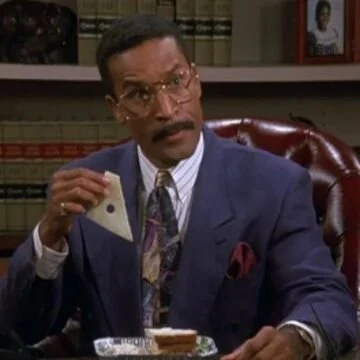
Jackie Chiles was the next TV lawyer I loved. All of his plots and plans seemed destined to end in riches but for the meddling idiocy of Kramer. Ever the terrible client, Kramer would either take a deal too early (always wait to hear what comes after “coffee for life” when considering an offer) or who would put the balm on (nobody told him to put the balm on!) I had no clue Jackie was a parody of Johnnie Cochran or that the cases were parodies of real-life big-ticket litigation that was happening at the time. I just thought he was a clever foil for Kramer.
Before there was Ally McBeal or Jackie Chiles, Judge Harry Stone was the first fictional lawyer I wanted to be like. Not only was he a judge, he was a magician and made jokes to the people in his court room. When arguments arose, Harry solved them with a sleight of hand or a laugh. The people in his court room loved him and all left happy, except for some of the ones who were taken into custody.
I also saw non-fictional lawyers on TV. My dad worked nights, so during the OJ Simpson trial, he would be glued to the TV, commenting on the performance of the lawyers. To me, a nine-year-old kid, it was another set of lawyers on TV for me to admire and study. My dad wasn’t in the legal business. He worked as an independent contractor for the Dallas Morning News, mass-delivering newspapers across the DFW metroplex. He filled red metal racks with thick newspapers seven days a week, with no time off, no weekends or holidays.
Things like the OJ trial and crime in general were good because they sold papers. Daddy would buy the papers from the printer for about 10 cents each, then sell them in the stores for 50 cents to a $1.50 on weekends. The more papers that sold meant more quarters for him to collect and bring home to my mother to count out and deposit in the bank.
I was unabashedly a daddy’s girl growing up. He thought anything I did was the absolute greatest and praised me for my accomplishments. He also praised the skills of some of the lawyers at the OJ trial and criticized others. My impressionable little mind put all the pieces together: Lawyers like Marcia Clark and Christopher Darden are good and smart. Lawyers like Ally McBeal and Harry Stone are funny and smart. Dad respects lawyers. I must be a lawyer. Also, bonus, Ally McBeal gets with Robert Downey, Jr. Done and done.
But the other part of me, the deepest part of me, wanted to be a comedian and a writer. Just as I thought Jackie Chiles was great on Seinfeld, I envied that Jerry himself was a comedian. He seemed to do nothing during the days except hang out with his rag tag group of friends then kill it on The Tonight Show. Well, except when his Charles Grodin BBQ sauce was destroyed.
I also deeply loved and obsessively watched The Dick Van Dyke Show. It aired originally from 1961 to 1966, but the re-runs came on via syndication. My mom recorded them each day for my dad to watch later in the evening. He would sleep during the early morning hours, until about 11am, right when the re-runs would air.
She’d pop a cassette in the VCR and record them, giving me a chance to watch an episode not once, but twice when my dad would want to turn it back on after dinner. It followed Rob Petrie, a professional full-time television comedy writer. He got to write jokes for money! He worked alongside a woman named Sally Rogers. She was a girl like me who also got to write jokes for money!
With the purchase of our first home computer, I learned that all the weird fantasies I had in my head could be translated onto the page. I could write them out just like Rob and Buddy and Sally.
I wrote my first novel at 11 years old. I like saying it that way because it sounds fancy and pretentious. What I actually wrote was a very long and convoluted piece of Backstreet Boys fan fiction. All the main characters were either Backstreet Boys or my fifth-grade classmates. We lived together in an enormous house in Florida because obviously when you earn multiple millions of dollars in a world-famous boy band, you pool all of your money together for one single house like some sort of sad Tampa reality show.
Inspired, I am sure, by the hours of All My Children I had absorbed during the summers, the story included dramatic twists and turns. Two of my classmates were Nick Carter fans, so a love triangle formed where he was forced to choose between them. Yes, in reality we couldn’t drive a car, hadn’t learned algebra and hadn’t yet gotten our periods, but on paper, all bets were off.
I, of course, was paired up with Howie D., the self-described Latin lover of the group. But to juice up dramatic tension, I had to throw a wrench in. I decided that the best thing for the plot would be an illness. People in soap operas were always hovering over the hospital beds of loved ones, lamenting that they should have proposed sooner or said “I love you” earlier.
So I did a little poking around on Alta Vista and gave my fictional self Mosquito-Borne Encephalitis. It seemed serious enough to put me in a coma, but not terminal enough to kill me. I was, after all, the star of this great work of art. I wasted all the ink in my parents’ inkjet printer to “publish” my manuscript, which I then bound in a three-ring binder. Much to my horror, both my mother and sister found the finished work and reviews were not great.
I didn’t write as much after that, just made up stories in my head. Then in seventh grade, I met Mrs. Shurtleff, my English teacher. She hosted a creative writing club that met mornings before the first bell rang. Anything was fair game for us to write – fiction or non-fiction, poetry or prose. Once per semester she hosted a reading event where we could share our pieces aloud.
In my internet scouring for further information on my favorite Backstreet Boy, Howie D., I came across some unsettling information. My betrothed, the man who sat by my beside and mourned me as I suffered from my bout with encephalitis, was “said to be dating a woman named Minda.” I was crushed and felt completely powerless. How could I compete with this woman, given that I was only 13 years old and lived thousands of miles away?
I sought my revenge the only way I knew how – on the page. Driven by an urge to kill, I did just that. To be fair, I had also read American Psycho for class earlier that year, so I had violence on the brain.
Side Note: That book is FILTHY! I went back as an adult and tried reading it. It was overwhelmingly obscene. I felt like a complete prude, but I had to put it down. It made me sick, and my job is actually studying and talking about crimes. When I read it in seventh grade, I felt like I was generally unphased by the subject matter. Judging by the violence in my Minda story, that was not entirely true. I was very phrased!
It came time to read our stories out loud for our friends, our parents, and the faculty. I had printed my piece out, adding the title in red dripping font that looked like blood. My story centered around a man named Howard (excellent cover, McKinney) and his wife, Minda. Very early in the story, Minda is killed in a bus accident. By that I mean, I graphically described her being run over by a bus. I read this. Out loud. In front of everyone. And honestly? It got some laughs.
Without knowing what I was doing, I employed the rule of three – I had three different spouses get hit by the same bus. No one in the audience asked why there was not an investigation into the rash of bus crashes on this particular route or the negligence of the city’s bus operators. I guess they were just being gentle since I was only in seventh grade.
I ended up reconnecting with Mrs. Shurtleff as an adult, and we’ve struck up a friendship. We go out for breakfast or lunch once a month, and she’s truly a guiding light in my life. I asked her why she didn’t report me to the counselor for writing about violent death-by-bus. She said because we write about things as a way to process our feelings.
I wasn’t really plotting to kill a woman via municipal transportation. Rather, I was angry and felt powerless and writing it out was the only way for me to regain control. Super cool of her to (1) not judge me at the time, and (2) agree to meet with me knowing my little demented mind wrote that all those years ago.
Now feeling as I have - a bit powerless and out of control - I think is why I have been writing so much. Some days working in a “profession” like the law can feel like you’re on a moving sidewalk at the airport. You could get off in the middle. It wouldn’t be easy. You would have to heave your legs over the glass partition. Maybe you’ll stumble, lose your luggage, make a scene. It’s not easy, but it’s also not impossible.
The alternative is staying on, being hurtled to the destination that you may have changed your mind about.
I think it’s fair to hop off the sidewalk if you feel like it. Just because we wanted to step on back when we were in first grade or in our teens or twenties or even thirties, doesn’t mean we should trudge dutifully toward that end. It’s ok to change your mind and head where you want to go instead.
After graduating law school and passing the bar, I started looking around for ways to maybe get off. When my mom asked what she and my dad should get me for a law school graduation gift, I told her I wanted a gift certificate to take comedy classes.
“How about a briefcase?” she asked.
It’s not easy to shift gears at any point in our lives. It can feel a bit like admitting we were wrong. Because I am humble I can say – I absolutely was not wrong. I am glad I went to law school. I have had the privilege of helping a lot of people in the past five and a half years. I hope to still help plenty more through all the pro bono opportunities Dallas has to offer. I’ll still be a lawyer. I just won’t be mostly a lawyer. Being a lawyer has made me a better podcaster, writer, and thinker in general. I’d never tell somebody to go to law school to get into comedy, but it sure worked for me.
We live in a label-driven society. If I am not a (insert profession here), then what am I? You still are you. Even if you’re doing a thing that feels like everyone expects you to do, it’s never too late to change. Only you know what you want to do. Somewhere quiet deep inside you, you can see yourself doing it, whatever “it” is. And if you open your eyes and find that you’re not doing it, then by all means, try and chart a path towards it.
Charting that path will not be easy, but the alternative - not moving toward what you truly want - is death. Waiting for each of us at the end of any moving sidewalk is the great city bus ready to take us all to the same place. It is better that we don’t hurtle toward it kicking and screaming and miserable but instead move gladly on the path made for each of us. After all, the moving sidewalk is ending.
***
This piece first appeared in Sunday Morning Hot Tea. Subscribe so you don’t miss another piece.
Screaming at the Screen
“That’s Lynn,” my mom said, pointing to a woman we had only ever met online. I was twelve and accompanying my mom on an in-person meeting of her fellow members of the Mature Fan Club for the Backstreet Boys, an adults-only online fan group for the band. Yes, I know that’s a lot to unpack in one sentence.
Yes, there was an all-adult Backstreet Boys fan club based on a message board. Yes, saying “all adult” makes it sound sexual. However, you should know that it was indeed not sexual. In fact, those certain smutty fan-fiction writers who churned out erotic tales about the band were outsted. Yes, now as a grownup, I see that the sex stories were a feature not a bug of an all-adult club for a boyband full of overly sexualized grown men. But I was only twelve, and so I had no voting rights in the entity.
Lynn, my mom’s fellow member, did have voting rights. In fact, she ran the club with a handful of other women from across the U.S. and Canada. Lynn was in Texas and was the height of sophistication and fanciness as far as I knew. She drove a Lexus. She was a Lawyer. These terms were mostly meaningless to me, a child, whose prized possession was a throw pillow printed with the face of Howie D. from said Backstreet Boys.
But those two L-words – Lawyer. Lexus. – my mom said with such importance. It was the same reverence or fanciness she used to describe a celebrity or a fancy brand of toilet paper. “I noticed they used Charmin,” she may say after leaving someone else’s house. Not an indictment, but a point of praise, of awe and wonder.
A lawyer, eh? A Lexus, you say? Other than my brush with this totes profesh woman, I had no context for what a cosmopolitan woman-about-town should look like. I was only just meeting in real life the type of non-family role models who I may have possibly tried to be. Before that, my biggest frame of reference was TV shows and rom coms and all the tropes of women depicted therein.
One of my favorite rom coms was Mrs.Winterbourne, a film starring Ricki Lake as a down-on-her-luck ragamuffin preggo who scams her way into a multi-million-dollar family and steals the heart of prime-1990s-era Brendan Fraser. *tiger growl noise* She’s the protagonist, by the way, the one running the con. Them’s the 90s!
Morals aside, the sexual tension in that film was groundbreaking for my barely pubescent blooming sexuality. I wore out that VHS tape. To clarify, I wasn’t rubbing myself up against the furniture or anything. I was just staring at the screen, breathing heavily, and wishing a boy (preferably Brendan Fraser) would kiss me.
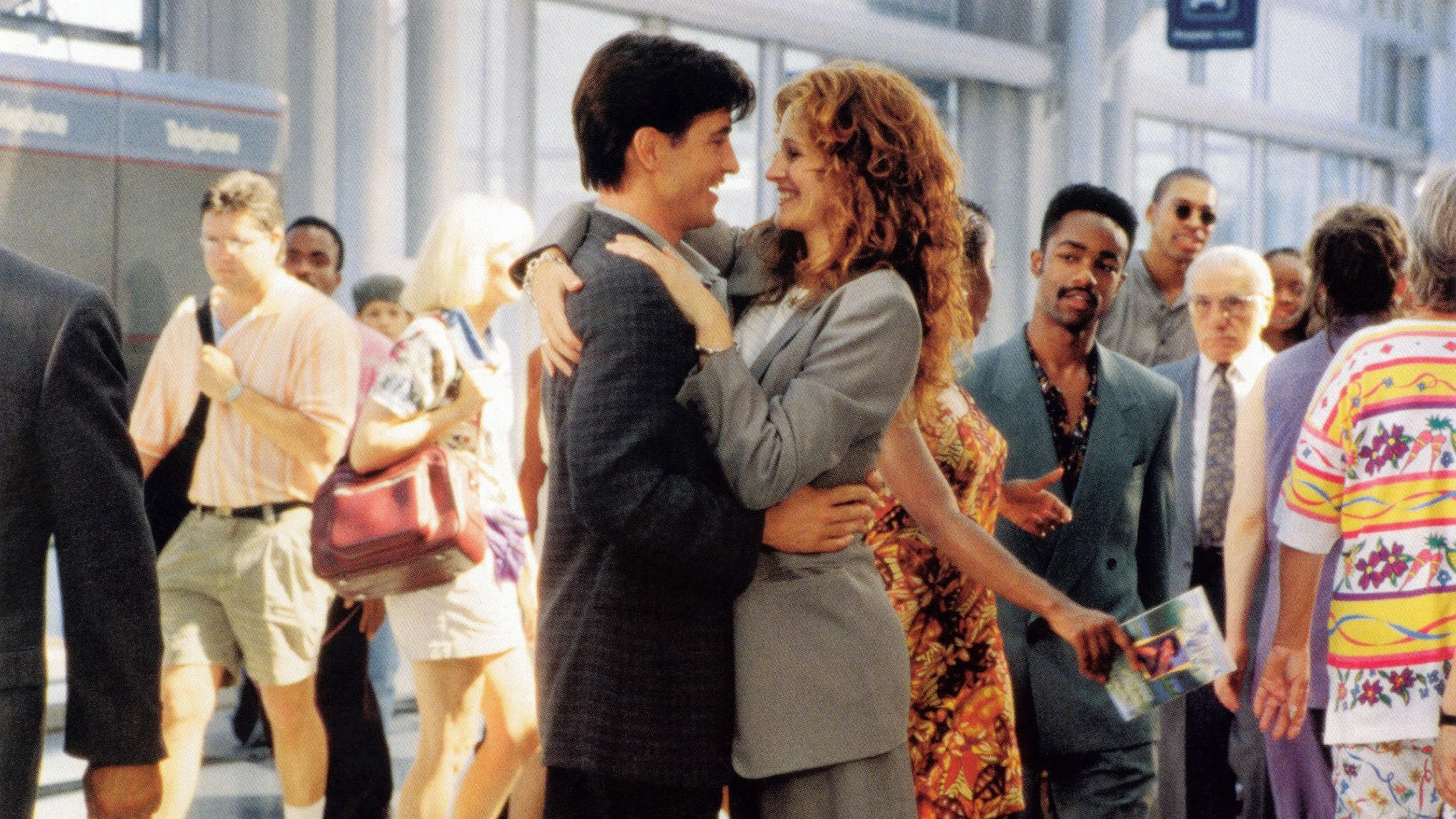
That movie did a number on me, but the one that really warped my mind at that age was My Best Friend’s Wedding. You ever hold the memory of a movie in your heart but dare not re-watch it for fear of destroying your love for it when you realize it is full-blown trash? That’s what happened to me and My Best Friend’s Wedding.
The scene where they’re dancing to “The Way You Look Tonight” on the boat going under the bridges? My heart fluttered. When Julia Roberts teared up, I teared up! When he sees Julia Roberts in her black lacy bra? I was giddy. When she finally kisses him at the end? Little Heather cheered for Julia Roberts. I regarded Cameron Diaz as an annoyance, someone who was in the way. I also hated the ending.
I cheered for Julia Roberts the whole time, just as the writer and producers likely intended. I mean, they cast Julia Freakin’ Roberts. Everyone loves her. I don’t even care, you guys, she IS America’s sweetheart. The top 3 American exports are (1) vehicles, (2) optical, technical, and medical apparatus, and (3) Julia Roberts movies. I love her. How could you not love her? I know there are people out there who hate her, but I don’t know any of them personally because I make it a point not to associate with human garbage.
I almost just asked whether she has ever even played a villain in a movie because how could she pull it off with her being so beloved? Then I remembered: My Best Friend’s Wedding. Putting her as the lead in this was the ultimate scam on the audience because, wow, objectively, her character SUCKS.
I re-watched the movie with one of my BFFs, Elyse (yes, that Elyse) when she was in town visiting. Upon rewatch, we realized this movie was an actual horror film. Julia Roberts is a monster. Michael/Dermot Mulroney (NOT Dylan McDermott) was an actual shit bag. He didn’t invite his “best friend” to the wedding until mere DAYS before the ceremony? That’s not an invite. It’s not even a courtesy call. That’s a dick swing and not shocking coming from this charmer.
Also their little pact? Not married by age 28? Baby, I hope you ain’t married by 28. When I was 28, I was dumb as hell! Maybe instead they should make a marriage pact if they’re not married by the time they’re 38 then they can enter into a sham union. At least by then they probably need insurance and maybe if their careers are going well, they’d need the married-filing-jointly tax breaks.
Kimmy/Cameron Diaz honestly should have left both their dysfunctional asses so they could get together then inevitably get divorced only a few short years later. Then you know Michael would be calling Kimmy up, all drunk and sad, like, “I made the biggest mistake of my life!”
You sure did! Meanwhile, Kimmy is booed up with someone else who is not sneaking a peek at someone else’s lacy black bra or SNIFFING ANOTHER WOMAN’S HAIR WHILE ENGAGED TO HER or getting their feathers ruffled when that other woman brings a man around and forces said man to hide his sexual orientation.
Let’s also be real and just say George/Rupert Everett is the only character you don’t want to yeet directly into the sun. He gets manipulated by Julia Roberts into deceiving some rando strangers and trying to ruin their PLANNED AND PAID FOR wedding.
I also have to say as a person currently planning and paying for my own wedding with my fiancé: shit is EXPENSIVE. I know Kimmy’s rich daddy, played by the incomparable Philip Bosco (RIP), was covering the cost. But if someone tried to thwart my planned and PAID FOR wedding, I would commit a violent felony against them. And my best friends gang (I cannot say “bride tribe” with a straight face) would help me destroy the evidence. Coming between a couple and their non-refundable deposits is some high stakes meddling, Julia Roberts. Do you know how hard it is to choose a linen and chair combination that is at once in-budget, on-theme, and not too matchy-matchy?
No, you wouldn’t know because you inhabit that lovely 90’s rom com trope of the single, hardworking woman, so focused on her climb to the top that she let love pass her by. Morphing from a once young and desirable future-wife material to a nearly 28-year-old chain-smoking spaz in a series of blazers. Don’t let them fool you, 90s rom com career woman trope. There is hope for you. Your journey will begin, just not with ruining my wedding.
It’s all a matter of perspective and a loss of innocence. Little Innocent Heather thought it was adorable and charming and all fun and games to go after the man. Real Life 34-Year-Old Heather planning a wedding? No ma’am. It ain’t all Frank Sinatra songs and Jell-O metaphors. You’re playing with real bucks, and my suspension of disbelief is destroyed. I decided to research just who would write such an abhorrent character like Jules – a woman who was willing to lose all dignity to try and destroy an innocent woman all over some extremely mediocre and frankly pretty stupid guy?
** checks IMDB **
Ah, yes, a man.
At least in Mrs. Winterbourne Ricki Lake taught the up-tight Brendan Fraser to dance and laugh and love again. She saved Shirley MacLaine from an imminent cardiac event. She was scrappy. She beat the system. The fight wasn’t woman against woman. It was underdog versus the established elite of generational wealth.
Ricki charmed a man, not with her looks or sophistication or impressive station in life. She wasn’t a lawyer. She didn’t drive a Lexus. Instead she got the guy using her wit and courage and smart mouth. I guess I learned something from those rom coms after all.
***
This piece first appeared in Sunday Morning Hot Tea. Subscribe so you don’t miss another piece.