

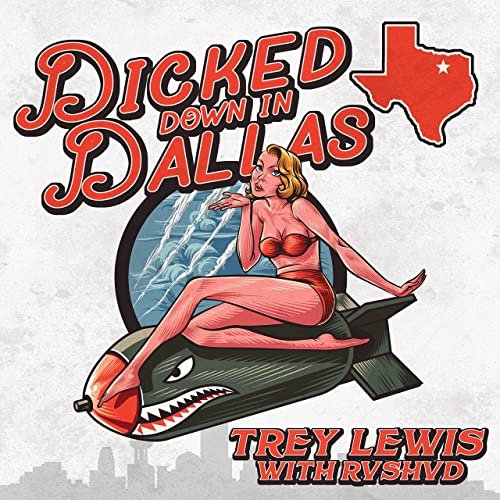
In Defense of “Dicked Down in Dallas”
As I was researching our most recent Sinisterhood minisode, I decided to search Spotify for some songs about Dallas that I may not have heard before. Up popped Willie Nelson’s “Dallas,” an old favorite. Then I scrolled to Alan Jackson’s “Dallas,” a hit by anyone’s standards. Of course, Spotify offered me the theme song to the TV show Dallas. A hype song, but not what I was looking for
Then I spotted it. Sitting at the bottom of the search results was a tune by someone named Trey Lewis. A name and a song that I had never heard before. Familiar with Willie’s contribution and already tired of Jackson’s before the chorus even begun (Sorry, Alan, but it’s no “Chatahoochie,”) I clicked play on the new song.
Once the opening chords began, I fell in love. It’s a modern country classic. The strum of the guitar. The hit of the bass. The lyrics - pure poetry. Given the song’s liberal use of swears, I’ll issue a warning to you now - by proceeding further, you will see some naughty words. If you choose to listen along to the song while reading this - which I highly recommend - you’ll hear a lot more.
As I listened for the first time, I became outraged. It had nothing to do with the curse words. I sat there, hurt, wondering why no one in my life - not anyone who knows me personally nor anyone familiar with the podcast - ever bothered to send this song to me. After poking around on Google, I found that it went viral on TikTok in December 2020. That was a full year before I ever heard it. How dare you all let me down so hard?
Late to the party though I may be, I’m asking you to put aside any preconceived notions you may have based on the song’s title or the obscenity of the lyrics. Free your mind, open your heart, and join me on a journey into the majestic beauty of “Dicked Down in Dallas,” a song celebrating the beauty and independence of female sexuality.
“Dicked Down in Dallas” primarily catalogs the sexual exploits of a specific woman. Though the list of acts and geographic locations is long, at no point does the narrator ever slut shame her. He lists the various sex acts she engages in - including being “analed in Austin” and “buttf**ked in Boston” - but never assigns a moral value to her acts. He also doesn’t name her or directly identify her.
In the second verse, he veers into possible judgement, saying, “I wonder what her Daddy’d say,” speculating, “Maybe he’s the one to blame.” Given the narrator’s morally agnostic discussion of her actions throughout the rest of the song, I hesitate to jump to labeling this a judgment. Instead, I see this as a comment on the patriarchy’s harmful oppression that the woman (the “dickee” in this song) and every other female-identifying person has to suffer. If she wants to get “tore up in Tyler” and be free to “drop[] it like a tailgate,” she should be able to do so, without her actual “Daddy” or the proverbial “Daddy” of society judging her. And if either her father or society as a whole were so inclined to judge, their harmfully antiquated views of female sexuality make them “the one[s] to blame.”
In addition to the original song, there is a remix featuring singer Rvshvd (pronounced “Rashad”) that includes a bridge not in the initial version. The bridge offers the greatest simile in the history of music, as sung by Rvshvd himself. He observes the female protagonist to be “Poppin’ that cooter like a cap gun.” Who, except a poetic genius, would ever think to compare the enthusiastic way a female uses her sex organs with the white hot fire of a non-lethal fire arm?
The remix offers up a few additional lyrics that, upon first blush, appear to toe the line between acceptance and judgment. Rvshvd comments, “I’m a little concerned,” regarding the woman’s many exploits. However, his concern should not be read as judgment. Any of us, with the knowledge that a friend was getting “nasty in Nashville” to the point that “everyone knows her name” would express our concern as to whether she was getting nasty in the safest way possible (e.g., with the proper prophylactic measures in place).
It is also relevant to note that this song was released at the height of the COVID-19 pandemic. Rvshvd’s expression of concern was therefore more likely regarding her adherence to proper CDC guidelines and social distancing measures than any concern about her chastity or reputation.
The COVID concern is even more likely given his description of her generous lovemaking style as being “like a little league team, everybody gets a turn.” With that many participants engaging in the process, guidelines must be observed for everyone’s safety. Hopefully with everyone tested, masked, and vaxxed, she can run through that train with nary a sniffle.
The most beautiful part of “Dicked Down in Dallas” is the narrator expressing his ongoing interest in the female protagonist’s return, all the while acknowledging her otherwise full dance card. This is expressed perfectly when he sings, “Now I’m the one on my knees/Praying she’ll come back/Give me that sweet ass” despite his already knowing well that “she is getting dicked down in Dallas.” Fully aware of her myriad exploits, the narrator still wants her. This flies in the face of misogynistic expressions (both in real life and online) that classify a woman with a robust sex life as being impure or sexually undesirable.
The narrator here is not disgusted by her past (or present, for that matter). Rather, he reaffirms over and over his ongoing romantic interest in the ingenue, though she is “putting [him] through hell/f**king someone else.” If he were making a judgmental statement and planned to reject her for her sexually robust behavior, he would no longer express an interest to have her back. He could save the strain on his knees and quit praying for the return of her sweet ass.
The catalog of her various acts is not paired with any moral judgment. The only behavior for which he expresses a disdain does not involve her sexuality at all. Instead, it is her thoughtlessness as she took off “like a bat out of hell” headed out to begin (or continue) her sexual walkabout. The only thing he complains about is her series of abrupt departures without offering sufficient goodbyes.
His silence as to the moral value of her sexual escapades is proper given the pair’s ambiguous relationship status. Though the narrator is disappointed that she “left [him] all alone in Montgomery tonight,” nothing in the song points to the couple having an exclusive monogamous relationship. On the contrary, he laments that she “didn’t think twice about Amarillo” and that “Denver all but once crossed her mind.” If the narrator was the one left alone in Montgomery, but not the one left in Denver or Amarillo, then he has knowledge of other sexual partners in those towns who had suffered the same fate as he.
Yes, she may have made it with him in Montgomery, but he has no ownership over either the dickee or her body. Absent an agreement between the parties, he has no grounds to object to her behavior. Given the ambiguity of their relationship, that only affirms the beauty of “Dicked Down in Dallas.” He is in emotional turmoil at the natural end of their non-monogamous tryst, yet he never passes a negative judgement on her behavior.
He is able to express his feelings, voice his disappointment, and lament the ache of her absence but has progressed beyond the misogynistic need to lash out at the woman who has caused his heartache. The easiest path would be to sling mud, call names, and label her an unchaste woman. Yet, instead, he presents the reality as it is and expresses his feelings on the situation without assigning a moral value to her behavior.
The exaltation of the female protagonist is well deserved. There has not been a harder working character in a song since Dolly Parton’s “9 to 5.” She is traveling the country, which is a hassle in and of itself. Not only that, she is also getting tore up left, right, and center all along the way. This includes “suckin’ off ol’ what’s his name” in the Lone Star State as you are trying so hard to well as being both analed in Austin and buttf**ked in Boston. The singer's choice to name two seemingly similar acts in two different ways may be in an effort to delineate between two different acts, or merely a device to achieve poetic alliteration. In either case, it only further proves her endurance and ability to withstand great physical challenges.
Not only is she busy fogging up windows of all kinds (“Chevy’s, ‘Yotas, and Fords”), she is driving cross country in order to do so. Driving is exhausting. Driving AFTER you’ve been dicked down? That’s a super-heroic feat. Not to mention the price of gasoline and the general wear and tear on her car. And her ass.
At first blush, it would be easy to label this song vulgar and a transparent attempt to slut-shame a man’s ex. However, when the lyrics are examined, we see it is a highly evolved work of poetry, celebrating the female body’s capacity for hard work and difficult feats. It also gave us the phrase “poppin’ that cooter like a cap gun,” and for that I will always be grateful.
***
This piece first appeared in Sunday Morning Hot Tea. Subscribe so you don’t miss another piece.