

Legal Question: Raging Abe Simpson and His Misguided Miscalculation in “The Unenforceability of the Flying Hellfish Agreement”
This week’s question comes from Paris via asking me on the couch and me responding, “If you really want to know, you should fill out the form on the website.” Paris asks:
“Is the Tontine agreement made in The Simpsons Season 7, Episode 22 legal? Abe Simpson and Monty Burns enter into a contract where the last surviving participant becomes the sole inheritor of valuables. Is that legally possible?”
Great question, Paris! Spoilers ahead for those of you who missed this episode when it aired 25 years ago this week.
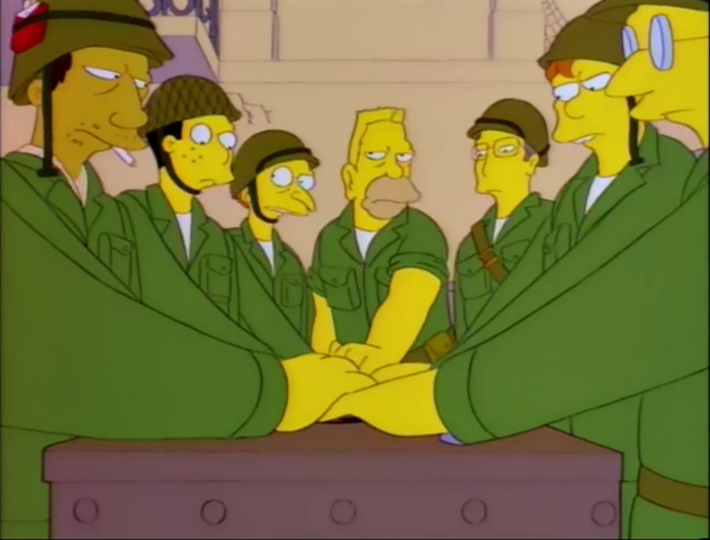
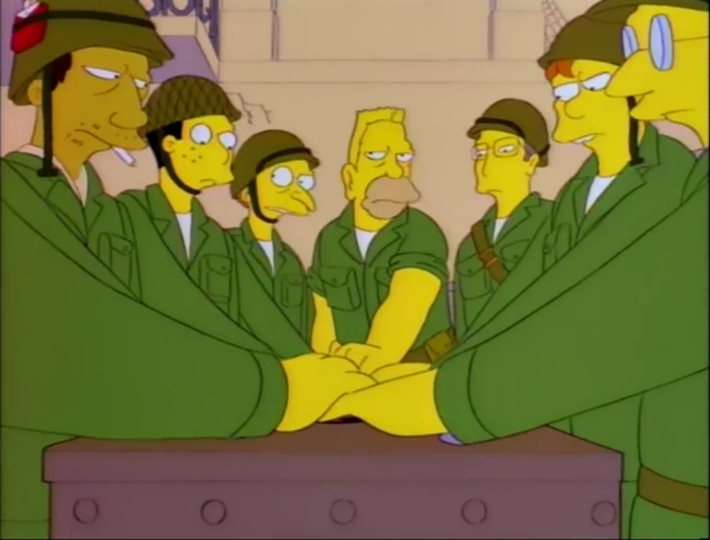
In case you haven’t seen The Simpsons episode in question, it involves a pact made between nine of Springfield’s men who served together in World War II in Germany as part of a crew called The Flying Hellfish. In the present day (1996), Grandpa Simpson checks his mail and receives notice that someone named Asa Phelps has died. Grandpa yells, “The seventh Hellfish has died!” Then remarks how he is one step closer to “the treasure.”
Grandpa meets Monty Burns in the cemetery for Asa’s sad and poorly attended funeral, where the men each put keys into a monument. A door opens to reveal a box. Inside is a list of nine names, six of which are crossed off, including Sheldon Skinner, Arnie Gumble, Iggy Wiggum, Milton “OX” Haas, Etell Westgrin, and Braff McDonald. Grandpa Simpson crosses off Asa Phelps, leaving only Mr. Burns and himself on the list.
Burns tells him, “Seven gone. As soon as you’re in your press-board coffin, I’ll be the sole survivor, and the treasure will be mine.” Mr. Burns refers to their “gentlemen’s agreement” saying that the crew swore on their lives to uphold it. The two men keep referring to the treasure as the “Hellfish Bonanza.”

“Seven gone. As soon as you’re in your press board coffin, I’ll be the sole survivor and the treasure will be mine.”
That “Bonanza” was made up of priceless paintings by what looks like a Rembrandt with mentions of Monet and Botecelli, that they had taken from a German castle. When the group of men found the paintings during the war, they figured that immediately selling the stolen loot would get them busted. To lay low, the group agrees to hold the paintings in a “tontine” suggested by Mr. Burns.
Ox, one of the soldiers, explains the scheme as, “Essentially we all enter into a contract whereby the last surviving participant becomes the sole possessor of all them purty pictures.”
Fast forward back to 1996 where Grandpa and Bart retrieve the paintings from under the waters of Lake Springfield. No sooner have they come up for air, the paintings are stolen by Mr. Burns. Grandpa Simpson catches up to Burnsy and “discharges” him from the Hellfish. Grandpa says this ouster also kicks Mr. Burns out of the Tontine, so Grandpa declares himself entitled to keep the paintings. His victory doesn’t last long. Soon U.S. government agents show up to return the paintings to the descendants of their rightful owner.
WHAT IS A TONTINE?
A tontine is, not surprisingly, a real thing. Writers for The Simpsons are always bringing in real historical and cultural references. Invented in the 1600s, tontines were ways for people to obtain payouts based on their own mortality. They were also used as investment plans often run by the government in order to fund large scale projects, similar to how municipal bonds are used today.
In a tontine, the government/organizer sets up the structure and maintains the money. People called “subscribers” put money into the scheme. The subscribers receive payments of interest while the pot of money grows. Then as each person dies, the share of the pie and payouts become bigger based on the fewer number of remaining participants. Finally, the last person to survive would be entitled to the payout of the remainder once the rest of the participants died.
The setup is not quite the same as what the Flying Hellfish used it for, but it is similar. This investment structure was invented by and named for a banker and politician from Naples, Lorenzo de Tonti. Though he later had to seek political asylum for participating in a revolt, his name remains tied to the financial setup he created so many centuries ago.
Tontines were popular throughout the years and eventually made their way to the United States. However, in 1905, tontines had devolved into something more similar to a Ponzi scheme. An investigation by the state of New York put restrictions on tontines after an executive of a life insurance company was misusing money from the tontine accounts to fund his lavish lifestyle. This misuse made tontines appear risky, so they became subject to heightened regulation.
COULD THE FLYING HELLFISH USE THIS SET UP FOR THEIR PAINTINGS?
Not likely. Tontines don’t normally hold property. They hold money and pay out dividend-like payments. Instead, what the men may have created was more like a trust. Under the law, a trust is an arrangement whereby a person (a trustee) holds property as its owner in name only for the benefit of one or more beneficiaries.
Under Oregon law, a trust need not be evidenced by a trust instrument. That means that a trust can be created by speaking the trust into words. The initial “trust” may have been created back in Germany, but the men acted in accordance with the trust for years in Springfield. Arguably, it would be governed by Oregon law. Yeah, the Simpsons live in Oregon.
Whether it was a “tontine” in the strict sense of the word or a trust, the Flying Hellfish “tontine” is still an oral contract to which all nine of the Flying Hellfish agreed. The major problem with this oral agreement is a law called the Statute of Frauds.
The Statute of Frauds requires that certain agreements must be in writing to be enforceable. For instance, if an agreement cannot be performed within one year, it must be in writing to be enforceable. Since the agreement was contingent on the deaths of members several years apart, the contract would likely be void under Oregon’s Statute of Frauds law. This means that if the agreement was not in writing, it would not be a real agreement.
The biggest issue with determining legal title to the Hellfish Bonanza is the court’s abhorrence of illegal contracts. Even if it were in writing, it’s based on the underlying illegal act of stealing paintings.
Oregon courts have held that, “If the consideration for the contract or its agreed purpose is illegal or against public policy on its face, it will not be enforced.”
Because the underlying consideration for the Hellfish contract was stolen paintings, the contract is based on illegal consideration and “against public policy.” Contracts are usually considered “against public policy” if they are harmful to society or citizens. Awarding ownership of stolen paintings to one of two thieves would be both illegal and against public policy.
If Mr. Burns or Grandpa Simpson wanted to argue in court that either of them was entitled to the paintings, they would not likely be successful. They are fighting over stolen property, based on an oral contract that does not satisfy the Statute of Frauds. The court wouldn’t likely award the paintings to either man.
Even though Mr. Burns and Grandpa Simpson’s tontine was probably not enforceable, real life tontines are trying to make a comeback. According to the Washington Post, there is a growing set of lawyers and economists that think tontines are the future of retirement savings plans in America. They’re overwhelmingly more popular than annuities, which require participants to bet on their own lives. Tontines allow people to bet against the lives of others, which people seem more enthusiastic about.
In countries throughout Africa, a version of tontines that work like “peer-to-peer savings circles” are an important source of capital for small businesses that would not otherwise have easy access to capital to scale up in size. So while they would not be a good way to hold stolen paintings in trust for the benefit of stubborn old men unwilling to die, tontines are real and are still used to this day.
Thanks for the question, Paris! If you have any other questions, I expect you to submit them through the form and not ask me directly. (Kiddddding!)
Got a question? Submit it here. They can be legal what-if questions, questions on current events, or questions about the legality of actions in TV shows or movies you’ve seen. I never ever want to answer your personal legal questions, so don't send those. Love you, but I don’t do that.
***
This piece first appeared in Sunday Morning Hot Tea. Subscribe so you don’t miss another piece.

Legal Question: Total Workplace Discrimination Makeover - Dave Ramsey's Office Nightmares
This week’s question comes from me incredulously reading the news and then seeing this fool on billboards all over Dallas:
“The company of Dave Ramsey, personal finance ‘expert’ and evangelical Christian radio host, has repeatedly fired employees over premarital sex. Is that legal?”
Excellent question, me! I love answering questions from you, but just like you, I sometimes hear about things happening and wonder whether they’re legal. Here’s one that has been rattling up in the ol’ noodle since the news was announced.
As some of you may know, Dave Ramsey is a personal finance personality. He has a radio show, tons of books, and offers personal financial training. Most effective may be his personal story that captivates listeners. At 58 years old, Ramsey has an estimated net worth of $200 million, even after previously filing for personal bankruptcy earlier in his life. He utilizes Biblical principles to guide others to a life free from debt in pursuit of financial freedom.
Ramsey has created The Lampo Group, LLC which operates Ramsey Solutions, the company that runs his courses, publishes his books, and produces his radio show. The company has about 900 employees, which subjects it to the federal laws like the Family and Medical Leave Act and Americans with Disabilities Act. Based in Tennessee, it is also subject to Tennessee state employment laws as well.
In July 2020, a former employee filed suit against Ramsey Solutions after being fired for having premarital sex. Yeah, I just wrote that sentence, and that sentence says that a company prohibited its employees from getting their bang on outside the confines of work.
Now, look, I get it. They’re a religious company. The issue we have here is with enforcement. Unless the company wants to invest in fleetwide chastity belts for every employee, the only real way to glean whether an employee has had sex is if that employee shows up pregnant. This disparately impacts women, at least according to the fired woman’s attorney.
That is what happened to the plaintiff suing Ramsey’s company, Caitlin O’Connor. After discovering she was pregnant with her long-term partner’s baby, O’Connor asked her HR representative for paperwork on FMLA leave that she planned to take as her maternity leave. She also requested paperwork on ADA accommodations because she was carrying a “geriatric pregnancy” and wanted to explore options for possible accommodations.
The next day she was told she had to meet with the board of the company. A few days later, after meeting with board members, she was terminated after four years of solid performance for violating “Company Conduct.” The exact language in the company policy is available in the complaint. It reads:
“The image of Ramsey Solutions is held out to be Christian. Should a team member engage in behavior not consistent with traditional Judeo-Christian values or teaching, it would damage the image and the value of our good will and our brand. If this should occur, the team member would be subject to review, probation, or termination.”
The Code of Conduct also incorporates a “righteous living” policy which prohibits premarital sex.
O’Connor’s complaint argues that her termination interfered with her right to take FMLA leave, discriminated against her due to her sex, pregnancy, religion, and disability, and was in retaliation for becoming pregnant, requesting FMLA, and/or her disabilities. She also pointed out that Ramsey Solutions “in a particularly cruel manner” also terminated her health insurance benefits which include pre and post-natal care.
Ramsey Solutions had a defense to these allegations: it didn’t only fire Caitlin O’Connor for violating this policy. It fired several other folks, too – to be precise, it fired eight other employees over the past five years. In its Motion to Dismiss filed in the case, the parent company argued that because it is a private, for-profit employer, it is within its legal rights to fire employees for any reason so long as the reason is not discriminatory or retaliatory.
Is it legal for Dave Ramsey’s company to fire employees for doing the no-pants dance?
Maybe. In the 2014 U.S. Supreme Court Decision Burwell v. Hobby Lobby, the Supreme Court held that “closely held” for-profit companies can exercise religious beliefs.
“Closely held” is defined by the IRS as those companies that have more than 50% of the value of their outstanding stock owned (directly or indirectly) by 5 or fewer individuals at any time during the last half of the tax year; and that are not personal service corporations. According to the Washington Post, as of 2014, approximately 90% of U.S. corporations are “closely held”, and approximately 52% of the U.S. workforce is employed by “closely held” corporations.
Hobby Lobby, a chain of craft stores with 500 locations and 13,000 employees falls under this definition. It stands to reason then that The Lampo Group LLC/Ramsey Solutions with its 900 “team members” falls under the definition as well.
The Hobby Lobby decision confirmed that the Religious Freedom Restoration Act of 1993 (RFRA) allows a for-profit company to deny its employees health coverage of contraception to which the employees would otherwise be entitled based on the religious objections of the company’s owners.
The majority of justices in Hobby Lobby specifically emphasized that the decision only concerned the contraceptive mandate of the Affordable Care Act and should not be understood to hold that all insurance-coverage mandates, e.g., for vaccinations or blood transfusions, must necessarily fall if they conflict with an employer’s religious beliefs. The Court also clarified that the Hobby Lobby decision does not provide a shield for employers who might cloak illegal discrimination as a religious practice.
Even with these caveats, there is nothing stopping someone from asking the Court to extend the law to their religious-based practices in their “closely held” businesses that would otherwise run afoul of anti-discrimination laws.
Given this possibility and what it has to lose, it doesn’t seem like Ramsey’s organization is willing to back down. If so inclined, the case could be argued up to the higher court, and Ramsey Solutions could ask for relief under the RFRA. That law provides that the government “shall not substantially burden a person’s exercise of religion even if the burden results from a rule of general applicability.” The Hobby Lobby court confirmed that the definition of “person” includes corporations. The exception to that rule – which allows the government to burden the religious exercise of employers – occurs where the government demonstrates that applying the burden on religious exercise meets two requirements:
(1) The burden on exercising religion is in furtherance of a compelling governmental interest; and
(2) The burden on exercising religion is the least restrictive means of furthering that compelling governmental interest.
In plain terms, if the government was to infringe on the exercise of religious beliefs, it has to have a really really good reason to do so, and it has to infringe on the exercising of religious beliefs in the least restrictive way possible. This sounds like nonsense, and it is. Welcome to the practice of law, where the rules are made up and the points don’t matter.
There are two questions then: (1) Does the federal government have a compelling interest in preventing discrimination on the basis of sex, pregnancy, and disability and providing medical leave to employees? I think it does. Then (2) Does prohibiting employers from firing employees who engage in premarital sex further that government interest via the least restrictive means possible? In other words, is there another, easier way to prevent discrimination other than prohibiting companies from firing people for doing the humpty hump?
Let’s take Hobby Lobby for example. The ACA mandate at issue in Hobby Lobby forced all employers, including companies with religious beliefs, to provide contraception to their employees. The Court reasoned there were other, albeit not as convenient, ways for employees to obtain access to contraception. Because the contraception mandate forced companies to violate their “religious beliefs” where a lesser restrictive alternative was available, the Court held the mandate was in violation of the RFRA.
I am racking my brain for a less restrictive way to further that compelling government interest of a workplace free from discrimination on the basis of sex, pregnancy, and disability besides prohibiting companies from firing people for having sex outside of marriage. I got nothing. If you can think of a way, please reply to this newsletter and let me know what that is.
Whether Ramsey Solutions is in violation of federal law may be a question for the Supreme Court. As for state law, in 1997, the Supreme Court held that the RFRA is unconstitutional as it applies to state and local laws in City of Boerne v. Flores. So as to its violations of Tennessee state laws, Ramsey’s company wouldn’t be able to rely on the RFRA to get out of those claims.
Based on their most recent filing, Ramsey Solutions seems intent on fighting O’Connor’s lawsuit. She filed in federal district court, so it could be appealed to the Sixth Circuit Court of Appeals, and later, the Supreme Court. That is when we will see whether the new make-up of the Supreme Court will extend the RFRA to employment laws, potentially eroding laws meant to protect employees who don’t necessarily fit a “Christian ideal” in the eyes of their employers.
It also is not clear whether these accusations have impacted Ramsey’s image or lost him any audience members. I’ve never followed him much or read any of his books, so I can’t tell you whether “discriminate against your employees” is some kind of hot tip for personal finance. I’m no expert, but I can tell you “don’t get sued” is a pretty good plan for saving money on legal fees. I am also rusty on my Bible reading, so I’m not sure whether “thou shalt deny pre- and post-natal insurance care to unwed mothers” is in the New Testament or the Old. Maybe it’s not in either???
Caitlin O’Connor isn’t the only one suing the Ramsey entity. On April 15, 2021, a former video editor for the company sued Ramsey Solutions and Dave himself in county court claiming the workplace was run as a “religious cult” that referred to those who wore masks as “wusses” and demanded “complete and total submission to Dave Ramsey and his views of the world to maintain employment.” According to the complaint, this employee was fired for “failing to follow [Ramsey’s] particular view that taking precautions other than prayer against COVID infection would make a person fall out of God’s favor.” As far as I can tell, Ramsey is not a doctor or infectious disease expert.
As for Ramsey himself, he doesn’t seem to give an eff about any of this. In a Q&A he posted on his website, he told a Twitter user it was OK to fire an employee for having an extramarital affair outside the office. Ramsey, who as far as I can tell, is not a lawyer either, said, “I’ve got a right to tell my employees whatever I want to tell them. They freaking work for me.” Amen, I guess?
I hope that was interesting for all you to learn as it was for me to research. Thanks for reading.
Got a question? Submit it here. They can be legal what-if questions, questions on current events, or questions about the legality of actions in TV shows or movies you’ve seen. I never ever want to answer your personal legal questions, so don't send those. Love you, but I don’t do that.
***
This piece first appeared in Sunday Morning Hot Tea. Subscribe so you don’t miss another piece.

Legal Question: Road Hazards and the Efficacy of Caution Signs
This week’s question comes from Lauren via the form. Lauren asks:
“Landscaping trucks with open tops and just a thin tarp or net over the top always have signs on the back saying it’s not their fault if something falls out of their truck and damages your car. Is that legit? If so, what the heck?! They speed down the highway leaving trails of gravel bouncing off the road and windshields. Are the signs just there to scare people out of coming for them? And why don’t they just use a tarp/net that’s actually the right size to cover the top? That last part might not be a legal question, but it seems like a super easy solution.”
Excellent question, Lauren!
The short answer is – those signs are bullshit. They’re basically there to scare you out of coming after them. But they also have a purpose.

A friendly warning or an attempt to shirk responsibility?
Car accidents in general are governed by the laws of negligence. Laws vary based on jurisdiction, and since I’m based in Texas, I’ll use its laws in this answer. But overall the rules of negligence are fairly similar across states.
NEGLIGENCE
There’s a whole law school class called Torts that covers, in part, the idea of negligence. Not to be confused with delicious tortes or tortillas, torts are wrongful acts that cause somebody to suffer loss or harm, resulting in legal liability to the wrongful actor. Negligence is one of these “torts,” and it is the basis for most car accident law.
To succeed in claiming somebody like the driver of a truck full of flying objects is responsible for damages, you have to prove the elements of negligence. These are:
Duty – (lol duty) – This is the standard of behavior we are all supposed to adhere to. For instance, when you’re driving, you shouldn’t be breaking laws like speeding or distracted by a cell phone. You also have a duty to secure objects on your truck, possibly by using a tarp/net that is appropriately sized.
Breach of Duty – This means that the wrongdoer/truck driver failed to adhere to that standard of behavior. For instance, he was speeding and swerving or failed to secure his objects in the way a reasonable truck driver should.
Causation – Lots of times this is called “cause in fact” because you’d have to prove that the injury you suffered – hopefully just something like a smashed windshield, but even something as serious as injury or death – was “ in fact” caused by the trucker’s failure.
Proximate Causation – You also have to prove that the trucker (or a reasonable person) would have known that leaving things loose in the truck bed, combined with swerving and speeding, would have caused something like your smashed windshield. The key here is whether the resulting damage was foreseeable.
Damages – You have to prove there was actual harm done to you – like your windshield was damaged or you were physically injured.
You need to prove all these things to win your case against a truck driver whose errant objects flew out and smashed your windshield.
IS THE SIGN LEGIT?
Like I said, the sign is partially to scare people off, but it also has another important use. When hearing claims of negligence, courts use a concept called “comparative negligence.” Because you’re out on the road driving, you also have a standard of behavior you should adhere to. Basically, you should also be driving safely, legally, and free from distractions. If a truck in front of you is losing gravel or leaves, and you were following closer than the law allows, you could be breaching your duty of care.
When two parties both act in a way that contributes to the accident, the court has to allocate responsibility in order to figure out who is going to pick up the tab for the damages. Some states do this with a rule called “contributory negligence.” This rule is harsh because if a defendant (accused wrong actor) can prove that the plaintiff (injured party) was in ANY WAY also at fault, then that plaintiff cannot recover ANY money at all for the damages caused by the defendant. Pretty rough, right?
Texas is one of a majority of states that use another standard called “comparative negligence.” Rather than being completely screwed if you contributed to the accident in some way – perhaps, for instance, by following too close despite being warned by a sign – you could still recover damages.
What a judge or jury would have to decide is how much at fault you were for the accident. How close were you? Did you see/read the sign? Were you given enough warning to back up? Were you following closer than the Texas Transportation Code allows? Texas law says a driver has to maintain an “assured clear distance” between themselves and the car in front of them so that the driver can stop without hitting the other vehicle.
The “fact finder” – either a judge or a jury, depending on the type of trial – would then decide what percent liable each driver was.
Perhaps they determine that you were following a safe distance, so far back that you couldn’t even see the sign. In that case, you may be 0% comparatively negligent. What if, instead, you were close enough to see the sign and see the loose rocks before they flew your way? The fact finder may say you were 25% liable. In that case, if your replacement windshield cost $1,000, you would only be entitled to ask the truck driver for $750.
If, however, you were tailgating the truck to the point that your front plate nearly touched his bumper, your dash cam shows the sign clearly in your view, and the tarp is seen clearly whipping in the wind, then a fact finder may say you both were at fault – maybe 50%/50%. In that case, you can ask for $500 of the $1,000 cost for your replacement windshield.
The only hiccup really happens when you’re found to be over 51% responsible. In that case, you can’t get any compensation for your damages. This is known as the 51% Bar Rule. Texas is one of 21 states that follows this rule.
WHY DON’T THEY JUST USE A TARP/NET THAT’S ACTUALLY THE RIGHT SIZE TO COVER THE TOP?
You’re totally right. They should! If they did, and something unforeseeable happened, like a normally reliable tarp randomly ripped, then the driver probably wouldn’t be liable. The driver could argue they behaved as a “reasonably prudent person would under the same or similar circumstances,” which is the degree of care we should be operating under.
Some professions have a bit higher duty. In this case, the driver would need to be acting the same as another reasonably prudent truck driver – for instance, by securing the cargo and ensuring no loose debris is flying off their truck.
So if the driver was acting right – securing the cargo and driving safely – and something still happened, then that’s what we call a good ol’ fashioned accident, and it’s what insurance is made for.
As we always say, you can try to sue anybody for anything, it’s just a matter of whether you will win. Likewise, you can always try making a complaint to a company or its insurance for the actions of its drivers, signs or not. You may face roadblocks (see what I did there?), but you sure can try. When trying to make a complaint, it is always good to have evidence like the company name, the truck’s license plate, truck number, description, etc. It also may rise to the level of criminal action if the negligence is egregious and damaging enough. Stay safe out there!
I hope that answers your question, Lauren! Thanks for sending.
Got a question? Submit it here. They can be legal what-if questions, questions on current events, or questions about the legality of actions in TV shows or movies you’ve seen. I never ever want to answer your personal legal questions, so don't send those. Love you, but I don’t do that.
***
This piece first appeared in Sunday Morning Hot Tea. Subscribe so you don’t miss another piece.
Legal Question: Can You Sue Yourself?
This week’s question comes from Cara:
“This question was inspired by a line in your Santa Clause analysis...can you sue yourself? Is it legally possible? And if so, why might someone do it?”
Great question, Cara. This is one of those technicality-type questions. The short answer is yes. It’s kind of like that Spiderman meme:

It is legally possible to sue yourself because of the concept of “capacity.” There are two kinds of capacity in the legal world - one deals with the mental state required to sign a contract or make decisions. We’re not talking about that one today. The capacity we are concerned with is “a specified role or position” that a person holds.
You can think of capacity as different hats. Each hat is a different role. If you have more than one hat, you can put on one hat, sue yourself, then put on the other hat to be sued. Let’s look at an example.
In 2016, a woman named Barbara Bagley sued herself in a personal injury lawsuit. She was driving a car with her husband as a passenger, and they crashed. Sadly, Barbara’s husband died from his injuries in the accident. Barbara then decided to seek financial compensation for the loss of her husband by suing the driver involved - herself.
Barbara brought the lawsuit in her capacity as a spouse who lost her husband. Wearing her grieving widow hat, Barbara sought compensation for all the love, affection, and wages she lost when he died. Wearing her driver hat, Barbara was sued for negligently causing the accident. This seems like a stupid idea until you realize who defends negligent drivers and pays any legal judgments against them: car insurance companies.
So Barbara the grieving spouse was suing “herself” as the negligent driver, though really that second “Barbara” was covered by the insurance company and its $$ DEEP POCKETS $$.
And you know what? It worked! The court ruled in favor of Barbara the grieving spouse based on the language used in Utah’s Wrongful Death and Survival Action Statutes. Despite the insurance company arguing that it was an absurd result, the Utah Supreme Court allowed the grieving widow to collect from herself as the negligent driver (and, therefore, the insurance company) based on the plain language of the statute. Words matter!
So while you cannot sue yourself in your own capacity - and why would you? You’d have to pay yourself back! - you can sue yourself if you do so in a different “capacity,” especially if it is supported by a statute. At least you can in Utah because Utah is a wild and hedonistic paradise with no rules!*
* Please note, I have never been to Utah.
I hope that answers your question, Cara! Thanks for sending.
Got a question? Submit it here. They can be legal what-if questions like the one above, or questions about the legality of actions in TV shows or movies you’ve seen. I never ever want to answer your personal legal questions, so don’t send those. Love you, but I don’t do that.
***
This piece first appeared in Sunday Morning Hot Tea. Subscribe so you don’t miss another piece.