

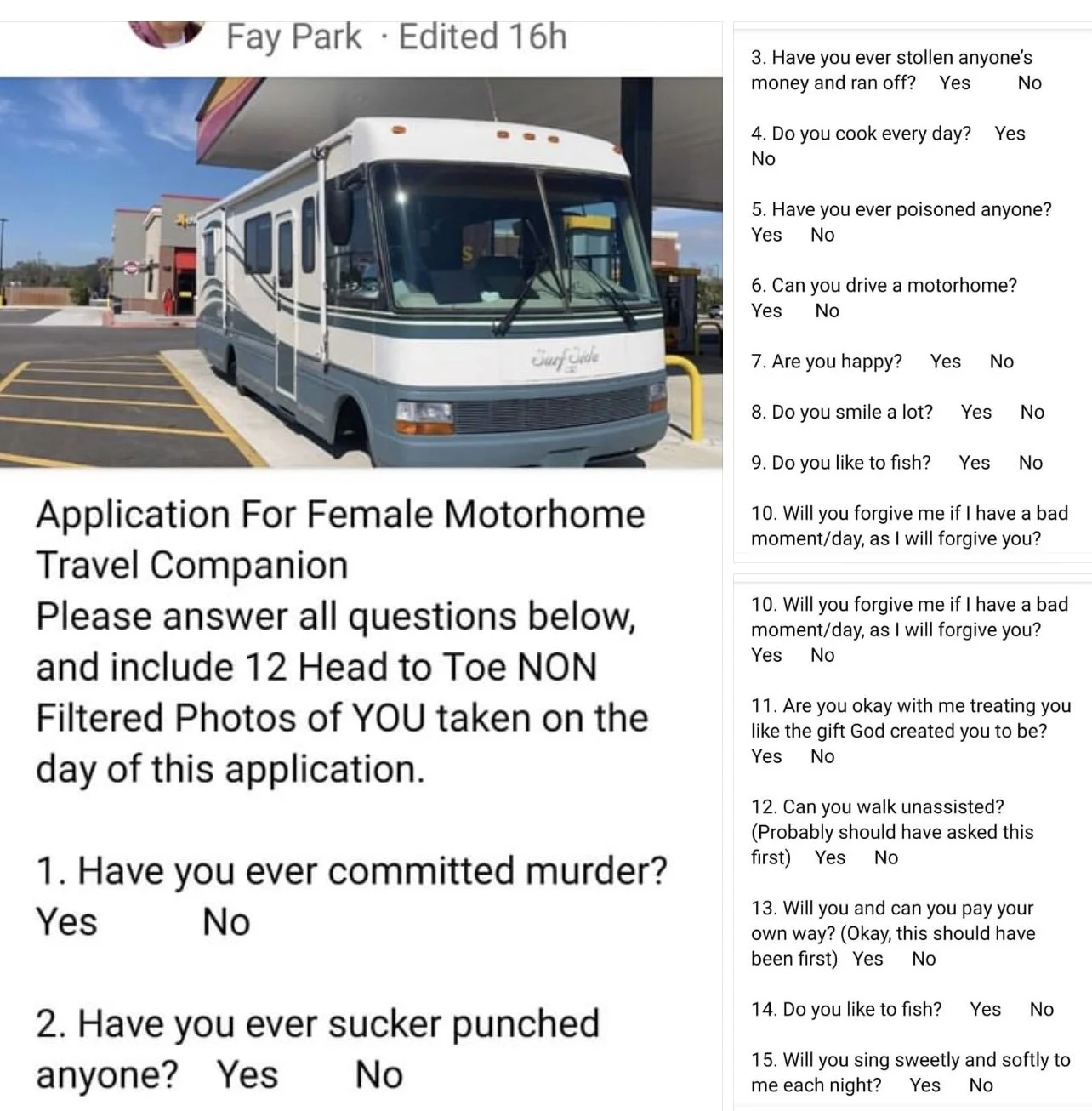
My Application to be a Female Motorhome Travel Companion
This was a post on someone's NextDoor neighborhood app that has been screenshot and shared online. The questionnaire follows a photo of a motorhome parked at a gas pump outside of a combination Pilot truck stop/Hardee’s restaurant, the worst gas station/restaurant combo. Everyone knows the best combo is the TA/Taco Bell Express or the Exxon/McDonald’s if you’re in a pinch.
The post is titled Application For Female Motorhome Travel Companion. It reads: “Please answer all questions below,” then includes the following demand: “12 Head to Toe NON Filtered Photos of YOU taken on the day of this application.” This is a newsletter, so you get the answers to all questions below, but I’ll spare you the 12 head to toe non-filtered photos. I am in jeans and a black t-shirt. I just ate scrambled eggs and breakfast potatoes in an airport hotel restaurant at 6AM. You can visualize what I’ve got going on.
I think I would be a great fit for this job because I’ve been traveling a lot recently. I wanted to know if I could make the cut as a motorhome mama. There is no better way to measure myself than against this gentleman’s metrics of success.
Question 1 – Have you ever committed murder?
Wow, starting off strong. No, sir, I have not yet committed a murder. That’s the problem with your question. You didn’t ask whether I would be willing to commit a murder. You only asked if I have already done so. I have not.
Hang on a minute.
You didn’t specify why you were asking this.... Did you need someone with prior experience? Was the right answer to this question actually yes?
Question 2 – Have you ever sucker punched anyone?
Now I am worried the right answer to this question is yes, too. I have not sucker-punched anyone as I would define it. One time, someone slapped me in the face and called me a “whore” at a bar when I was 19. I told him if he touched me again, I would – and I’m not super proud of this but it’s true – “grab you by the nuts and twist until I felt a pop.” I must have heard that from a movie. I felt like Dirty Harry when I said that.
Despite my very clear warning, he slapped me again. Yes, I grabbed his nuts. No, I didn’t feel a pop, probably because I have early onset wrist weakness from a lifetime of typing. He did drop down to his knees, though, then ran from the bar. It was a whole scene.
I don’t consider this a sucker-punch given that I provided him with proper notice. So, no.
Question 3 – Have you ever stollen anyone’s money and ran off?
I have to point out the stollen is original to the question and not me. I am ashamed that my answer to this question is yes. When we were little kids, probably in third grade, my childhood best friend, Marila, and I found a wad of cash up at the local recreation center. It was hidden back in some bushes, if I recall correctly. It was as if someone had stuffed it back in there to hide it from whoever they stole it from.
Considering there is no honor among thieves, Marila and I made off with the loot. We biked a few minutes up the block until we got to my house and hid in the garage. Some big kids came looking for us. Turns out, we were right. They had stolen the money from somewhere else and had hidden their riches in the bushes. When the boys tried approaching my garage, my mom came out and yelled for them to get out of the yard and go home.
Thanks to our unwitting accomplice, they scrammed. We stashed the cash – a whopping six dollars in crumpled ones – into my brown glass owl piggy bank. I’m sure later we spent it on candy at the Diamond Shamrock gas station near Marila's house.
Question 4 – Do you cook every day?
No. If I am forced to cook, I boil gluten-free noodles, melt a pad of butter in them, and sprinkle them with the kind of parmesan “cheese” that comes in packets crammed in the side of your pizza box. Now baking on the other hand?
I don’t do that either. Sorry.
Question 5 - Have you ever poisoned anyone?
I can't help but feel like this is related to question 4 and comes from a place of personal experience. Either that or this is entrapment. Are you the FBI, sir? If you are, you have to tell me.
Question 6 - Can you drive a motorhome?
I am not trying to be too picky here, but I feel like you should have put this question up higher. No, I have never driven a motorhome, but I have a lot of self-confidence so I think we'll be good. By that I mean I’ll be like, “I got this!” Then I’ll take the wheel, pop a curb at best or skim your roof on an overpass at worst. But I will have driven it.
Question 7 - Are you happy?
Good lord. Wow. Coming straight for the gut punch. You know, are any of us truly happy? I like to think I am. Happiness is a transitory feeling, though. I don't think anyone is truly happy all the time. Maybe content, joyful. If happiness is achieved through doing fulfilling creative work and sharing it with others, then yes, I am happy. If happiness is a Hardee’s Monster Angus Burger in a truck stop parking lot in your SurfSide RV, I’m afraid I’ve been living life wrong.
Question 8 - Do you smile a lot?
Ah, I see where you're going. Number 7 was not about my true happiness and fulfillment. You want to know if I'll shut up and smile. I do smile, but I rarely shut up. I laugh a lot, usually when I am happy or amused, but also when I’m nervous.
I got in trouble for laughing once in grade school. I attended a public elementary school in Mesquite called Rutherford. It was built next to cow pastures and fields. As the houses popped up beside it, the amount of students outnumbered the space to hold us. Soon, the fifth and sixth grade classes were relegated to portables. This was a soft word for mobile homes turned into classrooms. The floors were lined with linoleum tile, and the walls were covered in inspirational posters like “Hang in there!” and “If you can dream it you can do it!”
In fifth grade, we switched classes for each subject, so we got shuffled around between portables a lot. For instance, during our lesson on our changing bodies, girls were ushered into one portable with my home room teacher, Mrs Kralik. A woman of 60 with a cropped gray haircut, Mrs. Kralik exclusively wore knitted sweaters and long jean skirts. To teach us about the inner workings of our personal sexuality, she showed a short video about penises and vaginas and periods. When it ended, she explained the most important thing to remember was that puberty changed our hormones and changed hormones made you stink. So wear deodorant.
A student raised her hand.
"Mrs. Kralik, how are babies made?"
"Just wear deodorant. That's all you need to know."
To be fair, that was not bad advice. It’s just not as all-encompassing as one would hope in order to prevent teen pregnancy or STD transmission.
The boys were shuffled into Mr. Shirley’s class. Mr. Shirley was the science teacher, a round man with a crescent of gray hair framing his bald head. He wore white short-sleeved button-downs with brown striped ties and filled his front pocket with ball point pens. I have to believe he purchased his ensemble all together from Party City in a plastic bag labeled ‘90s Science Teacher at a Public School. He kept a shelf of hissing cockroaches and lizards behind his desk. In the top drawer of his old metal desk, he kept Jelly Bellies. Not plain, store-brand jelly beans. Jelly Bellies. The real deal. Raw and loose in the metal drawer. If you answered a question in his class correctly, you’d get to go and rifle through the drawer and get you a Jelly Belly.
The day I got in trouble for laughing was in late January 1996. On this day, I would not be getting a Jelly Belly. Our lessons on wearing deodorant behind us, this was a solemn day. All home room classes gathered in Mr. Shirley’s room. My class was last to enter, so while some kids sat in desks, we were forced to stand crowded in one corner of the room. Mr. Shirley cut the lights and rolled a black metal cart with an enormous tube TV strapped on top.
“Ten years ago,” Mr. Shirley started, “the Challenger space shuttle took off.”
Took off. That’s what he said. He said it took off. Technically this was true. Technically, the Titanic set sail. Technically, JFK visited Dallas. Technically, I went to Disney World in sixth grade. Saying it like that really buries the lead. It leaves the story unfinished when you fail to mention the sinking, the shooting, or the pants-pooping on the way to the airport.
That's how he set us up. He told us, "The Challenger took off."
“Now, here is a video of that day,” he said.
He pressed play. A video began and introduced the crew. As you would expect, they focused a lot on Chrysta McAullife. A teacher chosen for the mission, the announcer said.
How cool, I thought. She worked so hard teaching her kids, and now she gets to learn firsthand what space is like!
I should reiterate that on this day in January 1996, I was nine years old. I still believed in Santa. I thought the basket on the front porch each year was from the actual Easter Bunny and not our kind neighbor.
So there I stood in the back of the class, engrossed in this lovely story of a woman fulfilling her dreams. Beep, beep, beep went the count down. Three, two, one.
You know what happens next. What was once a sleek spaceship erupted into a huge fireball on the screen in front of us.
Silence.
Then laughter.
I began to laugh. Hard. I couldn’t control it. Couldn’t explain it. I was sad. I was confused. I was laughing. All I know is Mr. Shirley took me by the arm and drug me out of the dark portable. My eyes blinded in the sun outside the door, he questioned me.
“Why did you laugh?”
I had no reasoning. I could only spit out facts.
“She worked so hard. She got to go to space," I said.
“She almost got to go to space,” he corrected.
That afternoon after school, Shirley decided to call my mother and squeal on me. She normally had great deference and respect for teachers, so I expected her to take his side.
“She laughed? At a video of the Challenger explosion?” my mom asked, repeating his complaint back to him. Then she hit him with the money question.
"Did she know?”
“Know what?” he asked.
“How it ended? Did you tell the kids before you started the tape what would happen?”
He was forced to confess he had not.
“Well there you go,” she said. She hung up the phone.
Yeah so anyway, I do smile a lot.
Question 9 - Do you like to fish?
I don't like to do anything that's a whole deal. Like having to get the tackle box, the worms, the hooks, the vest (you HAVE to wear a vest when you fish, otherwise what are you doing?) It seems like a whole deal. To fish the right way, I feel like I have to invest in all the various accouterments needed to fish properly. I’m not doing that.
Question 10 - Will you forgive me if I have a bad moment/day, as I will forgive you?
First you have to forgive me for looking at this question with my eyes narrowed and my lips pursed. This sounds like you are asking for pre-forgiveness for acting rude toward me. I will consider forgiving anyone, but I am not going to give you or anybody else a free pass.
Question 11 - Are you okay with me treating you like the gift God created you to be?
Honestly that's the only way anybody is allowed to treat me. Glad to hear you are on the ball already!
Question 12 - Can you walk unassisted? (Probably should have asked this first)
I got stuck in the Jungle Cruise boat at Disneyland and Paris had to pull me out so you tell me. Also — this? This is what you “should have asked first”? I think you did all right with the murder and punching questions right off the bat.
Question 13 - Will you and can you pay your own way? (Okay, this should have been first).
Yes. While I do respect equal contributions in a partnership, again, let's reevaluate your priorities. You definitely should clear up the murdering and the poisoning before worrying about splitting the check at Hardee's.
Question 14 - Do you like to fish?
My answer has not changed. So sorry. But if you're asking twice, maybe THIS should have been your first question.
Question 15 - Will you sing sweetly and softly to me each night?
I will sing for you, but these pipes are at and always stay at eleven. I don't do softly. I can hit you with some Fleewood Mac, some Lady Gaga. I can hit like 65% of notes in Katy Perry songs. I also do a pretty inauthentic Bon Jovi impression. But these pipes don't come for free. If you want me to sing to you AND not murder you AND try to fish, I will require compensation. Even then I make no promises on the murder question.
Well, sounds like I am not cut out for the motorhome mama lifestyle. That’s ok. Even if I can hack it in the SurfSide, I know a great guy who will drive me all over the state of Texas. He’ll also pull me out of a canopied tramp steamer piloted by a trusty skipper when I get stuck. Plus, he’s already accepted my application.
If you think you’re cut out for the road life, I’ve included a screenshot of the post below.
***
This piece first appeared in Sunday Morning Hot Tea. Subscribe so you don’t miss another piece.
The Gifts We All Give
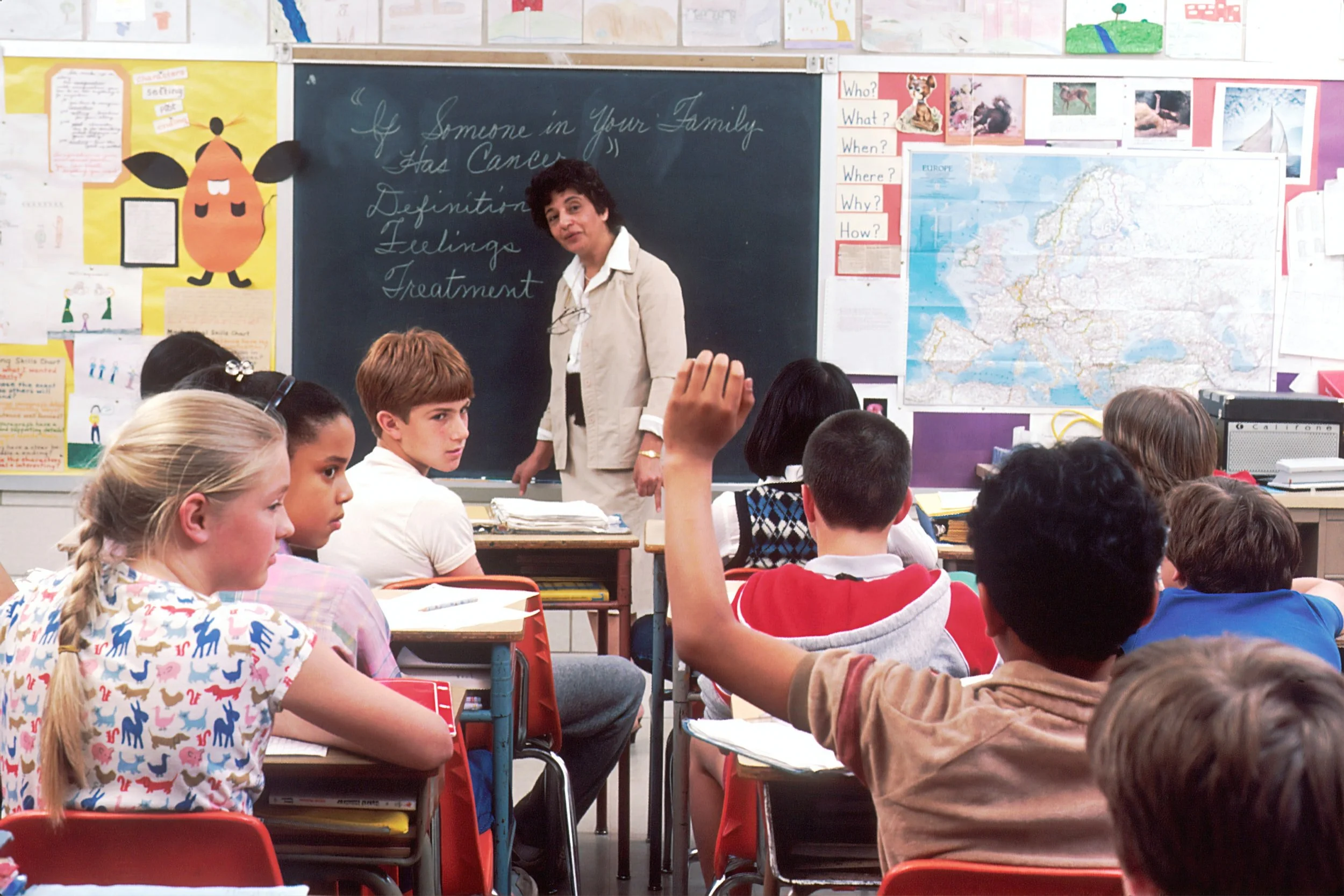
This week, Paris and I caught up on the new TV series Abbott Elementary. If you’re not watching that show, you may be the only one. The runaway hit has been compared to Modern Family and has grown almost as fast. I’ve laughed out loud while watching and teared up at times, too. It follows new and veteran teachers at an underfunded Philadelphia public school. I won’t give anything away, but one story arc involves a program for gifted students.
The efficacy and equity of these programs have been debated by education experts and scholars. I am neither an education expert nor a scholar, so I’ve got nothing to contribute to that debate. What I can contribute is my experience in these programs and how I related to Miss Teagues, the protagonist on Abbott, a former “gifted kid.”
They chuck these labels on you early. In kindergarten, my tall, lanky redheaded teacher, Miss Lacey, pulled my mom aside. She said that while my math scores left something to be desired, my verbal scores were high enough to suggest “gifted” classes. That put me into the first and second grade ABLE classes, the designated “gifted” classes at my elementary school. That acronym was the first in a series of several that would define my education.
I have no clue what we did differently than other first and second graders. I remember a girl peed her pants in first grade, leaving a warm puddle in the curve of the blue plastic chair. In second grade, a boy pooped himself, forcing him to waddle out of the classroom wearing a full pair of steaming sweatpants. Why was there so much defecation and urination in these classes? If we were the “gifted” kids, why couldn’t we find the bathrooms on time?
By third grade, the not-quite-ABLE-to-use-a-toilet kids were mixed in with everyone else. Instead, on Wednesdays, a bus would get us and take us to the QUEST Program. I have no idea if this was an acronym or not, but I wouldn’t put it past them. We rode around to other schools, picking up other gifted kids, and were dropped off at Rugel Elementary on the other side of town from me.
I looked it up, and my old school district still does all these programs, including QUEST. That one promises to train students “in critical thinking, problem-solving, and decision-making.” Let me tell you some fun things that happened on the bus to QUEST. A girl threw my New York Yankees hat out the window over a highway overpass. I have still never replaced it. I poked another girl in the eye using a bit from Three Stooges. We stomped our feet on the floor of the bus in unison until the bus shuddered to a stop. We were convinced beyond a shadow of a doubt that our foot stomping caused the bus to break down. In reality, it was probably just an old bus. We didn’t care the real cause. All we cared was that we got to miss class and joke around with each other while we sat at a stop sign waiting for backup.
Each year of QUEST, from third through sixth grade, was themed. One year, our theme was “decades” while another it was “mysteries” then “animals.” Killer themes, really. At the end of each year, we had a capstone project we were required to complete in line with the theme.
For the decades year, we had to come up with an invention. Mine was a Beatles trivia board game because I was obsessed with the Beatles at the time. For the mysteries year, my mom helped me carve a scale model of the Titanic from floral foam because I was obsessed with the movie Titanic and Leonardo DiCaprio. For the animals year, I didn’t even make anything. My mom had made a plush humpback whale for my sister’s science project years earlier. I dusted that baby off, took it in, and passed with flying colors.
Once we were in middle school, we no longer got bussed off to QUEST. Instead, they segregated the school’s “teams” into the gifted kids, who they called “The Trailblazers,” and the others. The Trailblazers were in the AT classes - the acronyms keep coming, buckle up. Not sure what AT stood for - maybe Advanced and Talented? As for the other teams, I can’t recall what they were called. It was probably something like the Yeah Y’all Are Heres.
It’s hard being labeled at all, but I imagine being labeled as “aiiiight” has got to do something to a kid’s psyche. Even if you don’t overtly label them “average” or “regular,” kids understand how the inverse of concepts work. If you point to one group and say, “They are gifted and talented,” the kids on the other side of the hand can finish the sentence for themselves. At least give them that much credit.
At the end of eighth grade, the middle school students were invited to apply for the Renaissance English classes in high school. This was also known as GT - gifted and talented. I did this, with the encouragement of my middle school teacher, Mrs. Shurtleff. Seemed like a lot of work. Didn’t want to do a project to apply. Didn’t want to get rejected. Was not stoked about a summer reading list of any length, much less one so long it required a cart to shop for.
But Mrs. Shurtleff had read my ironic short story about a woman getting repeatedly hit by a bus (a thinly veiled piece of Backstreet Boys fan fiction, by the way). She thought I had the chops to succeed and needed to be challenged. Also, she mentioned that those classes got to go on dope field trips like Washington D.C., Disney World, and New York. Making a collage folder and writing some essays didn’t seem like too much work when bad ass spring breaks were waiting on the other side.
Once in the class, I learned it was more than just English. We learned art, literature, culture, history, architecture, music, and all the things you need to be a well-rounded human (and not sound like a total yeehaw at a dinner party). It was transformative. We were treated like small adults, given deadlines and projects with leeway on completing them. As for the trips, they were not school funded. Our teacher, Mrs. Muhl, empowered each of us to self-fund our trip with plenty of fundraising opportunities throughout the year. Money - or lack thereof - didn’t stop us from going if we wanted. She would encourage us to be enterprising and to earn the money ourselves rather than relying on parents.
We also got permanent hall passes, which was one of the best benefits of the whole program. If you got to school early in the morning, the teachers on hall monitor duty would usher you into the cafeteria where you could eat or do your homework in near silence. Not if you were a GT student. Several of us had magical pink hall passes with no date on them. These let us move past the hall monitor and make a hard left down a hallway to Mrs. Muhl’s room rather than be herded into the cafeteria.
All this to say, being a “gifted” kid included with it a collection of amenities that went beyond an ordinary learning experience. Abbott Elementary explores this concept, the disparity in experiential learning, and all the benefits of being labeled “gifted” heaped on only those kids. The gifted kids in the show get a hands-on learning experience. A class full of – Ms. Teagues struggles to find the word - “…regular? non-gifted? re-gifted?” - students walk by and see all the fun their counterparts are having. They beg their teacher to give them the same experience.
Being on the other side of the fence, we noticed the disparity, too. We knew we were getting VIP treatment, but without the benefit of maturity and experience, we felt entitled to it. Now, with hindsight and distance, it’s clear how harmful that disparity was and is.
Yes, in the “real world” there are actual VIP sections - closer concert tickets, better airplane seats, faster entrance to nightclubs. But that’s all for grownups. Grownups know why they get those things - they paid more for better seats, accumulated airline loyalty miles, or know the doorman. When you’re a kid, it’s not easy to identify why some kids get the velvet ropes and trips to Disney World while you’ve got to stand outside and wait to be let in.
On the flip side, all those perks come with strings attached. Senior year, they handed out some packets to us. They just had numbers on them, no names. We were told to fill them out as best we could. They were to be anonymously evaluated by a team at the higher levels of administration. The goal? To filter out future leaders of our fine city for the “Leadership Program.” There were five of us selected from my school. The commitment wasn’t much. We drove over on something like the last Friday of each month and learned how not to act like trash.
Seriously. They trained us on how to wear suits and how to choose our “power color.” They trained us on fine dining, teaching us which forks went where and which glasses were for wine or water. My group spectacularly failed at fine dining day. One of us said, “There better be steak,” not knowing the program’s director was standing behind him. We all got a talking to for laughing at what was arguably a great joke. Turns out that’s considered “rude,” but it was hilarious. It was also prescient. There was no steak. That’s what was really rude.
I know there were other lessons - probably how not to pick your nose or scratch your balls in public - but clearly they didn’t stick. Don’t get me wrong. Again, the perk was nice. Even without steak, we still got a free training meal and a few hours out of class.
The double edge sword of this was the pressure of expectation. We were The Chosen Ones, like the little green alien in Toy Story. The claw got us, and we believed we were ascending to a better place. Weeeee.
Except… chosen for what?
For every echelon, there was always some place higher to go. Even being in this group wasn’t enough. Amongst the GT students, there was still a race to the top 10% of our class. Then that wasn’t enough. You had to be one of the top 10 people of our class. After that, it became a race to where we’re going next, what we were going to be. College applications and acceptances. Big plans and pipe dreams. Achieve, achieve, achieve. “What’s next?”
It wasn’t enough for me to get a bachelors in creative writing. My senior year of high school, I declared to no one in particular that I would be getting a Ph.D. in the subject. I said this not knowing that was the tits-on-the-bull of degrees for what I ultimately wanted to be – a writer. I said it because it was terminal. The highest achievement. The most I could do. Plans have, of course, changed, but there are days I get pangs. Stupid, I know, but it was drilled into my brain matter. Achieve more. Do more. Be better. Live up to your potential.
Rather than a Ph.D. In English, I got a different kind of doctorate (I guess??) For what? To help people, sure. To demystify the law for folks when and how I can, yes. But also because it was what came next, what I was supposed to do after undergrad. I’m a comedian and podcast host. My job is not J.D.-required, much less even J.D.-preferred. It helps some days when we’re breaking down constitutional law, but it’s not much help when we’re proving the existence of dragons (THEY WERE REAL! I WILL FIGHT YOU!)
Even with the success of the show, I can’t help but feel some days like it’s still not enough. There’s an itch to do more. To achieve that next thing. I was talking with my writer friend, Victoria, the other day, about the idea of societally imposed timelines. It’s an odd, melancholy feeling of looking at your peers - in whatever arena, be it professional, personal, or educational - and feeling out of step.
I took five years to graduate from undergrad and four for law school. The normal route is four and three years, respectively. I also took a year off after college to work at Navy Pier selling tickets and giving tours on boat rides. As I started law school, I noted via social media that a high school classmate of mine was just finishing their law degree. Same gifted cohort. Same graduating class. Same hometown. So far “ahead” of me as I was just starting. I was rattled.
Of course, I forged ahead and finished anyway, however “late” and on whoever’s timeline. I achieved what I did in my law practice and now joke with my former colleagues that I am “retired” from practicing. The other day I researched a magical creature for several hours while drinking coffee in my PJs with no bra on. Truly living the dream.
Christie and I say to each other every day how absolutely grateful we are to do the job we do. Saying that again and again is the only way for me to combat that weird voice in my head that still whispers, You are not enough. Get an MFA, it tells me. Get an LLM in entertainment law. Achieve more. Put more on up on the wall.
The trick is to drown it out with gratitude. To remind myself that I am, as we all are, exactly where we’re meant to be for the journey each of us are on. The only person I need to be better than is me yesterday, and even if I’m not, that’s fine, too.
As for my “regular” classmates from all those years ago? That label is bullshit. They’re all gifted in their own ways. They’re artists and musicians and engineers and teachers and comedians. They’re dancers and coaches and moms and dads and counselors and realtors and human beings.
I am creeping up on twenty years out of the hallowed halls of John Horn High School (in 2025 - I have some time!) I realize it is time to cast off the pressure that has accumulated over the decades. As transformative they were, it is pathetic to have held onto these labels for so long.
But also, it was pathetic to hold on to them back then, too. It was pathetic for any of us to ever think we were “better” than one another when, in reality, we were always just different. Some of us were experts at what a test could pick up. Some of us were experts at something you couldn’t even test for.
In an ideal world, all students would get to relish in those creative, satisfying, exciting ways to learn. They would all get those perks, the trips, the hands-on training. And if you didn’t get them when you were in school, don’t worry. The perks weren’t even that good anyway. I told you, we never even got any steak.
***
This piece first appeared in Sunday Morning Hot Tea. Subscribe so you don’t miss another piece.
Oh Baby
One summer morning, my mom rounded the corner of our hallway and found me, her youngest child, just ten-years-old on the toilet, in turn guzzling soda and grunting.
"What are we doing now?" she asked, looking from the two-liter bottle of Sprite on the counter to my legs dangling from the toilet.
"I thought if you ate or drank while on the toilet, it would immediately come out," I said, pants gathered around my ankles. I had taken several gulps from the bottle beside me, and no matter how I bore down, nothing came out but a few trickles.
She had found me in similar scenarios before. One time, when she found me sitting at our coffee table, covering my face in watercolor paints while wearing a floor-length vintage lace nightie with a Marvin the Martian T-shirt over it, she said nothing. Any time she walked into my room, she was likely to find me sitting on the end of my blue velour inflatable sofa having a full-on conversation with the air.
To clarify, I wasn't talking to myself. I was giving an interview to David Letterman and his studio audience.
Given my track record, there was nothing surprising about my Sprite/toilet experiment.
"That's not how that works, ding dong," she said walking away. She added over her shoulder, "Don't waste all the Sprite."
I was offended at her flippant dismissal. How dare she challenge my scientific inquiry? I didn't have a lot to go on. I went to public school in the conservative state of Texas, so anything below the waist was explained “because God.” And my parents weren't much help. They relied on the schools for the explanations. Meanwhile, I ended up with a series of electronic children over the course of my youth, none of whom possessed or explained realistic human bodily functions.
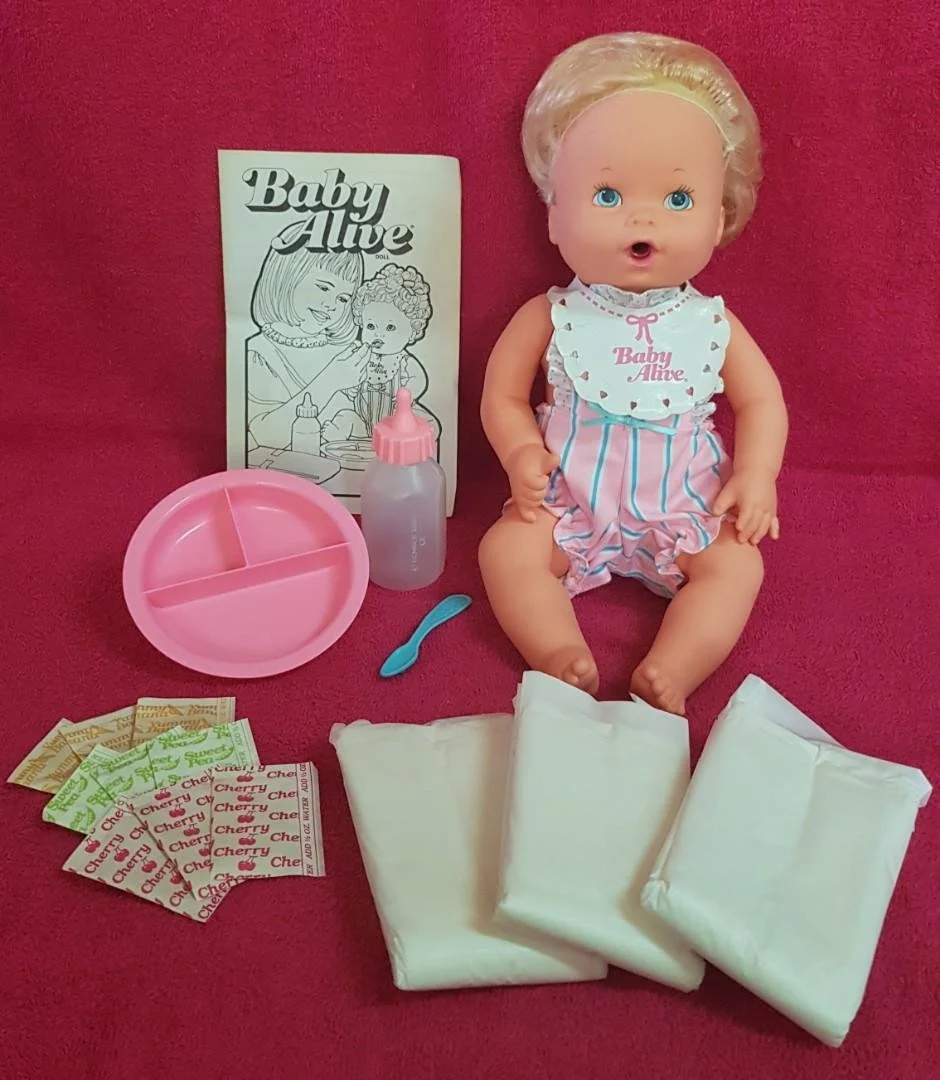
The first of these was a doll called "Baby Alive" I received a few years before the toilet test. Rather than a lifeless, plush Cabbage Patch doll, Baby Alive did just what real kids do – eat, drink, and soil themselves. The only thing this doll didn't do was grow up to resent me.
She came with a mechanical mouth, and a little bowl and spoon from which you fed it "food." The food was small packets of powder that, when mixed with water, formed pastes in such appetizing colors as beet red, grass green, and a putrid yellow that you would then force feed into the doll's gaping maw.
Baby Alive did not have a sophisticated digestive tract. I had to change the doll's wet diaper immediately after eating because Baby Alive, much like me in my 30s, almost instantaneously evacuated her bowels and bladder after every meal. The substance shot out of the quarter-sized hole in her bottom the same color as it had gone in. So after a delicious meal of red paste, Baby Alive produced a veritable crime scene in her pants.
When I ran out of food packets, mom informed me that we would no longer replenish the food supply. Doll food rations were expensive. The box warned against feeding the baby anything but the pre-approved packets, which was a pretty good racket for Hasbro.
From that day forward, my Baby Alive subsisted on water only, which made being a parent seem pretty cheap and easy. The commercial's catchy jingle had promised an experience "so real." However, reality would have necessarily involved government intervention when I fed my child only water, then eventually nothing. I ended up leaving her nude and abandoned in a plastic crib, exposed to the elements, batteries corroding, forgotten for years in a space beneath the treehouse in my parents' backyard.
Later, I would get a Nano Baby. This was an egg-sized electronic "game." It had a gray square screen on which a cartoon baby would appear, asking to be played with, fed, or changed. I should mention there was no off-switch, and without proper attention, Nano Baby would simply die. As it was only a toy, you could reanimate your dead Nano Baby by jamming a paperclip into its reset port in the back.
One trick to avoiding the death/regeneration cycle of my Nano Baby was to leave it in my mom's care. That meant that even when my sister and I were at school, she had not even one moment of peace, forced to feed, play with, and change a digital dependent during what was her only time alone during the day.
I received my third robot child for one week during my sophomore year of high school. Prior students in health classes at our school took home flour sacks covered in nylon pantyhose. Not my class. We got a fresh crop of Ready-or-Not Tots, infant size robots that used computer chips to track how we treated them. We had to soothe it when it cried, feed it, change it, and wake up with it during the night.
The Ready-or-Not Tot sat mostly upright, with a forlorn look on its face, arms outstretched. Its rubber expression said, "Love me or you'll get a C." The mold that the manufactures had used for the face made it appear as if, at some point, this creature was sentient but had now realized its horrible fate. Doomed to be stuffed into lockers, forgotten in backpacks, left crying in the trunk of a car — forever ignored by teenagers while they made out in dark parking lots.
A week after adopting our plastic children, we were to return them to Mrs. Gragg, the kind, soft-spoken child development teacher. She would then plug the child into its base, and the baby would give us a grade.
I received my Ready-or-Not Tot the same week I was taking driver's ed. While my mom sat for Ready-or-Not Tot, I attended class in a strip mall storefront, wedged between a Blockbuster Video store and a Cici's Pizza Buffet. Our teacher, who I'll call Pam, was a round woman with unnaturally bleached hair who barked at us like a drill sergeant. I'm not sure if it was the room or her or the Blockbuster next door, but the classroom always smelled like freshly popped popcorn.
Night after night, Pam began class by following the state sanctioned video-then-workbook format. Then, without fail, whenever we got to the discussion portion, she would veer off course.
Now, looking back as an adult, I understand Pam a little more. Allowing 15-year-olds on the road is, for the most part, a terrible idea. I've also come to understand that once you have experienced the wrenching grip of tragedy, it is hard to function without that tragedy then coloring everything else you do.
But we all have to soldier on and not let that tragedy pour out of us at every occasion. If we don't, we become that one person at the party, you know the one, who has to be handled with kid gloves lest we give them the opportunity to let the story slip out.
Pam was that person.
And her trigger for telling that story was driving.
Also cars.
Rules of the road.
The road itself.
Yellow lines.
Curbs.
Basically everything we covered in the class set her off.
If they gave awards for enduring human tragedy, Pam would win by a mile. Not only did she seem to suffer from some popcorn-related odor issue, she had lost nearly everyone close to her to one common foe: decapitation.
Her teaching method relied heavily on personal anecdotes. Every cautionary tale she shared with the class of apprehensive soon-to-be drivers ended in decapitation. I tried researching the statistical likelihood of being decapitated but could not find any reliable statistics. If we are going by Pam's numbers, the chances are about one in five.
Each lesson was introduced by a happy but stern woman on a tube TV that Pam wheeled in from the back room. After the video, we were given worksheets with blanks that corresponded to the video.
The proper following distance is ______ feet behind the car in front of you.
Pam would rush through the workbook answers, then launch into an anecdote about a family member, friend, or friend of her son. Each of lives had been cut short by that vicious and all too common beast: decapitation. The cause of death in each case was decapitation, and the cause of each instance of decapitation was a lack of attention to the Texas Department of Public Safety's guidelines.
"My son knew a boy whose name was Kevin," she began one day when the subject was tailgating. "He drove a beautiful black Camaro. He followed a semi-truck too closely, much closer than the 150 feet suggested by the Texas DPS. When the semi stopped, Kevin's car went right underneath. Kevin was decapitated," she said.
The class stared at her. No one spoke.
"So," she concluded. "Don't follow too close."
In reality, a far more likely result of following too close is a rear end collision. Everybody's heads remain attached to their respective bodies and, at most, you will probably be sued by the other driver. It may require everyone to go to court, testify, and be forced to take a day off work. Your insurance premiums will probably go up. A real pain in the ass, and I suppose, only slightly less painful than decapitation.
During the chapter about stopping to render aid, Pam shared another story.
"My husband and I were driving home when we saw an SUV on the side of the road in a ditch. As we approached, we noticed it was the McNally's car. They were a family from our church. As I opened the door to look inside, I found the whole family. Everyone in the backseat had been decapitated."
Everyone? I thought. In the backseat?
I had so many questions but said nothing. It wasn't my place to question her. I couldn't even drive a car, not legally at least. And she had sat front row to the worst driving had to offer. Maybe she really did see decapitated bodies in the back of that SUV. Maybe she stumbled upon some crime scene, the work of some lucky serial killer who had found himself the perfect hiding place: right in Pam's sight where it could be brushed off as, not a crime, but the result of yet another case of reckless disregard for the rules of the road.
After five solid evenings spent in that strip mall store front, the classroom portion was over. Another student and I were then scheduled to spend a few hours with Popcorn Pam behind the wheel getting on-the-road experience.
When we arrived at the school that Saturday, we were surprised to find that Pam was absent. Trevor, a 20-something substitute instructor was there instead. He took us cruising around our hometown in the driving school's tan Saturn sedan. We went through the motions, making the requisite turns and doing our assigned parking jobs. The other student was behind the wheel when Trevor asked our opinion of the classroom portion.
"That lady, Pam, is a nut," I said.
There was a long pause.
“Oh really?” Trevor asked.
“Yeah, she always smells like popcorn and every story ends in decapitation,” I said.
"Well she's my mom, so..." Trevor said, trailing off. The student driving sucked in air, and I slumped in the backseat, ashamed.
Aside from some awkwardly mumbled instructions, we were all silent for the remainder of the lesson. I felt so guilty for insulting his mom, but how was I supposed to know he was her son? His head was still attached to his body.
I burned with shame. This woman had opened herself up, shared tragic stories with us, and my inclination was to mock her. I imagined someone mocking my mom and felt myself get angry. I looked at Trevor as he remained quiet. If someone were to come after my mother, I wouldn't be so passive.
Despite my blunder, Trevor gave me a passing grade on the driving portion. That, coupled with the five evenings of lectures on all the possible beheading scenarios that accompany driving, got me my license.
During this time, my mom cared dutifully for her plastic grandchild. At the end of the week, when Mrs. Gragg plugged Ready or Not Tot into its base, the report revealed my mom had done an A+ job. The machine indicated that the baby was never neglected or ignored. Mrs. Gragg announced that my baby had been cared for perfectly, proving that my mom was indeed ready and capable of raising a child.
None of my three pretend-children made me want kids. All three were unfeeling nuisances I saddled my mom to care for. Maybe that's the real lesson – not in my interaction with the fake babies, but in my mom's interaction with me.
The real test for when I'm ready to have kids will be when I'm ready to love a creature as she loves me: patient and kind, caring but realistic, ceaselessly supportive. Either that, or I should just hurry up and have one now while she's still around to lend a hand and help keep me from needing to press the reset button.
***
This piece also appeared in Sunday Morning Hot Tea. Subscribe so you don’t miss another piece.