
Hook, Line, and Sucker
Bouncing balls. Jumping children. Painted faces. Squeals. Screams. Laughter.
Last weekend, Paris and I found ourselves the only childless couple at a four-year-old’s birthday party in a mini gymnasium. Kids flew around the foam-covered floors and walls, flipping and jumping, and sometimes landing upright.
One particularly runty kid, the younger sibling of a party attendee, flipped off the trampoline and onto the floor. Her mom was elsewhere, mingling with other grownups. Paris and I were the closest adults in range. She locked eyes with me and began to cry. We stood, staring back at her. It’s a particularly sticky situation being a random adult at a kid’s birthday party. On the one hand, you’re an extra chaperone. On the other, you shouldn’t go around snatching up kids that don’t belong to you.
The kid's mom’s MomRadar™ kicked in, and she ran over to scoop the girl off the ground in seconds flat. But still, in that moment when she looked at us, she believed that because we were taller, we had the answers. She believed we could help, that we must know how the world works.
Sorry, little kid. That just ain't true.
Being a kid involves a ton of inherent trust. It’s an innocent viewpoint, one that I held dear throughout my earliest years. That belief was completely shattered one summer day in 1992: the day I realized adults have no idea what they're doing, even if they tell you otherwise.
I am the youngest grandchild in my family by five years and five months. As such, my role has often been that of gullible guinea pig. Early on, my mom trained me to follow her without question by calling things “adventures” rather than “chores” or “errands.” She would ask if I “wanted to go on adventure.” These adventures could mean throwing phone books with her best friend, Lillian. It could mean going to a movie set with Lillian’s husband, Dan. Just as likely, it could mean going to the grocery store or taking cans to the recycling plant.
It could also mean going to the dentist and having five teeth removed.
This scam worked every time. A gambler by nature, I risked the dentist “adventures” and endured the grocery store “adventures” to get to the movie set adventures. If adventure was on the menu, I would always order it.
This fateful day in the late fall, my mom asked me if I’d like to go on an adventure to my Aunt Bari’s house. I said yes. I had hope. Bari’s house was where we spent all our Christmas Eves throughout the years. An adventure to her place was bound to involve a gift or at least some fun. I was wrong.
Honestly, I should have known. Just a few months before, I had heard my mom, my Aunt Bari, and her sister, my Aunt Vicki, all circled around my sister, Shannon, in our dining room. Shannon was crying. My mom was comforting her. Aunt Vicki, who we were told had “beautician training,” was applying some goop from a container to my weeping sister’s head as the three of them told her, “You must suffer to be beautiful.”
This oft-repeated phrase was how they got Shannon to endure hours with noxious perm chemicals singing her scalp, its fumes permeating the walls and upholstery. The result of her suffering was not beauty. Instead, Shannon ended up sporting a blond Jheri curl when the process was done. The combined result of their laughter, the reckless abandon, the results of their attempt started the erosion of my trust in adults.
Maybe, just maybe, I thought, they don’t really know what the hell they’re doing.
Still, it was my mom. They were my aunts. They were grown. They drove us around. They fed us. They gave us a place to live. They kept us safe from strangers. Being vested with that much responsibility, I relaxed back into the notion that they had to know what they were doing. They had to.
As I eyeballed the situation that day at Bari’s house, I was relieved that there were no chemicals around. They had stacked three phone books on a wooden dining chair and asked me to climb on up. Suspicious at the three of them together, especially after the number they had done on Shannon, I hesitated.
At the first sight of uncertainty, they started convincing me: “Come on,” they said. “It’ll be fun. It’s an adventure!”
I settled up onto the phone books and turned to face the fireplace. I noticed how the mantle looked emptier without the family’s Christmas stockings. Christmas would be here before we knew it. I started making a list in my head of all the things I would ask Santa to bring me that year.
I was wretched from my thoughts by Aunt Vicki pulling a comb through my hair, yanking my head back every few strokes.
It was shocking, but I was ready for this. It wasn’t long before that day when we had been visiting family in Tennessee. A strong-handed cousin had gone wild on my head with a fine-toothed comb. She had tried yanking my hair into a thick braid on our cross-country visit.
“One day, I’m gonna be a hairdresser,” she assured me, as if her future plans somehow qualified her to perform the current task. Like telling someone, “Lie back, I’m going to be a doctor some day,” as you make the first cut of the at-home tracheotomy.
My Tennessee cousin’s amateur cosmetology had prepared me for that day, I thought. It was a tough comb job, but I was tougher.
Then I saw Bari affixing an attachment to her vacuum cleaner. My mom held an instructional booklet in her hand, flipping through the pages and reading out loud.
“Affix the hose – yeah, yeah, yeah. Be sure to attach the safety – blah, blah, blah.”
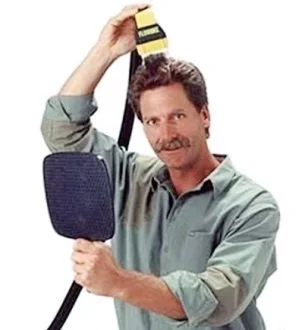
She flipped the booklet shut and tossed it on the dining table without finishing. Bari snapped the attachment into place. The box on the ground read in large block letters - FLOWBEE.
I cannot fault Bari for purchasing this contraption. The advertisement featured, as most infomercials do, smiling people using the product. These actors made using the Flowbee look effortless, even fun.
In retrospect, the infomercial footage is iconic. A middle-aged man with feathered hair drags the machine over the crest of his skull, sucking chestnut hairs conveniently into the vacuum bag below. A small boy, even younger than I was, smiles as a disembodied hand runs the business end of the vacuum across his scalp with ease.
One guy who looks like an off-duty soccer coach stands cutting the hair of someone I have to assume is also on the coaching staff. In another scene, a man suctions the hair off a woman while a third guy watches. The woman on the receiving end of the hose monitors the Flowbee’s efficacy with a hand mirror, her eyes narrowed.
Hey, this footage tells the audience, Even extremely discerning women let their friends cut their hair with a vacuum cleaner hose.
A professional hand model in pleated slacks and a pastel button-down tucked neatly into his pants demonstrates all the parts, showing off how simple it all is to assemble, use, then disassemble.
The voiceover really sells it: “Tens of thousands of satisfied customers! Save time and money! Have fun!”
The Flowbee, like almost every other product ever marketed to the masses, promised to fulfill your dreams, solve your problems, and answer your prayers.
“Who has time to get a haircut?!” the announcer asks. “Don’t you hate spending time sweeping up all that hair?”
No one bothered to ask why you wouldn’t just use the vacuum to suck up the hair from the floor, rather than sucking hairs still attached to your head into a relentless machine.
Trusting the grownups around her, little Heather sat on the phone books, a vulnerable target for the waiting Flowbee. My mom had disregarded the instructions. Bari had eyeballed the assembly. Vicki had been eager to grip the hose. Though I started to question the whole idea, I had no chance of escape. We had driven all the way to Bari’s house, and it wasn’t even Christmas. No chance we were leaving without completing the adventure.
Though the written instructions had been tossed aside, the Flowbee came with an instructional video on VHS tape. We popped it in the VCR and watched it play. Two hosts came on screen. For some reason, they kept trying to sell the Flowbee rather than explain how to use it. My dudes, we already plunked down the money. Just give us the instructions. But, nope, Gary and his sidekick continued to extoll the Flowbee’s virtues.
“A lot of kids like trendier haircuts,” Gary’s partner said. “With kids these days, we are talking about any kind of haircut imaginable.”
Gary agreed, “That’s one of the great things about the Flowbee. You can create. You can experiment.”
Great, just what I wanted to be. An experiment.
Then, finally, instructions, though scant: “Bounce it up and down. Make sure you bounce it up and down.” Everyone in the instructional video gave the same imperative: Bounce. It. Up. And. Down.
The video rolled to a close. My mom and two aunts descended on me. Bari fired up the vacuum. Vicki grabbed the hose and held it over my head.
“Just start at the back,” my mom told her. Vicki pressed the Flowbee down toward my scalp. In direct disregard of Gary’s imperative, she did not bounce it up and down.
Neither the Flowbee nor I was prepared for what happened next.
As an adult, I have been told by haircare professionals that I have densely placed follicles. My hair is like a forest you cannot walk through without first thrashing a machete out in front of you. Using the Flowbee on my hair was like trying to drive a school bus through that dense forest. Everything gets ruined, and all you hear is the sound of children screaming.
The vacuum’s engine whirred on, but the Flowbee’s “state of the art” blades ground to a halt. The searing pain was worse than anything my inept cousin from Tennessee could have ever done. I'm not sure if it was the lack of bouncing up and down or my hair or a combination of the two, but there was no way I was walking out with any of the trendy haircuts Gary had mentioned.
My hair and the Flowbee were at an impasse. It wasn’t until Bari unplugged the vacuum that I could hear their laughter over my screams. They snipped my hair free and caught their breath. I was traumatized and sobbing, but they could not help themselves. The infomercial, the instructional booklet, the VHS tape, Gary – nothing prepared any of us for this.
When you start out as a kid, you think that grown ups have all the answers. They know what to do, know how stuff works, know how to run the show. The day comes for us all when we learn that is not true. Not at all. When you actually are a grown up, you realize you don’t know what to do. You can just do your best to appear authoritative. You master pretending to know all that stuff so the kids around you don’t freak out and you don't either.
Once you’ve pretended long enough, the grift has worked on you as well the kids around you. You become fully convinced of your authority. That’s when you pull out your credit card. That’s when you pay your four easy payments. That’s when you drive your youngest child to another town to be a test subject. That’s when you throw caution to the wind, fire up the vacuum, and let nature take its course.
***
This piece first appeared in Sunday Morning Hot Tea. Subscribe so you don’t miss another piece.
Journey Back to the Times
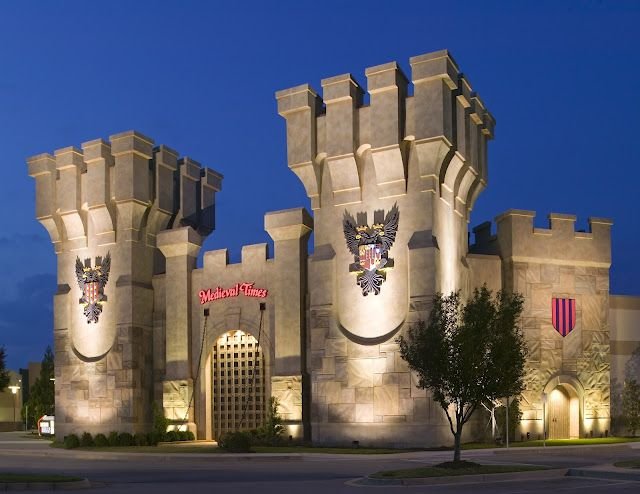
It was the first weekend in December 2021, and for the second time in a calendar year, Paris and I were walking through the parking lot of Medieval Times on our way to a matinee show.
“We were just here,” I said, but he reminded me it had been months earlier. But was “months earlier” in Medieval Times time actually that long ago?
“You think there are people who come here a lot?” I asked. “Like frequent flyers?”
“I’m sure,” he said. “The staff probably recognizes them.”
“I bet you can’t miss them,” I said. “You’d notice repeat offenders. This place is more of a once-a-year kind of deal.”
“Unless you’re us,” he said.
Medieval Times: Dinner and Tournament isn’t normally the type of place you’d go to more than once, at least not this close together. It’s a place for birthdays, field trips, company outings, and, yes, anniversaries.
We came in July for our friend’s 35th birthday. The vibe of our group that day fell somewhere between nostalgic and snarky. We came to enjoy the camp, though a bit ironically, and to revel in the nostalgia.
This second trip, my attitude had veered beyond nostalgia and fell directly into snarky disdain. I was not there to get into the show. I was there neither to hoot nor holler. Looking around that clear Sunday afternoon in December as we walked past the putrid green pond stocked full of listless orange fish, flanked on all sides by happy families snapping selfies with the castle, I realized we were in the minority. By a lot. They were all there to hoot, to holler, and to journey back to a simpler era where forks didn’t exist (except they did…)
My mom had requested the trip so she could share the experience with her only grandchild, my four-year-old niece, Sydney. Mom was firmly in the nostalgia camp, though in our family, it is impossible to experience anything without at least a pinch of snark involved.
Back in the mid-1990s when we first traveled to the castle on the interstate, our intentions were pure — much like the crowds we found ourselves surrounded by this day. Back then, we bought the schtick whole hog. We wore our crowns and scarfed our chicken by hand without comments, paying no mind to the others in the crowds around us.
Now, navigating a crowded lobby on a Sunday afternoon in our thirties, forties, and sixties, respectively, the people around us were almost all we noticed. Though there was a posted mask mandate, nobody around us wore masks.
“There’s nothing more on brand than spreading a plague,” I told Paris.
We waited for the show to begin beside an armory, a glass and wood countertop lined with red velvet where a wench was selling swords.
“Who buys a sword or full suit of armor?” my mom asked. “How do you get it home?”
“Did you see the guy in the Stetson with the crown on top of his cowboy hat?” my brother-in-law, Aaron, asked.
“Dedication,” I said.
“Shhhh,” Sydney said, commanding us to pay attention as the announcer took his spot on the balcony.
She was staring up at a man in black velvet robes accented with gold piping. He stood poised against the railing, ready to address the crowd below him. His red hair parted down the middle did little to hide the headset microphone through which he spoke. His British-ish accent boomed across the crowd and drew our attention.
“Lords and Ladies,” he began then asked if we were ready for the dinner AND tournament. The crowd gave a half-hearted “woo.” He doubled down.
“Are you ready?” he boomed, pausing for effect between each word. The crowd stood at attention and gave him a more satisfactory “woo.”
“Before we begin, I have a few announcements,” he said then began the near-impossible task of directing a crowd, in a British accent, while making sense, and also maintaining character.
The need for crowd control stemmed from our assigned seats. Customers are supposed to sit in sections separated by color. The announcer clarified that there was a red section, a yellow section, and a red AND yellow section, but that we shouldn’t confuse the three. Just like with the fork thing, I guess they only had five colors back then so they had to mix and match. We followed the arrows and signs around the arena to our place in the solid red section.
With the lights up, we could take stock of who else filled the seats that day. The Venn diagram of the type of folks that come to Medieval Times is a solid circle with those who slurp signature cocktails from the souvenir cups at a Margaritaville on vacation. Nearly every table I glanced at, it was easy to mentally replace whatever they were wearing with T-shirts that read HARD ROCK CAFE - BRANSON, MISSOURI.
Row after row was filled with rhinestone-encrusted jeans and leather cowboy boots. I even saw one man in a pair of dirty jean overalls who was a piece of straw in his mouth away from being a living cartoon character.
Don’t these people have horses at home? I thought.
Soon, fog filled the arena and our red-headed announcer was back. He galloped to the center of the sandy floor on his horse and explained that we would see a tournament the purpose of which was to find a champion to become protector of the realm. The queen emerged and addressed the crowd, flanked on one side by a “councilor” called Cedric, who we joked was a total simp for her.
One by one, the knights rode out on their mighty steeds. And one by one my family had comments to make. The black and white knight was deemed to look “Beetlejuice as hell.” The yellow knight looked like a soccer dad. The blue knight, with his slick ponytail, had clearly been born for this. Our red knight, my brother-in-law noticed, looked like the gigolo from the film Deuce Bigalow.
With the announcement of each knight, the audience members waved their souvenir flags and screamed for their guy. What happened down in that sand pit really seemed to matter to these people. The ponytailed stranger on a horse was not just a person but became their person, just by virtue of the color of his cloaks.
The queen, Doña Maria Isabella, was an elegant woman in her early thirties, with long, dark curls. She addressed the crowd using an English accent that sounded like it made a pit stop in Prohibition New York on its way to the castle that day. I looked at the signs above each section. The names were all of areas in Spain, not England (or the five boroughs either). None of it added up.
I snarked on the actors’ accents to Paris and commented on their stiff-sounding script and corny jokes, which hadn’t changed since July. I got pretty good at doing an impression of the queen. Soon, our serf came to bring us ye olde Pepsi and piña coladas.
“The classic drink of the era,” I said, lifting the souvenir plastic cup to my lips.
I couldn’t help but roll my eyes at the pageantry and drama that began the show. Early on, during some of the horse dancing, I got up to use the restroom. When I got back in the arena and began heading down toward my seat, I heard a warning from the announcer, “Do not distract her and please stay in your seats.”
I looked down toward the sand pit and saw a woman with a falcon on her arm. She swung a treat up in the air, and the bird took flight.
“I repeat - remain seated for your own safety,” the announcer said. “This is a bird of prey.”
I had to decide whether I wanted to run down toward my seat and risk a falcon to the head, or stand where I was and risk a falcon to the head.
I hurried down the stairs, at once afraid of the bird and also aware of my movement in opposition to the clear instruction we’d all just been given. I caught eyes with Cedric the queen’s simp. I saw through his accent and corny jokes and felt the pity of a man who dresses in velvet robes for a living.
The hell are you doing? his eyes seemed to say.
I gave a small shrug and ducked down as I made it back to my seat in time for the bird to return to its trainer’s arm.
I leaned forward to look past my sister and fixed my eyes on my niece. She was sitting on the edge of her seat, her chin propped on the table, eyes glued to the bird.
Once the tournament began, she was even more entranced. The spotlights turned down low, the strobe lights in full force, she shoved rotisserie chicken into her mouth and barely blinked as the men jousted, tussled, and jumped from their galloping horses. With each event, I watched her cheer and gasp and laugh.
Watching her watch the show, I got wrapped up in it, too. I cheered and booed and waved my flag. With each passing event, it became very important to me that the red knight win.
Come on, Gigolo, I thought to myself as he sped head long into another knight. Win it for us.
Safe in the dark of the arena, I knew no one could see me cheering. No one could judge. In that moment, the arena thick with artificial fog and scored by a booming soundtrack, we were all united in a singular purpose. It was printed right there on the paper napkins: dinner AND tournament.
After the jousting, the knights engaged in hand-to-hand combat. At one point, the action stopped, and the announcer asked the crowd whether the knights should fight to the death. The crowd roared, but the queen stopped us. She spoke of honor, of valor, of bravery. She told us only she could determine whether knights could fight to the death. And then she told them to go for it. We all screamed.
Our own red knight faced off against Beetlejuice - the black and white knight. As they exchanged blows, I called out.
“Go for the throat!”
“Don’t say that,” Sydney told me, worried for both men’s safety.
Nonetheless, our knight heeded my advice. He went for the throat and emerged victorious. Our section went wild.
After the show, I waited in a mile-long line for the ladies room. A woman behind me couldn’t stop talking about the show. She was in her mid-sixties. Her voice was husky, and her thick accent placed her home somewhere far outside the city limits.
“Don’t matter who the winner was,” she said. “There wasn’t nobody better than the green knight. I bet he’ll be walking on air for days.” She was speaking to her mother, an even more shrunken woman in her eighties.
“What a job,” the mother said.
“Going to work for an ego boost,” the husky voiced woman said with a laugh. “Can you imagine?” Then she said it again, “Yep, don’t matter who they said won. The green knight - he was the best.”
She was wrong though. It did matter who they said won. That’s the point of a tournament. There was someone better than the green knight. It was the red knight. Our knight. The one who won.
I secured my red paper crown on my head and patted the red flag sticking out of my purse. I navigated past her on the way to the sink.
“Excuse me,” I said. Then finished the sentence silently, Winner coming through.
***
This piece first appeared in Sunday Morning Hot Tea. Subscribe so you don’t miss another piece.

That's Fair
The third Saturday in October, I woke up to a text from my sister, Shannon. She let me know that she and her husband, Aaron, were headed to the State Fair of Texas with my four-and-a-half-year-old niece. I screamed to Paris, who was in the shower, that as soon as he was out, we were headed to the Fair. It was closing weekend, and the weather was perfect – a cool 75 degrees, no clouds in the sky. It’s what we called “Fair weather” growing up. Not meaning “fair” as in temperate; we meant capital-F “Fair” as in, the type of weather perfect for going to the Fair.
We went to the Fair every single year when I was a kid. We had a route we’d always walk, always parking in the same lot, exchanging our coupons for foods at the same stands. It marked the beginning of the fall season for us, and for me, meant that my birthday was around the corner.
It also meant we got two days off school and a free ticket to the fair. Every year I’ve been in town, I’ve gone back to the Fair. In 2019, the first year Paris and I were dating, I went with my family but not with him. As a non-native Texan, Paris doesn’t quite have the same attachment to the Fair as me. It makes sense, really. When you try to explain the Fair to someone not from here, you sound absurd.
“There is a giant cowboy named Big Tex who used to be a Santa, then he burned down, but now he’s back. He wears jeans with a twenty-foot inseam. There are buildings filled with cars, and you can just, like, sit in them. Then in another building, people will try to holler at you until you buy stuff. Like live action infomercials. Also, there’s a place with glass cases full of people’s art projects. Yeah, like homemade quilts and dolls and puppets. The rides are great. The best part? They’re the exact same ride machines that were there when I went as a child. I am 35 years old, why do you ask?”
In 2020, the Fair offered a COVID-safe drive-through experience, but I had no interest. I didn’t want to see the shuttered buildings and closed food tents. So, earlier this year, when a Facebook targeted ad offered me seasons passes, I snatched them up. I went on opening day with my cousin, Ami, a Fair aficionado.
With the gates reopened, I decided to shake up my usual McKinney Family Fair To Do List. Instead, I let Ami lead the way and let myself spend coupons on things I never had before. I tried a caramel apple covered in nuts. I had to keep my tradition of Texas-shaped nachos from the Hass family booth. To change it up, instead of a small boat of chips and plain cheese, I went with Nachos Grande, an order that came on a plate and was covered in salsa, sour cream, guacamole, and finished with a little Texas flag set onto a toothpick.
On my second visit this year, I went with my dear friends Gypsy and James. Gypsy was born and raised in Mesquite like me, so she also has a deep love for all things Big Tex. We happened to go the weekend before I had a combination colonoscopy/endoscopy. On the hunt for whether celiac disease was causing my severe stomach illness that had only gotten worse since July, my doctor told me to have some gluten on Sunday.
“Just don’t go crazy,” he said.
Sorry, doc. I had Deep Fried Chicken Fettuccine Alfredo, which tasted exactly as it was described. A ball of fettuccine noodles and chicken, slathered with Alfredo sauce and fried into a ball. It was disgusting and amazing all at the same time. I also followed Gypsy and James to their favorite funnel cake stand where I ordered a red velvet funnel cake.
This was my idea of “not going overboard.” The gluten worked. I got my diagnoses (non-celiac gluten intolerance and some other stuff). I was only sick for about 48 hours since the pre-treatment for the colonoscopy flushed out everything I’ve ever eaten. The funnel cake was worth it, even though I got covered in so much powdered sugar I looked I sneezed while doing cocaine.
(Honestly, I’ve never done cocaine. I don’t know if it’s the same consistency as powdered sugar. I’m basing this totally on what I’ve seen in movies.)
Another day, I went with my high school pals. Sean was in town from Austin, and we met Jeff, Emily, and their baby, Canyon, for a day of fair fun. We ventured toward the beer garden area where I sampled the Fair’s version of frozen daiquiri for the first time. Not bad. Just as you would expect, like a Slurpee with some wine in it.
We also headed down the Midway where they took Canyon on the carousel. He squealed and cried, and honestly, I’m not sure what else he did. That thing spun so fast, it seemed like it could whiff off its axis at any moment. I didn’t see the ride operator’s panel, but I am sure the speed was cranked up to eleven. Just watching it was enough to make me dizzy.
The Fair only runs from the end of August through mid-October. When Shannon texted me that weekend, I was eager to go one last time before it shut down for the year. Paris and I met her, Aaron, and Sydney at around 11am on a bright and sunny Saturday morning. There were folks milling about the main area around Big Tex, and Paris and I navigated the crowds to find my family.
People watching at the Fair is one of the best parts. Walking through the hoards, we passed a man in a black t-shirt, printed with neon green letters asking the age-old question: “Do I Look like I give a fuck?” Paris and I read the shirt at the same time.
“We can’t know from the back of his head,” Paris said. We walked faster to pass him and saw the shirt was printed with the same question on the breast pocket.
“He does not look like he does,” I said.
We found them though the mess of folks, and started off for some food and rides. After getting her face painted, Sydney was most excited about the funhouses. At the State Fair, the funhouses are portable metal structures, between one and two stories tall, with various lights, mirrors, obstacles, and optical illusions throughout. They’re also machines of death and destruction.
When I was about ten years old, my dad and I went through one of these funhouses. The entrance contained a set of mechanical stairs that slid back and forth. Walking up these steps, my left foot was swallowed whole. The cerulean canvas shoe I had been wearing was torn to pieces, leaving my foot bare and smashed between unceasing pieces of moving wood.
I screamed to the point that Fair medics showed up and carted me off to the first aid tent in a golf cart. They ended up duct taping my shoe back on my foot, and my family continued our Fair visit. We couldn’t waste a good Fair day just because a foot was crushed, could we?
The first one she chose was not my nemesis funhouse. It was a whimsical structure and cost seven coupons to enter. That should have tipped us off as to its complexity and intensity. Though she passed the height requirement to get in, she was the littlest person in there by several feet. No matter, she walked the same steps as the teenage boys in front of us without hesitation.
We slid down the final slide together, and she marched in a straight line to her parents, asking to go through another one right away. The next two we tried only cost five coupons, followed shortly by one that only cost four. It seemed we had leapt off the seven-coupon cliff and would be chasing that high until the Fair next year.
As we rounded a corner that final day of the Fair this year, I came upon it. The funhouse that ate my foot. Shannon and I exchanged glances and told the story to Aaron and Paris. I looked at the admission: five coupons. I felt ashamed that I had been bested by a five-coupon funhouse all those years ago. Sydney was determined to conquer them all, so we turned our coupons over to the grizzled man at the entrance and headed toward the stairs. I silently swore an oath to shove my foot back into the stairs if I needed to in order to protect her.
My dramatic plans were unnecessary. She hopped up and over them with no issue. Same with the spinning barrel. She just ran right through. We made it across a bridge and over some unstable platforms that spun beneath us. Halfway through the very funhouse that had chewed on my limb all those years ago, she looked up at me and said, “They’ve got to make these harder for me.”
Sure, kid. Great idea. The last time I set foot in here, I was actually devoured by the machinery, but yes, let’s crank up the thrills, limbs be damned. I’m proud of her every single day, but I was overwhelmed in that moment. So little and already so brave. Turns out the best way to beat something like that is just not to flinch.
We ventured back through the Midway where Aaron and I decided to ride The Magnum. Listen, I know out of context saying I decided to “ride The Magnum” with my brother-in-law sounds very backwoods, but let me tell you – it is very backwoods. It’s just not sexual
The Magnum is a long-time State Fair staple. In operation for at least 30 years, this metal machine whips riders around in small circles, strapped into carts that extend from a four-armed piece that itself also whips around in circles. Then the carts aren’t even secured in place. They rock back and forth on a center axis.
It’s hard to explain, but I imagine it’s like a homemade version of what they used to prepare astronauts for G-force in space.
We both walked onto the ride with full knowledge of what could happen to us. We weren’t fraudulently induced. Not only is the ride operating in the open in broad daylight, we’ve both seen it there for decades. It’s the same hunk of metal that has occupied space on the Midway since the Reagan administration, beckoning riders to hop on board with the enticing imagine of an airbrushed Tom Selleck.
We handed over our fourteen coupons each – if you’re playing at home, 1 coupon = $1 – and walked onto the metal platform toward our waiting coffin. We took our seats and clicked the shoulder bars into place.
“You know you don’t realize how rusted everything is until you’re strapped down,” I said.
We both noted the bolts, the very ones that kept our cart attached to the rest of the ride, and how rusted and crumbling they were.
“Nice knowing you,” I said.
“Why did we do this?” Aaron asked. We both looked at my sister, ever the good decision maker, staring back at us from solid ground. She waved.
The machine revved up. They played some song like “Highway to Hell” as we began to spin. Then we spun some more. Then we flipped. We would get stuck halfway through a flip, suspended in the air, parallel with the ground, before we whipped back the other way.
I think I handled it pretty well, screaming, “This is how we die” multiple times in a row.
For the record, we didn’t die. It was only about a 2-minute ride. Not even a full song, but it felt like plenty. We got our fourteen-coupons’ worth. And we both managed to walk away without losing consciousness or the food we had just ingested.
“Did y’all have fun?” Shannon asked.
“Too much,” I said.
It was getting late in the day, and the Fair started getting crowded. They headed for their car while I told Paris I wanted to ride one last ride.
It was a ride we would beg to go on as kids, and sometimes we did. But as we grew up, we adopted a new Fair route. See, the Fair has something like eleven different entrances. Depending on how you get there and where you park, your route through the place will change. A long time ago, we began favoring a parking lot near an eastern entrance, which meant we hit certain booths and food stands in a certain order, following a well-trodden path.
Now, with the Fair reopened, knowing how much there was I missed out on when it was closed for the pandemic, I wanted to branch out. As a creature of habit, this is hard. I can’t always bring myself to deviate from my rituals. I like what I like.
I am, on the other hand, marrying Paris Brown – the king of Let’s Just See Where This Path Takes Us and emperor of Let’s Try This New Thing. It’s both exhausting and thrilling.
So, in the spirit of going where the path leads, I asked to ride the haunted house ride, the same one that had been around since my childhood. The last time I had ridden it was probably 20 years ago. Paris, ever eager for an adventure, jumped in the fiber glass cart with me. We squeezed beside each other and filled the entire space.
“Tight fit,” he said.
“Fun fact – these are the same carts they have used for the past thirty years,” I said.
“What?”
The cart began to move.
First, we slammed through a set of swinging doors, wood dented and paint chipped from years of use. The walls at various points were covered in aluminum foil, glow-in-the-dark paint, and mirrors. We rode through artificial fog past a skeleton with its pants down. Paris asked if it had also been there when I was a kid.
“That’s a new addition,” I said. No funds for new carts, but sure, add a pervert skeleton.
After bends, curves, and a short drop that took us outside past the waiting line, we rolled out the exit doors. We disembarked and another couple scrambled on as our cart slammed into the one in front of it.
Headed back toward our car, we passed the official Midway Barker of the State Fair. He’s a talking optical illusion – human torso and head (a real guy) from the chest up suspended on a long brass pole. It gives the illusion that he’s missing everything from his ribs down, which he takes as an opportunity to gather a crowd and sing parody versions of popular songs, replacing the lyrics with references to his pole or lack of body. It
I glanced at the Barker and kept walking. Paris stopped, awestruck, and listened to a few of the jokes. He caught up to me and took me by the hand.
“How did you walk by that so nonchalantly?” he asked.
“Walk by what?” I asked. “The Barker? That’s just the Fair, babe.”
***
This piece first appeared in Sunday Morning Hot Tea. Subscribe so you don’t miss another piece.
All the Things I Forgot About Traveling
We just wrapped up our seven-city, eight-show tour performing Sinisterhood live for fans and friends across five states. If you made it to a show, thank you so much! It was great to see all your lovely faces. If not, good news – we’re releasing the episodes on the feed, and we put up some behind-the-scenes video footage of Seattle/Portland, Denver/SLC, and San Antonio/Dallas (with Houston & Dallas Pt. 2 coming soon!) on our Patreon page so you can feel like you were there with us.
The Houston episode and the final Dallas episode have yet to be released on the feed, and both of those episodes have even more of my favorite moments. We laugh. We cry. We have a celebrity cameo. We (I) learn a basic tenant of science that was heretofore a mystery to me. It’s a great time.
But all that traveling meant we had to travel. Like travel-travel. Like get-back-on-airplanes-and-shuttles-and-Ubers travel.
The tour wasn’t my first foray back into traveling post-pandemic. I did a test run back in July when I flew to Philadelphia to visit my friend, Elyse. At that time, I had not been on an airplane since September 2019. Before COVID, I used to fly fairly often. I would fly back home to Dallas when I lived in Chicago. I’ve traveled for work over the years. I went on family vacations as a kid. All those times on a plane, I was never afraid of flying until it was time to get back in the saddle after quarantine.
For some reason, the prospect of flying to Philly in July made me a nervous wreck. I was having nightmares – not just about airplanes, but general stress nightmares. Like waking up screaming because I believed a spider was crawling on my face nightmares. I actually had to Google the phrase, “What does it mean to dream you were in an explosion?” With my brain in anxiety overdrive, it was hard to get to sleep the night before my first flight back in society.
Once I got into the airport, I calmed down a bit. The one constant I noticed among travelers was that we had all forgotten how to act around one another. I don’t mean it in the “People don’t know how to act” label we put on folks who are acting rude. I mean it seemed like we were just rusty at being around a lot of other humans.
The frontline folks seemed fine – the TSA agents, the airline employees. They had been out and about for the past year and a half, so they were caught up on human interaction stuff. I was privileged enough to spend a huge chunk of the pandemic holed up with just Paris and the dogs, with a side of virtual visits with friends and family. That meant I lost my once firm grasp on small talk.
I stood waiting to board my flight to Philly in one of my favorite masks designed by the internet artist Caroline Goldfarb. It’s a rainbow gradient print with a collage of Larry David heads. It never fails to bring compliments, so when a young woman in a faded t-shirt stopped me to mention it, I was ready. This was an interaction I’d practiced.
“I love your mask,” she said speaking through her own white paper mask. “I know who that artist is.”
I thanked her and told her I loved the artist, too.
“I know of that artist because I used to live in LA,” she said. “LA has its own art scene. It’s not like Texas, not like Dallas. LA – it’s just different, you know?”
I did not know but said I did anyway.
“I just really like Larry David,” I said.
“I am a comedy teacher,” she said. “Well, I was a comedy teacher. And one of my students wrote a whole essay about Larry David. He said it was very cathartic.”
I said, “I bet it was.” I don’t know what about a Larry David essay was cathartic, but the plane was about to board so I didn’t get to find out.
I had an exit row seat, which meant the gate agent asked me if I was at least 15 years old and ready and willing to assist the crew in the unlikely event of an emergency. I could have said “yes” and kept walking. Instead, because I forgot strangers could once again hear me when I talked, I said, “Absolutely, I am ready.”
This made me sound like a wannabe vigilante Batman type, ready to spring into action. Honestly, after the incidents on airplanes I had seen on the news in the days and weeks prior to my flight, I actually was feeling poised to swoop in if necessary.
Earlier in July, a woman had to be restrained on an American Airlines flight from DFW to Charlotte, North Carolina. According to reports, she attacked the flight crew and was trying to open the forward door mid-flight. As a result, flight attendants had to restrain her by taping her to her seat with duct tape. Just a week before that, a man on a Delta flight from LA to Nashville was attempting to open the cockpit door when flight attendants subdued him. He bit one of the flight attendants, so they zip tied him and drug him to the back of the plane.
If I recall correctly, one or both of these folks may have been suffering some type of mental health crisis. Nevertheless, if it’s a choice between keeping the plane full of people safely in the air or opening the door to the sky at 35,000 feet, I think I’d rather somebody get tied down rather than sucked out into space.
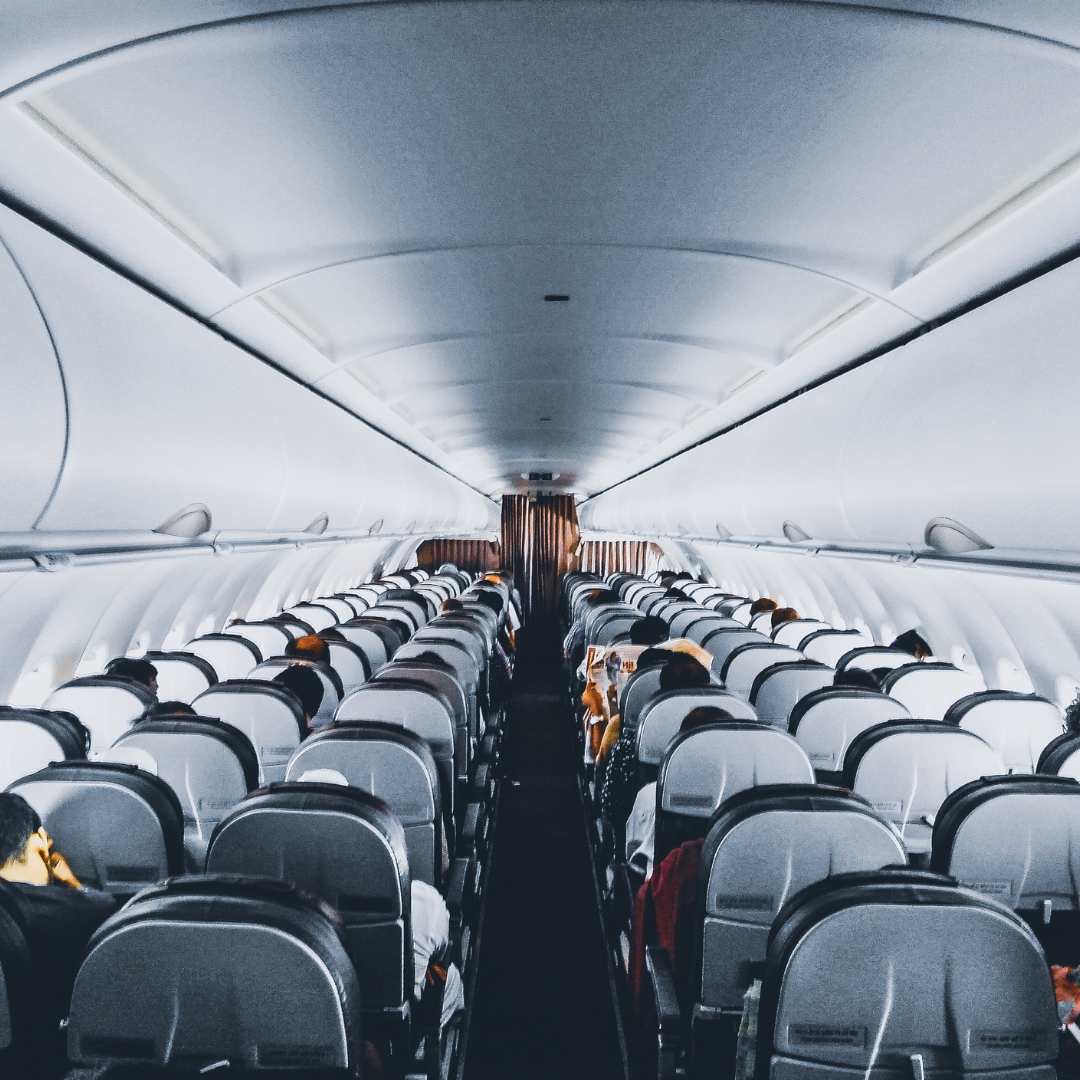
Settled in my seat, I hoped my flight would be nowhere near that eventful. I took my aisle seat and made brief eye contact with the woman wearing a long jean skirt and blue rubber Crocs sitting up against the window in my row. No funny business, I thought and smiled.
A man in his fifties built like a professional basketball player approached the exit row section and took the seat across the aisle from me. He wedged himself into the seat and announced to no one and everyone all at once, “I guess we got the kids’ seats today.” Nobody responded.
A woman then wandered up with an enormous suitcase, much too large to fit wheels-first into the overhead compartment. Paying no mind, she crammed it in sideways, crushing the items around it before lugging her giant canvas “personal item” to the window seat of the second exit row. There was no seat directly in front of her, just the flight attendant’s jump seat that pulled down from a wall.
“Where will this go?” she asked out loud, holding her bag out, noting the lack of under-seat storage in front of her.
“There’s nowhere for me to put this. Hmmmm.”
She got back up and stuffed the bag in front of the oxygen tank in another overhead compartment.
I hope we don’t need that.
When she returned to her seat, she set her open-lidded iced coffee on the floor, unfurled a copy of USA Today, and began leafing through sections. Oh to be that free.
The tall man tried his line again: “I guess we got the kids’ seats today.”
The woman lifted her coffee from the carpet beneath her, took a sip under her mask, and said nothing.
I silently assessed every person who walked past me down the aisle of the plane. Everyone looked unremarkable. Just folks loading onto an early morning flight. I thought back to the duct tape lady and the zip tie man. Did they look unremarkable when they got on their flights? Just your average Joe or Jane, headed to their seats, with no plans to try and escape into the clouds prior to touching down at their destinations?
After the whole plane had filled up, a slender redheaded boy, probably no more than 20 years old, slipped into the middle seat between me and Jean Skirt. His knees bounced with nervous energy, and he rubbed his hands on his masked face, pulling out then returning his bag to the seat underneath him over and over.
A wide man in a navy-blue American Airlines polo shirt came down the aisle, holding a silver piece of metal in one hand and a roll of duct tape in the other. He kneeled before Jean Skirt, pointing to the open hole on her armrest where a piece was missing.
“We’re going to put this baby on like this,” the maintenance man said as he lined up the silver piece in his hand with her armrest. “Then we’re going to give it a little of this.” He duct-taped the piece into place. “There. Let them worry about that in Philly,” he said and left.
The redheaded boy watched his every move, repeatedly wiping his palms down the thighs of his jeans.
I wondered what else had been duct taped into place, what else had been left for the folks in Philly to handle, what else would be hanging on as we hurtled through the sky.
Once we started to taxi and take off, I was overwhelmed with a sense of dread I’ve never had before when flying. Before all this, I had a couple of reasonable fears – terrorism, freak accidents, getting sucked into the airplane toilet, dropping my cell phone before landing and having it rocket to the other end of the plane.
Now, I added in hastily fixed plane problems and passengers in crisis who may or may not freak out and start chewing on the crew members. It was a lot to take.
Luckily for me, I faced no issues. I worked. I texted. I read. I stood up right when the plane got to the gate, very aware that I had morphed into that person but doing it anyway. Once you make that stand, you really can’t back down. You’re up. That’s just how it’s going to be.
After smooth sailing to Philly this summer, I was optimistic about traveling for the tour. The longer flights to Seattle and back home from Portland went well, as did the flights between Denver and Salt Lake City. So, boarding a plane at Dallas Love Field bound for Houston on my 35th birthday, I thought it would be just another go-round. Your usual cattle call of a Southwest flight, where passengers line up by number and scoot themselves on-board into whatever seats are available.
Christie and her husband, Tommy, sat in an aisle and middle seat on one row, while I took an aisle seat beside LeeAnn (my wiiiiife) on a row adjacent to them. We didn’t know it when we booked our tickets, but we were on a very special flight. This flight was transporting the Birthday Bitch Crew.
Though it was my actual birthday, I was sadly not part of the crew. You could tell the crew members by their custom t-shirts, each in a different bright neon color - blue, purple, orange, pink. The words across their chests were printed in white in a decorative font. First, you had THE BIRTHDAY BITCH. She was surrounded by The Lit Friend, The Thick Friend, The Snarky Friend, The Petty Friend, and The Petty Cousin. I immediately loved them all.
The Birthday Bitch herself chose the open seat in our row. She stretched above my head and popped her bright pink bag in the overhead compartment before wedging herself beside the window. The Petty Friend was seated in front of the Birthday Bitch, beside a couple that looked plucked from the shopping aisles of JC Penney.
The Petty Friend conducted a phone conversation on speaker phone at full volume in which she complained to the listener on the other end that an unnamed person was giving her a lot of headaches on Facebook.
“Listen, I am not here to get ratchet on Facebook because I’ve got a business to run,” she said. Then added, “A real business. Unlike the stuff she’s trying to do.”
Damn. Truly petty.
The Petty Friend wrapped up her conversation as one final couple boarded, the last two passengers on the plane. Possibly unfamiliar with the Southwest open seat policy and appearing generally irritated at the whole lot of us, the pair looked row by row in an effort to find two seats together. It wasn’t going to happen. Before I could tell them to sit the hell down so we could take off already, a flight attendant did it for me in a much nicer tone.
“But where will our bags go?” the woman asked, repeatedly pushing her chin-length salt and pepper hair behind her ear, moving her eyes one by one to each of the completely full overhead compartments.
Her husband’s blue Van Heusen button down stretched across his torso. In short order, he pressed himself up against my face and into my ear to reach into the compartment above me.
“Up here,” he said, shoving his body into me as he wrestled with the bags.
“Just move that pink one,” his wife said. “Stick it back there somewhere.” The Birthday Bitch looked at the pair, concerned, but said nothing.
“Um, actually,” LeeAnn said. “That pink one is our bag, and we’d like it to stay right where it is.”
The couple looked at one another a moment.
“She’s right,” the flight attendant said, approaching the pair with a 7-Up in hand. “You’ll have to gate check your bag.” Their faces fell. He moved his body off my head. I was able to smile.
The Birthday Bitch thanked LeeAnn. We all shared a laugh when I said I hoped we landed in time for the lady to make her Ann Taylor catalog shoot.
Silently hating people then mocking them out loud to make a stranger laugh? I’m back, baby, I thought. This is going to be a good flight.
The flight attendant handed the 7-Up and some antacid to the man behind Christie and Tommy. He was hunkered over, moaning, saying he was so nauseated he may throw up. He shuffled his feet underneath his seat, his black socks rubbing up and down the length of his Birkenstocks, and fanned himself with the safety card.
The winds outside were sustained at 35 miles per hour and gusting up to 60. They rocked the enormous aircraft like a rowboat before anyone had even shut the forward door.
“Folks, if the winds can rock a hundred-and-thirty-thousand-pound plane while we’re on the ground, you can bet this trip is going to be a bit bumpy,” the pilot warned. They slammed the forward door shut.
My mind raced back to Aviation Law class where we learned about that Delta flight that crashed at DFW back in the 80s. A microburst came along and caused the pilots to lose control. Over a hundred people died. A few survived. Those that did were in the back of the plane. I counted up to see what row we were on – six rows from the back.
“You know,” I said to LeeAnn, then paused, thinking better of it. “Nevermind.”
She shrugged.
Things were fine for a few minutes after takeoff, then, as we reached cruising altitude, we heard it. The dreaded ding. The fasten seatbelt sign illuminated, and the pilot made good on his earlier promise.
The bumps were small at first. I was able to continue my work, listening to some audio for the show. LeeAnn’s head was tilted back as she listened to music on her headphones. I looked across the aisle and saw Christie reading a book for the show. I looked back at our row. The Birthday Bitch was leaned up against the window, eyes closed, hugging her sweatshirt like a teddy bear.
Then, a big dip. And another one. The plane began to shudder in great heaves as it navigated the wind.
The Birthday Bitch woke up. The nauseated man in the Birkenstocks put his head between his knees and continued to moan. The shaking became so intense, I had to put my notebook away. I reached over and grabbed LeeAnn’s hand. She squeezed mine back. I saw Christie put the book away and lean over onto Tommy. The Birthday Bitch cradled her face in her hands. I thought she may be crying.
In a panic, I leaned down and grabbed the small diary I keep in my purse. I wrote:
This is how I die. On my birthday. Like the lyrics to some Alanis Morrisette song.
I started thinking about what my obituary would say. I hoped that if the plane did crash, we would live and that the Birthday Crew would survive, too. I thought, At the very least, surely God would spare the Birthday Bitch?
With what seemed like hours (but was really only about 40 minutes) trapped inside a metal tube being shaken like a maraca, we finally crashed to the ground and taxied to the gate.
“Sorry about that, folks. Welcome to Houston,” the pilot said on the intercom.
Welcome to Houston, indeed.
None of us could speak after the ordeal we underwent. When our nerves finally settled, Christie said, “I know it’s not his fault. Logically, I know that. But I just kept thinking, For God’s sake, DO SOMETHING!”
As is often the case, she perfectly articulated exactly what we had all been thinking.
We walked on wobbly legs up the ramp and into our waiting car. We made it to the show that night, and I won’t apologize for the amount of time we spent on the air recounting our near-death experience. You can hear it in Wednesday’s episode.
The next morning, we opted to cancel our flights and drive back home. We figured things would be a lot more stable if we had four wheels on the ground. Plus, we had the opportunity to stop at Buc-ee’s, the enormous Texas-based truck stop that defies all explanation.
We filled up the tank and used their sparklingly clean restrooms. Christie bought Christmas pajamas. I loaded up on Beaver Nuggets. Feet on the ground, we navigated a swarm of humans ravaging shelves of beaver-printed merchandise. We were safe. We were home.
***
This piece first appeared in Sunday Morning Hot Tea. Subscribe so you don’t miss another piece.

Fire Sale on a Life Well Lived
One of the best parts about working for myself is doing things at off-hours. Going to the grocery store, for instance, is much less stressful during the day when you’re only there with stay-at-home parents, retired folks, and Instacart shoppers. In that relaxed state, not having to rush around the after-fivers in their rolled-up button-downs and pinching heels, I can shop thoughtfully. On my last trip, I bought hopeful things like spinach and fresh raspberries and gluten free organic granola. Choices that said to the world, “I care about what goes into my body.”
I loaded the groceries into my car and headed home. About five minutes before getting to my house, I saw a bright yellow sign with the black outline of a cartoon finger pointing down a street well out of my way. It read “ESTATE SALE – THIS WAY,” as if it were offering me directions I didn’t know I had been waiting for. I wanted to turn toward the sign, but I had a momentary flood of doubt, the stuff that keeps me from acting on my every whim and impulse. A lesson learned over time.
“Silly child, you don’t need anything from an estate sale,” I thought to myself and kept driving.
“The fuck I don’t,” I thought, as I whipped a U-turn in a nearby circle drive to turn back toward the sign.
I followed the cartoon finger down a long stretch of street into a neighborhood I never knew existed. I’d passed the turn to enter this subdivision a thousand times before, but I had never made the turn to head inside. I drove so long that I started to lose hope, thinking I’d missed the sign directing me where to turn next. Then I saw another yellow sign, and yet another, beckoning me to hang a left, then a right.
When I was a kid, my mom and her best friend, Lillian, would sometimes take me to estate sales. Garage sales were always a childhood staple – we both hosted them and stopped at them, browsing yards full of random this-and-thats. But a garage sale feels different than an estate sale. The host of a garage sale has the autonomy to say, “I do not want this anymore.” Whereas an estate sale is made up of stuff someone wanted and would have liked to keep had they not, you know, died.
This estate sale was at a brick ranch house set off from the street by a curved walkway. At least a dozen cars were parked on either side of the street in both directions. Two other cars pulled in at the same time as me. I was nearly side-swiped by one of them, an older model Honda Civic which, judging by the car’s speed and proximity to my side mirror, was operated by Vin Diesel. The other was a larger black sedan that double-parked and engaged its hazard lights.
The Honda’s door opened, and a thick-necked man with thick dark hair stepped out, adjusting his t-shirt as he raced me to the door. An older gentleman stepped out of the black sedan carrying a large brown shopping bag with a receipt stapled to the exterior. The three of us were met at the home’s front door by a young woman with a mess of sandy curls wearing a t-shirt printed with the logo of the estate liquidation company.
“Uber?” she said to the three of us, and the older man obliged by holding the bag forward.
“I think you’re waiting for me,” he said. I got a whiff of the bag – fried chicken and fresh bread and hot wing sauce.
Honda Vin Diesel and I followed the woman inside the home, crossing the elevated threshold marked with yellow caution tape. I turned left into the dining room, carpeted with thick pink tread, and began to root through some stranger’s life.
A low-hanging chandelier in the center of the dining room was draped with more caution tape. The dining table had been shoved flush against one wall, serving as a makeshift display. every inch of the six-person table was covered with this impressive set of dishes – over a hundred pieces, easily – all matching and painted with a dusty pink and green floral pattern.
In the center, someone had propped up a faded booklet that featured photos of the dish set. A sort of dish manual, I suppose, though I am not sure what could necessitate over two dozen pages on dish use and maintenance. My instructions for dishes consist of: “Put food on dish, eat food off dish, clean dish, repeat.” Sometimes I even skip a step or two. The previous owner clearly followed the manual because, though the dishes were old, they were in great shape. I could tell they were her good dishes, the kind that you only break out for important company.
I moved past a pile of warped plastic tubs labeled VINTAGE TUPPERWARE - $3 and into the kitchen which looked frozen in time. The double oven was copper colored with a manual dial, labeled in a font that belonged in the Nixon administration. The Vent-a-Hood was also copper, with a scalloped edge that would have fit seamlessly in an old issue of Better Homes and Gardens Magazine.
The estate liquidation company had posted helpful signs around, listing the prices for various items: dishes - $2 each, cups - $3. I noted the handwritten $5 price tag on a special microwave bundt pan, accompanied by its manual in mint condition that read – “Optimized for the Microwave Chef.” I felt very seen. I am not much of a chef in the conventional sense. Aside from the occasional bag of burnt popcorn – which I agree with you, should be punishable by a day in the stocks – I can make just about anything in the microwave. Now that I know “Microwave Chef” is an available title, I know what to call myself.
I passed a set of commemorative glasses from the 1962 Seattle World’s Fair, then stopped to read a wooden plaque hanging from a cabinet knob. It read, “Being a mother is the most important job, but being a grandmother is the most fun.” Someone had tagged it with a small white sticker marked $3.
I made my way into the living room which was carpeted in the same thick pink polyester as the dining area. The fireplace hearth was blocked by a card table. On its left side, the liquidation company had set out black velvet boxes to display this grandmother’s jewelry. A glass cabinet behind the boxes held, I guessed, more valuable items like newer model cameras. On the right side of the table was a full-size professional cash register manned by a dark haired woman in her late twenties, wearing the same t-shirt as the woman who had answered the door.
I passed to the other side of the living room and browsed a wall-length built-in bookshelf. It was half-full of recipe books – both professionally published and typed at home on a typewriter – and half-full of medical books. Gray’s Anatomy. A medical encyclopedia. I flipped through some pages and saw the previous owners’ names – I’ll call him Bob and her Betty – stamped inside each inside volume.
I wondered if Bob had been a doctor or, like me, just curious about diseases. I found an orange tome as thick as a phone book titled, Basic Human Physiology: Normal Function and Mechanisms of Disease. Bob had highlighted, annotated, and circled multiple sections of the chapter on “Body Fluids and the Kidney.” The notes made me think he really understood what he was studying. When I flipped to the page titled, “Radiation Hazards in Space,” I slipped the book under my arm and continued browsing.
When I turned around, I noticed for the first time the taxidermy fish mounted on the living room wall. It was shiny and had its head turned, facing me, and keeping watch over a rifle sitting on the coffee table. A framed painting of birds in the forest hung on the wall perpendicular to the fish, above the head of the woman from the entryway who had taken delivery of the hot wings. Her takeout container was lying open just inches from the rifle, while she sat leaned back, licking sauce from her fingers on Bob and Betty’s sofa.
It occurred to me that, wherever she was, Betty probably did not allow eating in the living room. Based on the pristine condition of nearly everything in the kitchen, dining room, and living room, I imagined she would have especially not allowed eating hot wings on her sofa. But, then again, Betty wasn’t there.
I headed out toward the garage, stopping for a moment in the laundry room. Above the washer and dryer on some shelves, I saw an empty glass Dr Pepper bottle printed with an image of 1970s Dallas Cowboys legend, Roger Staubach. A collectors’ item in Bob’s eyes, surely, now labeled with a handwritten white sticker - $5.
Down the stairs and out the garage door, I was met with long tables that covered the entirety of the garage. The liquidators lined each table with box after box of screws, nails, hinges, and general garage items. I passed those to head toward the driveway, my eyes firmly affixed to a giant black leather trunk with a gold buckle. It was enormous, and my first instinct was to buy it right away. Then I tried imagining any possible spot for it in my house.
Finding none, I left the trunk behind and moved past four wooden schoolhouse chairs toward a stack of boxes, nearly as tall as me. Their initial function, based on the letters printed on the side, was to ship school yearbooks. Someone had written on the sides in black Sharpie, “PICKLE JARS,” which made sense in context with the nearby open box of various empty glass jars, ready to be filled with jams, jellies, and preserves.
There was a man behind the stack of pickle jar boxes. He lifted the trucker hat off his head and ran a hand over his sweaty head. He was older than me, maybe in his late 50s, with a thick gray beard.
“Can I help you?” he asked.
It wasn’t said in the chipper tone of an eager salesman. He wasn’t dressed like the liquidation company employees, either. He wore a black t-shirt stretched over his belly with red print reading “Stranger Things” from the Netflix show. It also looked to me like he was surveying the people themselves, rather than the objects. I wondered if he knew Betty and Bob, or at least, used to know them.
“I’m just wandering,” I said. I clutched my book to my chest, feeling suddenly guilty, like a vulture pilfering what was left of this man’s childhood home.
“We don’t sell needs here, you know,” he said, walking closer. “We sell wants.”
“That’s good,” I said. “Since I really want this book.” I held the book out, showing him the title.
“Mechanisms of Disease,” he read from the cover. “Humanity is a disease.”
“I hear you, brother,” I said, putting on a thicker than usually Texan twang. What I said was technically true, anyway. I had heard him.
I walked away from him, toward the shelves labeled CHEMICALS (VARIOUS) - $3. On my way back inside, I saw a rack of Bob’s hunting jackets – thick canvas pieces, printed with camouflage. Under the rack, someone had dumped all his bright orange knit caps, the kind hunters wear to avoid shooting each other, into a cardboard box. I wondered for a moment if Bob had been killed in a hunting accident, but figured, based on the state of the world we are in, probably not. Based on the sheer age of the items, it didn’t seem like he had been an active hunter, anyway, but was, instead, someone who had hunted – past tense.
I had a similar thought when I entered a nook, only slightly larger than a closet, adjacent to the living room. I found his photography equipment, laid out on the desktop beneath a mounted bookshelf. It was filled, rows and rows, with travel books. The pages lush with landscapes – Hawaii, Greece, Indonesia. Had he gone to these places? Taken his own photos there? Or just dreamed about it?
Some of the cameras had been used, their shutter buttons worn. Others stayed in dusty boxes, their technology long since obsolete. The optimism of a new purchase unfulfilled. What photos he must of imagined taking on those new cameras. What must have stopped him.
Rounding a corner to enter a spare bedroom, I was met with former president John F. Kennedy’s enormous face, framed in gold, propped up against a wall beside some empty suitcases, winter coats, and a brand new “Wedding Photos” album, still in its shrink wrap.
I moved on to the next door way. Pink tile clung to the walls in the guest bathroom, where rows and rows of old toiletries – like make-up and cologne – covered the countertop.
Who buys used cologne? I thought as a pair of women entered and began reading labels and sniffing a bottle marked Racquet Club for Men.
In the next spare bedroom, I found a porcelain jewelry box painted with the word “Grandmother” above a mushy messaged you would find inside any drug store greeting card. Beside the box, there was an open leather suitcase had a handle worn down to the tan underneath. It was propped open, with a folded Army uniform inside.
The rest of the room had all the makings of a spare bedroom/junk room. Unused printable labels still in their package. An old brown Swingline stapler. A pair of silver flashlights. An ancient clipboard. As I walked out, I passed a little boy’s baseball uniform with the word “Eagles” hand-stitched across the front.
When I reached the main bedroom, I saw that the woman of the house had quite a shoe collection. In addition to the 15 pairs hanging behind the closet door, there was another half-dozen pairs in plastic containers sitting on the top shelf. I could tell from the clothes on the hangers and the size of the shoes that she had been itty bitty, a waif of a thing, whose gloves could have been mistaken for those of a child.
In the otherwise middle-class elegant bedroom, with wood furniture and sensible drapes, I struggled to make sense of the lamp.
It stood nearly a foot tall on top of the dresser beside the mirror. It had a tan metal base and an opaque glass shade printed with the bisected head of an elephant. In yellow letters, it said “ZOO FREAK” with “KZEW 98 FM” printed smaller in black font along the bottom. The print above “ZOO FREAK” touted that this lamp was a “Collector’s Edition.” This led me to wonder: (a) what collector? and (b) were their other editions of this lamp?
How did Bob and Betty end up with this lamp? Did he insist on its place in the bedroom, the start of an argument that would linger as a lifelong ace up her sleeve she could use any time the subject of taste came up?
“Oh really, Bob? You think that would look good, like the zoo lamp?”
“I’ve told you, that lamp is a collector’s edition!”
Or did Betty so love her husband – radio station lamp and all – that she kept the lamp there long after he was gone?
So often things that drive us crazy when a person is around come to be some of the very things we miss the most about them. I wasn’t fully certain about all of their quirks, but I started to miss them.
When I wandered into their den and found a pile of board games, I missed them even more. A game of Clue, marked © 1956, caught my eye. I opened the box and found the pad of Detective’s Notes, scribbled with page after page of pencil marks, chronicling all the games they had played over the years. I closed up the box and put it back in its place, on top of Parcheesi and Battleship, and headed back into the living room to check out.
As I approached, the woman behind the register was absolutely destroying a piece of Texas toast. I took my time browsing Betty’s jewelry to let the woman finish her bite. Then I began looking in the small glass cabinet. I spotted a tiny gun inside the case, formerly a toy, I thought, but by then was missing so many parts it could only serve as a paper weight. I hated to bother the woman, but I wanted that gun. She handed it to me and I turned over my cash before leaving with my wants.
I looked around one last time at the things left behind. Stuff that would be discounted deeper and deeper each day as the weekend ticked by. The things over the years that they had bought and used and packed away, now on their way to future lives in new homes.
For a quick second, I felt bad for Betty and Bob, their lives on sale like this. But then I thought better of it. They didn’t sell needs there after all. They sold wants. At various times in their lives, all of this was exactly what they wanted – the Racquet Club cologne, the microwave bundt pan, the KZEW lamp. They wanted those things at one point or another, and for so many years, they got exactly that.
***
This piece first appeared in Sunday Morning Hot Tea. Subscribe so you don’t miss another piece.