

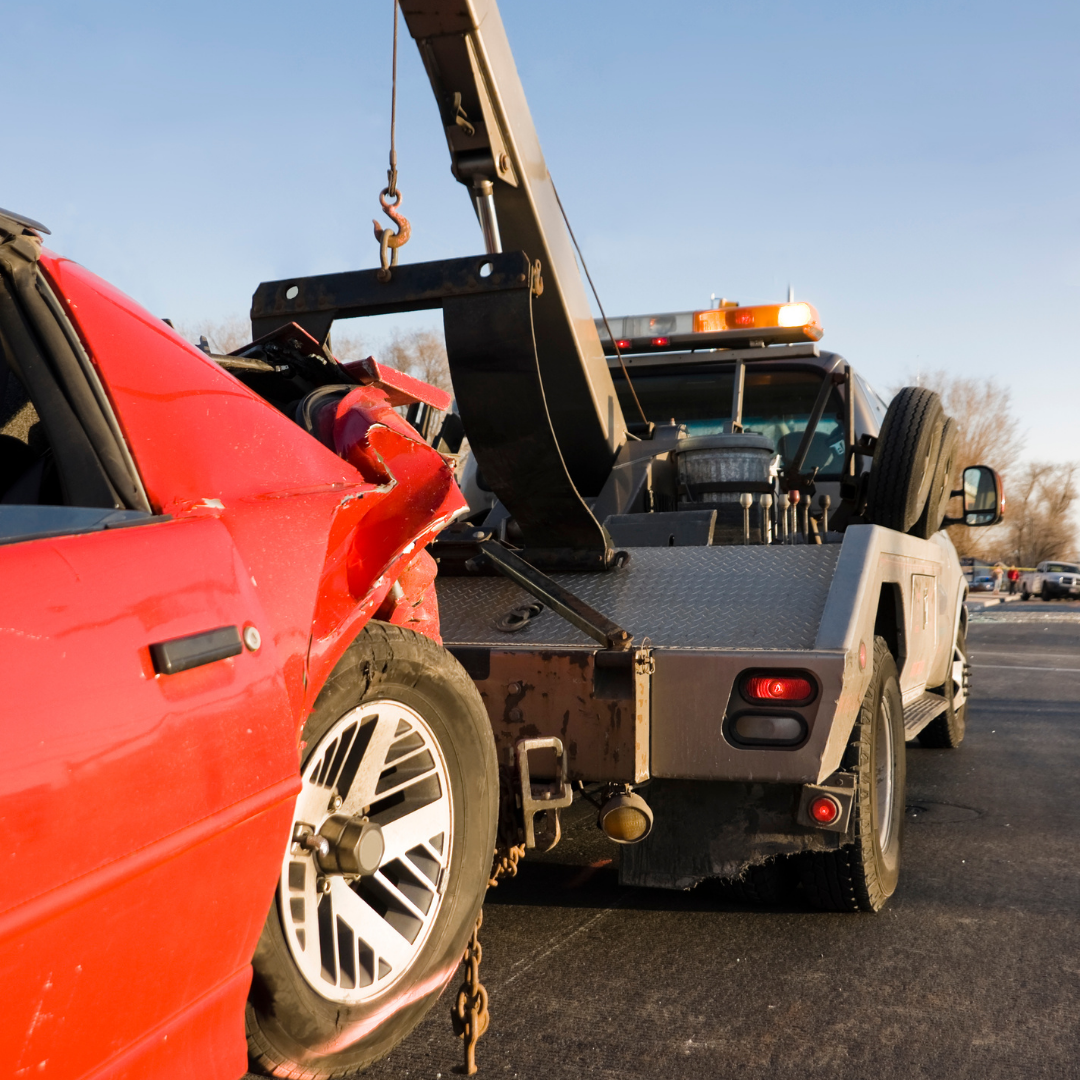
Legal Question: Tow Up
This week’s question is from Austin who asked me in-person. Austin asked:
How is towing not a violation of the Fourth Amendment?
Great question, Austin! I am going to quote from some SCOTUS decisions in this answer, but I’m not going to give you footnotes or citations because it’s Sunday morning and it’s early. Just know if you see quotation marks, it’s from the Court.
The Fourth Amendment (probably my favorite Amendment to discuss) protects the right of the people to be secure in their persons, houses, papers, and effects, against unreasonable searches and seizures.
See how it doesn’t say we are secure from ALL searches, just “unreasonable” searches. Generally, searches without a warrant are automatically unreasonable unless they fall into one of a few exceptions.
The exception that applies to towing is called the “community caretaking” exception. All these exceptions have been created by the Supreme Court, as it interprets the Fourth Amendment and applies it to specific cases. The community caretaking exception was developed in a 1976 Supreme Court decision called South Dakota v. Opperman.
In that case, the Court explained that police can impound cars to protect “public safety” or “community caretaking functions.” Those functions include towing “disabled or damaged vehicles” and “automobiles which violate parking ordinances, and which thereby jeopardize both the public safety and the efficient movement of vehicular traffic.” The Court called that right of the police to tow cars for public safety “beyond challenge,” so it’s a pretty solid reason why someone’s car can get towed.
The only time that “community caretaking” exception could be violating the Fourth Amendment is if that supposed caretaking was simply a pretext, or an excuse, for police to search a car on suspicion of criminal activity. When deciding that, courts have to analyze whether towing for purposes of “community caretaking” was reasonable, based on the facts and circumstances encountered by the officer at the time of the tow.
Some reasons why police may tow a vehicle is to protect it – for instance, if it is likely to be vandalized or stolen. If that is the police’s reason for towing the car, the court would look at the facts and circumstances: are cars frequently stolen in that area? Is there something damaged on the car, like a door lock or window, that would make it susceptible to being broken into?
Once they have towed the car, cops can perform an “inventory search” of the vehicle. The Court has held that an inventory search can’t be “a ruse for a general rummaging in order to discover incriminating evidence.” Giving cops free rein to dig through a car could lend itself to that “general rummaging.” To prevent that, the Court demands that there be a “single familiar standard” in place to guide the police and keep them to the task at hand – inventorying the items in a car that has been towed to protect the police and the car owner.
In order not to violate the Fourth Amendment, the police standard must “sufficiently limit discretion of law enforcement officers to prevent inventory searches from becoming evidentiary searches.” This means the policies and procedures need to be clear and strict to keep the police on-task when inventorying items.
To that end, the policies and procedures should have three purposes, according to the Court. These are “(1) protecting the property of the vehicle’s owner, (2) protecting the police against claims or disputes over lost or stolen property, and (3) protecting the police from danger.” The danger could be explosives or other harmful items inside a car.
The standards are important in the Court’s opinion because they help guide police “who have only limited time and expertise to reflect on and balance the social and individual interests involved in the specific circumstances they confront.” This means the procedures provide a quick and easy-to-follow guidance when police have to jump in and inventory items in a car.
If police find illegal stuff when conducting the inventory, those items can be admissible as evidence agains the driver whose car was towed. Sometimes, police wrongfully pull over a car or wrongfully tow the car. That’s when a car owner can challenge whatever police found when unconstitutionally searching their car.
There are tons of scholarly articles written on and a long list of cases discussing these concepts. But you didn’t ask for all that, you asked how towing isn’t a violation. Here’s the TL;DR version —
Towing doesn’t violate the Fourth Amendment if the towing was for public safety. Just because police tow your car does not give them free rein over the contents. But they can inventory the items, and if they see something in plain view, that can be used as evidence against you. They can’t “generally rummage” through your stuff and they have to follow a policy meant to protect your stuff, protect the police from claims of stolen items, and protect the police from danger.
Thanks for asking, Austin!
Got a question? Submit it here. They can be legal what-if questions, questions on current events, or questions about the legality of actions in TV shows or movies you’ve seen. I never ever want to answer your personal legal questions, so don't send those. Love you, but I don’t do that.
***
This piece first appeared in Sunday Morning Hot Tea. Subscribe so you don’t miss another piece.
Legal Question: Is Twitter the Government?
This week’s question comes from Candace H:
“Can you explain why Trump’s ban from Twitter (and Facebook, plus the overall removal of social media platform Parler, et al) did not silence first amendment rights (ie: explain government action censoring vs. private company rules and regs)? Please and thank you.”
Sure thing, Candace. I’ve seen a lot of wrong takes across social media claiming that Twitter’s booting of a serial-rule-breaker violates the First Amendment.
The “too long; didn't read” answer - it doesn’t.
The number one thing to remember is to whom does the First Amendment apply? Let’s take a gander at the actual language:
Congress shall make no law respecting an establishment of religion, or prohibiting the free exercise thereof; or abridging the freedom of speech, or of the press; or the right of the people peaceably to assemble, and to petition the Government for a redress of grievances.
There you go, right up front, they don’t even hide it: Congress shall make no law. Pretty simple. Court cases that have analyzed the First Amendment have extended that to the government and people acting on its behalf.
So if you find yourself reading a tweet from, oh I don’t know, a person who clerked for a Supreme Court justice, and that person claims an action by a private party violates the First Amendment, you can fact-check it yourself by asking: Is the actor at issue the government or an agent acting on the government’s behalf?
If not, it’s all good. No First Amendment violation. You can also now tell yourself you’re smarter than a SCOTUS clerk!
Similarly, Parler, the self-described conservative alternative to Twitter, got booted from Amazon’s web hosting service for violating Amazon’s terms. Parler sued Amazon, for breach of contract, conspiring to restrain trade, and for interference in Parler’s contracts with its current and future users. Obviously, litigation is ongoing, but Parler is correctly suing for really specific causes of action (whether or not they’ll be successful is TBD). But notice, Parler is correctly NOT suing for violations of its First Amendment rights because Amazon is not the government — at least not yet.
One rallying cry you often hear is that someone’s “rights” are being violated. If the First Amendment only applies to the government, what rights do we have when interacting with private businesses? Let’s look at an example (NOT rooted in reality, please don’t think this is based on me because IT IS NOT!)
Just an FYI, you can get kicked out of a Luby’s for saying, “This chicken fried steak fucking sucks.” As a private business, Luby’s can do that, but as we discussed above, Uncle Sam wouldn’t be able to make it a crime for you to say that. (Even though Luby’s CFS is amazing and anyone who says differently is a freedom hater.)
One way you could attack your ouster from the Luby’s is if another customer said the same thing you did but was treated differently than you. In that case, Luby’s may be violating the Civil Rights Act of 1964 which entitles people “to the full and equal enjoyment of the goods, services, facilities, and privileges, advantages, and accommodations of any place of public accommodation, as defined in the section, without discrimination or segregation on the ground of race, color, religion, or national origin.”
So if you’re the only one who got booted from the Luby’s for saying that, and they chose to boot you and not the other guy because of your race, color, religion, or national origin, Luby’s may be violating your rights. This is why company policies are really important. Having corporate policies allows businesses to act in a consistent manner with all their customers, regardless of a person’s protected status.
In addition to having the policies, companies need to enforce them in a consistent manner, lest they run afoul of civil rights laws. So while Luby’s may have a policy that they kick out anyone who besmirches the name of their chicken fried steak, they would also need to kick everyone out consistently.
Back to the question - once again, Twitter having policies, then enforcing those policies does NOT, in any way, violate the First Amendment again because Twitter ≠ the government.
Whether Twitter’s actions violate civil rights laws? That’s a different question, and the answer is TBD. The Civil Rights Act of 1964 was written a long time ago - in 1964, in case you weren’t paying attention. The concept of “public accommodations” that private businesses offer referred to stuff like restaurants and hotels, but obviously didn’t contemplate the internet or online spaces. Some people have called for an update to civil rights laws that would cover online spaces, but so far there’s nothing like that at the federal level, though some states do have anti-discrimination laws that apply to certain online businesses.
If there were a law like that on the books, someone would have to prove that Twitter’s policy was unfairly applied to people based on race, color, religion, national origin, or whatever other protected status this new law included.
Also, even if there were a new version of the Civil Rights Act that applied to online businesses, Twitter still wouldn’t be able to violate your First Amendment rights, even if it could violate some other rights you were entitled to under law. And why is that? One more time, with feeling:
Because Twitter ain’t the government.
Again - at least not yet. I’m sure one day they’ll merge, and Twooglebookppleazon will rule us all benevolently. But until then, they’re private businesses.
I think the point of confusion comes when people use the term “First Amendment rights” interchangeably with the concept of “free speech.” You can want free speech, but the only constitutional right to free speech that you’re guaranteed is from restrictions imposed by the government, and even that has its limits (but that’s another question for another day!)
I hope that answers your question, Candace! Thanks for sending.
Got a question? Submit it here. They can be legal what-if questions like the one above, or questions about the legality of actions in TV shows or movies you’ve seen. I never ever want to answer your personal legal questions, so don't send those. Love you, but I don’t do that.
***
This piece first appeared in Sunday Morning Hot Tea. Subscribe so you don’t miss another piece.